Gauss's Law
Beyond AP Physics 1
Original source retained for reference; this draft does not establish AP coverage.
Original author draft. Original wording and recorded answer states are preserved without claiming reviewed scientific correctness or AP alignment.
Physics 2 original textbook · Chapter 1
Section Overview
- Flux
- Electric Flux and Gauss’s Law
- The Infinite Charged Wire
- The Infinite Charged Plate
- Chapter Problems
Section 4
Gauss's Law
Gauss’s Law is an important result in electricity as it allows a simple means of finding the equations which describe electric fields. Gauss’s Law relies on the idea of a flux, or flow. When applied to the electric field we can then get what’s called the electric flux or “flow” of the electric field and from this electric flux Gauss’s Law can finally be found.
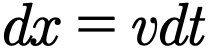
To begin let’s consider a ring of cross sectional area A in a stream which flows with a velocity v. In a time dt any particle of water will move a distance x given by
If the ring we inserted in the water is perpendicular to the velocity of the water we have that a volume of water Adx will have traveled through our ring. If we wish this could be expressed as

or
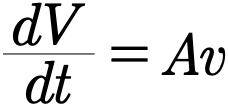
This value of volume per unit time is the flow or flux of the water.
Gallery 1.4 Fluid Flow
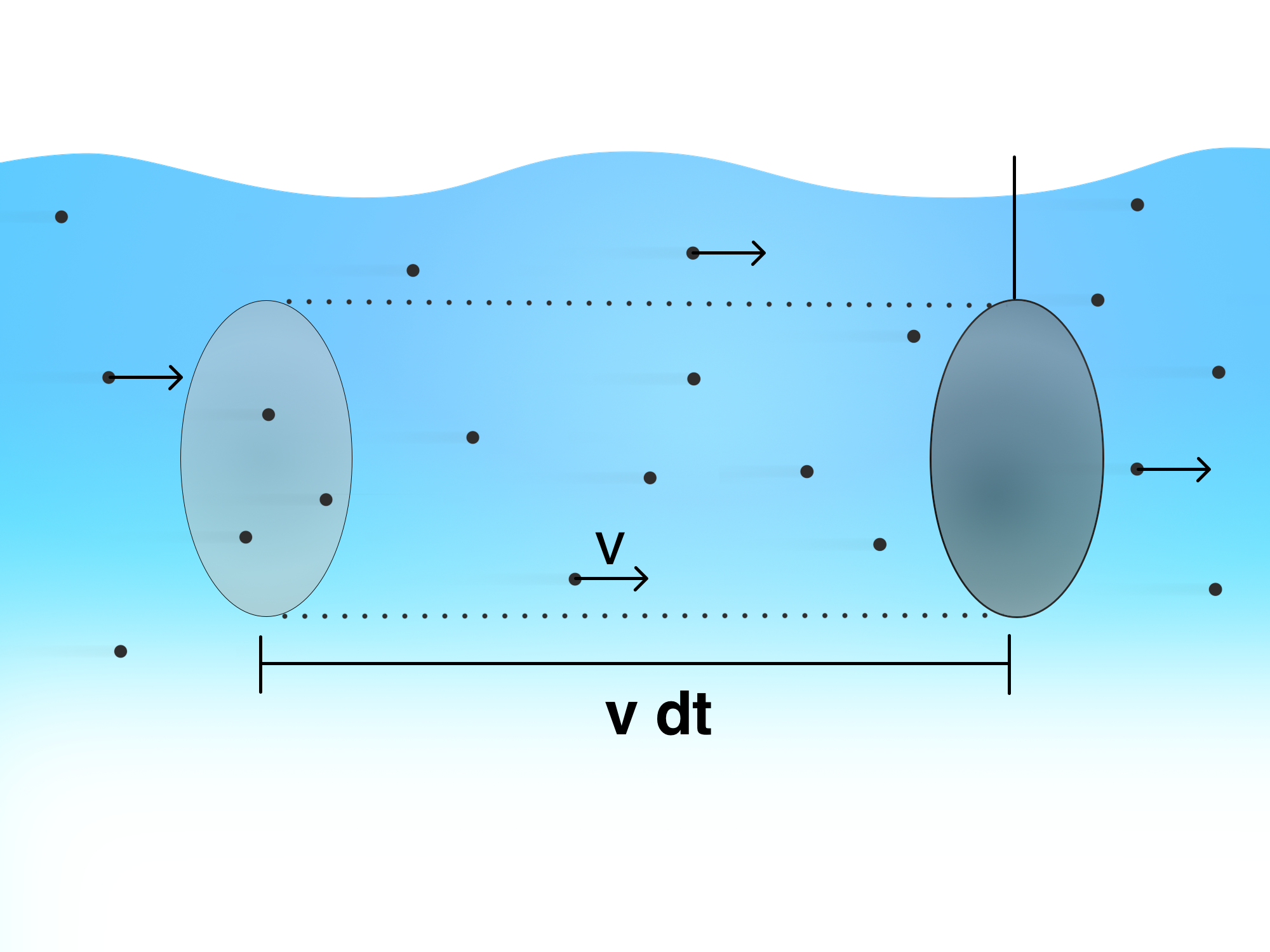
Here we have some ring which water of an average velocity v may flow through. In a small time dt the cylinder of water depicted will have flown through the ring.
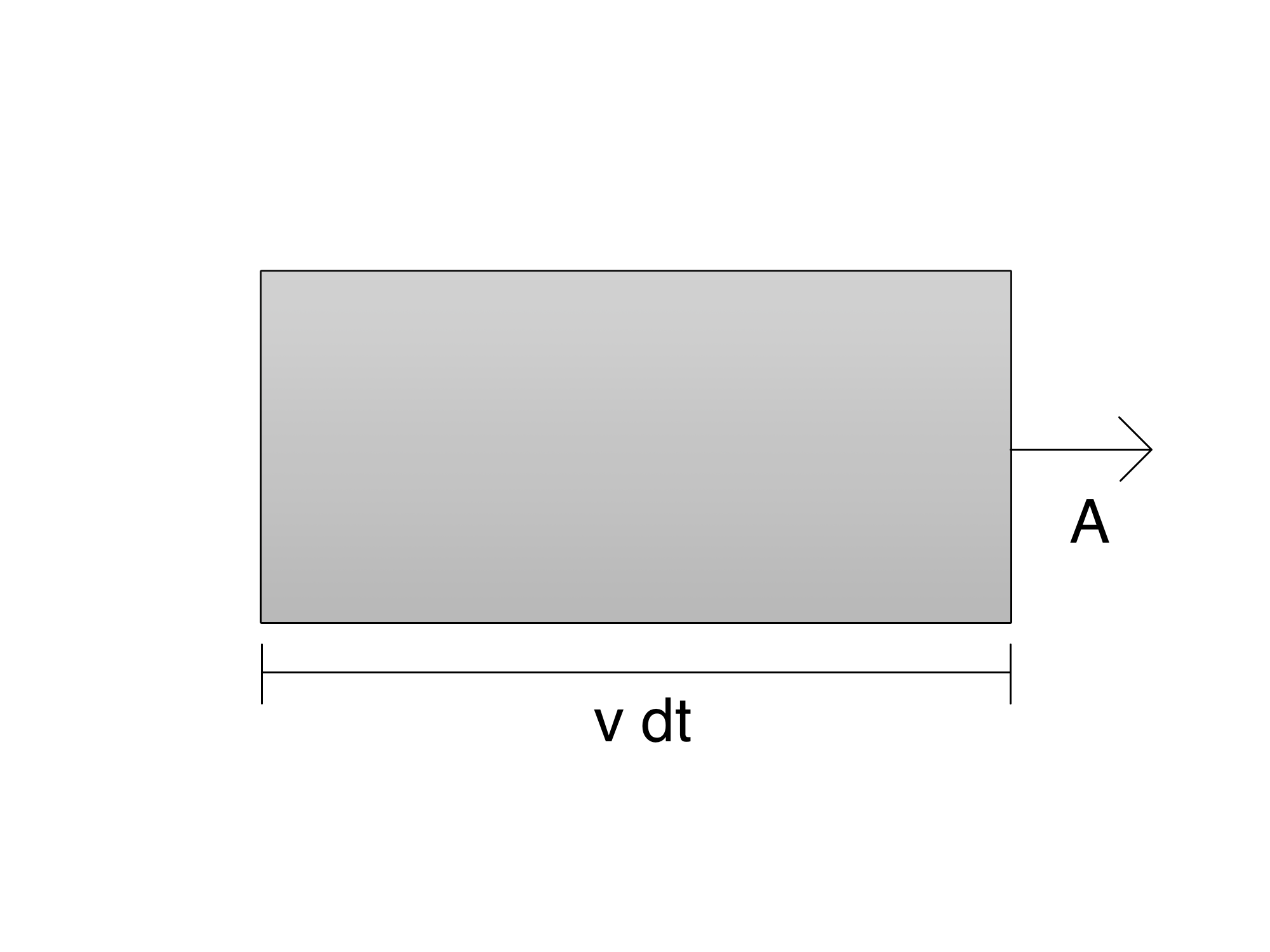
Above we have a profile view of the cylinder. The vector A is the area vector of the ring because it has a magnitude equal to the area the ring encloses and is perpendicular to the ring.
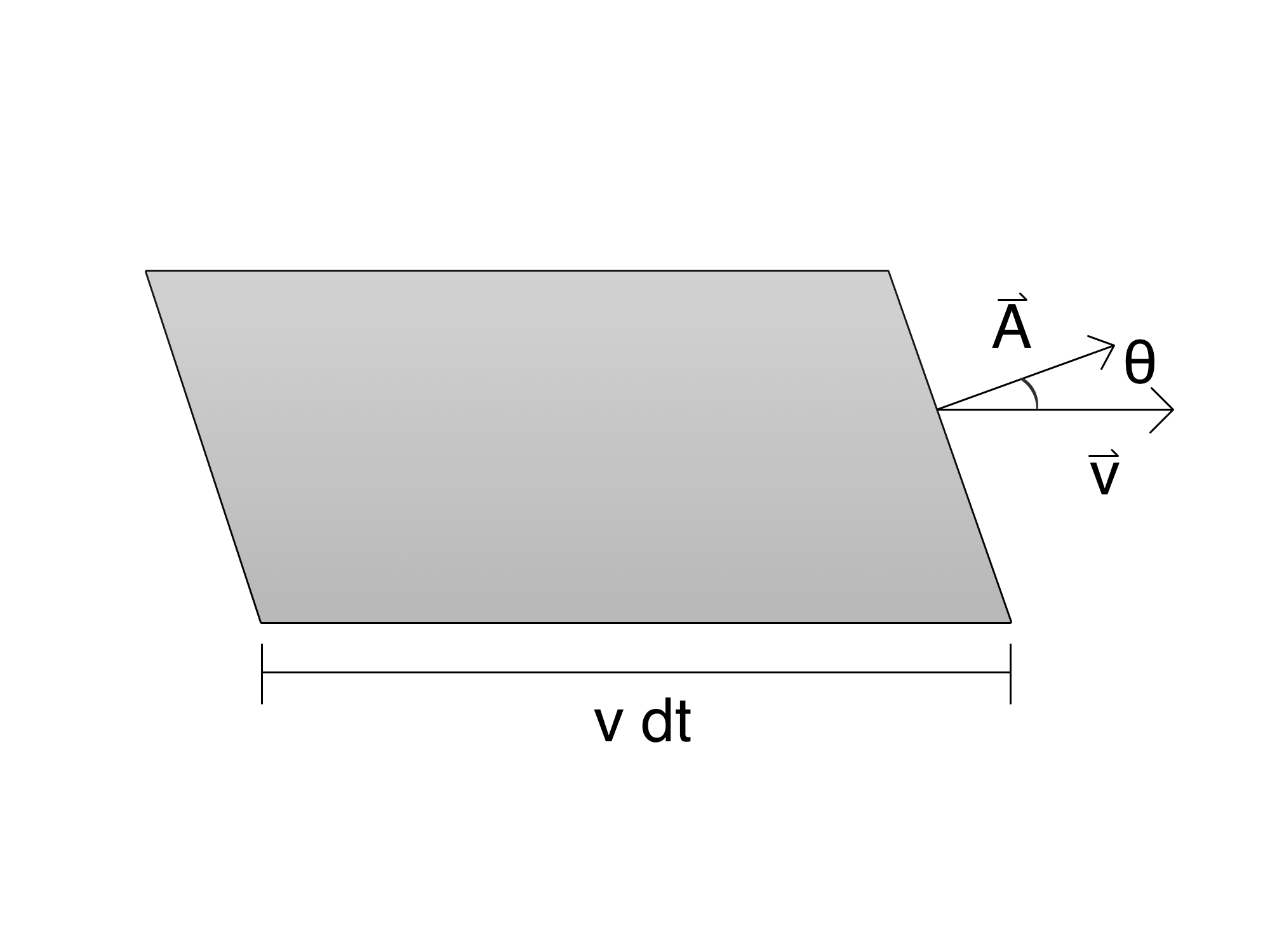
When the ring is tilted by some angle the area that the water sees is shrunk by a small fact which depends on the cosine. This new area seen by the water is what we call the effective area.
Before we start turning our ring to an angle with respect to the water I would like to introduce a little notation. We will be using A to represent the area vector of our ring. It is a vector which is perpendicular to the surface of the ring and has a magnitude that is equal to the area of the surface.
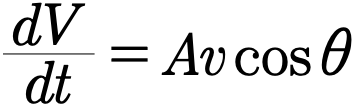
With this in mind we tilt our ring in the water so that the area vector with respect to the velocity makes an angle theta. By tilting the ring we have reduced the effective area which the water sees. To illustrate this effect to yourself grab (or imagine) some circular object (a soda bottle cap for example) and look straight into it with it’s flat surface parallel to your face. When you tilt this object you should see its effective area decrease, this effect applies to the water as well. The area we see is given by

Using this expression leads to a more general equation of the flux
also known as our friend the dot product
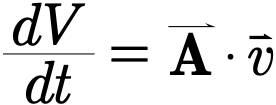
Although we did this for a very simple surface (the circle inside the ring) we can generalize this idea of flux to more complex setups like spherical shells. To do this all we must do is consider the flux as an integral adding up infinitesimal pieces of area dotted with the velocity in the area. We represent this by the integral
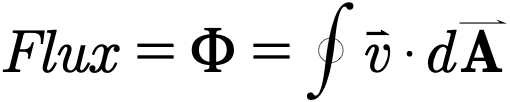
The above integral is not assumed to be completely understood in this book so we will not be going over methods of solving it. Instead I will say this. For simple surfaces (spherical shells, boxes, cylinders) in vector fields which are the same value all across the surface and hold the same orientation with respect to the area vector at all point the flux simplifies to the following.
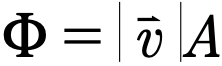
If we consider the flux of a fluid with velocity v and replace v with the expression for the electric field E we get that
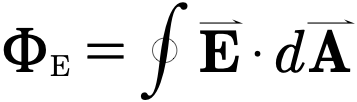
this is the electric flux. Using this we can get to Gauss’s Law. Take the example of a a single point charge of charge q center inside a spherical shell. This setup will meet the condition of uniformity as previously discussed so that we can separate out the electric field and replace the integral with the shells surface area. Doing so gives us

If we substitute in for E the electric field of a point charge we can get a expression for phi.

This leads to the following expression of Gauss’s Law.
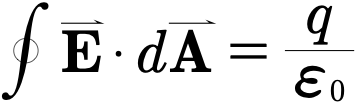
What this tells us is that the rate of “flow” of the electric field in and out of a certain area depends on the amount of charge which is enclosed in that area. This makes perfect sense! If you have a large amount of some single type of charge in one area you will find a proportional increase in the strength of the electric field!
Before we start going through examples I would like to discuss some of the principles we will use when solving problems using Gauss’s Law.
The first is that you should always have very nice symmetry in your electric field when using Gauss’s Law. Your surface should be in the form of a sphere, cylinder, or box otherwise you will have some difficulties with your calculation.
The second is the nature of the q given in the law. The q represents charge enclosed in your surface. Outside charge does not matter. This is due to the fact that the electric field from an outside charge contributes nothing to the flow since it’s electric field both pushes in and pushes out on the opposite side.
The third is that in order to avoid messy mathematics try to ensure that the field in question is uniform over your surface. If your field is uniform over the surface the E pops right out of the integral and all you have to do is replace the integral with the appropriate surface area and solve for E.
Example 1.4.1
Optional Gaussian-flux derivation. Prerequisites: cylindrical symmetry, flux and Gauss’s law. The final high-symmetry field can be discussed separately from this method. This preserved source example makes no AP coverage claim.
Find E at radius r from an infinite straight wire with uniform line charge density λ.
Authored clarification: Use a finite Gaussian cylinder of arbitrary length L.
Reviewed worked solution:
Cylindrical symmetry fixes field direction.
E is radial and constant on the curved side; cap flux is zero.
Apply Gauss’s law.
Cancel finite L.
Answer:
Check: The wire is infinite; the Gaussian surface is finite.
Interactive 1.5 The Infinite Wire
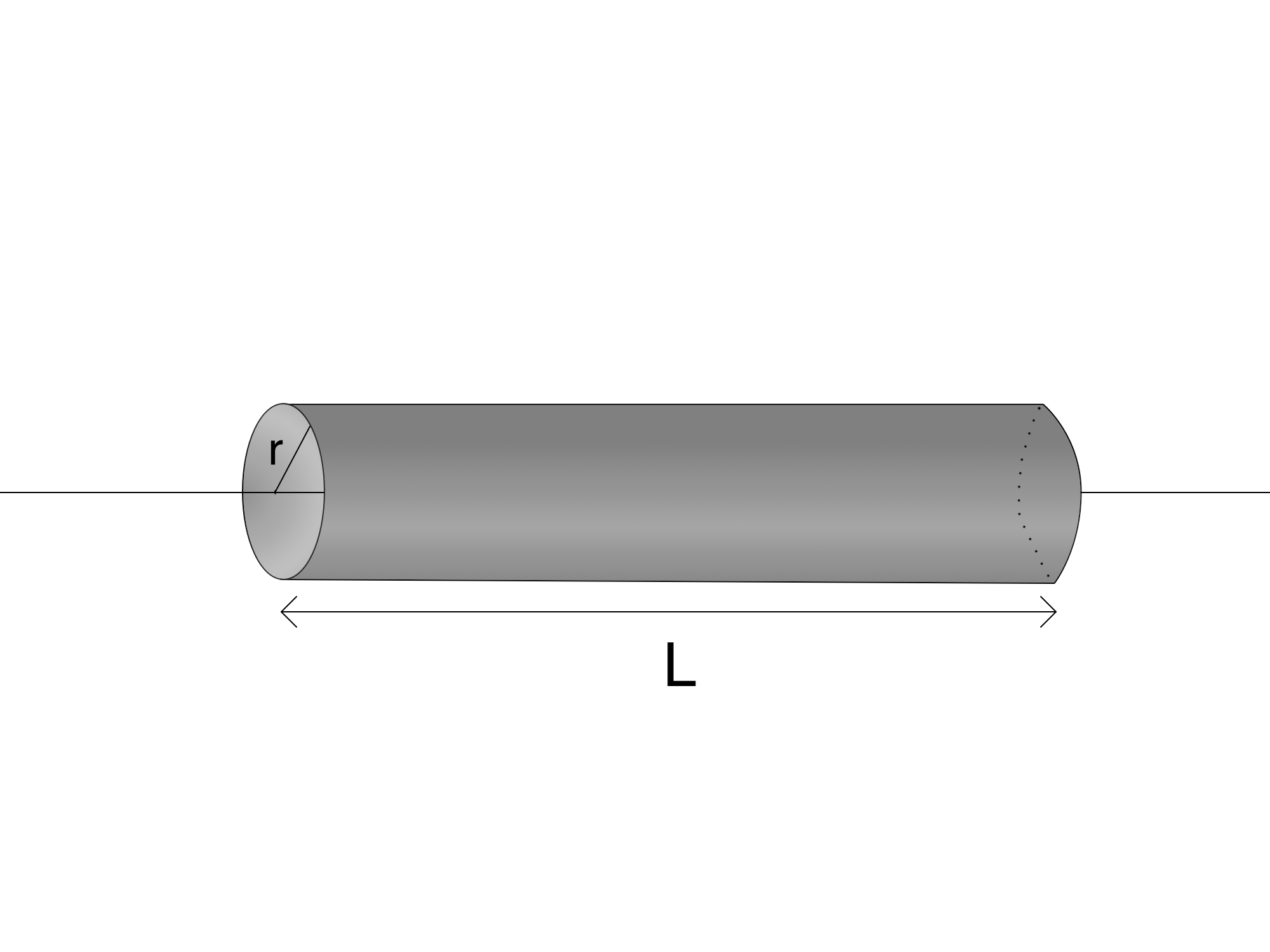
The Gaussian Surface
The cylinder in this problem is called a gaussian surface. Gaussian Surfaces are surfaces which holds a large amount of symmetry and which we use to enclose out charged objects in order to use Gauss’s Law effectively.
Cylinder Length
Use a finite Gaussian cylinder of length L, centered on the uniformly charged infinite wire. Its curved side carries flux , its caps carry zero flux, and its enclosed charge is .
The Wire
The thin black line represents the thin infinite wire.
Archived original widget · contains the source error
The cylinder in this problem is called a gaussian surface. Gaussian Surfaces are surfaces which holds a large amount of symmetry and which we use to enclose out charged objects in order to use Gauss’s Law effectively.
The cylinders length is given by L. Generally in these problems the parameter which you allow to be infinite in value will cancel out.
The thin black line represents the thin infinite wire.
Example 1.4.2
Optional Gaussian-flux derivation. Prerequisites: a finite pillbox, surface density and Gauss’s law. The final uniform-sheet field can be discussed separately from this method. This preserved source example makes no AP coverage claim.
Find the field of an infinite uniformly charged nonconducting sheet with density σ.
Authored clarification: A finite total q cannot specify an infinite uniformly charged sheet; σ is supplied instead.
Reviewed worked solution:
Use a finite pillbox.
Its faces of area A straddle the sheet; the side has zero flux.
Apply reflection symmetry and Gauss’s law.
Cancel arbitrary area.
Answer: The field points away from a positive sheet and toward a negative one, with magnitude |σ|/(2ε₀).
Check: A finite pillbox encloses σA, not the entire infinite sheet.
Interactive 1.6 The Gaussian Pillbox
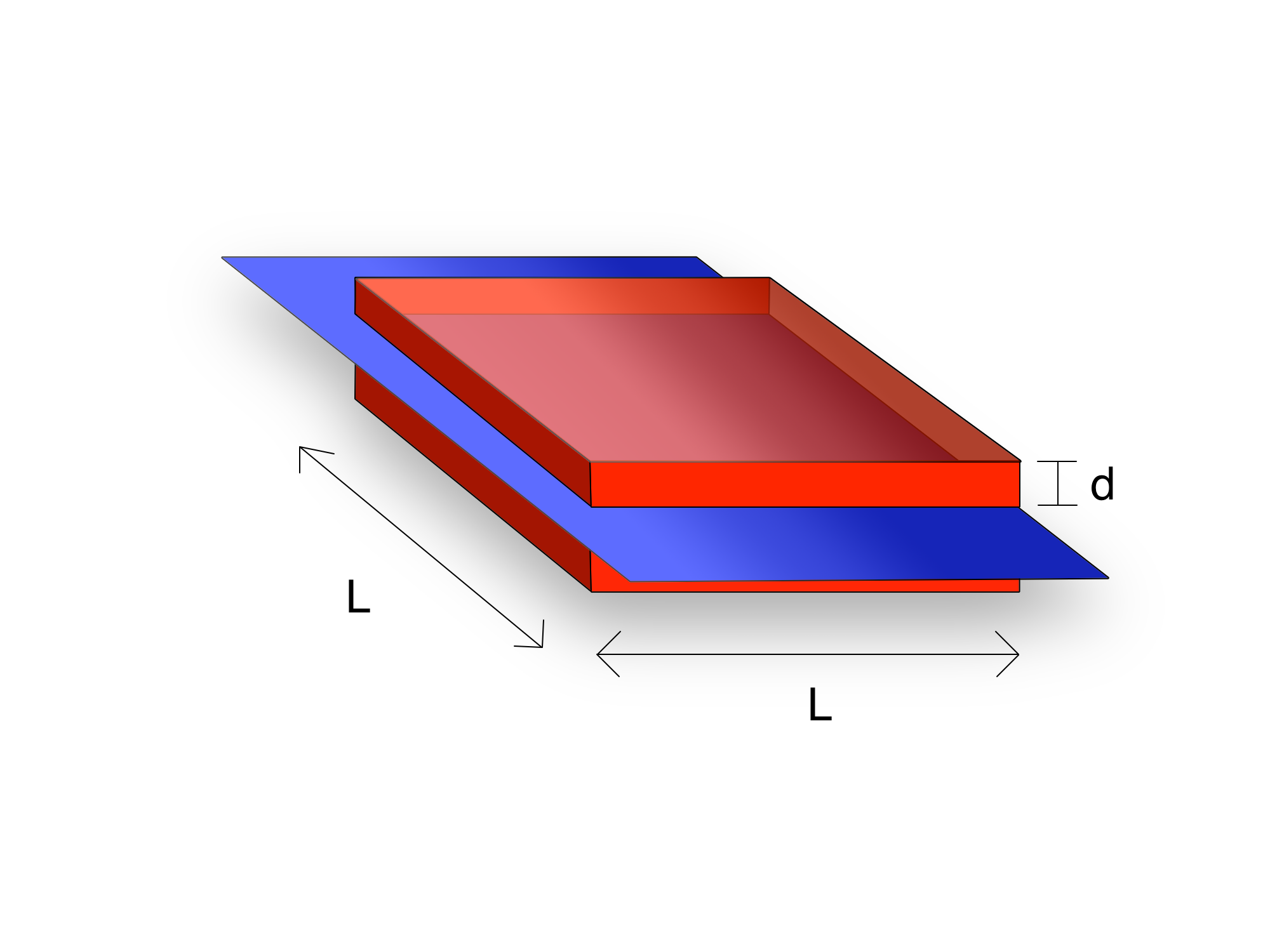
The Red
The red pillbox is a finite Gaussian surface crossing a finite patch of the infinite sheet. Its two end faces contribute flux; its side does not.
The Blue
The blue sheet is idealized as infinite and has surface charge density σ. A finite Gaussian pillbox encloses charge σA, where A is one face area. The arbitrary area cancels from .
Archived original widget · contains the source error
The red represents the Gaussian Pillbox the Gaussian surface we are using to completely cover our infinite plate.
The blue is our thin infinite plate. Like the rod it has a parameter L which actually extends out to infinity. During the calculation of the electric field L falls out giving the plates electric field as a constant.
Review 1.4 Section 4 Review
This review preserves the author’s recorded prompts, choices, and answer states. Corrected items have separate reviewed explanations and keys; unchanged draft keys are marked unreviewed. Unfinished items are not scored.
Original question 1
What is signed electric flux through an oriented surface?
A literal flow of electric-field material
Always the field magnitude times total area
Reviewed answer and reasoning
A
Flux sums the normal component of E with area and orientation; it is not a material flow.
This reviewed version states the assumptions or convention needed for one determinate answer. The archived source prompt and key are retained.
Archived original question and recorded key · contains the source error
The electric flux is a measure of the flow in and out of the given surface.
True
False
Original recorded key: A
Original question 2
Why is symmetry useful when using Gauss’s law to determine E?
It establishes direction and makes field magnitude constant on the contributing surfaces
Gauss’s law is valid only for uniform fields
Every point of a Gaussian surface must have the same field
Reviewed answer and reasoning
A
Gauss’s law always holds. Symmetry makes the flux integral evaluable in terms of a small number of field magnitudes.
This reviewed version states the assumptions or convention needed for one determinate answer. The archived source prompt and key are retained.
Archived original question and recorded key · contains the source error
In order to use Gauss’s Law efficiently symmetry and uniformity are needed in the electric field.
True
False
Original recorded key: A
Original question 3
What does the q in Gauss’s Law represent?
All visible charge
Charge enclosed by the surface
The charge of a proton
There is no q in Gauss’s Law
None of the above
Reviewed answer and reasoning
B
q is net enclosed charge, including signs, not all visible charges.
The independent semantic audit confirms this source prompt and recorded key under its stated conditions.
Archived original question and recorded key · contains the source error
What does the q in Gauss’s Law represent?
All visible charge
Charge enclosed by the surface
The charge of a proton
There is no q in Gauss’s Law
None of the above
Original recorded key: B
Original question 4
A uniformly charged solid insulating sphere has total charge Q, radius R and spherical symmetry. What is its radial field for 0≤r<R?
Reviewed answer and reasoning
A
A Gaussian sphere encloses . Divide by .
Authored correction or explicit assumptions; this reviewed key is separate from the archived original recorded states.
Archived original question and recorded key · contains the source error
A sphere of radius R and charge q sits on a table. Use Gauss’s Law to determine the electric field inside the sphere a distance r from the center.

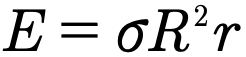
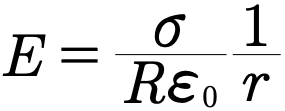
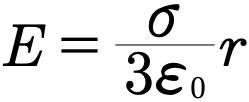
None of the above
Original recorded key: D
Original question 5
The same uniformly charged sphere has radius R and total charge Q. What is its radial field for r>R?
Reviewed answer and reasoning
A
Outside the sphere, a spherical Gaussian surface encloses all Q.
Authored correction or explicit assumptions; this reviewed key is separate from the archived original recorded states.
Archived original question and recorded key · contains the source error
A sphere of radius R and charge q sits on a table. Use Gauss’s Law to determine the electric field outside the sphere a distance r away.
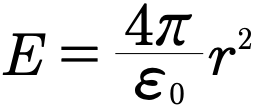
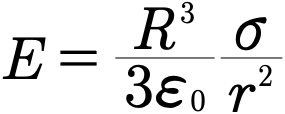
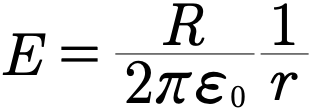
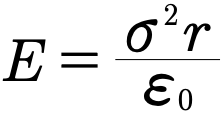
None of the above
Original recorded key: B
Chapter 1 Problems
Optional original-source extension. Prerequisites: vector addition, trigonometry and regular-pentagon geometry. This item makes no AP coverage claim.
Five identical point charges q are fixed at the vertices of a regular pentagon inscribed in a circle of radius R. Find the force on one charge and its initial direction of motion if released from rest.
Authored clarification: All five charges have the same signed charge; the circle radius is R and all positions are fixed while computing the instantaneous force.
Explain superposition and show from Coulomb’s law that electric fields add vectorially.
Authored clarification: Use classical electrostatics with fixed source charges; the test charge does not disturb them.
A prescribed electric field is . Find the force on a point charge q at (x,y).
Authored clarification: A and B are constants with units chosen so each field component has units N/C. This prescribed field need not be electrostatic when B≠0.
Optional original-source extension. Prerequisites: point-charge vector fields and coordinate geometry. This item makes no AP coverage claim.
Protons are at (a,−a) and (−a,a), while electrons are at (a,a) and (−a,−a). With a=1 m, describe the field-line pattern and give the electric field at an arbitrary point (x,y) away from a charge.
Authored clarification: Coordinates are in metres; particles are fixed ideal point charges ±e. Field lines are a qualitative representation of the vector sum, not particle trajectories.
Optional original-source extension. Prerequisites: continuous line charge, trigonometric components and a definite integral. This item makes no AP coverage claim.
A thin wire forms the upper semicircle x²+y²=R², y≥0 and carries uniform total charge Q. Find the field at its center.
Authored clarification: The original omits the charge distribution. Here it is uniform, the length is L=πR, and Q is explicitly supplied.
Optional original-source extension. Prerequisites: reflection symmetry, continuous surface charge and a double integral; the closed-form evaluation is supplied. This item makes no AP coverage claim.
A square thin plate of side L in the xy plane has uniform total charge Q. Find its electric field on the positive z axis at height h>0.
Authored clarification: The observation point is above the center, not an arbitrary off-axis point. Edge effects are included by integrating the finite square.
Two infinite nonconducting sheets at x=0 and x=d have uniform surface densities σ₁ and σ₂. Find the field between them for (a) σ₁=σ₂=σ and (b) σ₁=σ, σ₂=−σ.
Authored clarification: The sheets are ideal infinite nonconductors in vacuum; σ is positive when identifying directions.
Optional original-source extension. Prerequisites: cylindrical symmetry, continuous volume charge and Gauss’s law. This item makes no AP coverage claim.
An infinitely long insulating cylinder has radius R and uniform volume charge density ρ. Find its radial electric field at distance s from its axis, inside and outside.
Authored clarification: A finite total q is unsuitable for an infinite source. The chosen model is a uniform insulating cylinder; a conducting cable would have zero interior field at electrostatic equilibrium.
Reviewed worked examples
These authored derivations are paired with the original example identities. Added assumptions are stated.
Optional Gaussian-flux derivation. Prerequisites: cylindrical symmetry, flux and Gauss’s law. The final high-symmetry field can be discussed separately from this method. This preserved source example makes no AP coverage claim.
Example 1.4.1 · reviewed solution
Find E at radius r from an infinite straight wire with uniform line charge density λ.
Authored clarification: Use a finite Gaussian cylinder of arbitrary length L.
Cylindrical symmetry fixes field direction.
E is radial and constant on the curved side; cap flux is zero.
Apply Gauss’s law.
Cancel finite L.
Check
The wire is infinite; the Gaussian surface is finite.
Optional Gaussian-flux derivation. Prerequisites: a finite pillbox, surface density and Gauss’s law. The final uniform-sheet field can be discussed separately from this method. This preserved source example makes no AP coverage claim.
Example 1.4.2 · reviewed solution
Find the field of an infinite uniformly charged nonconducting sheet with density σ.
Authored clarification: A finite total q cannot specify an infinite uniformly charged sheet; σ is supplied instead.
Use a finite pillbox.
Its faces of area A straddle the sheet; the side has zero flux.
Apply reflection symmetry and Gauss’s law.
Cancel arbitrary area.
The field points away from a positive sheet and toward a negative one, with magnitude |σ|/(2ε₀).
Check
A finite pillbox encloses σA, not the entire infinite sheet.
Glossary and deeper reading · 9 refreshers
These editorial refreshers supplement the reading. Definitions and examples are added guidance; original source wording and recorded answers remain in their original context.
-
Electric flux
Electric flux measures the electric field’s normal contribution through a surface. Its sign depends on the chosen surface normal, and its calculation includes field strength and orientation rather than a literal flow of matter. For example, a uniform field parallel to a flat surface gives zero electric flux through that surface.
-
Gauss’s law
Gauss’s law relates net electric flux through a closed surface to the net charge enclosed by that surface. The law always holds in its applicable electromagnetic model, while using it to calculate a field simply requires sufficient symmetry. For example, a charge outside a closed surface contributes zero net electric flux through the whole surface even though its field can be nonzero on parts of it.
-
Electric field
An electric field assigns the electric force per unit positive test charge to each location. The field is produced by the sources and is a vector, while the force on a negative charge points opposite the field. For example, the electric field between ideal parallel capacitor plates can accelerate an electron opposite the field arrows.
-
Velocity
Velocity describes how position changes with time and includes direction. Instantaneous velocity describes one moment, while average velocity is displacement divided by elapsed time. For example, a car turning a corner can change velocity while maintaining the same speed.
-
Vector
A vector is a quantity with a magnitude and a direction, represented by an arrow or by components along chosen axes. Vectors add by adding corresponding components rather than simply adding their magnitudes. For example, an eastward displacement followed by a northward displacement produces a resultant pointing northeast. The zero vector has zero magnitude and no unique direction.
-
Magnitude
Magnitude is the nonnegative size of a vector quantity. It does not specify direction, and it differs from a signed component. For example, a westward velocity can have a negative x component while its speed, the velocity magnitude, stays positive.
-
Magnetic flux
Magnetic flux measures the magnetic field’s perpendicular contribution through a chosen surface. For a uniform field and flat surface it depends on field strength, area, and the angle to the area normal, and it is measured in webers. For example, rotating a loop from face-on to edge-on to a uniform field reduces its flux magnitude toward zero.
-
Fluid
A fluid is a material that flows and continuously deforms under a sustained shear stress. Liquids and gases are both fluids, although their compressibility and other properties can differ greatly. For example, both water in a pipe and air flowing through a duct are fluids.
-
Electric charge
Electric charge is a conserved property that determines electric interactions. It can be positive or negative and is measured in coulombs; ordinary net charges arise from an imbalance of charged particles. For example, transferring electrons between initially neutral objects leaves one negatively charged and the other positively charged.