Continous Charge Distributions
Beyond AP Physics 1
Original source retained for reference; this draft does not establish AP coverage.
Original author draft. Original wording and recorded answer states are preserved without claiming reviewed scientific correctness or AP alignment.
Physics 2 original textbook · Chapter 1
Section Overview
- Charge Distributions
- Electric Field of a Charged Rod
- Electric Field of a Charged Ring
- Limit of the Electric Field at large distances
Section 3
Continous Charge Distributions
Despite the simplicity of point charge configurations much work with phenomena dealing with electricity actually concerns itself with something called a charge distribution, charge continuously spread over some type of space. We deal with three types of charge distributions. A linear charge distribution is charge spread over a line, a surface charge distribution is charge spread over a surface, and a volume charge distribution is a charge spread over some volume. Although not always used the following symbols are typically reserved for their respective charge distributions
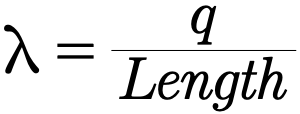
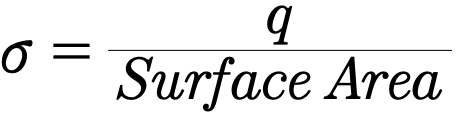
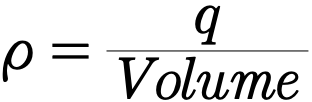
It is important to note that although in this book we will be dealing with only uniform distributions it is not uncommon to consider nonuniform distributions of charge. These considerations make problems slightly more mathematically involved so we will not be dealing with them.
Example 1.3.1
Find charge densities for: 10 C uniformly on a radius-2 m ring; 1 mC over the full closed cylindrical surface of height 1 m, radius 2 mm; and charge e uniformly within a sphere of radius 1 fm.
Authored clarification: The proton sphere is a stipulated uniform classical model, not a claim about its actual internal distribution.
- The linear charge distribution of 10C distributed over a ring of radius 2m
- The surface charge distribution of 1mC over a cylinder of height 1m and radius 2mm
- The volume charge distribution of a proton assuming a perfectly spherical geometry a radius of 1fm
1. The Linear Charge Distribution Over a Ring
For our linear charge distribution we will be looking at a ring. The relevant length of which is the circumference which is given by

Dividing the given charge by the above length then gives us our linear charge distribution

- The Surface Charge Distribution Over a Cylinder
Finding the surface charge distribution will follow a similar process. All we need to do is determine the surface area of our cylinder and then divide the given charge.
Reviewed worked solution:
Divide ring charge by circumference.
Include side and both caps of the cylinder.
Divide sphere charge by volume.
Answer: The line, surface, and volume densities are 0.795775 C/m, 0.0794186 C/m², and 3.82491×10²⁵ C/m³.
Check: Density units distinguish the three different distributions.

The charge used is just the protons charge so that for our volume charge we get

Now that we have an object with a charge distribution how do we determine the electric field around such an object? Since the object is continuously charged we can say that each part of it contributes some infinitesimal bit of electric field somewhere near the object. If we add up all these little bits then we can get the total electric field at some point or mathematically that
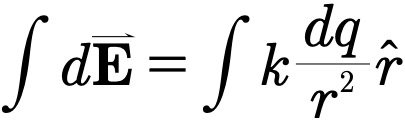
Unfortunately the above integrals won’t exactly do since we don’t have a clear value for the infinitesimal charge. Luckily though we do have the charge distribution. A charge distribution is nothing but a ratio so that it can easily be related to a differential.
In the case of a line charge we can say that
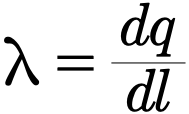
or if we wish to solve for dq
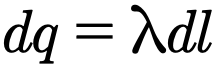
Ff we use the above and substitute into the integral for the electric field we can get that

This process can similarly done for surface and volume charges.
Example 1.3.2
Optional continuous-charge field method. Prerequisites: vector components and a definite integral along a finite rod. This preserved source example makes no AP coverage claim.
A thin rod of length 2L has uniform total charge q. Find E at height y>0 above its center.
Authored clarification: Place the rod on the x axis from −L to L; observation point (0,y).
Since we are dealing with a thin rod we will approximate it as a line of length 2L. Since this rod has a uniformly distributed charge we can then give it a line charge distribution
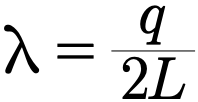
For this problem it is convenient to set the rod horizontal to the x-axis and centered at the origin. Doing so lets dl = dx making the integral we previously defined become
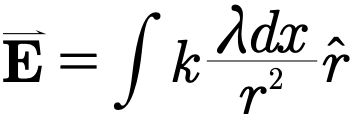
Getting rid of the unit vector we get that
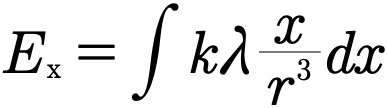
and
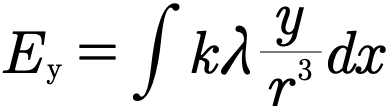
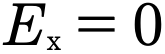
In this setup the left and right sides of the rod will contribute equal but opposite amounts to the electric field. This will result in cancellation making the x component of the electric field on the vertical axis zero.
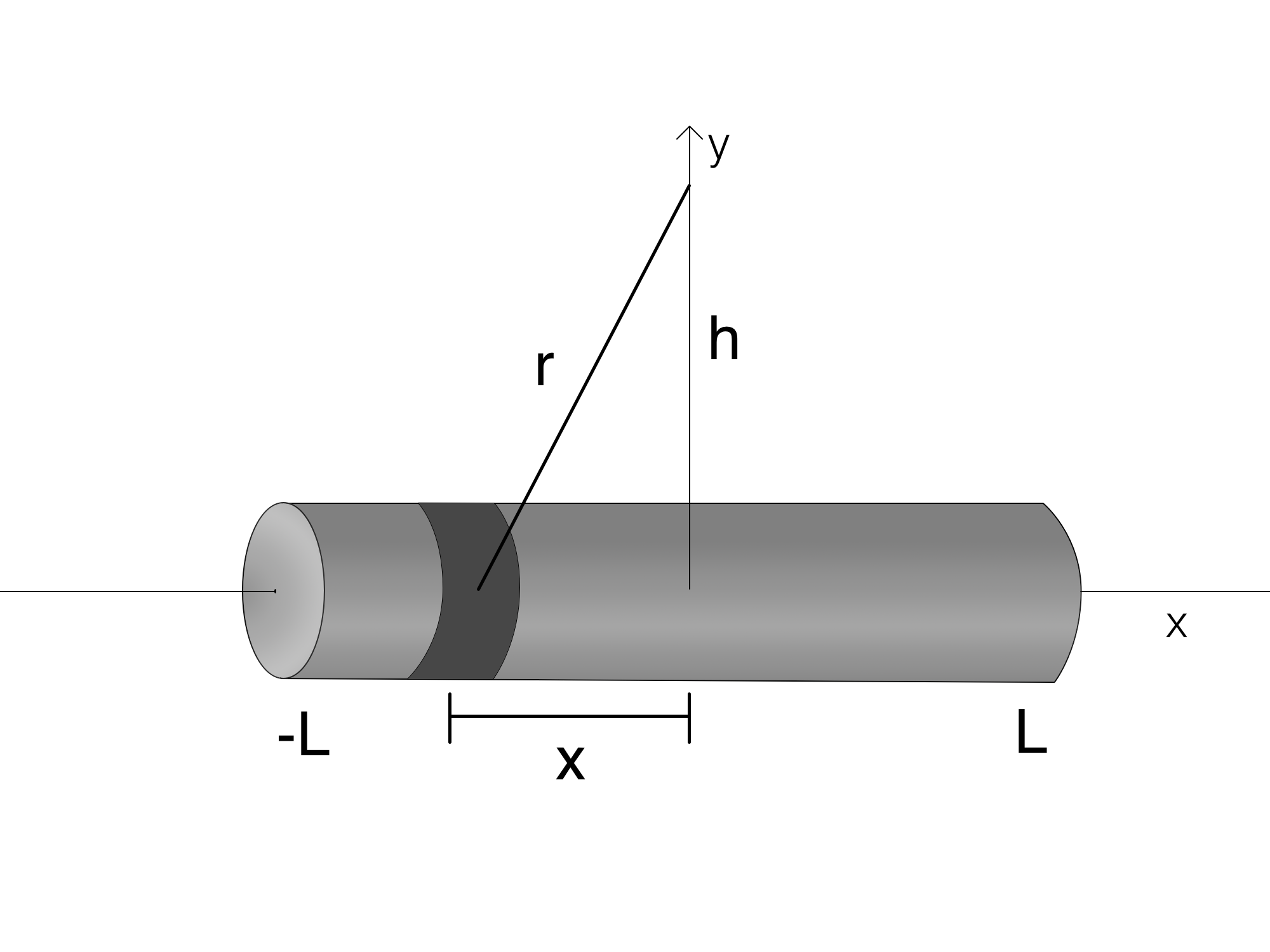
To get the y component of the field we will have to do a little muck work. First we must substitute r into our equation. This is nothing more than the pythagorean theorem since r will be the line connecting the rod at any point to the y axis. This makes our integral out to be
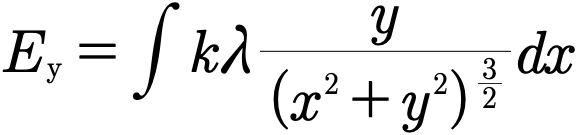
To solve this integral trigonometric substitution must be used. This particular form calls for
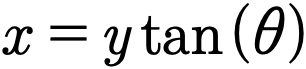
Which after making the substitution and doing a little algebra gives us the integral

Converting the sine into an expression in terms of x and y and using the integration bounds -L to L gives us our final expression for the y component of the electric field on the axis.

Interactive 1.3 Electric FIeld of a Rod
The Electric Field
If you look closely you can see that for each point on one side of the rod there is a corresponding point on the other side. Since the electric field is a vector which acts along r the x component of the electric field due to either side will cancel out allowing us to consider only the field in the y direction.
Pythagorean Theorem
In our rod setup h and x are perpendicular. This means that r, z, and h form a right triangle and the pythagoreantheorem can be used to determine the value of r
Point Above the Rod
This is our point above the rod which we are finding the electric field for. It is a distance h above the rod and a distance r away from any point on the rod.
Example 1.3.3
Optional ring-field derivation. Prerequisites: symmetry, differential charge and integration around a ring. This preserved source example makes no AP coverage claim.
A thin ring of radius R has uniform total charge q. Find E at height y on its axis.
Authored clarification: The source calls the radius z; R denotes that same radius here.
In this problem the line charge is given by
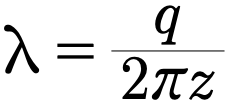
Since the charge is distributed around a ring of radius z.
Like the previous example with a rod of charge we will use the given geometry to make some simplifying assumptions. Since for every piece of the ring there is another piece of ring opposite it the x component of the electric field will always cancel. This leaves us with only the y component of the field to determine.
For the y component of the electric field we must now solve the integral
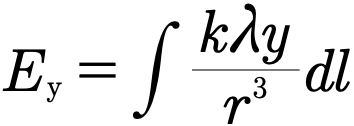
Here r is the length of the line from one part of the ring to our point above the rings center. This is given by
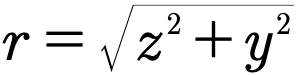
since the radius z and the height y form the legs of a triangle whose hypotenuse is r. If we substitute this back into our integral we get the integration of some constant value.
Interactive 1.4 Electric Field of a Ring
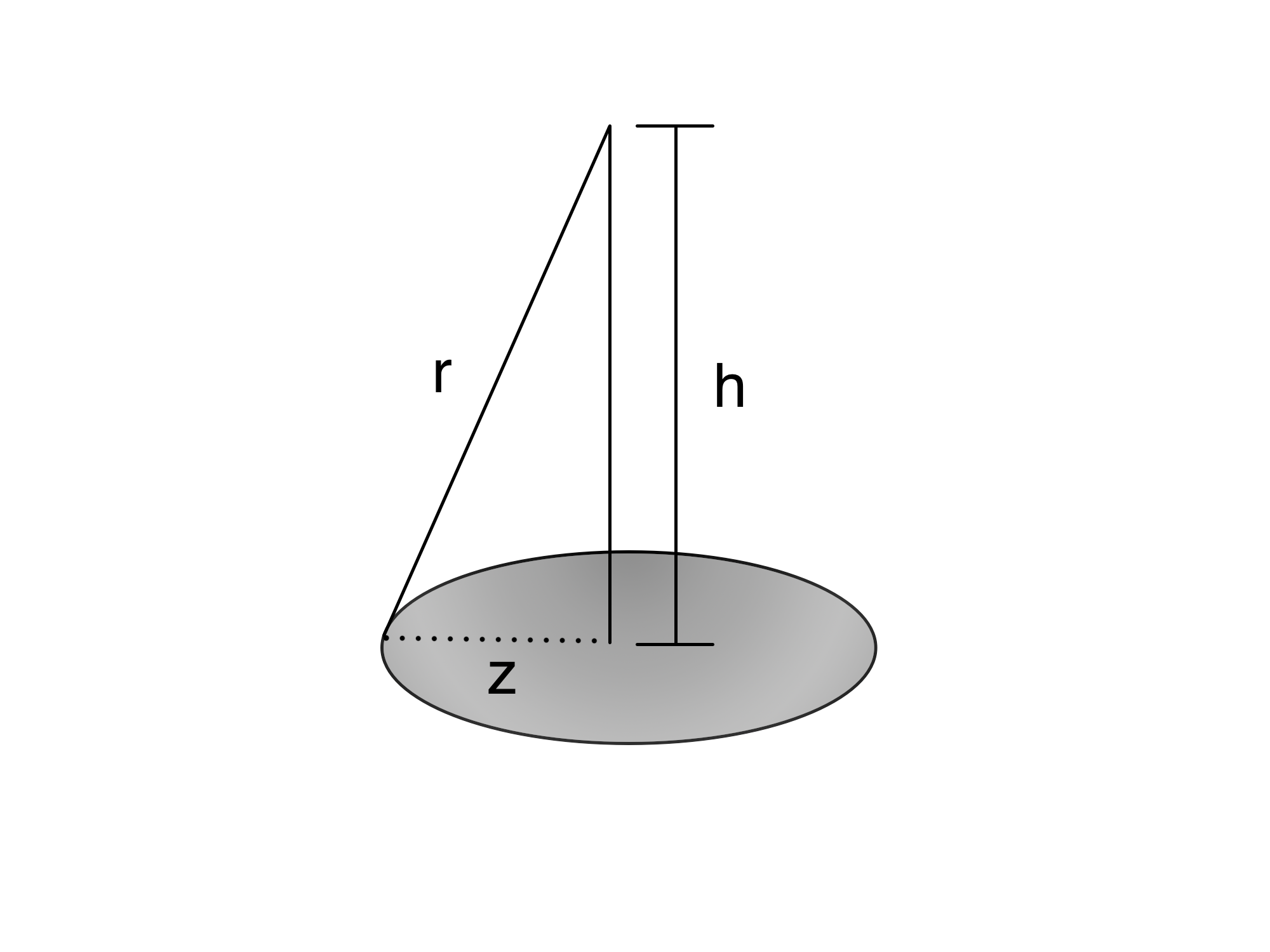
The Ring
In this problem we are looking for the electric field contribution of an infinitesimal piece of ring. As a result we will have to integrate around the ring in order to get a value of the electric field in this problem.
Distance form the Point
The distance from the point we are interested in an the ring is constant around the ring and is given by the pythagorean theorem.
This makes the integral

Now since we want to add up the contribution from each individual piece of the ring all we must do is integrate over the circumference so that

Finally if we want to make the final equation a little more readable we can back substitute for our line charge distribution to get that
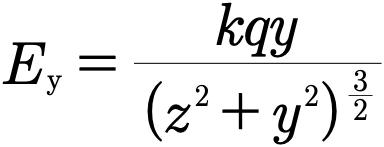
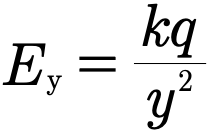
Often times when studying electric fields it is important to realize that a completely accurate description at every point is not needed. Instead we look at limiting behavior or what something approximates. For the two examples we studied it is possible to show that the electric field at large distances is the same as the electric field of a point charge. Consider the equation we found for the electric field of a rod of charge
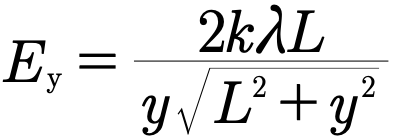
If we substitute in the charge and rearrange the bottom of the above equation we get that
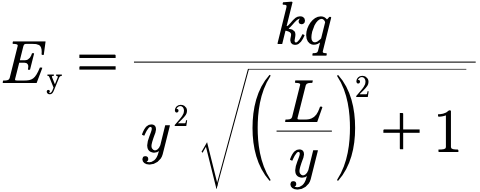
Now if y is much greater than L we can say that
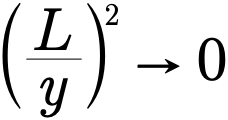
This simplifies the equation for the electric field to
Review 1.3 Section 3 Review
This review preserves the author’s recorded prompts, choices, and answer states. Corrected items have separate reviewed explanations and keys; unchanged draft keys are marked unreviewed. Unfinished items are not scored.
Original question 1
A charge distribution must always be uniform.
True
False
Reviewed answer and reasoning
B
Nonuniform charge distributions exist; false is correct.
The independent semantic audit confirms this source prompt and recorded key under its stated conditions.
Archived original question and recorded key · contains the source error
A charge distribution must always be uniform.
True
False
Original recorded key: B
Original question 2
Two hemispheres with radius r serve as caps for a cylinder of radius r and length L. If a charge q is uniformly spread on its surface what is its surface charge distribution?
None of the above
Reviewed answer and reasoning
C
Caps form a sphere of area 4 pi r^2; side adds 2 pi r L. sigma=q/(4 pi r^2+2 pi r L).
The independent semantic audit confirms this source prompt and recorded key under its stated conditions.
Archived original question and recorded key · contains the source error
Two hemispheres with radius r serve as caps for a cylinder of radius r and length L. If a charge q is uniformly spread on its surface what is its surface charge distribution?
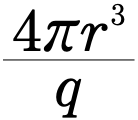
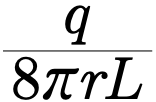
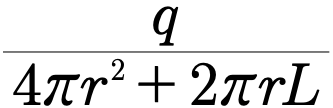
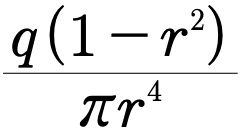
None of the above
Original recorded key: C
Original question 3
A uniformly charged ring of radius R and total charge Q is observed on its positive axis at h≫R. What is the leading field?
0
Reviewed answer and reasoning
A
The ring is a localized distribution with net charge Q; its far field approaches that of a point charge.
Authored correction or explicit assumptions; this reviewed key is separate from the archived original recorded states.
Archived original question and recorded key · contains the source error
In example 1.3.3 what does the electric field reduce to a large distance above the ring?
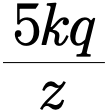
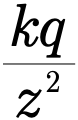
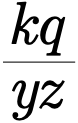
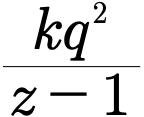
None of the above
Original recorded key: B
Original question 4
A uniformly charged rod of length 2L and total charge Q is observed on its extension, a distance y>0 from the nearer end. What is the field magnitude for Q>0?
Reviewed answer and reasoning
A
Use λ=Q/(2L): .
Authored correction or explicit assumptions; this reviewed key is separate from the archived original recorded states.
Archived original question and recorded key · contains the source error
A thin rod stands parallel to the vertical axis with a length 2L and charge q. What is the electric field a distance y from the top portion of the rod?
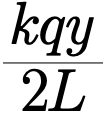
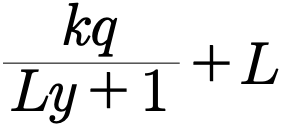
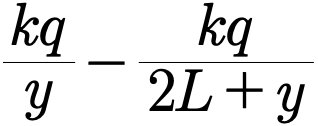
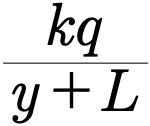
None of the above
Original recorded key: C
Original question 5
A thin disk of radius R carries uniform surface charge density σ. What is E on its axis at height h>0?
Reviewed answer and reasoning
A
Integrating concentric rings cancels transverse components and gives the stated axial field.
Authored correction or explicit assumptions; this reviewed key is separate from the archived original recorded states.
Archived original question and recorded key · contains the source error
A disk of radius z is situated on the ground. What is the electric field a distance h above its center?
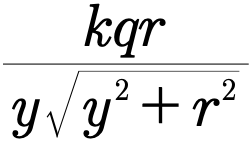
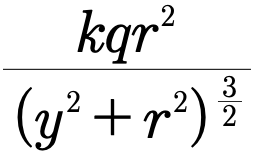
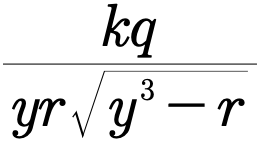
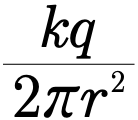
None of the above
Original recorded key: A
Reviewed worked examples
These authored derivations are paired with the original example identities. Added assumptions are stated.
Example 1.3.1 · reviewed solution
Find charge densities for: 10 C uniformly on a radius-2 m ring; 1 mC over the full closed cylindrical surface of height 1 m, radius 2 mm; and charge e uniformly within a sphere of radius 1 fm.
Authored clarification: The proton sphere is a stipulated uniform classical model, not a claim about its actual internal distribution.
Divide ring charge by circumference.
Include side and both caps of the cylinder.
Divide sphere charge by volume.
The line, surface, and volume densities are 0.795775 C/m, 0.0794186 C/m², and 3.82491×10²⁵ C/m³.
Check
Density units distinguish the three different distributions.
Optional continuous-charge field method. Prerequisites: vector components and a definite integral along a finite rod. This preserved source example makes no AP coverage claim.
Example 1.3.2 · reviewed solution
A thin rod of length 2L has uniform total charge q. Find E at height y>0 above its center.
Authored clarification: Place the rod on the x axis from −L to L; observation point (0,y).
Use line density.
Cancel transverse components and integrate.
Evaluate the endpoints.
Check
For y≫L, E≈kq/y².
Optional ring-field derivation. Prerequisites: symmetry, differential charge and integration around a ring. This preserved source example makes no AP coverage claim.
Example 1.3.3 · reviewed solution
A thin ring of radius R has uniform total charge q. Find E at height y on its axis.
Authored clarification: The source calls the radius z; R denotes that same radius here.
Use rotational symmetry.
All components transverse to the axis cancel.
Every element has equal source distance.
Integrate total charge.
Check
E=0 at the center; far away it approaches kq/y².
Glossary and deeper reading · 3 refreshers
These editorial refreshers supplement the reading. Definitions and examples are added guidance; original source wording and recorded answers remain in their original context.
-
Electric field
An electric field assigns the electric force per unit positive test charge to each location. The field is produced by the sources and is a vector, while the force on a negative charge points opposite the field. For example, the electric field between ideal parallel capacitor plates can accelerate an electron opposite the field arrows.
-
Electric charge
Electric charge is a conserved property that determines electric interactions. It can be positive or negative and is measured in coulombs; ordinary net charges arise from an imbalance of charged particles. For example, transferring electrons between initially neutral objects leaves one negatively charged and the other positively charged.
-
Charge density
Charge density specifies how much electric charge is distributed per unit length, area, or volume. The appropriate unit and geometry must be chosen before converting between density and total charge. For example, spreading the same charge uniformly over a larger surface lowers its surface charge density.