RC Circuits
Original source retained for reference; this draft does not establish AP coverage.
Original author draft. Original wording and recorded answer states are preserved without claiming reviewed scientific correctness or AP alignment.
Physics 2 original textbook · Chapter 4
The original text includes unresolved figure references such as “blah”. Those references are retained without inventing a figure association.
Section Overview
Section 5
RC Circuits are circuits which make use of both resistors and capacitors and as we will see they exhibit some interesting time dependent effects. Up until now we have assumed that every value on our circuits have been constant, something which is not true of the circuits we use on a daily basis whose values constantly fluctuate in order to perform certain functions.
In discussing these circuits we will be using something called a separable differential equation so we will spend a small amount of time introducing them. A separable differential equation is an equation involving derivatives which can be solved by separating differentials and integrating. A simple demonstration of this is given below.
Consider the equation
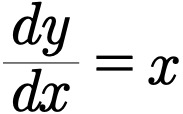
We can treat dy and dx as we would any number in a fraction and multiply both sides by dx.
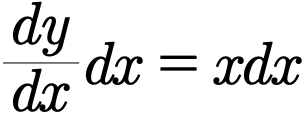
On the left side the dx’s cancel out leaving only a dy. If we now integrate both side we can determine what the function y actually is.
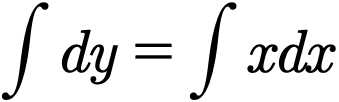
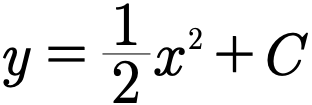
So that
Example 4.5.1
Solve (1+x)y′=x².
Authored clarification: This calculus extension is solved on an interval excluding x=−1.
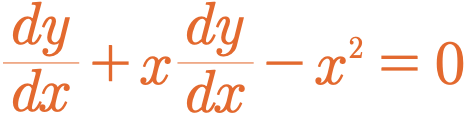
Reviewed worked solution:
Divide and perform polynomial division.
Integrate each term.
Verify by differentiation.
Answer:
Check: The original cubic antiderivative does not differentiate to the required equation.
Now that we have the needed mathematics under our belts we can begin to discuss the properties of RC Circuits. As mentioned previously an RC circuit is made up of both resistors and capacitors. In the case of a circuit with a single loop, a emf, a resistor, and a capacitor we can form the following equation using Kirchhoff’s Laws.
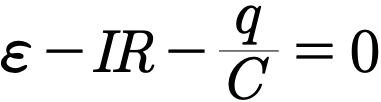
Recall though that current the current, I, is the change in charge over time. This means that we may rewrite the above equation with a minor change as
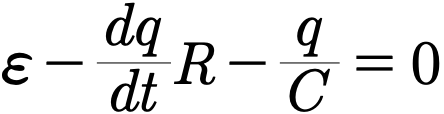
This equation above is actually a separable differential equation! With a little algebraic massaging we can get the following.
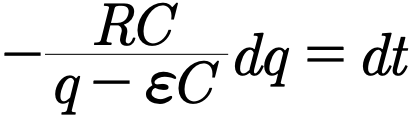
If we then integrate both sides of this equation from 0 to q and t respectively we can then get an equation which describes the change of the capacitors charge over time.
Gallery 1.14 A Simple RC Circuit
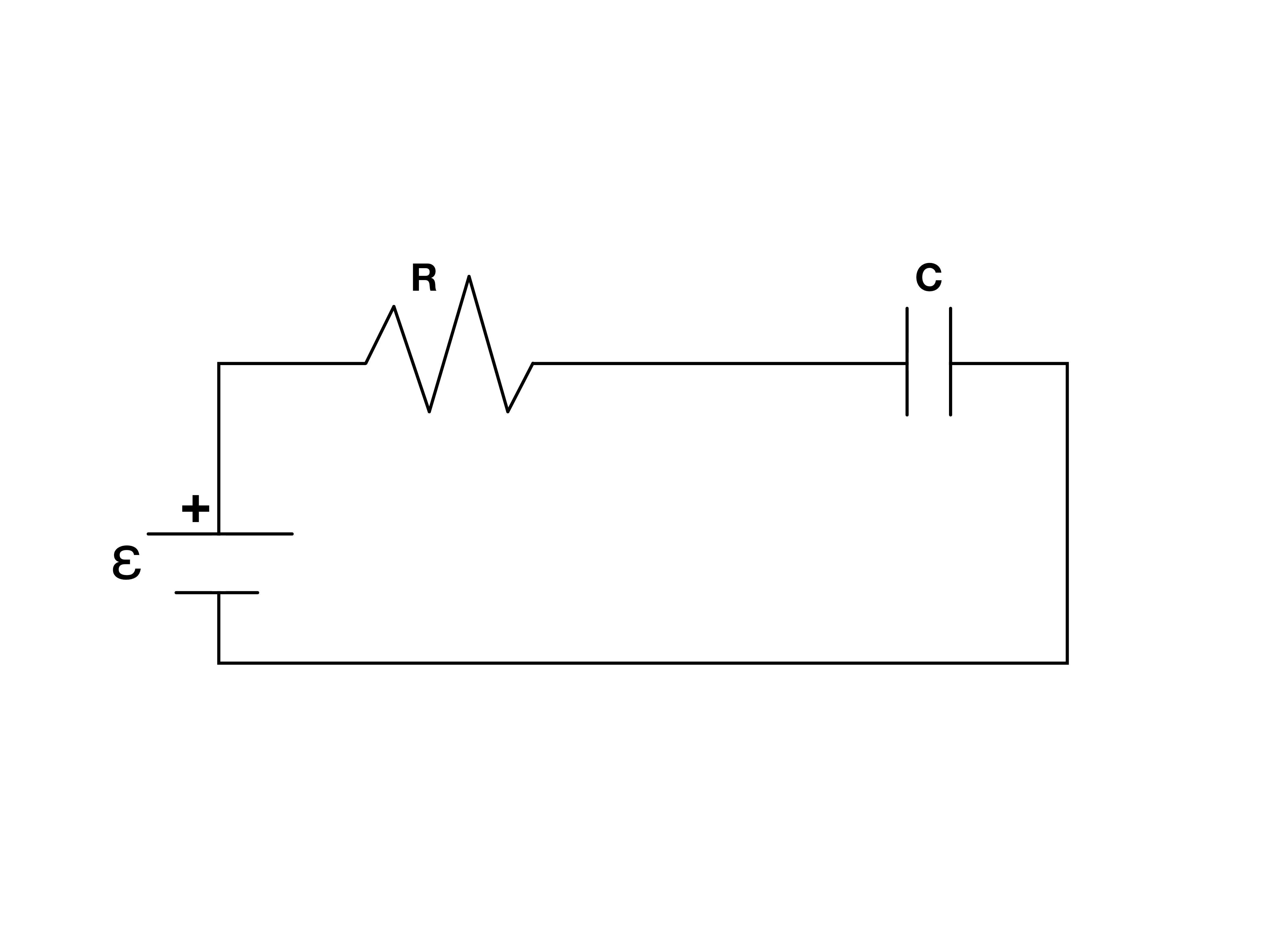
Here is a simple RC circuit. It is composed of a single emf, a single resistor, and a single capacitor. As we will see although the setup is simple the behavior of such a circuit is fairly complex.
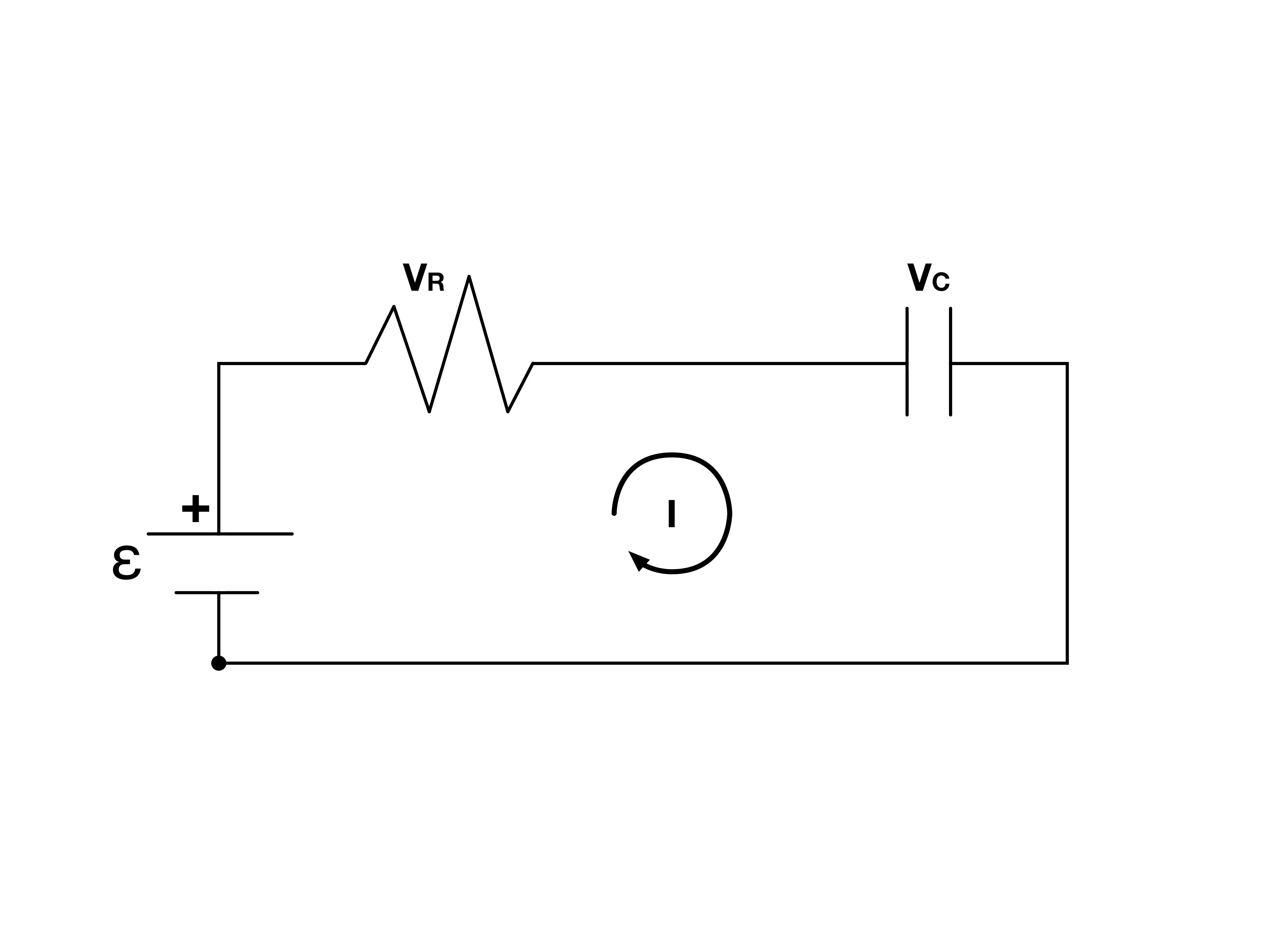
In applying Kirchhoff’s Voltage Law we assumed that the current in the circuit moved clockwise and starting at the bottom left dot moved with it across each of the circuit elements.
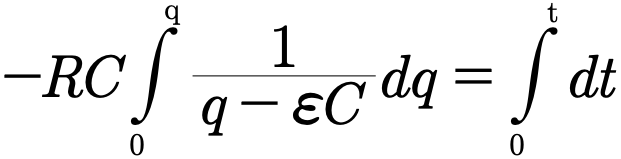
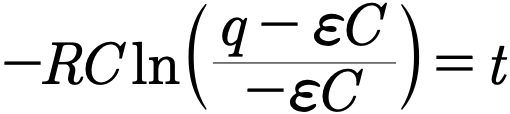
With a little more massaging we can get an expression for the charge in terms of t. First we move the -RC over to the right.
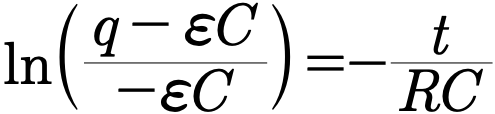
Then to get rid of the natural log we raise each side to e.
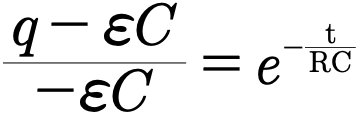
Finally we solve for q and do a little algebraic massaging to get our desired equation

From this equation we can now tell at any point in time after turning our emf on what the charge on our capacitor will be.
It is important to note a few notational aspects of the above equation. The term RC in the exponential is often denoted by tau, τ. Using τ for exponential decays is a common practice in physics. In the case of capacitors it is often called the characteristic time. The inverse of τ is the rate at which the exponential decays.
The next thing we will look at in this equation is εC. This quantity is the total possible charge that can exist on the capacitor and is often given the designation of Q. We say that this is the case because as you let the time in approach infinity you get that

And of course you expect to be at the largest possible amount as you reach the maximum amount of time.
An important aspect of this equation which should be noticed is that although at infinite time we reach the maximum charge this approach occurs asymptotically so that this charge is never actually reached. From this we can also say that the capacitor never reaches the maximum possible voltage since

As a final note we can also discuss the current in this circuit at any particular time. Since current is the change in charge over the change in time if we take the derivative of our equation with respect to time we will get the current at any particular time.

Using Ohm’s Law it is easy to see that the coefficient of our equation is nothing more than the highest possible current. Interestingly the highest current occurs at t=0 and then exponentially decays to zero.
For charging from an ideal constant voltage through a resistor, capacitor charge rises while current falls. For passive discharge through a resistor, both the capacitor charge and the magnitude of discharge current fall exponentially: .
Example 4.5.2
Optional arbitrary-time RC supplement. Prerequisites: exponential charging, logarithms and τ=RC; the required qualitative time-dependence discussion does not require this inversion. This preserved source example makes no AP coverage claim.
An initially uncharged ideal RC circuit has τ=3 s. When is charge 90% of its final value?
Authored clarification: Constant ideal supply; one simple resistor-capacitor charging path.
Reviewed worked solution:
Use charging law.
Set the fraction to 0.9.
Take the natural logarithm.
Answer: The time is approximately 6.91 s.
Check: At this time e⁻ᵗ/τ=0.1, so the charge is 0.9Qf.
Now by taking the natural log of both sides we can solve for t.
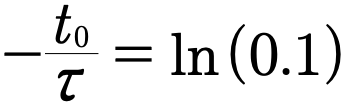
or by multiply both sides by -τ

Finally by plugging in the appropriate values we get that
Starting uncharged, . At 90% charge with τ=3 s, .
When we use capacitors in real life applications we typically never just charge them up and let them be. Often it is necessary to discharge the capacitor and like charging one this process takes time.
To figure out how to describe the time it takes to discharge a capacitor we must consider the conditions under which it is discharged. When discharging a capacitor the capacitor may not be connected to some type of emf otherwise the moment the capacitor lost a little of it’s charge the current induced by the emf would immediately try to fill it back up. For this reason we consider a circuit with only a single resistor and a single capacitor in a single loop.
Applying Kirchhoff’s Voltage Law to this setup yields the following equation.
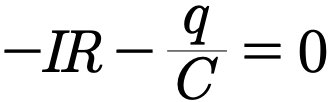
Like before this is a separable differential equation. By moving everything around and remembering that current is the time derivative of charge we can get
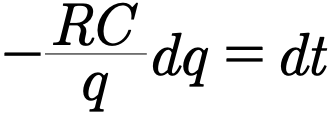
Now we integrate this function on the left from Q, the initial charge of the capacitor, to q the charge after a time t and on the left from our initial time 0 to our final time t. Doing so gives us that
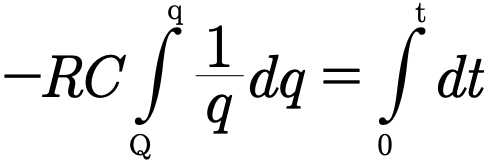
or
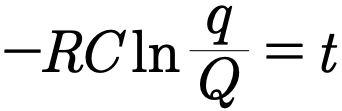
Now solving for q we get an expression which tells us the charge left on a capacitor after a time t if it had initial charge Q.
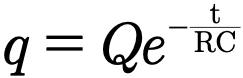
Example 4.5.3
Optional arbitrary-time RC supplement. Prerequisites: exponential discharge, ratios of remaining charge and logarithms; the required qualitative time-dependence discussion does not require this inversion. This preserved source example makes no AP coverage claim.
An RC capacitor decreases from 95% to 5% of a common reference charge with τ=1 s. Find elapsed time.
Authored clarification: Passive discharge; percentages have the same reference.
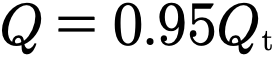
This problem is another exercise in our use of exponentials and natural logarithms. To begin this problem we first set Q to be 95% of our total charge
and then we let q be 5% of our total charge
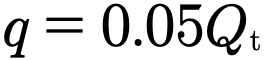
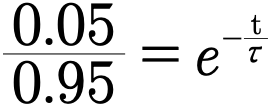
Plugging these values into our discharge equation yield that

From here we can move everything besides the exponential to one side so that
Review 1.5 RC Circuits
This review preserves the author’s recorded prompts, choices, and answer states. Corrected items have separate reviewed explanations and keys; unchanged draft keys are marked unreviewed. Unfinished items are not scored.
Original question 1
Given the equations derived in this section would you expect a capacitor to discharge in a finite amount of time?
Yes
No
Reviewed answer and reasoning
B
Ideal passive RC discharge approaches zero asymptotically; no exact finite time.
The independent semantic audit confirms this source prompt and recorded key under its stated conditions.
Archived original question and recorded key · contains the source error
Given the equations derived in this section would you expect a capacitor to discharge in a finite amount of time?
Yes
No
Original recorded key: B
Original question 2
In passive RC discharge, take positive capacitor current in the charging direction. What is i(t) for initial charge Q₀?
Reviewed answer and reasoning
A
Differentiate q=Q₀e⁻ᵗ/RC. The negative sign refers to the stated charging direction; the discharge magnitude decreases positively.
This reviewed version states the assumptions or convention needed for one determinate answer. The archived source prompt and key are retained.
Archived original question and recorded key · contains the source error
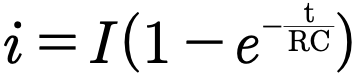
An equation for the current of an RC circuit as a capacitor is discharged was not given. Derive an expression for the current on discharge.
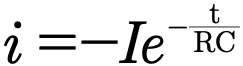

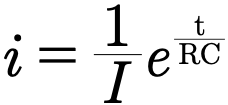
None of the above
Original recorded key: B
Original question 3
For passive RC discharge, the current magnitude is . What does I₀ denote?
The initial discharge-current magnitude Q₀/(RC)
The current after complete discharge
The capacitor charge at t=0
A current that increases during discharge
Reviewed answer and reasoning
A
Differentiate ; its rate of decrease has initial magnitude Q₀/(RC).
Authored correction or explicit assumptions; this reviewed key is separate from the archived original recorded states.
Archived original question and recorded key · contains the source error
In the previous question what does the I stand for?
The current at the instant the capacitor begins charging
The current expected through the capacitor after it is fully charged
The current expected through the resistor on capacitorless circuit
The current at some arbitrary point in time while the capacitor charges
None of the above
Original recorded key: E
Original question 4
In a simple RC circuit what is the definition of the characteristic time?
None of the above
Reviewed answer and reasoning
D
tau=RC has seconds units.
The independent semantic audit confirms this source prompt and recorded key under its stated conditions.
Archived original question and recorded key · contains the source error
In a simple RC circuit what is the definition of the characteristic time?
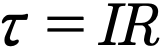
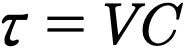
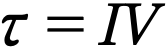
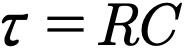
None of the above
Original recorded key: D
Original question 5
An initially uncharged capacitor, Q₀=0, charges through a fixed resistor R from a constant ideal voltage supply. Capacitance C is constant. After one time constant τ=RC, what fraction of its final charge Qf is on the capacitor?
0
None of the above
Reviewed answer and reasoning
C
After one time constant from uncharged, .
Reviewed correction. Archived source choices and key remain readable.
Archived original question and recorded key · contains the source error
In a charging capacitor if a single multiple of the characteristic time passes what fraction of the total charge would you expect to have?

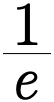
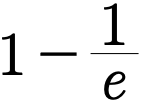
0
None of the above
Original recorded key: A
Taking the natural logarithm of both sides and then solving for t then gives that
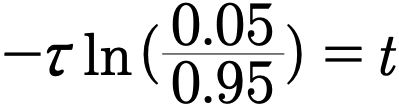
Finally we plug in our values and do the necessary calculations to get our answer.

Chapter 4 Problems
An ideal 12 V source is connected across C₁=2 μF in series with a parallel pair C₂=C₃=3 μF. All capacitors start uncharged. Find the equivalent capacitance.
Authored clarification: The original refers to “blah” without a recoverable named circuit. This is an explicitly authored replacement with a complete stated topology and values; no original diagram or source answer is inferred.
An ideal 12 V source is connected across C₁=2 μF in series with a parallel pair C₂=C₃=3 μF. All capacitors start uncharged. At electrostatic equilibrium, find the voltage across each capacitor.
Authored clarification: The original refers to “blah” without a recoverable named circuit. This is an explicitly authored replacement with a complete stated topology and values; no original diagram or source answer is inferred.
An ideal 12 V source drives R₁=4 Ω in series with a parallel pair R₂=6 Ω and R₃=3 Ω. Find the equivalent resistance.
Authored clarification: The original refers to “blah” without a recoverable named circuit. This is an explicitly authored replacement with a complete stated topology and values; no original diagram or source answer is inferred.
An ideal 12 V source drives R₁=4 Ω in series with a parallel pair R₂=6 Ω and R₃=3 Ω. Find each resistor current.
Authored clarification: The original refers to “blah” without a recoverable named circuit. This is an explicitly authored replacement with a complete stated topology and values; no original diagram or source answer is inferred.
Optional RC supplement: arbitrary-time exponential formulas. Prerequisites: exponentials and the time constant τ=RC; the optional calculus derivation also uses logarithms and derivatives. This item makes no AP coverage claim.
An ideal single-loop RC circuit has R=2.00 kΩ and C=100 μF, so τ=RC=0.200 s. At t=0 an uncharged capacitor is connected to a 12 V ideal source. Find q(t).
Authored clarification: The original refers to “blah” without a recoverable named circuit. This is an explicitly authored replacement with a complete stated topology and values; no original diagram or source answer is inferred.
Optional RC supplement: arbitrary-time exponential formulas. Prerequisites: exponentials and the time constant τ=RC; the optional calculus derivation also uses logarithms and derivatives. This item makes no AP coverage claim.
An ideal single-loop RC circuit has R=2.00 kΩ and C=100 μF, so τ=RC=0.200 s. A capacitor initially at 12 V is disconnected from its source and discharged through R at t=0. Find q(t).
Authored clarification: The original refers to “blah” without a recoverable named circuit. This is an explicitly authored replacement with a complete stated topology and values; no original diagram or source answer is inferred.
Optional RC supplement: arbitrary-time exponential formulas. Prerequisites: exponentials and the time constant τ=RC; the optional calculus derivation also uses logarithms and derivatives. This item makes no AP coverage claim.
An ideal single-loop RC circuit has R=2.00 kΩ and C=100 μF, so τ=RC=0.200 s. The initially uncharged capacitor begins charging from a 12 V ideal source. Find the source current I(t), positive toward the capacitor’s positive plate.
Authored clarification: The original refers to “blah” without a recoverable named circuit. This is an explicitly authored replacement with a complete stated topology and values; no original diagram or source answer is inferred.
Optional RC supplement: arbitrary-time exponential formulas. Prerequisites: exponentials and the time constant τ=RC; the optional calculus derivation also uses logarithms and derivatives. This item makes no AP coverage claim.
An ideal single-loop RC circuit has R=2.00 kΩ and C=100 μF, so τ=RC=0.200 s. The source is removed and a capacitor initially at 12 V discharges through R. Find the current magnitude I_out(t) flowing out of its positive plate as a function of time for t≥0, with time measured from source removal at t=0.
Authored clarification: The original refers to “blah” without a recoverable named circuit. This is an explicitly authored replacement with a complete stated topology and values; no original diagram or source answer is inferred.
Gallery 1.15 Circuits
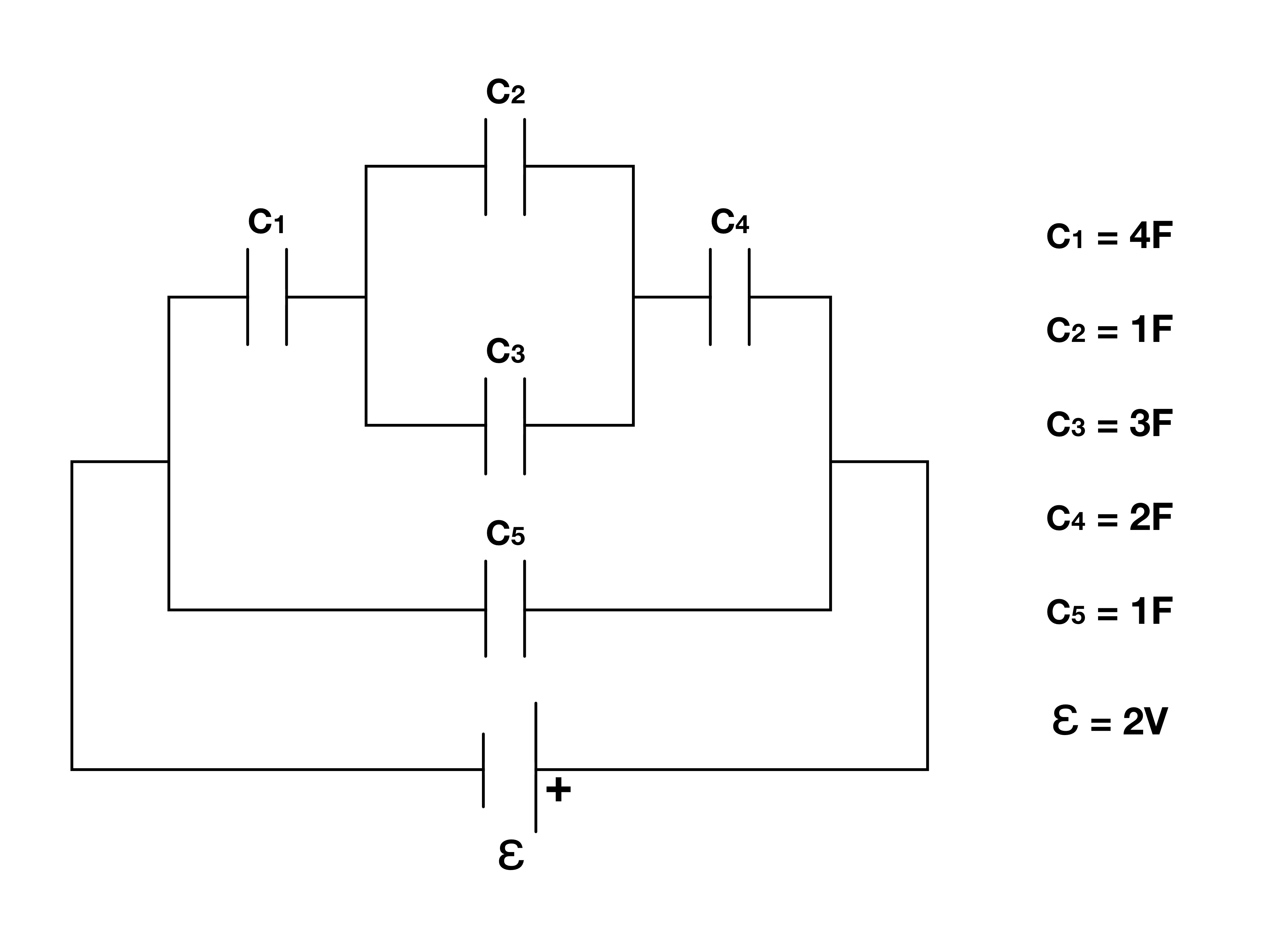
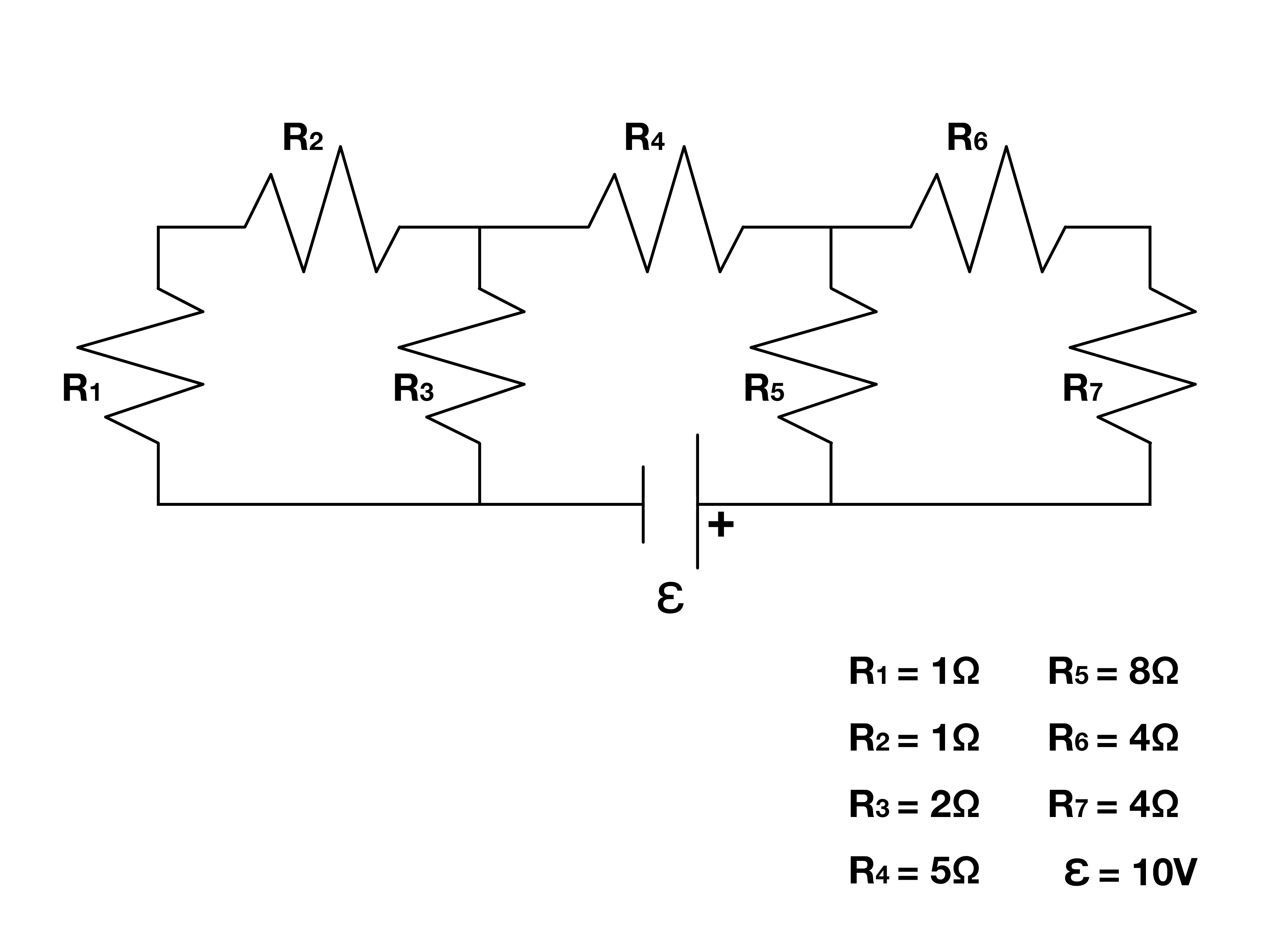
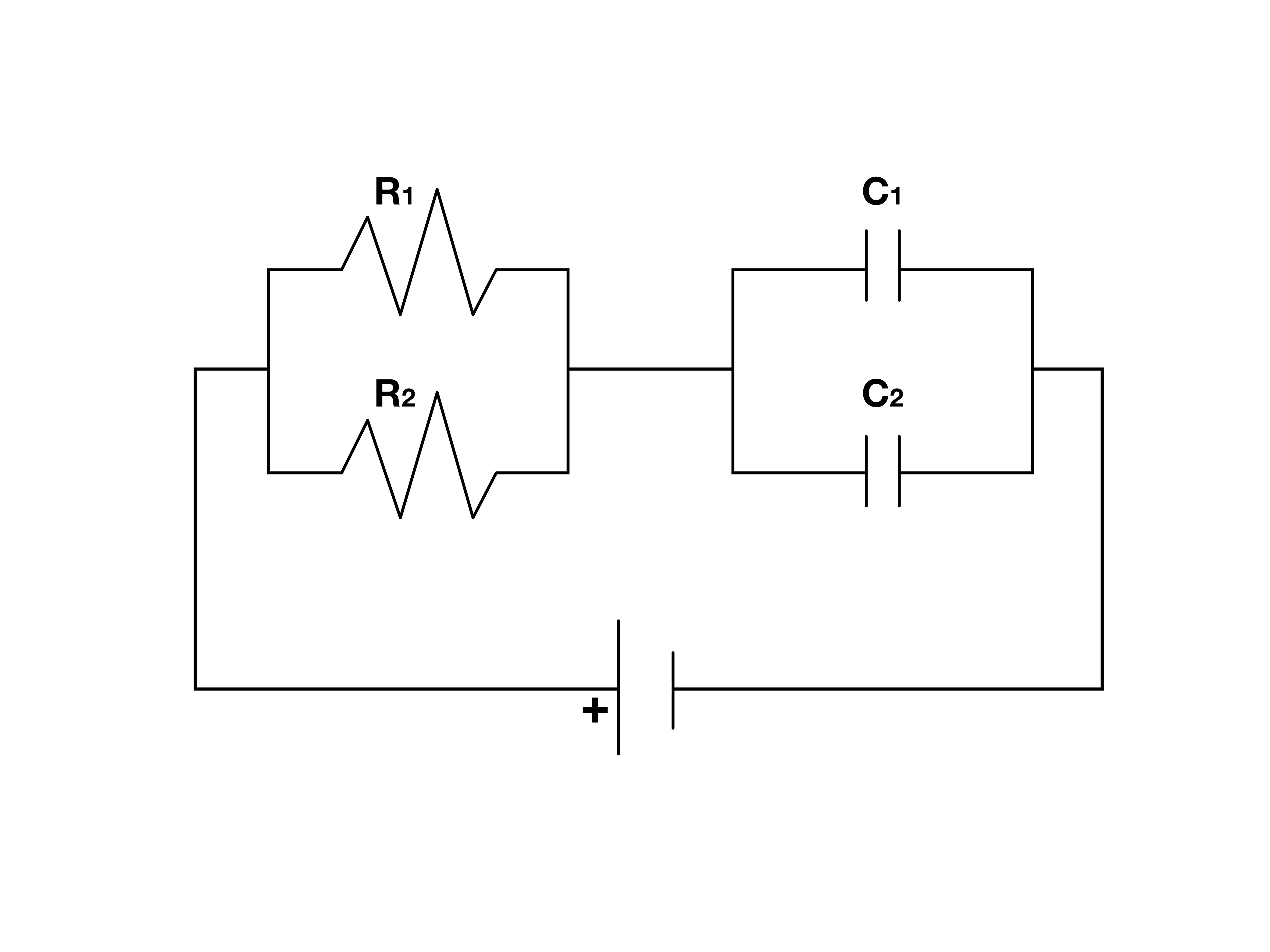
Reviewed worked examples
These authored derivations are paired with the original example identities. Added assumptions are stated.
Example 4.5.1 · reviewed solution
Solve (1+x)y′=x².
Authored clarification: This calculus extension is solved on an interval excluding x=−1.
Divide and perform polynomial division.
Integrate each term.
Verify by differentiation.
Check
The original cubic antiderivative does not differentiate to the required equation.
Optional arbitrary-time RC supplement. Prerequisites: exponential charging, logarithms and τ=RC; the required qualitative time-dependence discussion does not require this inversion. This preserved source example makes no AP coverage claim.
Example 4.5.2 · reviewed solution
An initially uncharged ideal RC circuit has τ=3 s. When is charge 90% of its final value?
Authored clarification: Constant ideal supply; one simple resistor-capacitor charging path.
Use charging law.
Set the fraction to 0.9.
Take the natural logarithm.
The time is approximately 6.91 s.
Check
At this time e⁻ᵗ/τ=0.1, so the charge is 0.9Qf.
Optional arbitrary-time RC supplement. Prerequisites: exponential discharge, ratios of remaining charge and logarithms; the required qualitative time-dependence discussion does not require this inversion. This preserved source example makes no AP coverage claim.
Example 4.5.3 · reviewed solution
An RC capacitor decreases from 95% to 5% of a common reference charge with τ=1 s. Find elapsed time.
Authored clarification: Passive discharge; percentages have the same reference.
Use exponential discharge.
Form the actual ratio.
Take logarithms.
The elapsed time is approximately 2.94 s.
Check
The starting value is 95%, not 100%.
Glossary and deeper reading · 2 refreshers
These editorial refreshers supplement the reading. Definitions and examples are added guidance; original source wording and recorded answers remain in their original context.
-
RC circuit
An RC circuit contains resistance and capacitance that produce time-dependent charging or discharging. Its initial and long-time behavior depends on the capacitor’s initial voltage and its actual connection to the source and resistors. For example, a discharged capacitor in a simple series charging loop initially carries current that decreases toward zero as its voltage rises.
-
Capacitor
A capacitor stores energy by separating charge between conducting regions. In the ideal two-plate model, opposite plate charges create a potential difference related to charge by the capacitance. For example, disconnecting a charged capacitor from a battery leaves energy stored until a discharge path is provided.