Charge and Matter
Original source retained for reference; this draft does not establish AP coverage.
Original author draft. Original wording and recorded answer states are preserved without claiming reviewed scientific correctness or AP alignment.
Physics 2 original textbook · Chapter 1
Section Overview
- Electric Charge
- Coulomb’s Law
- The Superposition Principle
Section 1
Charge and Matter
Take a moment to grab a balloon and rub it against your head. Besides looking silly you might find something interesting happening. Lifting the balloon you will see hairs stand up on end seemingly defying gravity being drawn to the ballon. In this scenario you have just witnessed one of the must fundamental interactions in our universe, the attraction of opposite charges.
The cause of the above effect is the depositing of electric charge which comes in two flavors, positive and negative. When placed near one another two like charged objects will repel and two oppositely charged objects will attract. If for instance we placed two positively charged spheres next to one another they would almost instantaneously repel from one another because they had the same type of charge. If we then took one of those positively charged spheres and placed it next to a negatively charged sphere we would then see the spheres attract.
Positive and negative charge just doesn’t float around by itself. It comes attached to certain fundamental particles. The particles we will discuss here are the proton and the electron although there are many many others.
The electron is the carrier of the negative charge. The charge of an electron is

The symbol C denotes the coulomb, the SI unit of electric charge. It is a derived unit: . The electron’s mass is approximately .
The electron mass is . Charge and mass have different units.
The proton’s charge is simply the negative of the electrons charge or

The protons mass is much larger than the electrons mass though coming in at
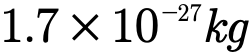
The proton is about 1836 times as massive as the electron (about 1800 to two significant figures).
The matter we deal with every day is actually composed of protons, electrons, and the neutron. Neutrons are relatively boring for our purposes since they have no charge and as a result exhibit no electrical effects (although they are important). Along with the protons, neutrons compose the nuclei of atoms. Of course if atoms were only made up of neutrons and protons they would have an excess of positive charge which would repel causing matter as we understand it to not exist. Luckily all atoms have a cloud of electrons surrounding them canceling out the positive charge which then allows atoms to get within reasonable distances of one another so that they may interact.
Now that we’ve spent so much time describing charge and what carries it we will now go ahead and take a more quantitative approach to its study.
As mentioned before objects with charge may either attract or repel one another. The law which describes the forces involved in these interactions is named Coulombs Law and like gravity it is an inverse square law.
Mathematically the law is written as
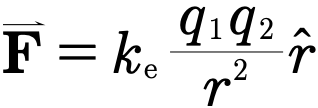
Where the q’s represent the charges of the objects in question, r the distance between their centers, and k the electric force constant which has a value of
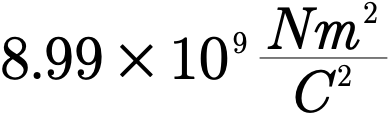
and which is often written as
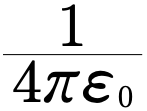
As with all forces the coulomb force has a direction. The direction of this force is along the line joining the two objects and in the equation the direction is given by the unit vector which points from one object to the other.

If we then wish to drop the unit vector and instead use the vector which runs between both objects we can just use the unit vectors definition
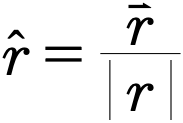
changing coulomb’s law to

Gallery 1.1 Forces and Charges
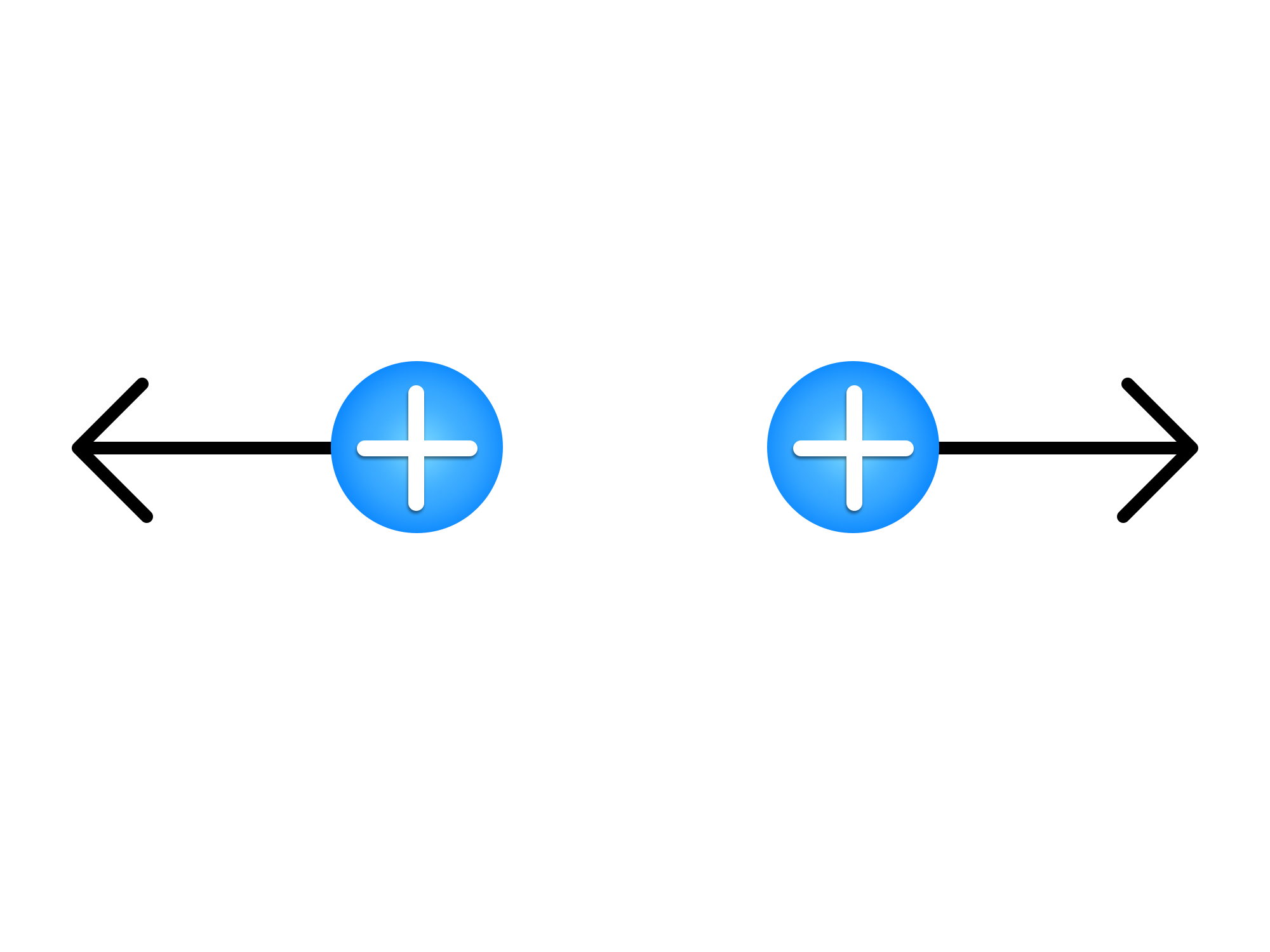
Like charges repel each other. Notice how the force acts along the line which joins the centers of the two particles.
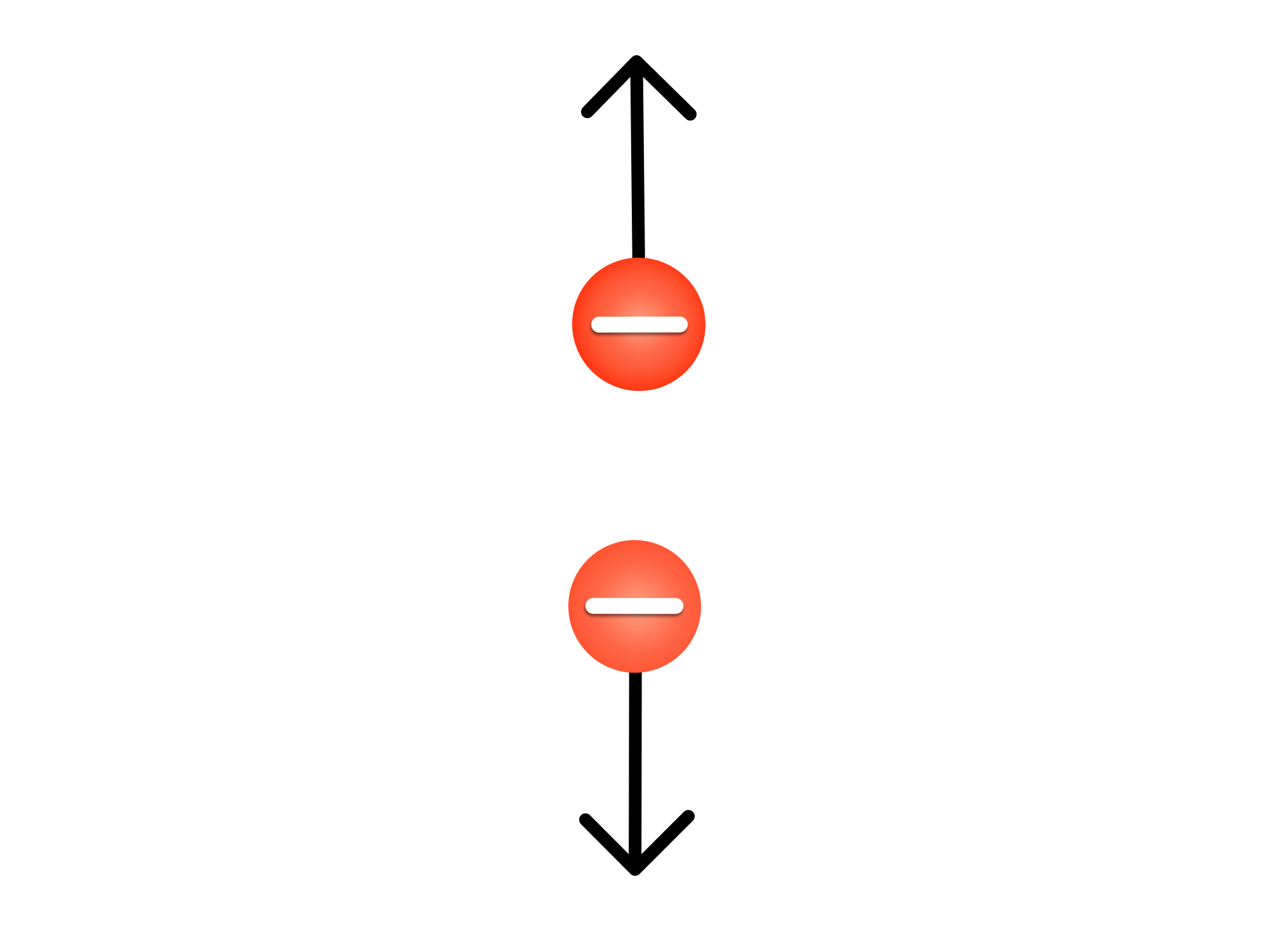
Repelling is a feature of like particles. Instead of two positive charges repelling here we have two negative charges repelling. The forces again acting along the line joining their centers.
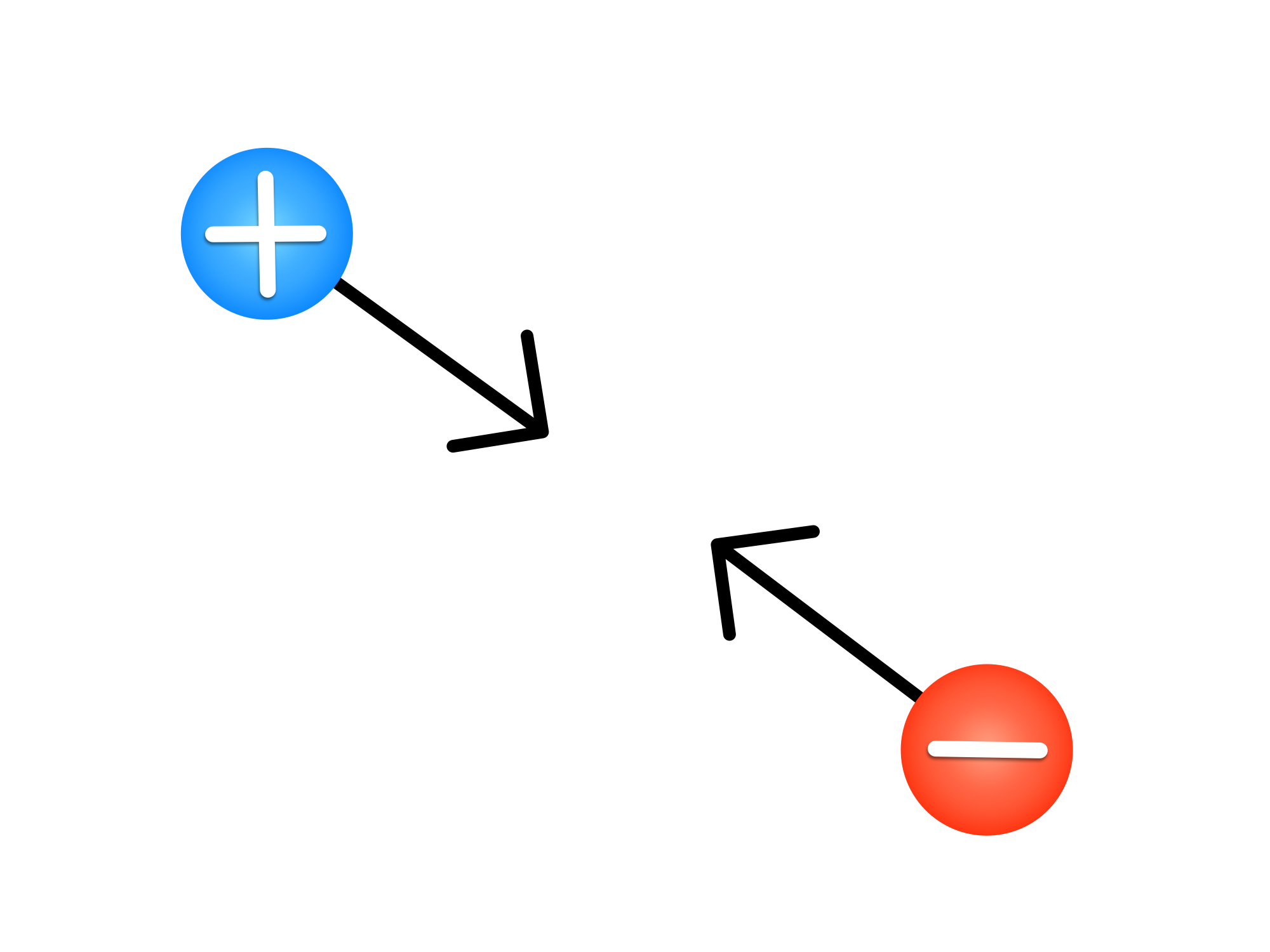
When two oppositely charged particle come near each other they attract. Like the case in which we have two like charge particles near one another this force acts along the line which joins the particles centers.
Example 1.1.1
Two protons are at (0,0) and (1,1), in metres. Find the force on the second proton.
Authored clarification: Coordinates are metres; point charges are fixed.
For this problem we will have to do two things. First we have to determine the magnitude of the force acting on the second proton and then we must determine the direction which that force points.
To determine the force we will have to use coulombs law which requires both the distance between our protons. Since that information was not given to us we will have to figure out how to get it.
Charge will be fairly easy. Since the given particles were protons which have a predetermined charge we simply need to find that information and jot it down. The charge of the proton was given earlier in the section as
The second thing we need to do is determine the distance between the two protons. Since we were given the protons positions on a grid all we need to do is a little bit of algebra.
The distance between two points on a plane is given by the formula

which is derived from the pythagorean theorem. Plugging the proper values into the above equation then gives us our distance
Interactive 1.1 The Superposition Principle
The Superposition Principle
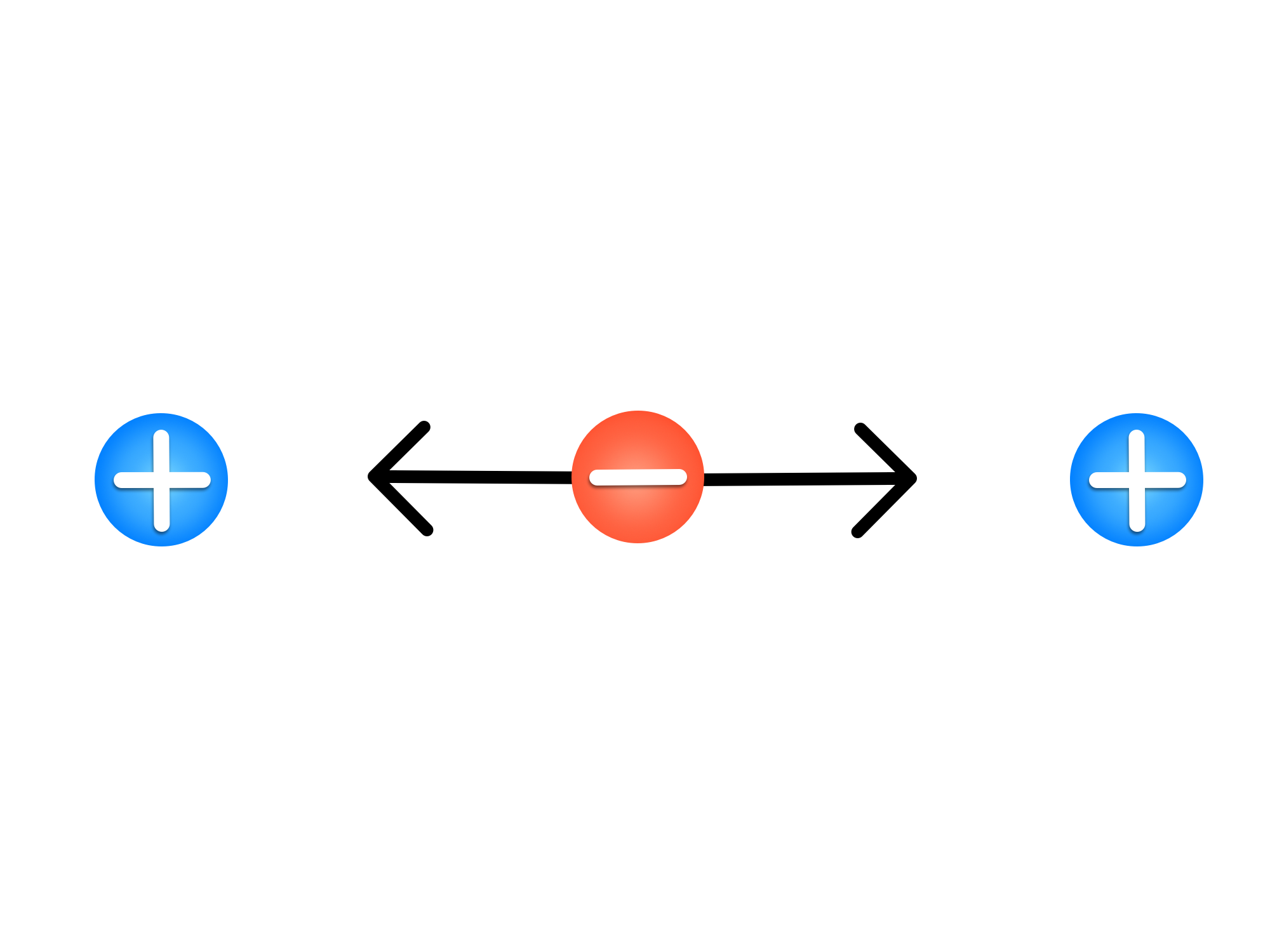
In this scenario the electron will not actually move. If you noticed each proton exerts a force which is equal and opposite of the force exerted by the other proton. The superposition tells us that these forces add together and cancel one another making the net force on the electron zero.
The Negative Charge
Here an electron is sandwiched between two protons. The protons pull the electron towards themselves.

With the above information and the electric force constant we can now calculate the magnitude of the force on the second proton.

The second portion of this question asks us for the direction of the force on the second particle in unit vector form. We can accomplish this be looking at the position vectors corresponding to each particle and then subtracting.
The position of the first proton is
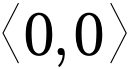
The position vector of the second proton is
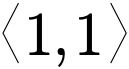
Subtracting the first from the second gives us the vector
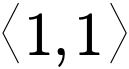
If we then use the definition of the unit vector we can get our answer
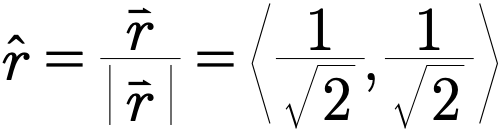
originating from second proton.
We know that this vector points in the correct direction because it points away from the proton at the origin and is parallel with the line joining the two protons as we would expect with a repulsive interaction.
As you may have noticed Coulomb’s Law as it was presented only considers the force between two objects. This is unfortunate since many interactions in nature will be involving more than two objects. Fortunately we have something which solves this issue. The superposition principle allows us to add together the forces due to coulombs law on a single object together much like you would sum forces on any other object.
Example 1.1.2
Protons at (0,1) and (1,0) attract an electron at (1,1), in metres. Find its force.
Authored clarification: Point charges have magnitudes e; positions are fixed.
For this problem we will be employing the superposition principle to determine the force on the electron due to both protons. To do this we will be determining the needed values due to each proton separately then add them together to get our final answer.
We will first be looking at the magnitude and direction of the force created by the presence of proton at (0, 1). The magnitude is easily determined by noticing that the distance between the proton and electron is 1 which along with the proton and electrons charge gives us all the necessary information to determine the force between them.

or if we wish to look strictly at the magnitude

Now we need to determine the direction of the force on the electron. The displacement vector which describes the direction of the force is given by subtracting the protons position vector from the electrons position vector which gives us
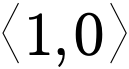
Unfortunately the vector above is not entirely correct. If we place the above vectors tail on the electron it points away from the proton which is incorrect since electron and protons are oppositely charged and attract. To fix this we must negate the vector. This s the displacement vector become
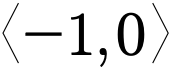
which luckily is already in unit vector form (test it out yourself).
The next thing we must do is determine the force caused by the presence of the proton at (1, 0). This is done in the same way as the first proton. The distance between the proton at (1, 0) and the electron is 1 so that the forces magnitude is

The unit vector is found again by subtracting the particles position vectors, changing signs if necessary, and reducing to unit vector form to give us
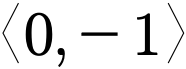
Finally we can use the superposition principle to add together our forces component by component. This is done by taking the magnitudes (without sign) and multiplying their corresponding unit vectors. For the proton at (1, 0) we have

The same thing can be done using the proton at (0, 1)

Review 1.1 Section 1 Review
This review preserves the author’s recorded prompts, choices, and answer states. Corrected items have separate reviewed explanations and keys; unchanged draft keys are marked unreviewed. Unfinished items are not scored.
Original question 1
The superposition principle is what allows us to sum the forces on an object due to coulomb’s law.
True
False
Reviewed answer and reasoning
A
Superposition adds vector forces on the same target; verified.
The independent semantic audit confirms this source prompt and recorded key under its stated conditions.
Archived original question and recorded key · contains the source error
The superposition principle is what allows us to sum the forces on an object due to coulomb’s law.
True
False
Original recorded key: A
Original question 2
Electrons are placed in 2 degree intervals on a circle of radius 1 millimeter centered around a proton. What is the force on the proton?
None of the above
Reviewed answer and reasoning
A
Evenly spaced charges around a complete circle cancel by opposite pairs; net force zero.
The independent semantic audit confirms this source prompt and recorded key under its stated conditions.
Archived original question and recorded key · contains the source error
Electrons are placed in 2 degree intervals on a circle of radius 1 millimeter centered around a proton. What is the force on the proton?




None of the above
Original recorded key: A
Original question 3
Four 2 C point charges are at (1,1), (0,2), (1,0), and (2,2), with coordinates in metres. What is the net force on the charge at (1,1)?
0
Reviewed answer and reasoning
A
The two diagonal forces cancel in x and add downward; the charge directly below pushes upward. .
Authored correction or explicit assumptions; this reviewed key is separate from the archived original recorded states.
Archived original question and recorded key · contains the source error
Four charges of q=2C are placed at (1,1), (0, 2), (1, 0), and (2, 2). What is the magnitude of the force on the charge at (1, 1)?




There is no net force
Original recorded key: C
Original question 4
Three protons are put in a straight line and equally spaced. What is the direction of the force on the proton in the middle?
Down
Left
Right
Up
There is no net force
Reviewed answer and reasoning
E
Middle of three equal equally spaced protons: equal opposite forces cancel.
The independent semantic audit confirms this source prompt and recorded key under its stated conditions.
Archived original question and recorded key · contains the source error
Three protons are put in a straight line and equally spaced. What is the direction of the force on the proton in the middle?
Down
Left
Right
Up
There is no net force
Original recorded key: E
Original question 5
Two electrons are placed at (-1, 0) and (1, 0) and a proton is placed at (0, 2). What is the direction of the force acting on the proton?
Down
Left
Right
Up
There is no net force
Reviewed answer and reasoning
A
Both attractions have downward components; horizontal components cancel.
The independent semantic audit confirms this source prompt and recorded key under its stated conditions.
Archived original question and recorded key · contains the source error
Two electrons are placed at (-1, 0) and (1, 0) and a proton is placed at (0, 2). What is the direction of the force acting on the proton?
Down
Left
Right
Up
There is no net force
Original recorded key: A
We can now add these vectors together to get the total force on the electron

The magnitude of the above vector is then given by

and the unit vector of the force is given by

Reviewed worked examples
These authored derivations are paired with the original example identities. Added assumptions are stated.
Example 1.1.1 · reviewed solution
Two protons are at (0,0) and (1,1), in metres. Find the force on the second proton.
Authored clarification: Coordinates are metres; point charges are fixed.
Use separation and equal positive charges.
Apply Coulomb’s law.
Normalize the displacement.
Check
Repulsive force points from the first proton to the second.
Example 1.1.2 · reviewed solution
Protons at (0,1) and (1,0) attract an electron at (1,1), in metres. Find its force.
Authored clarification: Point charges have magnitudes e; positions are fixed.
Each separation is 1 m.
Attraction points toward each proton.
Add components.
Check
Both components must be negative.
Glossary and deeper reading · 7 refreshers
These editorial refreshers supplement the reading. Definitions and examples are added guidance; original source wording and recorded answers remain in their original context.
-
Electric charge
Electric charge is a conserved property that determines electric interactions. It can be positive or negative and is measured in coulombs; ordinary net charges arise from an imbalance of charged particles. For example, transferring electrons between initially neutral objects leaves one negatively charged and the other positively charged.
-
Coulomb’s law
Coulomb’s law gives the electric force between point charges using their charges and separation. The magnitude grows with the product of the charge magnitudes and decreases with separation squared, with the medium accounted for in the stated model. For example, doubling the separation of two fixed point charges reduces the force magnitude to one quarter.
-
Gravity
Gravity is the attractive interaction between masses in the Newtonian model. For spherical bodies or point-mass approximations, its strength decreases with the square of the separation between their centers. For example, Earth’s gravity provides the inward force that keeps a satellite in orbit.
-
Force
A force describes an interaction that can change an object’s momentum. It is a vector measured in newtons, so both size and direction matter when forces are added. For example, a rope can pull a cart while the floor exerts friction in another direction.
-
Electric force
Electric force is the interaction of an electric field with a charged object. For point charges at rest, like signs repel and opposite signs attract, with direction along their separation. For example, an electron and proton exert equal-magnitude opposite forces on one another despite having different masses.
-
Unit vector
A unit vector has magnitude one and specifies a direction. Multiplying it by a signed component gives the vector contribution along that direction. For example, the Cartesian unit vectors identify the positive x, y, and z directions.
-
Vector
A vector is a quantity with a magnitude and a direction, represented by an arrow or by components along chosen axes. Vectors add by adding corresponding components rather than simply adding their magnitudes. For example, an eastward displacement followed by a northward displacement produces a resultant pointing northeast. The zero vector has zero magnitude and no unique direction.