Unit 4 / Linear Momentum
Unit 4: 34 practice problems
Work from memory first. Draw a diagram, choose a system, and say why your model applies. The 30 selected questions revisit every topic in Linear Momentum; 4 additional problems at the end ask you to explain and apply the models. The worked solutions live on their own page.
This is mixed topic review: short concept checks, calculations, and experiment tasks appear together. Choose a topic below to revisit its lesson, then return to the questions that challenge your model.
Question 1 · AP topic 4.1
1. Linear Momentum · 4
A 0.40 kg cart and a 0.60 kg cart start at rest on a level low-friction track. A spring between them is released. The lighter cart moves left at 3.0 m/s. Find the other cart’s velocity and compare their kinetic energies.
Your written working
Drawing is temporarily unavailable. Work on paper if needed, then record your reasoning here.
Saving written working requires JavaScript. The problem remains available above; keep your work on paper or in your own notes.
See this question in its original context ↗Review the model ↗Separate worked solution ↗
Question 2 · AP topic 4.2
2. Change in Momentum and Impulse · 4
A 2.0 kg object is moving downward at 3.0 m/s. A hand brings it to rest in 0.40 s. Find the average upward hand force, taking g = 9.8 m/s².
Your written working
Drawing is temporarily unavailable. Work on paper if needed, then record your reasoning here.
Saving written working requires JavaScript. The problem remains available above; keep your work on paper or in your own notes.
See this question in its original context ↗Review the model ↗Separate worked solution ↗
Question 3 · AP topic 4.3
3. Conservation of Linear Momentum · 4
Two riders of masses 40 kg and 60 kg move together at +2.0 m/s on a frictionless surface. They push apart. The 40 kg rider ends at +5.0 m/s. Find the other rider’s velocity and v_cm.
Your written working
Drawing is temporarily unavailable. Work on paper if needed, then record your reasoning here.
Saving written working requires JavaScript. The problem remains available above; keep your work on paper or in your own notes.
See this question in its original context ↗Review the model ↗Separate worked solution ↗
Question 4 · AP topic 4.4
4. Elastic and Inelastic Collisions · 4
A 0.40 kg cart at +3.0 m/s sticks to a stationary 0.80 kg cart. Find the final speed and the kinetic-energy decrease.
Your written working
Drawing is temporarily unavailable. Work on paper if needed, then record your reasoning here.
Saving written working requires JavaScript. The problem remains available above; keep your work on paper or in your own notes.
See this question in its original context ↗Review the model ↗Separate worked solution ↗
Question 5 · AP topic 4.1
5. Compare the cart evidence
Two carts travel on a level track in one camera frame. Cart A has mass 0.40 kg and velocity +3.0 m/s; cart B has mass 0.60 kg and velocity −1.0 m/s. Draw their momentum arrows to scale and show the system total. A second camera rides rightward at 1.0 m/s relative to the track. Without changing the physical motion, what total momentum would that camera measure? Explain why comparing one cart from each camera would be a poor test of momentum conservation.
Your written working
Drawing is temporarily unavailable. Work on paper if needed, then record your reasoning here.
Saving written working requires JavaScript. The problem remains available above; keep your work on paper or in your own notes.
See this question in its original context ↗Review the model ↗Separate worked solution ↗
Question 6 · AP topic 4.2
6. Choose the sensor and comparison
A 0.50 kg cart approaches a bumper at +2.0 m/s and leaves at −1.0 m/s. Contact lasts about 0.020 s. You have a motion sensor and can record the bumper force at either 50 samples/s or 2,000 samples/s. Choose a force setting and describe what measurements would let you test the impulse–momentum theorem, including one check for a systematic error. A softer bumper produces the same endpoint velocities over 0.040 s. Predict how its net impulse and average net force compare with the first bumper; justify the signs and ratios.
Your written working
Drawing is temporarily unavailable. Work on paper if needed, then record your reasoning here.
Saving written working requires JavaScript. The problem remains available above; keep your work on paper or in your own notes.
See this question in its original context ↗Review the model ↗Separate worked solution ↗
Question 7 · AP topic 4.3
7. Test the center-of-mass motion
Two carts have masses m₁ = 1.0 kg and m₂ = 3.0 kg. A synchronized video gives positions in meters: at t = 0 s, (x₁, x₂) = (0, 6); at 1 s, (2, 5); at 2 s, (4, 4); at 3 s, (3.75, 3.75). The carts meet and stick at about 2 s. Decide whether these data support constant center-of-mass velocity across the interaction. Show the representation you would use, with scales and units, and explain why averaging the two positions without their masses could give a misleading conclusion.
Your written working
Drawing is temporarily unavailable. Work on paper if needed, then record your reasoning here.
Saving written working requires JavaScript. The problem remains available above; keep your work on paper or in your own notes.
See this question in its original context ↗Review the model ↗Separate worked solution ↗
Question 8 · AP topic 4.4
8. Classify with measurement intervals
Two separate trials use the same initial total kinetic-energy interval, 1.16–1.24 J. In trial A the final interval is 1.12–1.22 J; in trial B it is 0.80–0.90 J. These intervals state the possible values given the measurement uncertainty. In both trials the carts separate after contact and the measured total momenta agree before and after. Which trial supports a clear inelastic classification? What can you claim about trial A? Choose one additional measurement improvement that would make the energy classification more useful and explain its connection to the calculation.
Your written working
Drawing is temporarily unavailable. Work on paper if needed, then record your reasoning here.
Saving written working requires JavaScript. The problem remains available above; keep your work on paper or in your own notes.
See this question in its original context ↗Review the model ↗Separate worked solution ↗
Question 9 · AP topic 4.1
9. Linear Momentum · 1
Two moving carts have a total momentum of zero. What must be true?
- The carts are both at rest.
- Their individual momentum vectors add to zero.
- Their total kinetic energy is zero.
Your written working
Drawing is temporarily unavailable. Work on paper if needed, then record your reasoning here.
Saving written working requires JavaScript. The problem remains available above; keep your work on paper or in your own notes.
See this question in its original context ↗Review the model ↗Separate worked solution ↗
Question 10 · AP topic 4.2
10. Change in Momentum and Impulse · 1
A 0.20 kg ball changes velocity from +6.0 m/s to −4.0 m/s. What is its momentum change?
- −0.40 kg·m/s
- −2.0 kg·m/s
- +2.0 kg·m/s
Your written working
Drawing is temporarily unavailable. Work on paper if needed, then record your reasoning here.
Saving written working requires JavaScript. The problem remains available above; keep your work on paper or in your own notes.
See this question in its original context ↗Review the model ↗Separate worked solution ↗
Question 11 · AP topic 4.3
11. Conservation of Linear Momentum · 1
Two carts collide on a low-friction track. Which condition makes their total horizontal momentum constant?
- They stick together.
- Their total kinetic energy stays constant.
- The net horizontal external impulse is zero.
Your written working
Drawing is temporarily unavailable. Work on paper if needed, then record your reasoning here.
Saving written working requires JavaScript. The problem remains available above; keep your work on paper or in your own notes.
See this question in its original context ↗Review the model ↗Separate worked solution ↗
Question 12 · AP topic 4.4
12. Elastic and Inelastic Collisions · 1
Two carts bounce apart after contact. Must the collision be elastic?
- Yes, because they did not stick.
- No; compare total kinetic energy before and after.
- Yes, if total momentum is constant.
Your written working
Drawing is temporarily unavailable. Work on paper if needed, then record your reasoning here.
Saving written working requires JavaScript. The problem remains available above; keep your work on paper or in your own notes.
See this question in its original context ↗Review the model ↗Separate worked solution ↗
Question 13 · AP topic 4.1
13. Linear Momentum · 2
A cart moves left. You choose right as positive. Which describes its momentum?
- Negative, in the leftward direction.
- Positive because its mass is positive.
- Zero unless a force keeps pushing it.
Your written working
Drawing is temporarily unavailable. Work on paper if needed, then record your reasoning here.
Saving written working requires JavaScript. The problem remains available above; keep your work on paper or in your own notes.
See this question in its original context ↗Review the model ↗Separate worked solution ↗
Question 14 · AP topic 4.2
14. Change in Momentum and Impulse · 2
A force–time triangle has base 0.20 s and height 8.0 N above zero. What impulse does it deliver?
- +0.80 N·s
- +1.6 N·s
- +40 N·s
Your written working
Drawing is temporarily unavailable. Work on paper if needed, then record your reasoning here.
Saving written working requires JavaScript. The problem remains available above; keep your work on paper or in your own notes.
See this question in its original context ↗Review the model ↗Separate worked solution ↗
Question 15 · AP topic 4.3
15. Conservation of Linear Momentum · 2
A 1 kg cart moves at +4 m/s and a 3 kg cart is stationary. What is their center-of-mass velocity?
- +2 m/s
- +1 m/s
- +4 m/s
Your written working
Drawing is temporarily unavailable. Work on paper if needed, then record your reasoning here.
Saving written working requires JavaScript. The problem remains available above; keep your work on paper or in your own notes.
See this question in its original context ↗Review the model ↗Separate worked solution ↗
Question 16 · AP topic 4.4
16. Elastic and Inelastic Collisions · 2
A mass m at speed v sticks to a stationary mass 3m with negligible external impulse. What is the shared final speed?
- v/4
- v/3
- 4v
Your written working
Drawing is temporarily unavailable. Work on paper if needed, then record your reasoning here.
Saving written working requires JavaScript. The problem remains available above; keep your work on paper or in your own notes.
See this question in its original context ↗Review the model ↗Separate worked solution ↗
Question 17 · AP topic 4.1
17. Linear Momentum · 3
A light cart has mass m and speed v. A heavier cart has mass 2m and speed v/2 in the same direction. Compare their momenta.
- The heavier cart has twice the momentum.
- The lighter cart has twice the momentum.
- They have equal momentum.
Your written working
Drawing is temporarily unavailable. Work on paper if needed, then record your reasoning here.
Saving written working requires JavaScript. The problem remains available above; keep your work on paper or in your own notes.
See this question in its original context ↗Review the model ↗Separate worked solution ↗
Question 18 · AP topic 4.2
18. Change in Momentum and Impulse · 3
A momentum–time graph is horizontal at +5 kg·m/s. What is the net external force?
- +5 N
- Positive but unknown.
- Zero.
Your written working
Drawing is temporarily unavailable. Work on paper if needed, then record your reasoning here.
Saving written working requires JavaScript. The problem remains available above; keep your work on paper or in your own notes.
See this question in its original context ↗Review the model ↗Separate worked solution ↗
Question 19 · AP topic 4.3
19. Conservation of Linear Momentum · 3
An isolated moving system explodes. Which graph must stay horizontal?
- The center-of-mass velocity against time.
- Every fragment’s velocity against time.
- The system’s kinetic energy against time.
Your written working
Drawing is temporarily unavailable. Work on paper if needed, then record your reasoning here.
Saving written working requires JavaScript. The problem remains available above; keep your work on paper or in your own notes.
See this question in its original context ↗Review the model ↗Separate worked solution ↗
Question 20 · AP topic 4.4
20. Elastic and Inelastic Collisions · 3
An isolated collision keeps total momentum but decreases total kinetic energy. What is the best conclusion?
- Momentum conservation is impossible here.
- Total energy was destroyed.
- The collision is inelastic and energy changed form.
Your written working
Drawing is temporarily unavailable. Work on paper if needed, then record your reasoning here.
Saving written working requires JavaScript. The problem remains available above; keep your work on paper or in your own notes.
See this question in its original context ↗Review the model ↗Separate worked solution ↗
Question 21 · AP topic 4.1
21. Introduction to Momentum · question 3
Your written working
Drawing is temporarily unavailable. Work on paper if needed, then record your reasoning here.
Saving written working requires JavaScript. The problem remains available above; keep your work on paper or in your own notes.
See this question in its original context ↗Separate worked solution ↗
Question 22 · AP topic 4.2
22. Introduction to Momentum · question 4
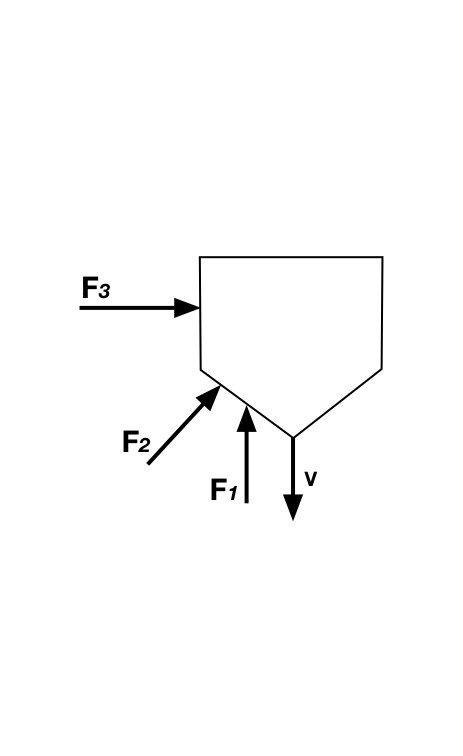
Three forces shown have equal magnitude and act separately on the same object for 5 s. Neglect other impulses. Which produces the largest magnitude of velocity change?
Your written working
Drawing is temporarily unavailable. Work on paper if needed, then record your reasoning here.
Saving written working requires JavaScript. The problem remains available above; keep your work on paper or in your own notes.
See this question in its original context ↗Separate worked solution ↗
Question 23 · AP topic 4.3
23. Introduction to Momentum · question 1
Two ice skaters are holding hands, traveling together at . If one ice skater has a mass of , and the other has a mass of , and they push off from each other, resulting in the skater going , what is the new velocity of the ice skater?
Your written working
Drawing is temporarily unavailable. Work on paper if needed, then record your reasoning here.
Saving written working requires JavaScript. The problem remains available above; keep your work on paper or in your own notes.
See this question in its original context ↗Separate worked solution ↗
Question 24 · AP topic 4.4
24. Inelastic Collisions · question 1
A ice hockey goalie catches a puck moving at . With what speed does the goalie return back, if no energy is lost to friction?
Your written working
Drawing is temporarily unavailable. Work on paper if needed, then record your reasoning here.
Saving written working requires JavaScript. The problem remains available above; keep your work on paper or in your own notes.
See this question in its original context ↗Separate worked solution ↗
Question 25 · AP topic 4.1
25. Work it out
Using typical masses, rank a boulder, football, bowling ball, and bullet by inertia when each has the same velocity. Explain what inertia depends on and how their momentum magnitudes compare.
Your written working
Drawing is temporarily unavailable. Work on paper if needed, then record your reasoning here.
Saving written working requires JavaScript. The problem remains available above; keep your work on paper or in your own notes.
See this question in its original context ↗Review the model ↗Separate worked solution ↗
Question 26 · AP topic 4.2
26. Introduction to Momentum · question 5
An object’s momentum is the only thing that determines how hard it would hit another object. True or False?
Your written working
Drawing is temporarily unavailable. Work on paper if needed, then record your reasoning here.
Saving written working requires JavaScript. The problem remains available above; keep your work on paper or in your own notes.
See this question in its original context ↗Separate worked solution ↗
Question 27 · AP topic 4.3
27. Introduction to Momentum · question 2
A skater and a 5 kg backpack initially move at 10 m/s. The skater throws the backpack forward at 13 m/s in the road frame and afterward moves at approximately 9.81 m/s. Neglect external horizontal impulse. Which listed value is closest to the skater’s mass?
Your written working
Drawing is temporarily unavailable. Work on paper if needed, then record your reasoning here.
Saving written working requires JavaScript. The problem remains available above; keep your work on paper or in your own notes.
See this question in its original context ↗Separate worked solution ↗
Question 28 · AP topic 4.4
28. Inelastic Collisions · question 2
A driver attempts to slow a runaway truck by getting in front of it and braking. If the driver is going and the truck is going , how much slower does the truck go once it hits the car in front of it, before braking? Assume they stick together in a brief collision with negligible external horizontal impulse.
Your written working
Drawing is temporarily unavailable. Work on paper if needed, then record your reasoning here.
Saving written working requires JavaScript. The problem remains available above; keep your work on paper or in your own notes.
See this question in its original context ↗Separate worked solution ↗
Question 29 · AP topic 4.1
29. Drone momentum vector
A 1.5 kg drone flies 4 m/s east and 3 m/s north. Find its momentum vector, magnitude, and direction.
Your written working
Drawing is temporarily unavailable. Work on paper if needed, then record your reasoning here.
Saving written working requires JavaScript. The problem remains available above; keep your work on paper or in your own notes.
See this question in its original context ↗Review the model ↗Separate worked solution ↗
Question 30 · AP topic 4.2
30. Introduction to Momentum · question 1
A tennis player hits back a tennis ball. The ball initially moved towards the player at a velocity of , and was hit back with a velocity of . If the ball weighs , and the racquet was hitting the ball for , what is the force the racquet exerts on the ball?
Your written working
Drawing is temporarily unavailable. Work on paper if needed, then record your reasoning here.
Saving written working requires JavaScript. The problem remains available above; keep your work on paper or in your own notes.
See this question in its original context ↗Separate worked solution ↗
Explain and apply the model
Try these problems before opening the solutions. State your assumptions, show the diagram or calculation, and explain what makes your answer follow.
Justify a short-interaction model
Two carts interact on a horizontal track for 0.030 s. Their average mutual force magnitude is 80 N, while the magnitude of the net external horizontal force on the pair is at most 0.40 N. A comparison interaction of the same duration has 40 N net external force. Velocities are measured immediately before and immediately after contact.
(a) Compare internal and net external force magnitudes and calculate their impulse scales in the first trial. Use that comparison to justify or reject approximately constant pair momentum over contact. Explain why duration and the shared interval matter.
(b) Explain why an object model at each cart’s center of mass is adequate for the requested initial/final velocity analysis, and name a contact-stage question it cannot answer. Evaluate whether the comparison trial allows the same negligible-external-impulse approximation.
Your written working
Drawing is temporarily unavailable. Work on paper if needed, then record your reasoning here.
Saving written working requires JavaScript. The problem remains available above; keep your work on paper or in your own notes.
Worked solution and rubric →Revisit the worked example →Read the relevant section →
Derive the force law from impulse
A constant-mass 1.2 kg cart changes velocity from −2.0 m/s to +1.0 m/s in 0.40 s. Right is positive. The measured force can vary during the interval.
(a) Starting from the net impulse–momentum theorem, derive the full chain F_net,avg = Δp/Δt = mΔv/Δt = ma_avg. State the constant-mass assumption and explain when the chain can represent instantaneous quantities.
(b) Calculate Δp, the net impulse, average acceleration and average net force with signs. Sketch a constant-force rectangle having the same impulse, labeling force/time axes and area, and explain why its height need not be the real peak force.
Your written working
Drawing is temporarily unavailable. Work on paper if needed, then record your reasoning here.
Saving written working requires JavaScript. The problem remains available above; keep your work on paper or in your own notes.
Worked solution and rubric →Revisit the worked example →Read the relevant section →
Find the compensating wall momentum
A 0.30 kg ball approaches a wall at +4.0 m/s and leaves at −2.0 m/s. Contact lasts 0.060 s. Take right as positive. Include the wall and Earth as the surroundings, with negligible other external impulse over contact.
(a) Use Newton’s third law at each contact instant to derive the equality of opposite wall-on-ball and ball-on-wall impulses over the same time interval. Calculate both impulses and both average contact forces.
(b) Calculate the compensating momentum change of the wall plus Earth. Compare whether momentum is constant for ball alone and for the enlarged ball–wall–Earth system, and explain how this interaction conserves momentum despite the ball reversing.
Your written working
Drawing is temporarily unavailable. Work on paper if needed, then record your reasoning here.
Saving written working requires JavaScript. The problem remains available above; keep your work on paper or in your own notes.
Worked solution and rubric →Revisit the worked example →Read the relevant section →
Check individual energies in an elastic collision
Cart A and cart B each have mass 0.60 kg. Initially A moves at +3.0 m/s and B is at rest. Immediately after their one-dimensional collision A is at rest and B moves at +3.0 m/s. Net external impulse and external energy transfer are negligible.
(a) Calculate each cart’s initial and final kinetic energy, each individual ΔK, and the initial/final total. Use these values to decide whether the collision is elastic and evaluate the claim that elastic means every object keeps its own kinetic energy.
(b) Check total momentum before and after, and draw separate energy bars for A and B at both endpoints using the same scale. Explain why the unchanged total does not require either cart to keep its velocity.
Your written working
Drawing is temporarily unavailable. Work on paper if needed, then record your reasoning here.
Saving written working requires JavaScript. The problem remains available above; keep your work on paper or in your own notes.
Worked solution and rubric →Revisit the worked example →Read the relevant section →