Solving Infinite Series
This original textbook reading covers part of the AP topic. Follow the AP course outline for complete topic instruction and practice.
Section 1 - Solving Infinite Series
Section 1
Solving Infinite Series
Now that you are familiar with Taylor Series Expansions and how they converge for certain x values, we can use the Taylor Series Identities to solve for the value of an infinite series.
The general rule to follow is to try to find a Taylor Series that matches the infinite series and plug in for x.
The Taylor Series Expansions of the most common functions are given in the following pages.
Basic Trig Functions

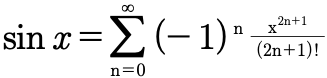 for -∞<x<∞

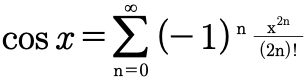 for -∞<x<∞
Geometric Function
 ≈ 1+ x + x2 + x3 + x4 + x5 + x6 + ... + xn
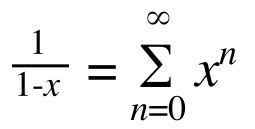 for |x|<1
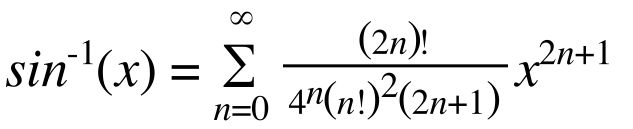

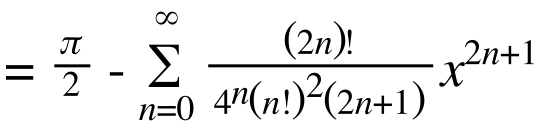
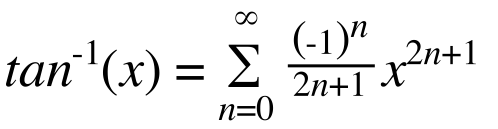 for -1 < x < 1

Exponential and Logarithmic Functions
ex ≈ 
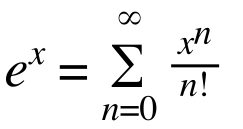 for -∞ < x < ∞

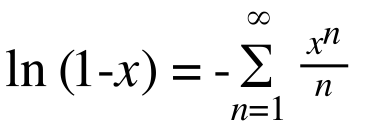 for -1<x<1
Mercator Series

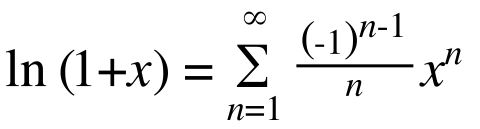 for -1<x<1
Example 7.1.1
Find the value of the infinite series

The first thing to do is to determine if there is a Maclaurin series to match this one.
If you recall
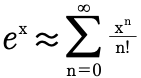 for all x values
then we can plug in x=3 to get
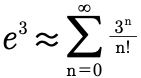
And the value of  is approximately
20.0855
Example 7.1.2
Find the value of the infinite series
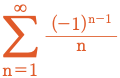
Expanding the series for the first eight terms...

The expansion is similar to the Maclaurin series for ln (1+x)

for x=1, so...

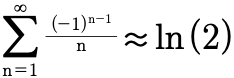
The series converges to the value of ln 2, or .693
Taylor Series expansions can also be used to solve for complex equations. Consider the following example..
Example 7.1.3
Use the Taylor Series Expansions to find a value for eix.
If the Maclaurin series for ex is

then the series for the example function is

Expanding the series for the first ten terms, you get...

Now I am going to rearrange the terms, separating the terms with an i from those without.

Then factoring out an i, the expression becomes

Looking at the terms, the expression appears to be an expansion of a complex sine and cosine function.
In fact, the terms without an i are the first six terms of the Maclaurin cosine expansion.
and the terms with an i are the beginning terms of the Maclaurin sine expansion.
As such, the Maclaurin expansion for the function eix is equal to
cos x + isin x
Review 1.1
Question 1 of 3 · 0 correct
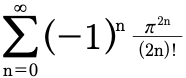
Evaluate the series
Glossary and deeper reading · 3 refreshers
These editorial refreshers supplement the reading. Definitions and examples are added guidance; original source wording and recorded answers remain in their original context.
-
Taylor series
A Taylor series is the infinite power series built from a function’s derivatives at a chosen center. Its coefficients are the derivatives at the center divided by the corresponding factorials. For example, eˣ has Taylor series 1+x+x²/2!+x³/3!+⋯ centered at 0. A Taylor series represents the function only where convergence and the vanishing remainder justify that equality.
-
Infinite series
An infinite series is the sum of the terms of an infinite sequence, defined through its partial sums. The series converges when those partial sums approach a finite value. For example, 1/2+1/4+1/8+⋯ converges to 1. Terms approaching 0 are necessary for convergence, but that condition alone is insufficient.
-
Inverse trigonometric function
An inverse trigonometric function returns a principal angle from a trigonometric output. The original trigonometric function is restricted to a one-to-one interval to define that inverse. For example, arcsin(1/2)=π/6 under the usual range [−π/2,π/2]. The notation sin⁻¹x means arcsin x, whereas the reciprocal of sine is cosecant.