Maclauren Series
This original textbook reading covers part of the AP topic. Follow the AP course outline for complete topic instruction and practice.
This reading includes verified answer corrections and explicitly stated clarifications.
Section Overview
Section 3
The taylor series is useful by itself but usually we only deal with a special case of the taylor series when a is zero. The series in this subset are called Maclaurin Series and there a quite a few common ones that you should be aware of. In this section we will derive a few of the more common ones.
Unfortuantely to describe these Maclaurin Series we will need the full infinite terms of the Taylor Series. To make the pattern in these series explicit it is then customary to write out a sum which describes the series. As a result learning to create these will also be a major focus.
Example 6.3.1
Create a sum which describes the Maclaurin Series of

We’ve already determined the first few terms of this taylor expansion when looking at how a finite number of terms in a taylor series can serve as an approximation.
We will first write out the first few terms of taylor expansion so that we can look for some pattern.
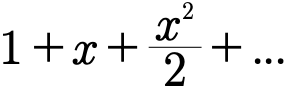
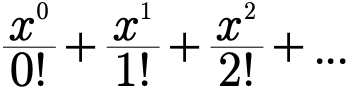
Looking at this as it is we may not be able to pull out a pattern easily so we will again write out the first few terms but without simplification.
Interactive 1.1
Read all original figure notes
Maclaurin Series
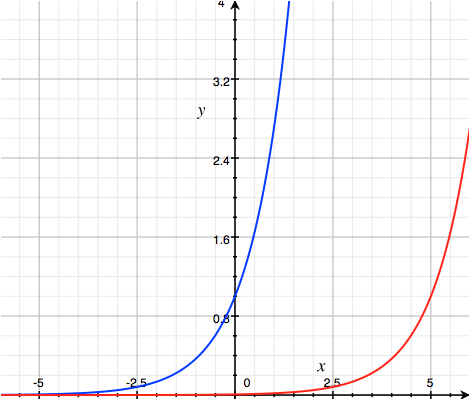
The blue line is the taylor series of the exponential. Since it is centered around zero it is also a Maclaurin Series.
Taylor Series
This is the exponential centered around five. As a result it is only a taylor series and not a Maclauren Series.
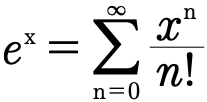
A pattern in this write out is much more obvious. Both the factorial and the power increase by one every term. This can be easily put into sum form. The sum we find is then
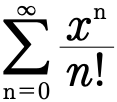
and since this sum describes the taylor expansion of  we may conclude that
Example 6.3.2
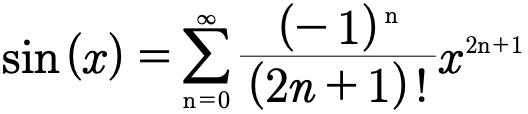
Create a sum which describes the Maclaurin Series of
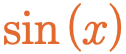
We start in the same way by determining the first few terms of sine’s taylor expansion around zero.
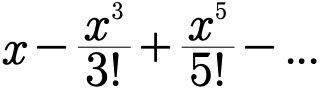
We then again rewrite things in a more explicit form
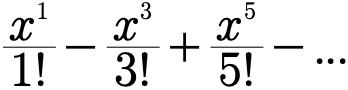
Here there are three things to note. First our sign is alternating and secondly we only have odd numbers for our powers and factorials. Both of these effects are due to the oscillating nature of derivatives of sines and cosines.
The final piece of information we need to notice is our first term is an x and is positive. This last bit of information is all we need. Combining all our ingredients together we can write a sum.
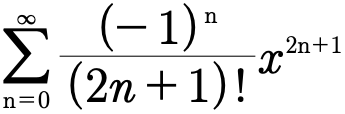
Since like before the sum describes the taylor series of sine we go say that
Example 6.3.3
Create a sum which describes the Maclaurin Series of
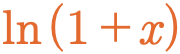
Due to the fact that the ln(x) by itself gives derivatives of 1/x it is impossible to formulate the Maclaurin Seris as we have defined it since we would be dividing by zero. To get around this issue instead of the ln(x) we look at ln(1+x). This does not work perfectly however and as a result the domain of this Maclaurin Series must be restricted.
Although the Maclaurin Series of ln(1+x) is in some respects kind of funky we none-the-less proceed in determining it in the normal manner.
Going ahead and writing out the first few terms of the taylor series centered at zero without simplification we get

Dropping the first term we then get

It should be fairly clear what the pattern is here. If we let the power be n and make sure our first term is positive we have that the nth term is
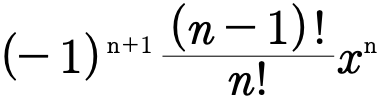
The factorial in that equation can be simplified though since

So that we now have that each term in the series is given by
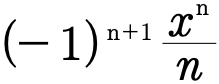
Putting this in sum form and noting that since the zero term fell out we have that

The reason for the domain limit is displayed in this examples image. Outside the domain the Maclaurin Series for ln(1+x) does not give an accurate view of the function.
Pay close attention to the indices of the sum in this case. We start at one instead of zero here. Starting at zero would force you to divide by zero which is not acceptable and since the zero term was zero it is ignorable.
Supplementary image for Example 6.3.3
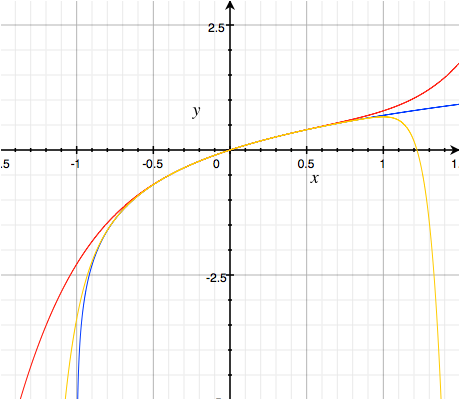
Read all original figure notes
ln(1+x)
The function expanded in example 6.3.3 is graphed in blue. The other lines graphed refer to the Maclaurin Series of the function to finite numbers of terms.
At -1
Here the actual function approaches negative infinity but since the taylor expansion is formed of polynomials it is not approached exactly.
At 1
Here a sharp decline in accuracy occurs but the function still exists.
To complete this chapter here is a list of some common Maclaurin Series which you may find useful later on.
The exponential function:

The natural log:


Trigonometric functions:


Chapter 6 Problems
- What is the definition of a power series?
- What is the definition of a power series?
- Prove that
Clarified version: the inner sum ends at n, so it includes exactly the coefficient pairs whose indices add to n.
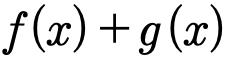
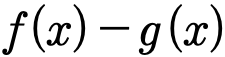
- For
 and compute the following.
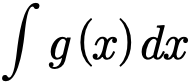
Clarified version: g(x) includes the factor xⁿ in each term, making it a power series in x.

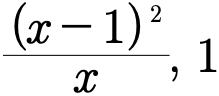
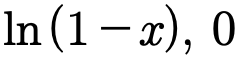
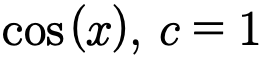
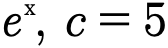
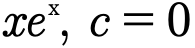
- Taylor expand the following function around the given value and note which are Maclaurin Series.


Glossary and deeper reading · 3 refreshers
These editorial refreshers supplement the reading. Definitions and examples are added guidance; original source wording and recorded answers remain in their original context.
-
Maclaurin series
A Maclaurin series is a Taylor series centered at 0. Its coefficients are determined by the function’s successive derivatives evaluated at 0. For example, sin x has Maclaurin series x−x³/3!+x⁵/5!−⋯. As with any Taylor series, equality to the function requires the appropriate convergence and remainder justification.
-
Taylor series
A Taylor series is the infinite power series built from a function’s derivatives at a chosen center. Its coefficients are the derivatives at the center divided by the corresponding factorials. For example, eˣ has Taylor series 1+x+x²/2!+x³/3!+⋯ centered at 0. A Taylor series represents the function only where convergence and the vanishing remainder justify that equality.
-
Infinite series
An infinite series is the sum of the terms of an infinite sequence, defined through its partial sums. The series converges when those partial sums approach a finite value. For example, 1/2+1/4+1/8+⋯ converges to 1. Terms approaching 0 are necessary for convergence, but that condition alone is insufficient.