Ordinary Differential Equations
This original textbook reading covers part of the AP topic. Follow the AP course outline for complete topic instruction and practice.
This reading includes verified answer corrections and explicitly stated clarifications.
Section 2
Differential equations is an extremely important topic in mathematics as it has far reaching consequences in wide ranging fields such as mathematics and economics. Even the most fundamental laws of physics in its simplest form is itself a differential equation.
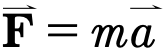
They are defined by a simple fact. A differential equation is any equation which contains within it the derivative or derivatives of one or more functions.
Here we will begin with the study of what are called ordinary differential equations or ODEs. These are differential equations which contain derivatives with respect to a single variable (partial differential equations or PDEs are the other type of differential equations and contain what are called partial derivatives).
Within the realm of ODEs there are many different classifications. One of which is the order. The order of a differential equation is the highest derivative taken contained within the differential equation. A first order differential equation for example would contain only first derivatives of a function. An example of a ODE with an order of one would be the equation
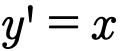
A second order differential equation would be a differential equation which contains only second derivatives or lower. An example of such an equation would be

The order of a differential equation is determined by the highest derivative appearing in it. The degree of a polynomial is determined by powers. Keep those two ideas separate.
Example 8.2.1
Determine the order of the following differential equation.
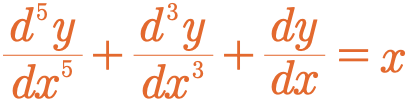
This is a simple problem. To check what order this differential equation is all we have to do is determine what is the highest derivative taken.
Recall that the nth derivative of a function y is denoted

The above differential equation is a 5th order differential equation since 5 is the highest n we have.
The nth derivative in prime notation is written as

The differential equation in the example above could then have been written in prime notation as

The second type classification we will make use of is linearity. An ODE is said to be linear when its highest degree is one and its coefficients depend only on x or constant numbers. Another way to say this is that the differential may be expressed in the form

where the coefficients

may be either constants or functions which depend only upon x.
For a homogeneous linear differential equation, sums and constant multiples of solutions are again solutions; its solution set is a vector space. For a nonhomogeneous equation, this closure claim generally fails. Instead, the general solution is one particular solution plus a solution of the associated homogeneous equation.
Example 8.2.2
Determine if the following differential equation is linear.
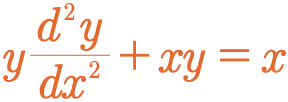
This is just another simple example. To determine whether the differential equation is linear we just have to check a couple of points.
Let’s first check that the degree is lower than one. Since no exponents higher than one are on y or its derivatives this test is passed.
The next thing to look at are the coefficients. Here we encounter a problem the first term contains both y and its derivative. This is not allowed so that we can say that the above equation is not linear.
Differential equations have two kinds of what could be aptly thought of as solutions. One of these is named the initial value problem which will be discussed later. The second is what is most commonly called a solution to a differential equation.
Solutions to differential equations must have a single property, a function is a solution of a differential equation if when you plug in that solution into the differential equation the differential equation gives back an identity.
Example 8.2.3
Determine if the given function is a solution to the given differential equation.
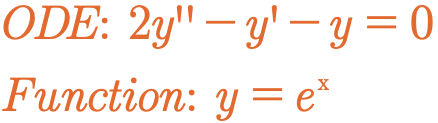
To check whether the given function is a solution all we must do is plug in the function into the ODE. Doing this gives us
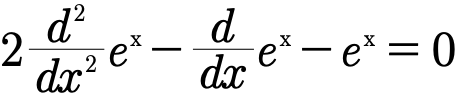
Since
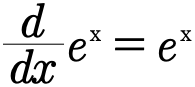
We can simplifying the above equation to give

Which gives us the identity
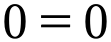
This tells us that the given function is indeed a solution to the given ODE.
Gallery 1.1 Solutions to Differential Equations
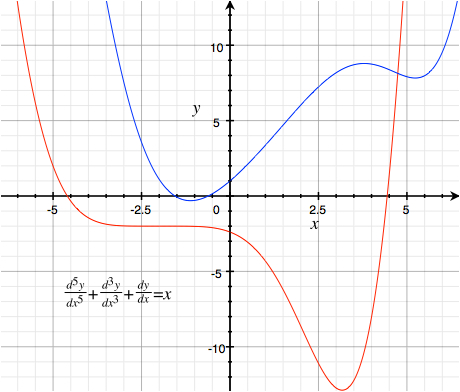
In each of the graphs shown several solution curves for each of the differential equation used in this section are plotted. The solutions from a single differential equation can vary widely depending on your initial values.
Read all original image captions
Image 1
In each of the graphs shown several solution curves for each of the differential equation used in this section are plotted. The solutions from a single differential equation can vary widely depending on your initial values.
Image 2
In each of the graphs shown several solution curves for each of the differential equation used in this section are plotted. The solutions from a single differential equation can vary widely depending on your initial values.
Image 3
In each of the graphs shown several solution curves for each of the differential equation used in this section are plotted. The solutions from a single differential equation can vary widely depending on your initial values.
Review 1.2 Ordinary Differential Equations
Question 1 of 5 · 0 correct
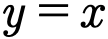
Is the following a differential equation?
Glossary and deeper reading · 7 refreshers
These editorial refreshers supplement the reading. Definitions and examples are added guidance; original source wording and recorded answers remain in their original context.
-
Ordinary differential equation
An ordinary differential equation uses derivatives of unknown functions with respect to one independent variable. Its order is the highest derivative appearing in the equation. For example, y″+y=0 is an ordinary differential equation of order 2. Equations involving partial derivatives with respect to several independent variables belong to a different class.
-
Differential equation
A differential equation relates an unknown function to one or more of its derivatives. A solution is a function that makes the equation true throughout an appropriate interval. For example, y′=2x has solutions y=x²+C. An initial condition can select a particular member of a family of solutions.
-
Derivative
A derivative gives the instantaneous rate of change of a function with respect to its input. At a point, it is the finite limit of the difference quotient when that limit exists. For example, the derivative of x² is 2x, so the tangent slope at x=3 is 6. A derivative function collects those rates across the inputs where the function is differentiable.
-
Function
A mathematical function assigns exactly one output to each input in its domain. Inputs can share an output, but one input cannot have two different outputs. For example, f(x)=x² assigns the output 9 to both 3 and −3. Function notation names the rule and its input; f(3) means the output when the input is 3.
-
Partial derivative
A partial derivative measures how a multivariable function changes with one input while the other inputs are held constant. The chosen variable must be specified. For example, for f(x,y)=x²y, the partial derivative with respect to x is 2xy. This is different from differentiating y as an unknown function of x in implicit differentiation.
Read more: Original source · Partial Differentiation (beyond AP) →
-
Second derivative
A second derivative is the derivative of the first derivative. It measures how the first rate of change changes with the input; further repeated differentiation gives higher-order derivatives. For example, f(x)=x³ has f′(x)=3x² and f″(x)=6x. For position measured against time, the second derivative is acceleration.
-
Polynomial
A polynomial in one variable is a finite sum of constant multiples of nonnegative integer powers of that variable. The degree is the highest exponent with a nonzero coefficient. For example, 2x³−x+5 is a polynomial of degree 3. Expressions containing 1/x or √x are not polynomials in x.