Practice of Evaluating Taylor Series
This original textbook reading covers part of the AP topic. Follow the AP course outline for complete topic instruction and practice.
This reading includes verified answer corrections and explicitly stated clarifications.
Section 3 - Evaluating Taylor Series
Section 3
Practice of Evaluating Taylor Series
You may come across an integral that you cannot anti-differentiate through the usual integration techniques.
One such integral may be

Thankfully, a Taylor-Series Identity may be used to help solve the integral. As long as the limits of integration are within the interval of convergence of the series, then the value of the integral can be expressed as a Taylor Summation.
Note: The value received from the Taylor Summation will be correct only to a certain extent. Increasing the number of terms in the Taylor Summation will make the value more precise.
The technique can be seen in the works of the next example.
Example 7.3.1
Use the Taylor Series for ex to solve the integral

Since the definite integral is in the interval of convergence, all we have to do is plug -x2 into the Taylor Series for ex and then integrate it term by term.
ex ≈ 
Plugging in -x2 for x,


The next step is to integrate it term-by-term.


Plugging in the lower and upper bounds...
= 
= 
Evaluating the seven term summation, we get the value
.7467
which is correct up to the thousandths-place of the actual value, which is
.7468
Example 7.3.2
Using the Taylor Series for cos x, evaluate the integral
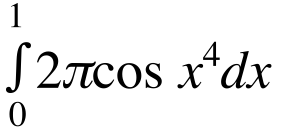
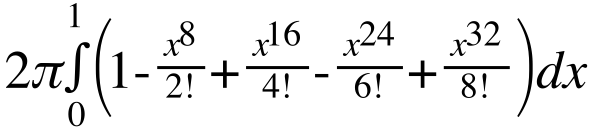
The limits of integration are within the interval of convergence, so we can use the expansion for cos x, replacing x with x4.
= 
= 
= 
= 5.949
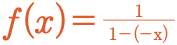
The expansion of the above function is

Integrating the expansion...

= 
Since the integral of  is ln |1+x|, we have that
ln (1+x) ≈
on the interval -1<x<1.
Review 1.3
Question 1 of 3 · 0 correct
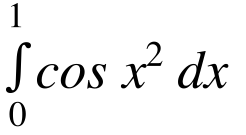
Example 7.3.3
Find the anti-derivative of the Taylor Expansion of
Chapter 7 Problems
For questions 1-3, determine the value of the expansion



For questions 4 and 5, evaluate the infinite sum
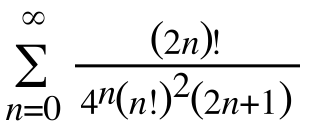
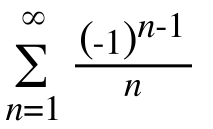
The average liger weighs 6.2lbs at birth. One standard deviation is approximately 1.2lbs.
- What is the probability of a liger weighing between 5 and 6.2 lbs?
- What is the probability of a liger weighing between 6.8 and 7.4 lbs?
- What is the probability of a liger weighing between 3.8 and 8.6 lbs?
For the next five questions, evaluate the definite integrals using a five-term Taylor Expansion
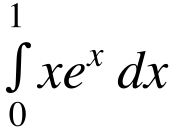
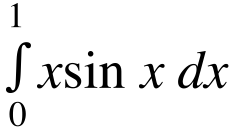
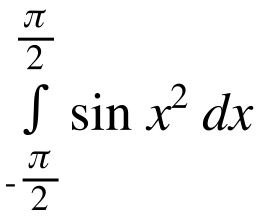
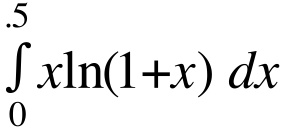
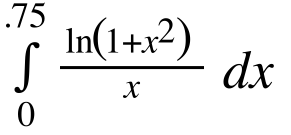
= 
The expansion follows the series..
 ,
where x=  . Therefore,
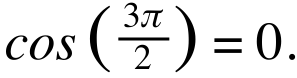
The expansion follows the series...
ex ≈
where x=420. Therefore, the expansion is equal to
e420
= 
The expansion follows the series...
 ,
where 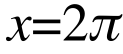 . Therefore,
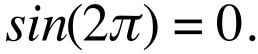
The summation follows the series..
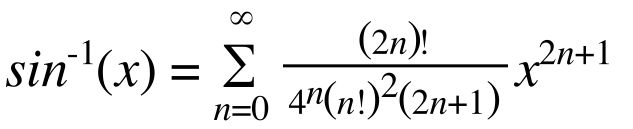
Where x=1. Therefore,
sin-1(1) =  .
The summation follows the alternating harmonic series. Expanding the summation...

The expansion follows the series...

where x=1. Therefore,
ln(2)=.693
- A weight between 5 and 6.2 pounds falls one standard deviation from the norm.
The values for a and b are
a= -1, b=0. Plugging it into the formula..
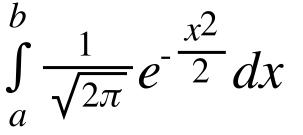
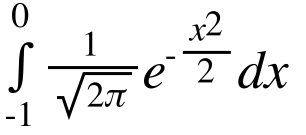 . Using the exponential taylor series..
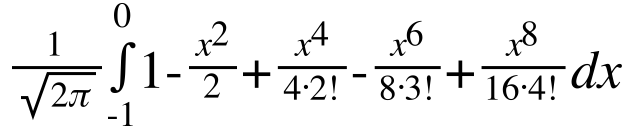



=34.1%
- A weight between 6.8 and 7.4 pounds falls between half and one standard deviation from the norm.
The values for a and b are
a= .5, b=1. Plugging it into the formula..
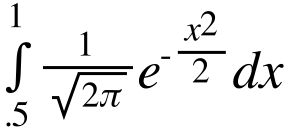 . Using the exponential taylor series..
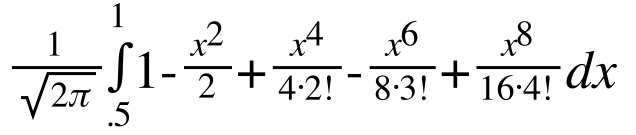


=14.99%
- A weight between 3.8 and 8.6 pounds falls between two standard deviations to the left and right of the norm.
The values for a and b are
a= -2, b=2. Plugging it into the formula..
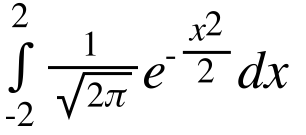 . Using the exponential taylor series..
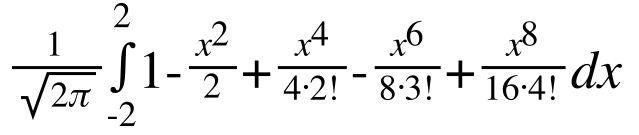

The first five terms give 0.984479786, or about 98.44798%. This truncation is too coarse for the full probability. Using sixteen terms (n = 0 through 15) gives 0.954499736, or about 95.45%, with next-term error at most 1.515 × 10⁻¹⁰.
Using a five-term expansion..
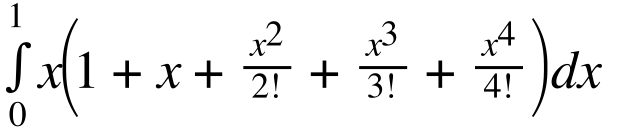
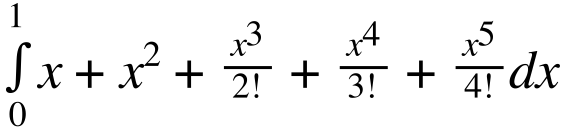


=
= .998
Using a five-term expansion..
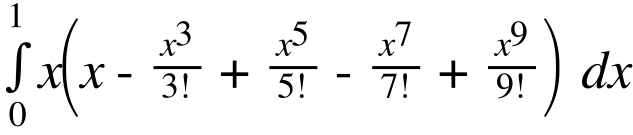
=
= .301168
Using a five-term expansion..
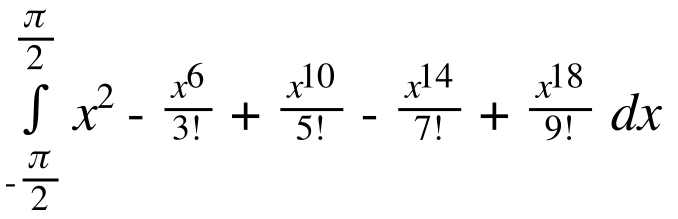


 `= 1.656
Using a five-term expansion..
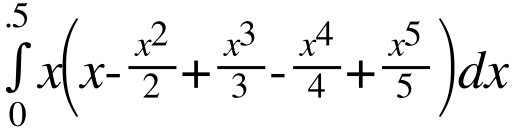
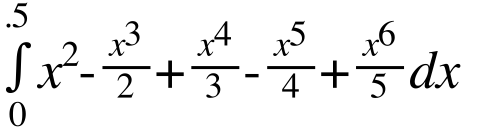

=
= .0355
Using a five-term expansion..
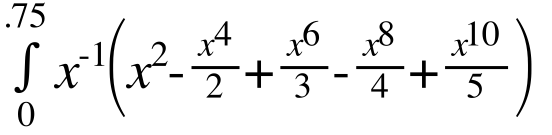
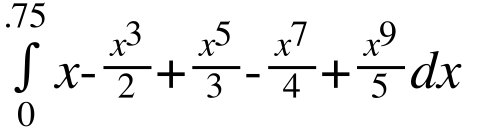
= 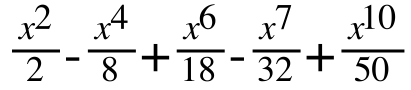

= 
= .2496
Glossary and deeper reading · 1 refreshers
These editorial refreshers supplement the reading. Definitions and examples are added guidance; original source wording and recorded answers remain in their original context.
-
Taylor series
A Taylor series is the infinite power series built from a function’s derivatives at a chosen center. Its coefficients are the derivatives at the center divided by the corresponding factorials. For example, eˣ has Taylor series 1+x+x²/2!+x³/3!+⋯ centered at 0. A Taylor series represents the function only where convergence and the vanishing remainder justify that equality.