Root Test
Beyond this AP Calculus course
This original textbook reading covers part of the AP topic. Follow the AP course outline for complete topic instruction and practice.
Section 2
- Convergent Example
- Divergent Example
- Inconclusive Example
- Proof (source link unavailable)
Section 2
Root Test
The root test is one of the later tests that you would try for convergence, if the integral or ratio test cannot be done for the series. The root test works best whenever a series’ terms have powers of n.
Root Test
For the given series  , let L be defined as

- If L<1, then the series absolutely converges.
- If L>1, then the series diverges.
- If L=1, the test is inconclusive. The series may diverge, conditionally converge, or absolutely converge.
Important Fact

 =1
Example 4.2.1
Determine convergence using the root test method.

Plug the series formula into the root test formula. Going through the steps...
=
=
=
= <1
As the limit value is less than one, the series passes the root test and converges,
Graph 4.2.1
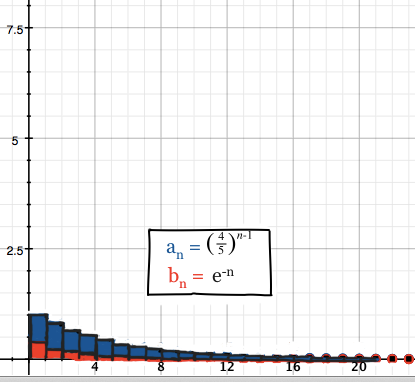
Area representation of the series. The area of the bars are the sequence terms.
Read all original image captions
Image 1
Area representation of the series. The area of the bars are the sequence terms.
Image 2
Graph of the partial sums. Notice how the example series, in red, is less than the blue, convergent, geometric series.
Example 4.2.2
Determine convergence using the root test method.

Plug the series formula into the root test formula. Going through the steps...
=
=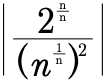
=
= >1
As the limit value is greater than 1, the series fails the root test and diverges.
Graph 4.2.2
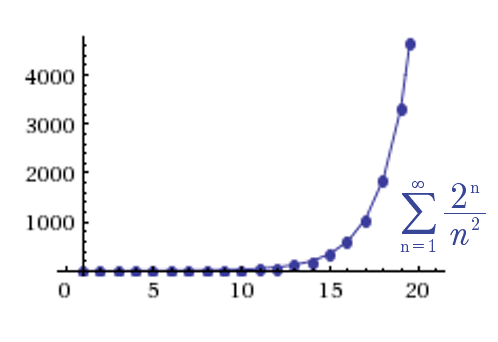
Read all original figure notes
Converges or
Diverges?
Since the sequence of partial sums is increasing without bound, the series diverges.
Determine convergence using the root test method.

Plug the series formula into the root test formula. Going through the steps...
=
=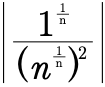
= 
Root Test Proof
The proof of the root test utilizes properties of the comparison test and geometric series.
- Proof of Convergence when L<1
For the series 
If  , and L<1, let there be a
value r, such that L<r<1.
Under these conditions, it can be said that
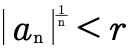
whenever n is greater than a certain integer N, or
whenever n≥N.
Through algebraic manipulation, the above inequality
becomes
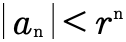
Since r<1, the geometric series

is convergent.
Therefore, through the comparison test, the series
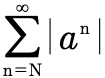
converges also.
Because the previous summation is convergent, this means that the series
absolutely converges.
Review 1.2
Question 1 of 7 · 0 correct
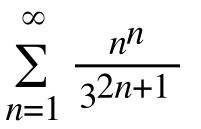
According to the root test, the series...
Glossary and deeper reading · 6 refreshers
These editorial refreshers supplement the reading. Definitions and examples are added guidance; original source wording and recorded answers remain in their original context.
-
Convergence of a series
A series converges when the sequence of its partial sums approaches a finite limit. It diverges when there is no such finite limit. For example, 1/2+1/4+1/8+⋯ converges to 1, while the harmonic series diverges. Convergence of the individual terms to 0 is necessary but does not by itself establish convergence of their sum.
-
Ratio test
The ratio test examines the limiting absolute ratio of consecutive series terms. A limit below 1 gives absolute convergence, and a limit above 1 or infinite gives divergence. For example, terms 1/n! give ratio 1/(n+1), whose limit is 0, so the series converges absolutely. A limit equal to 1 is inconclusive.
-
Geometric series
A geometric series adds terms that have a fixed common ratio. With first term a and ratio r, it converges to a/(1−r) when |r|<1. For example, 1+1/2+1/4+⋯ sums to 2. For a nonzero first term and |r|≥1, the infinite series diverges.
-
Common ratio
A common ratio is the fixed multiplier between consecutive terms of a geometric sequence or series. When the earlier term is nonzero, it equals the next term divided by that term. For example, 2,6,18,54 has common ratio 3. For a nonzero geometric series, its magnitude must be less than 1 for the series to converge.
-
Infinite series
An infinite series is the sum of the terms of an infinite sequence, defined through its partial sums. The series converges when those partial sums approach a finite value. For example, 1/2+1/4+1/8+⋯ converges to 1. Terms approaching 0 are necessary for convergence, but that condition alone is insufficient.
-
Absolute convergence
A series converges absolutely when the series of its absolute term values converges. Absolute convergence also guarantees convergence of the original signed series. For example, an alternating series with magnitudes 1/n² converges absolutely. An absolutely convergent series retains its sum under any rearrangement of its terms.