Parametric Equations
This original textbook reading covers part of the AP topic. Follow the AP course outline for complete topic instruction and practice.
Section Overview
- Parameters
- Direction
- Arc length
Section 4
Parametric equations are a very powerful tool in mathematics. Many equations in mathematics actually can’t be written in the form that you are probably familiar with but using parameters one can create all sorts of wonderful graphs.
In modeling physical behavior parameters are often used since they generalize into vectors very easily (if you are familiar with vectors you may notice their resemblance).
They can also be used to create visual art. As you will see parameters can take on very interesting shapes.
When first dealing with parametric equations it is important to understand what it means to be parametric. A parametric equation is nothing but a set of equations which describe a curve ( in other words a graph) based on only a single variable which in many cases is  . Take the following as a simple example, the very familiar line in the 2-d cartesian plane can be parametrized as follows.

It may seem a bit over the top to define a line in such a way but for much more complex equations or mathematical objects which are not functions it gives us a very easy and understandable representation of the curve.
The basic goal in parametrizing an equation is to get your values in the original equation, usually  and
 (sometimes
 too) to be functions of
 so that you may represent them as
 and
 . This allows you to represent the curve as above using
 .
Let’s use this process to parametrize a line as before.
Example 1.4.1
Parametrize a straight line in the 2-d cartesian plane which has a slope of 2 and an intercept of 9.
The first thing which needs to be done in this problem is to set t equal to something. Here we can just go ahead and set x equal to t.
Since 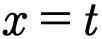 all we have to do is substitute. Therefore, substituting x for t we have
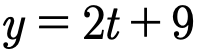
Now that we have  and
 in terms of t we can use the notation introduced a little earlier.

An important thing to realize about parametric equations is that they have direction or orientation. A parametrized circle for instance can open both clockwise and counterclockwise. In figuring this out you can think of the variable t as time and as time goes forward the dot which traces out the circle forming the curve moves in a certain way.
Example 1.4.2
Parametrize a straight line in the 2-d cartesian plane which has a slope of 2 and an intercept of 9.
Parametrizing a circle is a classic problem, it’s also pretty simple so long as you know a little trigonometry.
Remembering the definitions of the x and y components of the circle we have that
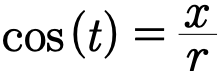
and
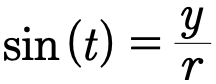
Solving for x and y in terms of t and plugging in y give us that
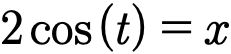
and
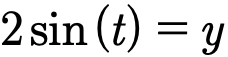
Which can then be put into our new notation.

To determine the direction which the circle one of the best method is just to use a few test points.
First let’s look at  when
 .
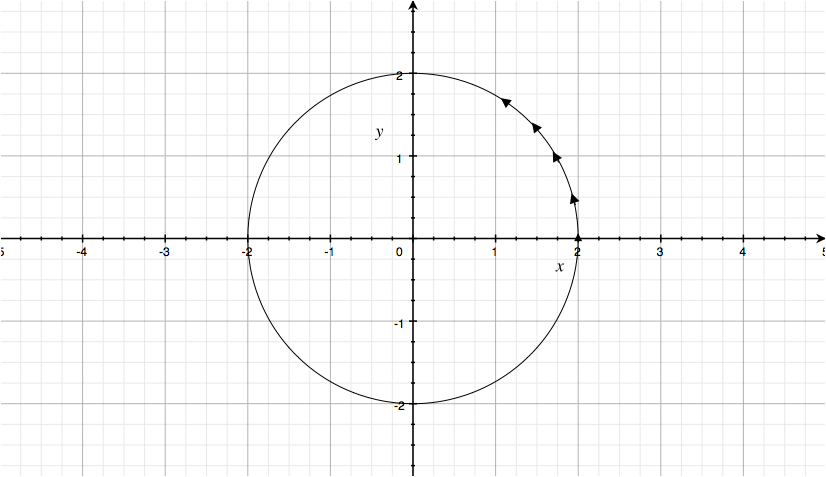
Supplemental Image for Example 1.4.2
Read all original figure notes
Parametrized circle at t = 0
When t = 0 the coordinates of the parametrized circle rest on the positive x-axis
Parametrized circle at t = 1
When t = 1 the coordinates move in the direction of the arrows which correspond to the circles orientation.
Since

and

we have that

Going through the same process with instead of using  we use
 we find that

If you were to plot these two points on a graph and drew a line from the first point to the second along a circle you would notice that the point was moving counterclockwise.
It is possible to construct a circle which moves in the opposite direction, just flip around sin and cos in the equation so that  reads
 and apply the same method that was applied in the example problem.
Using parametric equations it is possible to develop something know as arc length. Simply put arc length is the length of a curve, think of as similar to the arc of a circle (a piece of the circumference) and instead applied to the curves of any function.
The arc length formula comes in many flavors but it is most natural to look at it in terms of parametric equations.
If 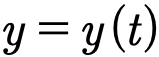 and
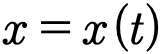 then the arc length of a parametric function
 is given by
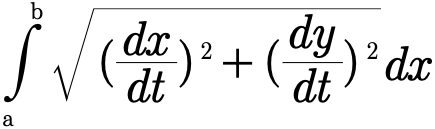
where 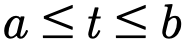 .
Example 1.4.3
FInd the arc length of the following parametric equation from 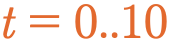
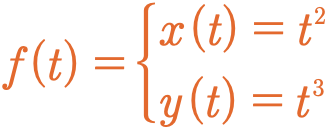
Using the arc length equation this problem is pretty simply. The first things we need to do is figure out what both 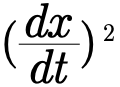 and
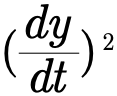 equal. Since
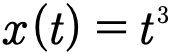
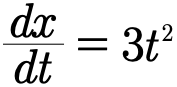
Squaring that gives us

Going through the same process for  .
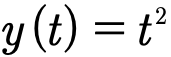
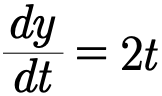
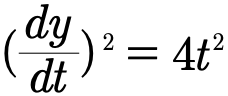
and finally
Pop Quiz 1.4.1 Parametric Equations
Question 1 of 5 · 0 correct
What type of curve does the following describe?

Plugging everything into the arc length equation gives
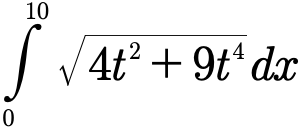
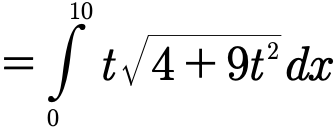
Which can be solved after some algebraic manipulation using substitution.

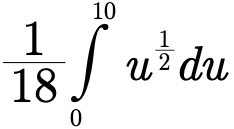
Letting 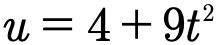 gives us the simplified integral
Which can be solved to give
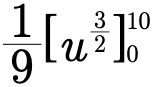
In order to use our end points we must substitute for  so that we get
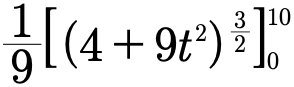
which can be solved to give us a final answer of

Glossary and deeper reading · 2 refreshers
These editorial refreshers supplement the reading. Definitions and examples are added guidance; original source wording and recorded answers remain in their original context.
-
Arc length
Arc length measures the distance along a curve over a specified parameter interval. For a smooth graph y=f(x), its length is the integral of √(1+[f′(x)]²) with respect to x. For example, the graph y=x from x=0 to x=1 has length √2. Parametric curves instead integrate the magnitude of their velocity, accounting for how the curve is traced.
-
Parametric equations
Parametric equations describe coordinates as functions of a shared parameter. For x=x(t) and y=y(t), the point (x(t),y(t)) traces a curve as t varies. For example, x=cos t and y=sin t trace the unit circle. The slope dy/dx equals y′(t)/x′(t) where x′(t)≠0, and the parameter also records orientation and repeated tracing.