The Harmonic Series
This original textbook reading covers part of the AP topic. Follow the AP course outline for complete topic instruction and practice.
- The Harmonic Series
- Proof of Divergence
- The Alternating Harmonic Series
Section 3
The Harmonic Series
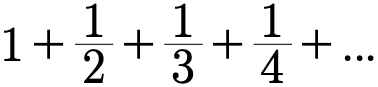
The above series is called the harmonic series. It it’s terms are called harmonic numbers and it follows a pattern defined by the sum
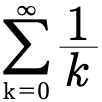
The thing to note about this series is that it has an interesting set of properties. In particular although the limit of the terms in the series approaches zero since
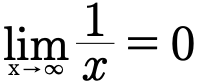
the nth partial sum of the series diverges as n approaches infinity.
Although the limit of the terms may be easily shown as above figuring out that this series is divergent is a little bit more tricky.
Although there are several ways to show that the harmonic series is divergent a straight forward way is to use the comparison test. That is we need to find a series which is divergent and whose partial sums are less than or equal to those of the harmonic series. If we find this series then because the harmonic series will always have a larger value it must also be divergent.
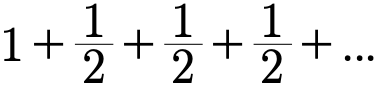
Let’s take a look at the following series
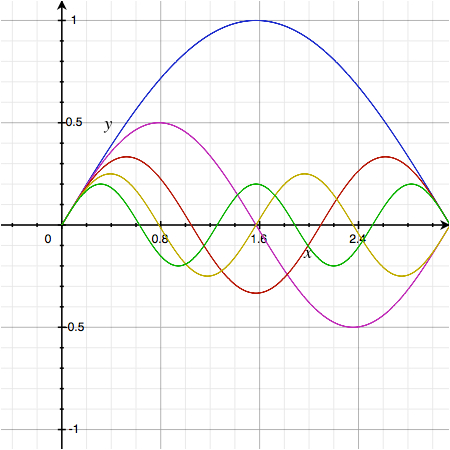
A Representation of the Harmonic Series
Read all original figure notes
What does each line represent?
Each line represents a different harmonic number. The number of humps each wave has determines the harmonic number of the line.
The Blue Line’s Harmonic Number
The blue line has a harmonic number of one. It represents the first term in the harmonic series.
The Green Line’s Harmonic Number.
The green line has a harmonic number of one-fifth because it has five humps.
It represents the fifth term in the harmonic series.
The first thing to note is that this series is divergent. If we continually add one-halves like we’re doing will never converge on a single value.
The second thing we need to do is figure out how this series is related to the harmonic series. Noticing that we can break up our series as follows

where each parenthesis marks a one-half split into multiple fractions we can then compare this series to the harmonic series.


If you look closely and compare every corresponding terms you will notice that the harmonic series terms are always going to be equal to or greater than the terms of the series we have created.
Since our original series is divergent and the harmonic series is larger than our series the harmonic series must also be divergent.
An interesting fact about harmonic series is through harmonic numbers they are related to harmonics in physics and music. The following image should give you an intuition of how they relate.
Alongside the harmonic series there is also the alternatingharmonic series. It is defined by the sum

and is named after the fact that the sign in the series alternates between positive and negative. Unlike the harmonic series which diverges the alternating harmonic series passes the alternating series test and converges as a result.
Since the series is convergent it has a value
Example 3.3.1
Determine if the following series is divergent or convergent.
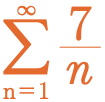
Knowing what we know about sums and harmonic series this problem should be straightforward. The first thing that we need to do is notice the fact that this sum is just a multiple of the harmonic series.
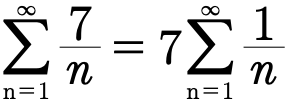
Since we know that the harmonic series is divergent and that multiplying a divergent series by a constant will not change the fact that it’s divergent we may conclude that the given series is divergent.
Example 3.3.2
Determine if the following series is divergent or convergent.
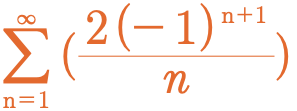
Like the previous example all we have to do here is use our knowledge of the harmonic and alternating harmonic series. Here we have again a constant multiple in a sum so we may rewrite the sum as follows.

Since the alternating harmonic series is convergent it has a defined value. Multiplying this value by another will then give us a new finite value so that the series defined in the problem is convergent.
Glossary and deeper reading · 7 refreshers
These editorial refreshers supplement the reading. Definitions and examples are added guidance; original source wording and recorded answers remain in their original context.
-
Harmonic series
The harmonic series is 1+1/2+1/3+1/4+⋯. It diverges even though its individual terms approach 0. For example, grouping terms from 1/2 through 1/3+1/4 and then 1/5+⋯+1/8 shows repeatedly added blocks of at least 1/2. It is a standard comparison that separates a necessary term condition from actual convergence.
-
Infinite series
An infinite series is the sum of the terms of an infinite sequence, defined through its partial sums. The series converges when those partial sums approach a finite value. For example, 1/2+1/4+1/8+⋯ converges to 1. Terms approaching 0 are necessary for convergence, but that condition alone is insufficient.
-
Limit
A limit describes the value approached by outputs as inputs approach a specified target or grow without bound. For an input approaching a finite target, its value at that exact input does not determine the limit. For example, (x²−1)/(x−1) approaches 2 as x approaches 1 even though the original expression is undefined at 1. A finite two-sided limit requires the left and right approaches to agree.
-
Partial sum
A partial sum adds the first finitely many terms of a series. The nth partial sum is Sₙ=a₁+a₂+⋯+aₙ when indexing begins at 1. For example, the first three terms of 1/2+1/4+1/8+⋯ give partial sum 7/8. Convergence of a series concerns the limit of these sums, not just the limit of the individual terms.
-
Convergence of a series
A series converges when the sequence of its partial sums approaches a finite limit. It diverges when there is no such finite limit. For example, 1/2+1/4+1/8+⋯ converges to 1, while the harmonic series diverges. Convergence of the individual terms to 0 is necessary but does not by itself establish convergence of their sum.
-
Comparison tests
Comparison tests determine convergence by relating nonnegative terms to a known benchmark series. Direct comparison uses a correctly directed inequality, while limit comparison uses a positive finite limit of the term ratio. For example, 0≤1/(n²+1)≤1/n² shows convergence because the upper p-series converges. Being smaller than a divergent series or larger than a convergent one does not settle convergence.
-
Alternating series test
The alternating series test applies to alternating terms whose positive magnitudes eventually decrease to 0. Those two conditions together ensure the partial sums approach a finite limit. For example, 1−1/2+1/3−1/4+⋯ converges because 1/n decreases to 0. If one condition fails, this test cannot by itself determine the result.