Implicit Differentiation
This original textbook reading covers part of the AP topic. Follow the AP course outline for complete topic instruction and practice.
Section Overview
Section 1
To begin this chapter we will be discussing implicit differentiation as a means of opening up a discussion on differential equations. To discuss implicit differentiation we will need to recall the chain rule and make clear what is meant by an implicit function.
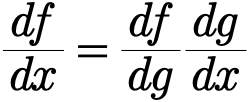
The chain rule is defined as follows:
For some functional composition f[g(x)]
An implicit function is some function which does not explicitly define one variable in terms of only the other. A simple example of this would be:
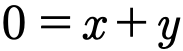
Here y is not explicitly defined in terms of only x. Although we could define the above example as an explicit function it is sometimes extremely difficult to do so. Instead of dealing with that difficulty we choose to circumvent it.
When using the derivative circumventing the problem is pretty easy. All that’s necessary is to apply the chain rule. This process of applying the chain rule to implicit functions is what we call implicit differentiation.
The process is fairly straightforward. Take for example the implicit function mentioned earlier
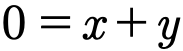
If we take the derivative of it with respect to x we get
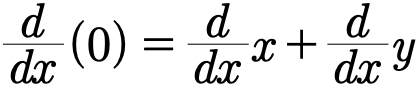
Differentiating zero and x with respect to x is straightforward but differentiating y with respect to x is not as clear. We can fix this though. We know y can be defined as some function of x and if we’d like we can even say that there is some function f which takes y as it’s input. Doing this allows us to create a composition of functions and once we have this we can apply the chain rule to the problem to solve for the derivative y in this problem.
Putting in our new notation and doing the easy derivatives we have that
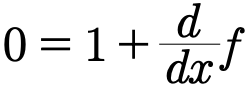
Using the chain rule on f(y) we get that
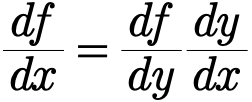
Substituting this into our implicit function we have that
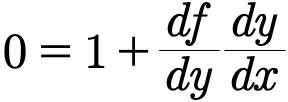
Looking at the derivatives in this equation one you may notice is the very familiar derivative of y with respect to x which we were originally solving for. The other though is f with respect to y and because we have defined f in terms of y it’s a derivative we can do, it’s just basic calculus.
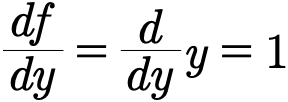
Making a final substitution we have that
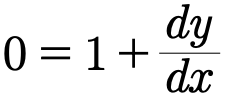
Which can easily be transformed into the explicit version
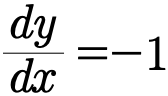
Example 8.1.1
Implicitly differentiate the following function with respect to x.
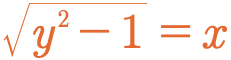
To begin this problem let’s go ahead and take the derivative then make any obvious simplifications.
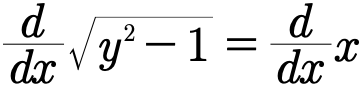
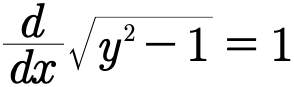
The next thing we then need to do is crack the square root and do do this we will just refer to the rules of calculus as we know them. All we have to do is apply the chain rule but since here we are also deriving implicitly we will have to derive the chain rule twice. If we let
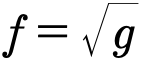
and
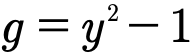
Then the chain rule takes the form
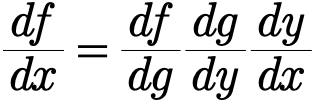
Using the powers of calculus we can now conjure an answer!

and
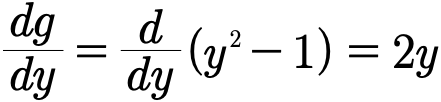
Plugging this all in gives that
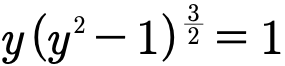
Example 8.1.2
Implicitly differentiate the following function.
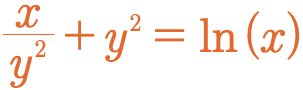
Like the previous problem we will begin by going ahead and applying the differentiation operator then doing the easy simplifications.
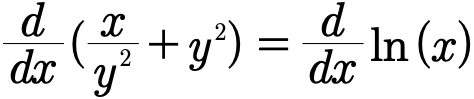
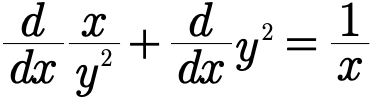
On the leftmost term we actually have a product so that the product rule applies and we get that
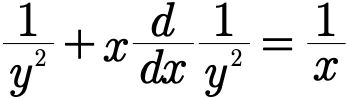
At this point we just need to do what we have been. To get rid of the final derivative we need to use the chain rule. If we go ahead and let
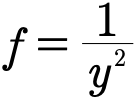
Then using the chain rule we have that

Interactive 1.1 Example Problem 8.1.3
Read all original figure notes
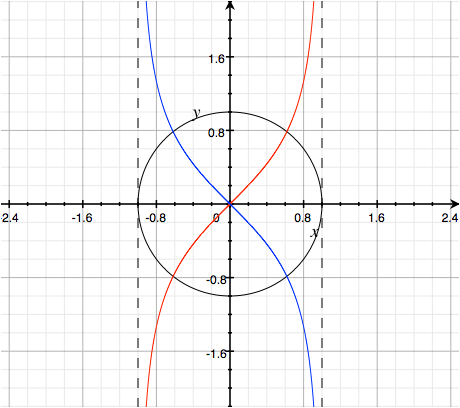
The Blue Line
The blue line represents the slope of the circles upper half. As it approaches +c the slope approaches negativity infinity as expected.
Near +c or -c
When x is near c the derivative approaches positive or negative infinity.
The Red Line
The Blue line represents the slope of the circles lower half. As the x value approaches +c the slope goes up as expected.
Which when substituted back into our equation gives us
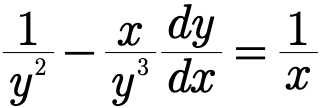
All the rules which involves the derivatives of functions still hold. This means that the product rule, quotient rule, sum rule, etc. all hold when doing implicit differentiation.
Example 8.1.3
Solve for the slope of a circle with radius c in terms of x.
Although this problem is solvable without using any special techniques using implicit differentiation makes the problem trivial. Recall the equation of a circle with radius c.
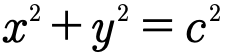
If we implicitly derive this equation we get that
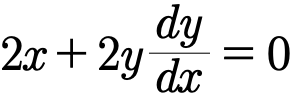
Which can readily be rearranged to give us
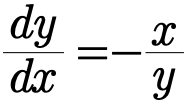
Although we now have the slope we are not quite done, we need to get rid of that pesky y. Luckily we already have a relation which relates y and x, the circle equation.
Solving it for x then gives us.
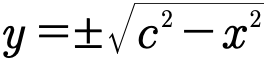
Plugging this in we then have that
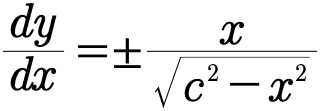
The slope of the circle at every point x.
Glossary and deeper reading · 6 refreshers
These editorial refreshers supplement the reading. Definitions and examples are added guidance; original source wording and recorded answers remain in their original context.
-
Implicit differentiation
Implicit differentiation finds a derivative from an equation relating variables without first solving explicitly for one variable. When y depends on x, differentiating a term containing y requires the chain rule and a factor of dy/dx. For example, x²+y²=1 gives 2x+2y(dy/dx)=0. Solving that relation for dy/dx gives −x/y only where y≠0 and the relation supports the local function being considered.
-
Differential equation
A differential equation relates an unknown function to one or more of its derivatives. A solution is a function that makes the equation true throughout an appropriate interval. For example, y′=2x has solutions y=x²+C. An initial condition can select a particular member of a family of solutions.
-
Chain rule
The chain rule differentiates a composition by multiplying the outer derivative at the inner output by the inner derivative. For differentiable functions, (f(g(x)))′=f′(g(x))g′(x). For example, the derivative of sin(x²) is cos(x²)·2x. Nested compositions require a factor for each successive layer.
-
Derivative
A derivative gives the instantaneous rate of change of a function with respect to its input. At a point, it is the finite limit of the difference quotient when that limit exists. For example, the derivative of x² is 2x, so the tangent slope at x=3 is 6. A derivative function collects those rates across the inputs where the function is differentiable.
-
Function
A mathematical function assigns exactly one output to each input in its domain. Inputs can share an output, but one input cannot have two different outputs. For example, f(x)=x² assigns the output 9 to both 3 and −3. Function notation names the rule and its input; f(3) means the output when the input is 3.
-
Composite function
A composite function applies one function to the output of another. In f(g(x)), evaluate g first and then use its output as the input to f. For example, if f(u)=u² and g(x)=x+1, then f(g(x))=(x+1)². The composition is defined only where the inner output lies in the outer function’s domain.