Geometric Series
This original textbook reading covers part of the AP topic. Follow the AP course outline for complete topic instruction and practice.
Section Overview
- Definition of a Geometric Series
- Value of a Geometric Series to the nth term
- Convergence and Divergence
Section 1
Geometric Series

The above expression is what is known as a geometric series. What makes it geometric is the fact that every successive term shares a common ratio  . If you take the time to look at the above and divide every term by the term before it you will notice that in this case the ratio is
 .
Example 3.1.1
Determine whether the given series are geometric.
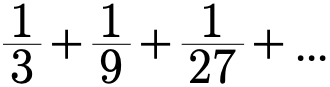
Using the definition given above all we have to do is determine whether there is a single ratio between successive terms.
Starting with the first two terms  and
 we divide
 by
 .
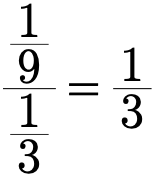
Moving on we will take the next two successive terms  and
 and repeat the same operation.
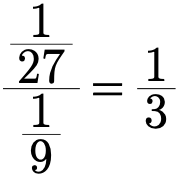
Since both ratios are the same value,  , we may conclude that the given series is geometric.
Here is another series to check:

To check it we will go through the same process.
Starting with the first two we get that
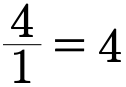
Using the next two terms we find that
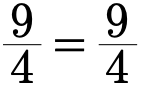
Since the two ratios are not the same the series is not geometric.
In the above example only the first three terms were used to check to see if the series was geometric. It is not necessary to use only the first three terms, any pair of successive terms can be used to determine if the series is geometric.
The next thing to look at is the symbolic representation of a geometric series. It is the sum as follows.
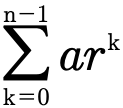
This sum gives you the first  terms of a geometric series with ratio
 and first term
 .
Expanded the sum looks like this:

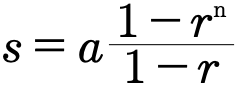
Using this representation of a geometric series it is possible to find an expression which gives you the value of the sum to  terms.
In the first part of this sum we say that  is equal to the expanded series.

Multiplying everything by  gives us:

We can now subtract  by
 which cancels out all the middle terms.

Now we manipulate the equation algebraically to isolate  .

Example 3.1.2
Calculate the sum of the first  terms of the geometric series
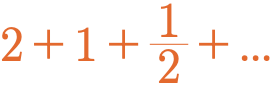
To begin a problem like this we must first determine what our  and our
 are.
The first term, in this case a  , will always be our
 .
To determine what our  is all we have to do is determine the ratio between any two successive terms is. Since we already know the first few terms we will just choose
 and
 . Dividing
 by
 then gives us that
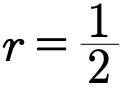
Now that we have both  and
 we can use the equation that we just derived for the first n terms.
Plugging everything in and doing the algebra then gives
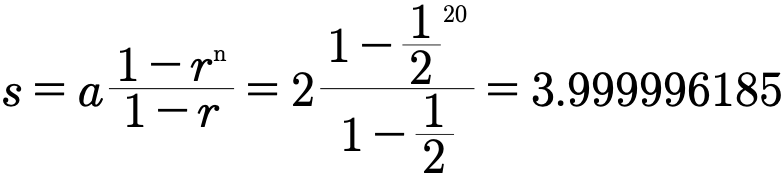
Like any other series it is possible to determine whether a geometric series converges our diverges. In the case of the geometric series depending on the value of  both situations can occur.
In the case that 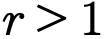 a geometric series is divergent.
In the case that 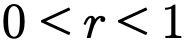 a geometric series is convergent.
To prove the two above statements all that’s necessary is to pass the symbolic representation of the geometric series given earlier through the appropriate convergence test.
If a geometric series is convergent it is possible to determine the value of the series by taking the limit of
as  approaches infinity.
Example 3.1.3
Determine whether the following series are convergent or divergent and calculate the value of the series if possible.
Let’s first start with the series
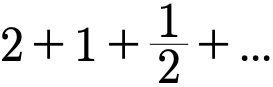
From the Example 3.1.2 we know the values of  and
 so can immediately begin checking for convergence.
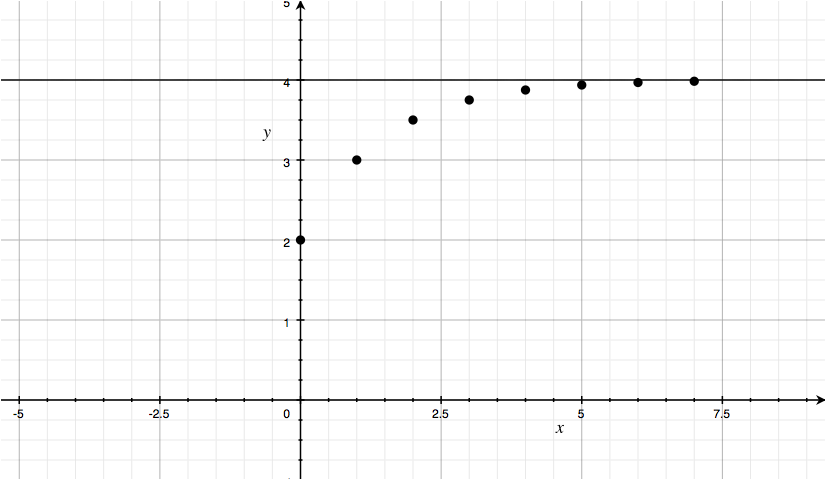
Supplemental Image for Example 3.1.2 and 3.1.3
Read all original figure notes
Successive Terms
Because successive terms in the series become have as large as the terms before as you approach a large number of terms the amount added to the total sum becomes extremely small quickly.
The Sum at Infinity
As the number of terms in the series defined in example 3.1.3 approaches infinity it approaches this line at y=4.
Our Starting Value
The value we start at with in a geometric sum is a. In the series defined in example 3.1.3 this value is 2.
As a reminder
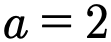
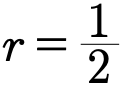
Since  the series is convergent and we can find the value of the series as our number of terms approaches infinity. All we have to do is use the formula derived earlier and take its limit. This gives us
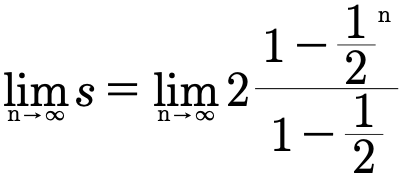
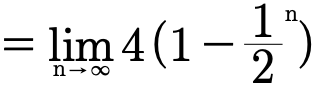

The next series we will look at is
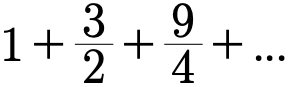
The first thing we need to do is determine the value of  . To do that all we need to do is divide the second term by the first.
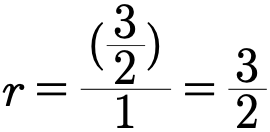
Since 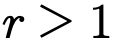 the series is divergent and as a result we are unable to figure out the series value for an infinite amount of terms.
Pop Quiz 1.1.1 Geometric Series
Question 1 of 5 · 0 correct
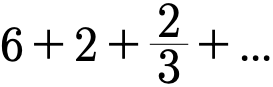
Determine if the following series is geometric. If the series is geometric determine it’s r and a.
Glossary and deeper reading · 2 refreshers
These editorial refreshers supplement the reading. Definitions and examples are added guidance; original source wording and recorded answers remain in their original context.
-
Geometric series
A geometric series adds terms that have a fixed common ratio. With first term a and ratio r, it converges to a/(1−r) when |r|<1. For example, 1+1/2+1/4+⋯ sums to 2. For a nonzero first term and |r|≥1, the infinite series diverges.
-
Common ratio
A common ratio is the fixed multiplier between consecutive terms of a geometric sequence or series. When the earlier term is nonzero, it equals the next term divided by that term. For example, 2,6,18,54 has common ratio 3. For a nonzero geometric series, its magnitude must be less than 1 for the series to converge.