Ratio Test
This original textbook reading covers part of the AP topic. Follow the AP course outline for complete topic instruction and practice.
Section 1
The ratio test is one of the easier tests to apply when trying to determine convergence. It is best to use whenever the series formula has factorials or powers of n.
The ratio test for convergence works in relation to how a geometric series converges when the common ratio is less than one, or r<1. The proof of the ratio test can be seen at the end of this section.
Ratio Test
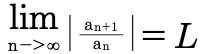
For the given series  , let L be defined as
- If L<1, then the series absolutely converges proof
- If L>1, then the series diverges proof
- If L=1, then the result is inconclusive. The series may diverge, conditionally converge, or absolutely converge.
Graph 4.1.1
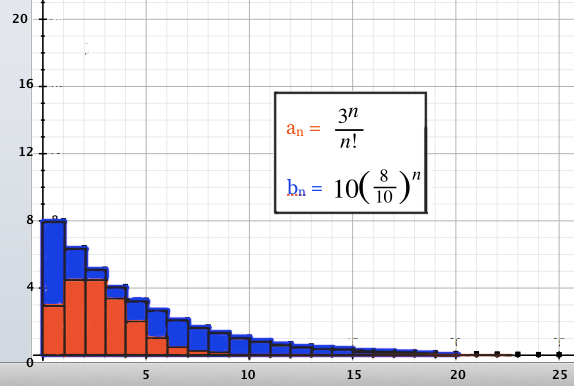
The sequence terms of the example series are in orange, and a geometric sequence is given in blue. The area of the bars of each sequence represent the series. As you can see, the values of the example series’ terms are less than those of the geometric series. Since the geometric series is convergent and is approximately equal to 40, the example series must have a value less than 40 and is therefore convergent.
Read all original image captions
Image 1
The sequence terms of the example series are in orange, and a geometric sequence is given in blue. The area of the bars of each sequence represent the series. As you can see, the values of the example series’ terms are less than those of the geometric series. Since the geometric series is convergent and is approximately equal to 40, the example series must have a value less than 40 and is therefore convergent.
Image 2
A further look at the two sequences as n approaches 100. Notice that the terms start to converge to zero.
Image 3
Graph of the partial sums of the example series. Notice how the sum converges to just over 19.
Use the Ratio test to determine the convergence of the following infinite series.

Plug the series formula into the ratio test formula. Going through the steps...
L =
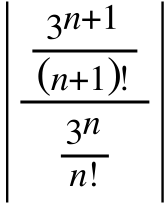
L =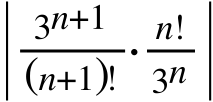
L =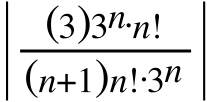
L =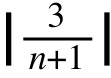
L = < 1
Since the limit is less than 1, the series absolutely converges.
Graph 4.1.2
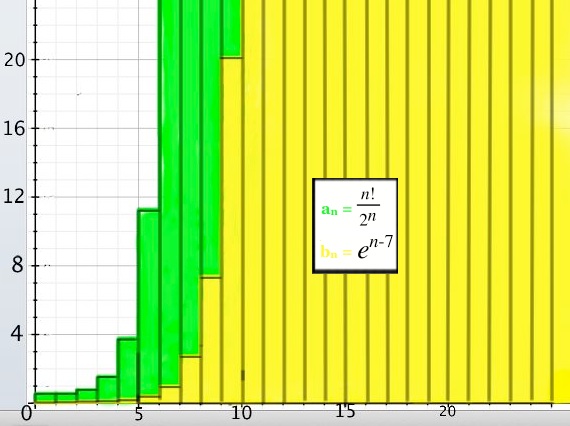
The sequence terms of the example are in green and another sequence is given in yellow. The area of the bars represent each series. The series in yellow diverges. Since the example series is greater than the one in yellow, the example series diverges also. Also, notice how the terms for both series increase and do not converge to 0, so they must diverge according to the Test for Divergence.
Read all original image captions
Image 1
The sequence terms of the example are in green and another sequence is given in yellow. The area of the bars represent each series. The series in yellow diverges. Since the example series is greater than the one in yellow, the example series diverges also. Also, notice how the terms for both series increase and do not converge to 0, so they must diverge according to the Test for Divergence.
Image 2
Graph of the partial sums. Notice how the sums are continuously increasing.
Use the Ratio test to determine the convergence of the following infinite series.

Plug the series formula into the ratio test formula. Going through the steps...
L =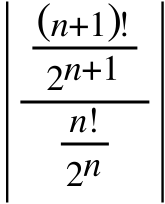
L =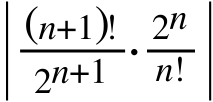
L =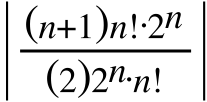
L =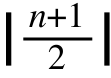
L = > 1
Since the limit is greater than 1, the series diverges.
Graph 4.1.3
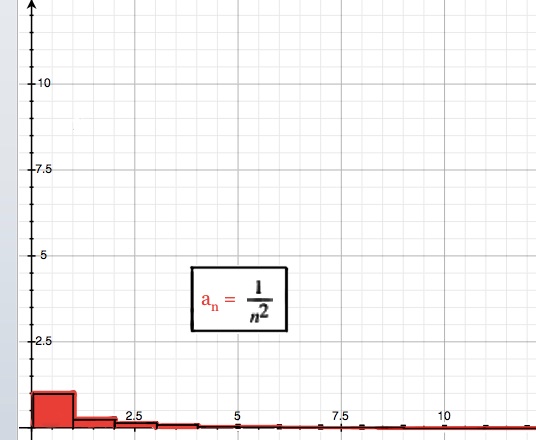
The example series’ terms in red. Notice how ‘flat’ the end terms are; the little change in value between terms is why the ratio of the next term to the previous one goes to one.
Read all original image captions
Image 1
The example series’ terms in red. Notice how ‘flat’ the end terms are; the little change in value between terms is why the ratio of the next term to the previous one goes to one.
Image 2
Graph of the partial sums of the example series.
Use the Ratio test to determine the convergence of the following infinite series.
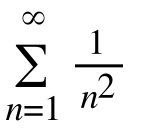
Plug the series formula into the ratio test formula. Going through the steps...
L =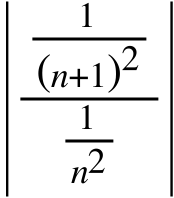
L =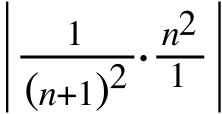
L =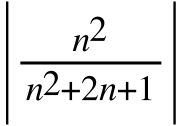
L = 1
Since L=1, the test is inconclusive, and another test must be used to determine the convergence of the series.
This example, however, is a p-series problem where p>1, so the series converges.
RATIO TEST PROOF
The ratio test ‘works’ by incorporating properties of the Comparison Test, Divergence Test, and Geometric Series.
Proof of convergence for L<1.
For the series 
If , and L<1, let there be a value r, such
that L<r<1.
Under these conditions, it can be said that
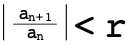
whenever n is greater than a certain integer N, or
whenever n≥N.
Rearranging the previous inequality, we can get
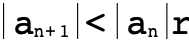
and since we are concerned with integers n≥N, we can
see the values of the series terms for the next consecutive
terms after N to be
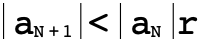


where the general form is
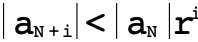 , whenever i≥1.
Since r<1, the geometric series
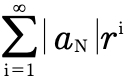
converges.
Through the comparison test, the series
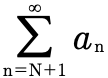
converges also.
Since 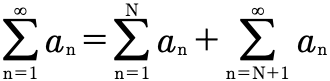
and both of the last two summations are convergent,
the original series
converges.
Review 1.1
Question 1 of 5 · 0 correct
- Proof of Divergence for L>1
For the series 
If , and L>1, this means that
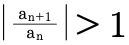
whenever n is greater than a certain integer N, or whenever n≥N.
Rearranging the previous inequality,
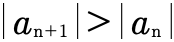
Since the absolute value of the next term is greater than the previous term, it can be seen that
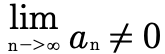
Therefore, through the divergence test, the series diverges.
Glossary and deeper reading · 6 refreshers
These editorial refreshers supplement the reading. Definitions and examples are added guidance; original source wording and recorded answers remain in their original context.
-
Ratio test
The ratio test examines the limiting absolute ratio of consecutive series terms. A limit below 1 gives absolute convergence, and a limit above 1 or infinite gives divergence. For example, terms 1/n! give ratio 1/(n+1), whose limit is 0, so the series converges absolutely. A limit equal to 1 is inconclusive.
-
Convergence of a series
A series converges when the sequence of its partial sums approaches a finite limit. It diverges when there is no such finite limit. For example, 1/2+1/4+1/8+⋯ converges to 1, while the harmonic series diverges. Convergence of the individual terms to 0 is necessary but does not by itself establish convergence of their sum.
-
Infinite series
An infinite series is the sum of the terms of an infinite sequence, defined through its partial sums. The series converges when those partial sums approach a finite value. For example, 1/2+1/4+1/8+⋯ converges to 1. Terms approaching 0 are necessary for convergence, but that condition alone is insufficient.
-
Geometric series
A geometric series adds terms that have a fixed common ratio. With first term a and ratio r, it converges to a/(1−r) when |r|<1. For example, 1+1/2+1/4+⋯ sums to 2. For a nonzero first term and |r|≥1, the infinite series diverges.
-
Common ratio
A common ratio is the fixed multiplier between consecutive terms of a geometric sequence or series. When the earlier term is nonzero, it equals the next term divided by that term. For example, 2,6,18,54 has common ratio 3. For a nonzero geometric series, its magnitude must be less than 1 for the series to converge.
-
Absolute convergence
A series converges absolutely when the series of its absolute term values converges. Absolute convergence also guarantees convergence of the original signed series. For example, an alternating series with magnitudes 1/n² converges absolutely. An absolutely convergent series retains its sum under any rearrangement of its terms.