Trigonometric Substitution
Beyond this AP Calculus course
This original textbook reading covers part of the AP topic. Follow the AP course outline for complete topic instruction and practice.
Section Overview
- Trigonometric Identities
- Trigonometric Functions
- Rules for Trigonometric Substitution
Section 1
Trigonometric Substitution
This section will be a quick review of trigonometric substitution including some review of some important trigonometric identities. If you feel comfortable with this material you may wish to skip into the next section.
When dealing with trigonometric substitution the first thing that we need to remember is our trigonometric identities. Without them we would be dead in the water.
The most important is without the doubt the pythagorean identity. It is defined as

which can made into

and

by dividing everything by cosine squared or sine squared respectively.
The definitions of the trigonometric functions and their inverses are also very important.
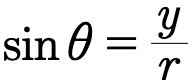 ,
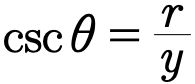
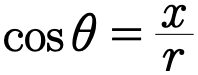 ,
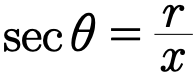
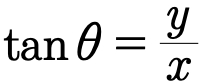 ,
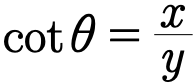
As a quick refresher I will also go over the different trigonometric substitution cases and what to substitute into each.
When you are given something with the form
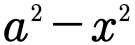
you will want to make the substitution
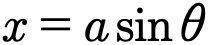
When you are given something with the form
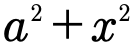
you will want to make the substitution
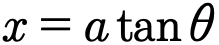
Finally, when you are given something with the form
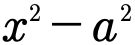
you will want to make the substitution
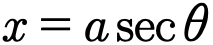
Example 1.1.1
Integrate the following
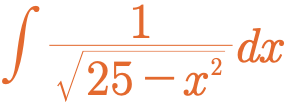
The first step in solving integrals is always to see what type of integral you’re looking at. In this case since we have something with the form 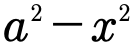 we know we can use trigonometric substitution to solve the integral.
The next thing we need to do is start applying our method. The form we have means we have to substitute 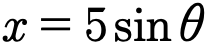 .
Since we’re substituting we must change our variable of integration.
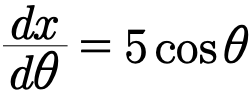

Making the appropriate substitutions into our integral gives us something a little more workable.
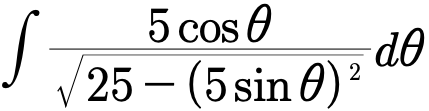
Making some algebraic manipulations gives us
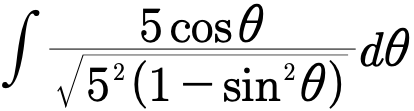
which then allows us to use our trigonometric identities to simplify the integral

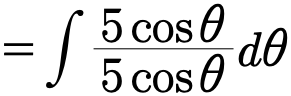
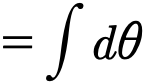
Solving this integral gives you 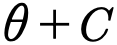 . A little bit more must be done though, since our original integral was given to us with
 as our variable we should change it back.
Since all we have to do is solve for  we can just use
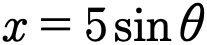 .
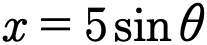
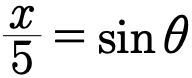
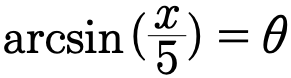
Finally substituting for  gives us our answer.
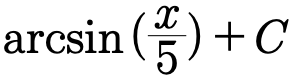
Example 1.1.2
Integrate the following
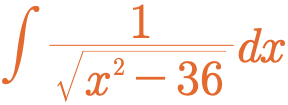
Like in the previous problem we will first want to notice what form it is in. Looking at the square root in the denominator we notice that we have something in the form 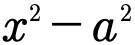 which means we must use the substitution
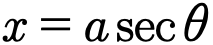 .
Making the substitution we of course need to make a variable change. Since
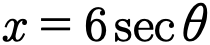
taking the derivative of the above function respect to theta then gives
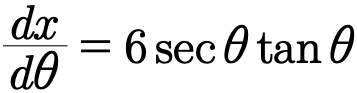
so

making the appropriate substitutions in the original integral then gives
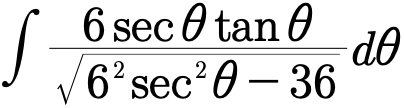
which can be simplified through a few algebraic manipulations and trigonometric substitution.
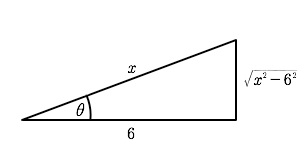
Looking at 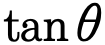 you can see that we don’t have a direct route. Remembering that all trigonometric functions are relatable through a right triangle though we can easily find a solution to the problem. We first have to construct a triangle based on the fact that
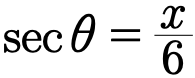 . Please take a look at the interactive image for this chapter.
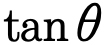
Since 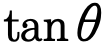 is defined as the opposite over adjacent legs of a right triangle we have that
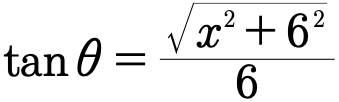
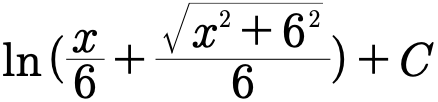
Substituting for both  and
 gives us our final answer.
Triangle used in Example 1.1.2
Read all original figure notes
Pythagorean Theorem
Since we have both a leg and the hypotenuse of the triangle we can solve for the missing side using the pythagorean theorem
Setting up the Triangle
When setting up a triangle like this you may set the angle to wherever you would like so long as you correctly label everything else
Glossary and deeper reading · 2 refreshers
These editorial refreshers supplement the reading. Definitions and examples are added guidance; original source wording and recorded answers remain in their original context.
-
Trigonometric identity
A trigonometric identity is an equality that holds for every input where both sides are defined. Identities let you rewrite expressions without changing their values on that shared domain. For example, sin²θ+cos²θ=1 follows from the unit circle. Any division used while rewriting an identity can introduce domain restrictions.
-
Function
A mathematical function assigns exactly one output to each input in its domain. Inputs can share an output, but one input cannot have two different outputs. For example, f(x)=x² assigns the output 9 to both 3 and −3. Function notation names the rule and its input; f(3) means the output when the input is 3.