Alternating Series and the Alternating Series Test
This original textbook reading covers part of the AP topic. Follow the AP course outline for complete topic instruction and practice.
Section Overview
Section 1
An alternating series is something you have already seen in this book but it is not something that has been defined clearly. The example illustrated before this chapter was that of the alternating harmonic series and was called alternating because the sign in the series would alternate between positive and negative.
All alternating follow a similar sign pattern to that of the alternating harmonic series, it’s what makes them alternating. The more rigorous way of saying it is as follows:
A series may be called an alternating series if it can be defined by the following sums
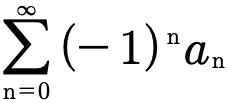
and
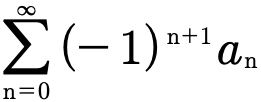
so long as 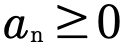 or
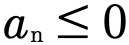 for all
 .
Although only two separate series are explicitly defined here many series reduce to the above when you do a small amount of algebra on it’s exponents. As an example
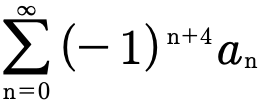
reduces to
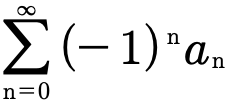
because

by using exponent rules.
The small stipulation at the end of the definition is also important to understand. If  isn’t made of a single sign even though your sign may alternate it may not necessarily alternate in a predictable way causing the series to no longer be alternating.
Example 5.1.1
Express the sum
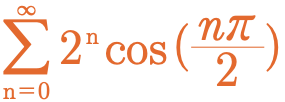
as a sum in the form
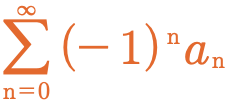
In a problem like this the first thing you’ll always want to do is write out a few terms of the original series. Doing this gives us a starting place to look for patterns.
Since we’re looking at a trigonometric function the first four terms should be perfect since after the first four terms a pattern will probably repeat itself.


Looking closely at the series we notice that every other term is zero, only even powers of two are kept, and every other non-zero term is going to alternate sign because of the cosines cyclical nature. We can now then rewrite our series a little more clearly.

This of course is nothing but powers of four with an alternating sign! We can therefore rewrite the series as a sum in the required form.
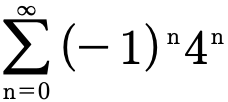
For alternating series a special test named the alternating series test can be used to determine if an alternating series converges.
This test relies on two things to be true about the series. Both
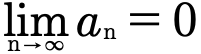
and for the sequence formed by  after some point successive terms must decrease.
If the series passes the two test and is alternating then the series will converge.
An important thing to note is that even though a series may fail the alternating series test it may still diverge.
Example 5.1.2
Determine whether the series defined by the following sum converges.
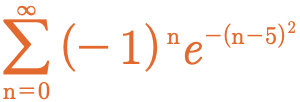
Since we have an alternating series we can use the alternating series test to determine whether this series will converge. This means that we must first determine whether
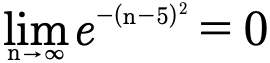
This is easily confirmed.

The next thing we must do is determine if after some point the sequence formed by

decreases.
To do this all we have to do is set up a little inequality using successive terms.
For our second condition to be met

Now all we have to do is confirm that we can find some value of n for which this works by doing a little bit of algebra.



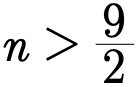
Once n is greater than 4.5 we’re assured that the sequence will decrease.
Since all conditions were met we can conclude that the given alternating series will converge.
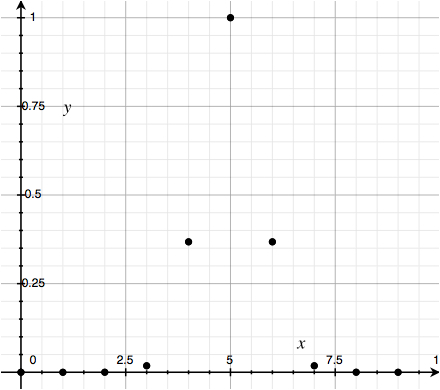
Supplementary Graph for Example 5.1.2
Read all original figure notes
Sequence Plot
This is a plot of the sequence looked at in Example 5.1.2
After n=5
After n=5 the terms in the sequence steadily decrease. The inequality determined in Example 5.1.2 says this occurs after 4.5 but since our sequence only uses the natural numbers this behavior actually starts when n=5.
Glossary and deeper reading · 4 refreshers
These editorial refreshers supplement the reading. Definitions and examples are added guidance; original source wording and recorded answers remain in their original context.
-
Alternating series
An alternating series has successive terms that switch between positive and negative signs. The alternating series test establishes convergence when the term magnitudes eventually decrease and approach 0. For example, 1−1/2+1/3−1/4+⋯ satisfies those conditions. Alternating signs alone do not guarantee convergence.
-
Alternating series test
The alternating series test applies to alternating terms whose positive magnitudes eventually decrease to 0. Those two conditions together ensure the partial sums approach a finite limit. For example, 1−1/2+1/3−1/4+⋯ converges because 1/n decreases to 0. If one condition fails, this test cannot by itself determine the result.
-
Harmonic series
The harmonic series is 1+1/2+1/3+1/4+⋯. It diverges even though its individual terms approach 0. For example, grouping terms from 1/2 through 1/3+1/4 and then 1/5+⋯+1/8 shows repeatedly added blocks of at least 1/2. It is a standard comparison that separates a necessary term condition from actual convergence.
-
Infinite series
An infinite series is the sum of the terms of an infinite sequence, defined through its partial sums. The series converges when those partial sums approach a finite value. For example, 1/2+1/4+1/8+⋯ converges to 1. Terms approaching 0 are necessary for convergence, but that condition alone is insufficient.