Integration by parts
This original textbook reading covers part of the AP topic. Follow the AP course outline for complete topic instruction and practice.
This reading includes verified answer corrections and explicitly stated clarifications.
Section Overview
- Derivation of Integration by Parts
- Integration by Parts with e
- Integration by Parts with a Trigonometric Function
- The integral of the natural log
Section 2
Integration by parts
Integration by parts is a way to simplify many integral-calculus problems. We derive it from the product rule for derivatives, then rearrange and integrate. Choosing which factor to differentiate and which to integrate is the useful part of the method.
Integration by parts is extremely important whenever solving problems which involve integrals in many field which use calculus. Many integrals involving the exponential e, sine and cosine require integration by parts to solve easily and efficiently. The derivation of the rule is as follows.
Suppose you have a function defined as

This means that if we take the derivative of both sides of the equation then
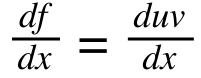
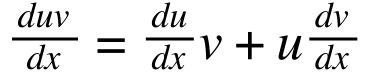
Differentiating the product on the right uses the product rule: (uv)′ = u′v + uv′. Integrating that identity and rearranging gives integration by parts.
Visualizing Integration by Parts
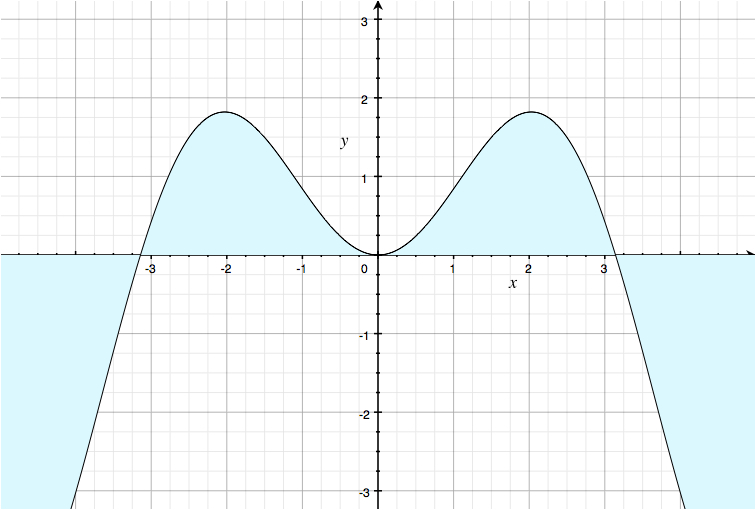
The first two integrals added together are equal to the third. Play close attention to the humps of the graphs, that is where it is most clear.
Read all original image captions
Image 1
The first two integrals added together are equal to the third. Play close attention to the humps of the graphs, that is where it is most clear.
Image 2
The first two integrals added together are equal to the third. Play close attention to the humps of the graphs, that is where it is most clear.
Image 3
The first two integrals added together are equal to the third. Play close attention to the humps of the graphs, that is where it is most clear.
Integrating through everything we find that
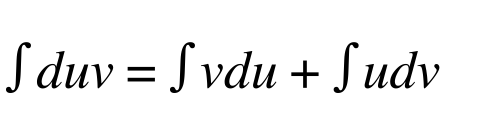
and that
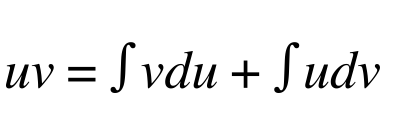
Finally, by rearranging everything we get the equation which tells us how to integrate by parts
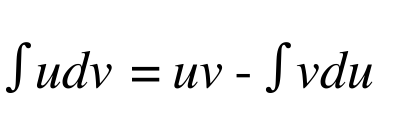
If you followed the derivation it might not be exactly clear how the final result is used when the integral you have is full of x’s but it will be clear after a little explanation of what the above equation actually means and a few classic (and very important) examples.
For the first example we will solve the integral
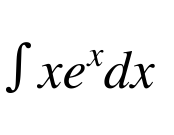
You should primarily focus on its form, the product of both  and
 . If you attempted to solve this integral by using substitution or some other method you would be hard pressed to find an answer, the repeating nature of the exponential’s derivative makes a substitution impossible. This is where the beauty of integration by parts comes in, it moves around the problem by isolating the exponential.
Example problem 1.2.1
Integrate
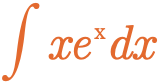
The first thing you’ll want to do in this problem is isolate the part of the equation which does not have a repeating or cyclical derivative, in this case that would be the  . To do this we make the following substitution, we let
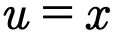
which then take the derivative of to get
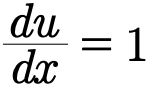
which allows of to find that
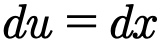
By doing these operations we have taken care of both  and
 in the integration by parts equation. For
 and
 we then focus on the exponential,
 . Similar to what we did to
 we let
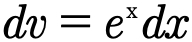
which we can integrate to find that
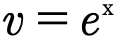
With everything for the integration by parts equation defined we can now just substitute so that
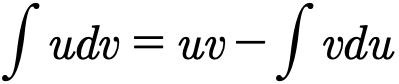
becomes

which when we solve the right hand side by integrating the exponential gives us

Finally, when we write out the entire problem we have that

All problems involving integration by parts follow this methodology. You define the part of the integral you can remove using derivatives as  ( in the previous example that was the
 ) and the part you have trouble removing as
 ( which was
 in the previous example ) so that you can find
 and proceed to take integrals and derivates of those as needed. Once you have all your little bits you can substitute everything in and repeat as needed.
The second example I will show you contains a trigonometric function. Like the exponential, derivates and integrals of trigonometric functions tend to be cyclic so they lend themselves well to solutions using integration by parts. Let’s take a look at the problem
Example Problem 1.2.2
Integrate
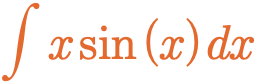
Like with the exponential you’ll want to define  and
 . like in the example will be assigned to the piece of the equation you can get reduce or get rid of using a derivative. So that
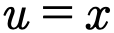
and that
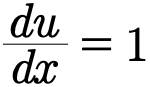
so
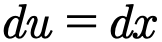
 like in the first example will be assigned to the piece of the integral which does not reduce or disappear when derivatives are taken of it. Therefore

integrating reveals that
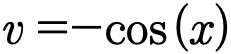
Substituting everything into the integration by parts equation gives us

pulling the negative outside of the integral and integrating the cosine produces

which finally produces by adding in the constant of integration our answer

For the first two examples you have only a single power of x but it is not uncommon to see integration problems with multiple powers of x in them. In those cases generally all you will have to do i repeatedly apply integration by parts and besides being a little bit tedious so long as you understand the method and keep track of everything you should be fine.
Example Problem 1.2.3
Do the following operation
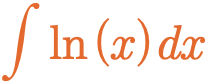
The integral of 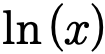 is something that you might come across often in other settings and remembering can sometimes be a pain. Knowing how to do the integral and other integrals like it can save you a lot of energy in other scenarios.
To begin this problem like other integration y parts problems you’ll want to define what  and
 are. Unlike in the other problems this can be pretty tricky. For a problem like this you’ll want to set
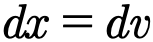 and
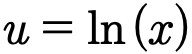
so that
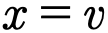 and
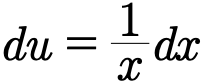
which after substituting into the integration by parts formula gives us
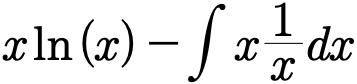
at this point all that is left is the integration so that we get

Glossary and deeper reading · 5 refreshers
These editorial refreshers supplement the reading. Definitions and examples are added guidance; original source wording and recorded answers remain in their original context.
-
Integration by parts
Integration by parts rewrites an integral using the derivative product rule in reverse. It takes the form ∫u dv=uv−∫v du with suitable choices of u and dv. For example, choosing u=x and dv=eˣ dx turns ∫x eˣ dx into x eˣ−∫eˣ dx. The choices should simplify the remaining integral, and definite bounds must be carried through consistently.
-
Function
A mathematical function assigns exactly one output to each input in its domain. Inputs can share an output, but one input cannot have two different outputs. For example, f(x)=x² assigns the output 9 to both 3 and −3. Function notation names the rule and its input; f(3) means the output when the input is 3.
-
Product rule
The product rule differentiates a product of two differentiable functions. It gives (fg)′=f′g+fg′, changing one factor at a time and adding the results. For example, the derivative of x sin x is sin x+x cos x. The product of the two derivatives is generally not the derivative of the product.
-
Derivative
A derivative gives the instantaneous rate of change of a function with respect to its input. At a point, it is the finite limit of the difference quotient when that limit exists. For example, the derivative of x² is 2x, so the tangent slope at x=3 is 6. A derivative function collects those rates across the inputs where the function is differentiable.
-
Integral
Integration can mean accumulating a function over an interval or finding an antiderivative. A definite integral gives a number, while an indefinite integral represents a family of antiderivatives. For example, integrating 2x indefinitely gives x²+C, and integrating it from 0 to 2 gives 4. The Fundamental Theorem of Calculus connects these two operations under its hypotheses.