Infinite Series
This original textbook reading covers part of the AP topic. Follow the AP course outline for complete topic instruction and practice.
Section 2
Infinite Series
For the sequence {an}, there exists a sequence of partial sums, or {Sn}, where
S1 = a1
S2 = a1 + a2
S3 = a1 + a2 + a3
Sn = a1 + a2 + a3 + ... + an
{Sn} = {S1, S2, S3, ..., Sn, ...}
The term Sn is defined as the partial sum of the sequence.
Remember in the last section how we defined a sequence as an infinite list of numbers? Well, this leads us to the topic of this section - infinite series.
An infinite series is described as the sum of all the terms in an infinite sequence.
Before going more in depth of the subject of infinite series, there is one thing we must cover first.
Example 2.2.1
Find the first, second, and third partial sum of the sequence
{ }n=1.
To find up to the third partial sum, the first three terms need to be evaluated.
a1 = 
a2 = 
a3 = 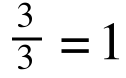
To find the partial sums...
S1 = a1
= ,
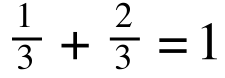
S2 = a1 + a2
= 
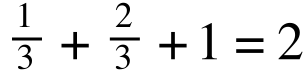
S3 = a1 + a2 + a3
= 
Example 2.2.2
Find the first, second, and third partial sum of the sequence
{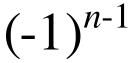 }n=1. Then, write those terms into a sequence of partial sums.
To find up to the third partial sum, the first three terms need to be evaluated.
a1 = 
a2 = 
a3 = 
To find the partial sums...
S1 = a1
= 1,
S2 = a1 + a2
= 1 + (-1)
= 0
S3 = a1 + a2 + a3
= 1 + (-1) + 1
= 1
To write the sequence of partial sums, list the sums in order.
{1, 0, 1, ...}
Next we are going to cover the notation for infinite series that you will see in many sequences and series problems.
Infinite Series Notation

 =

where j is the lower bound of summation, k is the upper bound of summation, and an is the sequence whose terms we are adding together. As you can see, infinite series uses summation notation, where the upper bound heads toward infinity.
Example 2.2.3
For the sequence
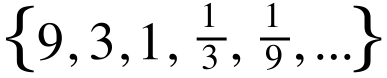 ,
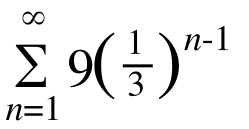
write its associated infinite series using sigma notation.
Looking at the terms, you can see that it is a geometric sequence where the common ratio is  .
We want an explicit function for the terms in the sequence. For this example, the function for the sequence is
an = 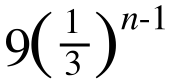
Now that there is an explicit function, you can use sigma notation to get the infinite series
Review 2.2
Question 1 of 5 · 0 correct
Find the fifth partial sum of the sequence 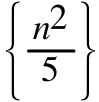 n=1.
Similar to how a sequence either converges to a number or diverges, the same rules apply to infinite series.
Property 1 states that no matter how many terms (in this case, an infinite amount) you add together in a particular sequence, if the sum gets closer to a certain number L, then the associated infinite series converges.
Property 2 states that as you add together ALL (again, an infinite amount) the terms of a sequence, if there is no such number to which the sum heads toward, then the associated infinite series diverges.
Now that you know how the concepts of convergence and divergence can apply to infinite series, we can go over the notation that you will see in many sequences and series problems.
For this section, we will only be concerned with whether or not the infinite series converges or not (diverges). Finally, here is one last tip to help determine convergence.
In order for an infinite series, , to converge, then
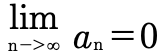
If the associated sequence does not converge to 0, then the infinite series diverges.
Note: If the sequence converges to 0, it does not mean that the series automatically converges. The infinite series can still diverge even if the sequence converges to 0.
Example 2.2.2
A frog leaps forward one foot and then leaps forward half the distance it did in the previous jump. If this frog were to continue leaping forever, how far would it end up? The data for how far the frog leaps, in feet, for each trial is given in the sequence
an = 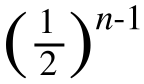 , with starting index n=1
We want to see if the infinite series 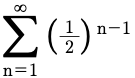 converges or diverges.
Looking at the given information, you can see that we are dealing with a geometric sequence.
Looking at the convergence of the sequence,
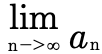 =
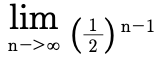 = 0.
Since the sequence converges to 0, this means that the associated infinite series can still converge.
Next, we want to take a look at {Sn}, or the sequence of partial sums. Finding the partial sums...
S1 = a1 = 1




Putting the partial sums into a sequence, it starts to look like...

Looking at the first five terms, it appears that the terms get closer to 2. If we were to continue the sequence, the partial sums reach a value that continually gets closer to 2.
Since the sequence of partial sums converges to 2, this means that the infinite series
= 2.
Therefore, the frog leaps a total distance of about 2 feet.
Example 2.2.3
Find out if  converges or diverges.
Glossary and deeper reading · 3 refreshers
These editorial refreshers supplement the reading. Definitions and examples are added guidance; original source wording and recorded answers remain in their original context.
-
Partial sum
A partial sum adds the first finitely many terms of a series. The nth partial sum is Sₙ=a₁+a₂+⋯+aₙ when indexing begins at 1. For example, the first three terms of 1/2+1/4+1/8+⋯ give partial sum 7/8. Convergence of a series concerns the limit of these sums, not just the limit of the individual terms.
-
Sequence
A sequence is an ordered list of terms indexed by integers. A rule can specify each term directly or recursively from earlier terms. For example, aₙ=1/n produces 1, 1/2, 1/3, and so on. An infinite sequence converges when its terms approach a finite limit as the index grows without bound.
-
Infinite series
An infinite series is the sum of the terms of an infinite sequence, defined through its partial sums. The series converges when those partial sums approach a finite value. For example, 1/2+1/4+1/8+⋯ converges to 1. Terms approaching 0 are necessary for convergence, but that condition alone is insufficient.