Convergence and Divergence of an Infinite Series
This original textbook reading covers part of the AP topic. Follow the AP course outline for complete topic instruction and practice.
Chapter 2 - Sequences and Series
Section 3
Convergence and Divergence of an Infinite Series
Series Convergence Properties
For the sequence of partial sums, or {Sn}, if...
1.  {Sn} = L ,
then the associated infinite series converges.
2. {Sn} = DNE ,
then the associated infinite series diverges.
Property 2 states that as you add together ALL (again, an infinite amount) the terms of a sequence, if there is no such number to which the sum heads toward, then the associated infinite series diverges.
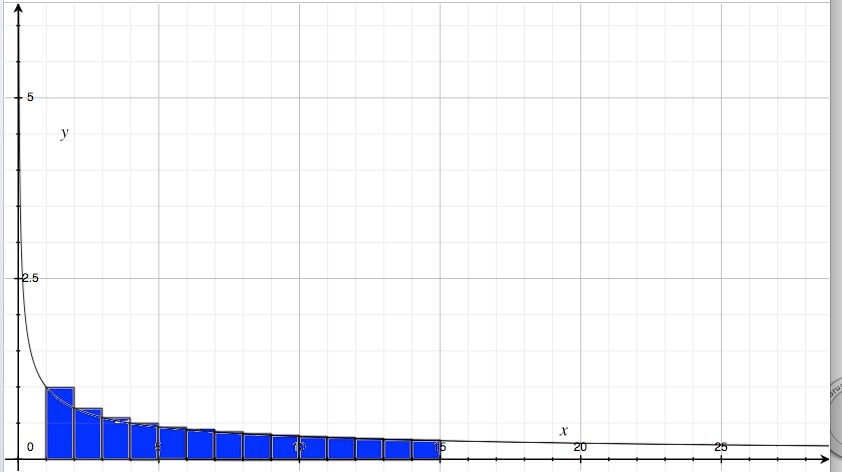
For this section, we will be looking at several functions to see how graphically a series can either converge or diverge.
Interactive 2.1
Read all original figure notes
Converges or Diverges?
Since the area under the curve is infinite, the area of all the blue bars is greater than that, or infinite also. This means that the value of the infinite series is ∞ and that it diverges.
Sequence Terms
The blue bars represent the terms of the sequence. Since they are a left-hand Riemann sum of a decreasing function, the area of all the blue bars is greater than the actual area under the curve.
Area under the curve
The area under the curve on the interval [1,∞) is determined using an improper integral. For this function, the area is infinite.
Example 2.3.1
Determine the convergence of the infinite series
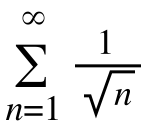
For this example, we will be comparing the infinite series to the function 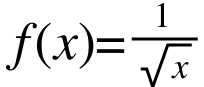 .
In the preceding graph, the curve is defined as the function .
Each blue bar represents the terms of the sequence 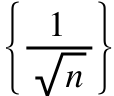 , where the width is 1 and the height is the respective value of the function at each consecutive x value. The area of all the blue bars is equal to...

Or

Which is the written out value of
.
Now we will be comparing the area of all the blue bars to the area underneath the curve from x=1 to x=∞.
As stated before, the area of all the blue bars is defined as
And the area underneath the curve is defined as the improper integral
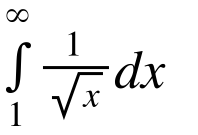 .
Since the blue bars are an over-approximation of the actual area,
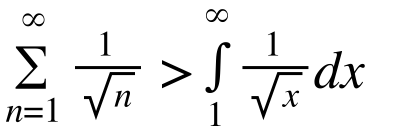
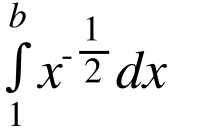
Now the next step is to check the value of
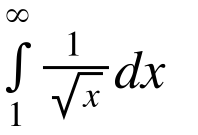
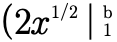
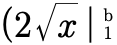
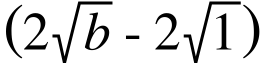
Going through the steps...
= 
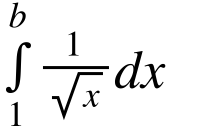
= 
= 
= 
= 
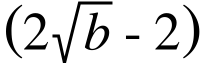
= 
= ∞
As the value of
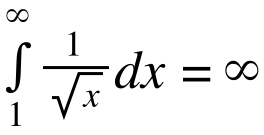 ,
This means that
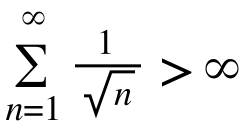
Or in other words
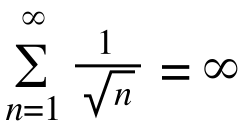
Since the value goes to infinity, this means that the infinite series diverges.
Interactive 2.2
Read all original figure notes
Converges or Diverges?
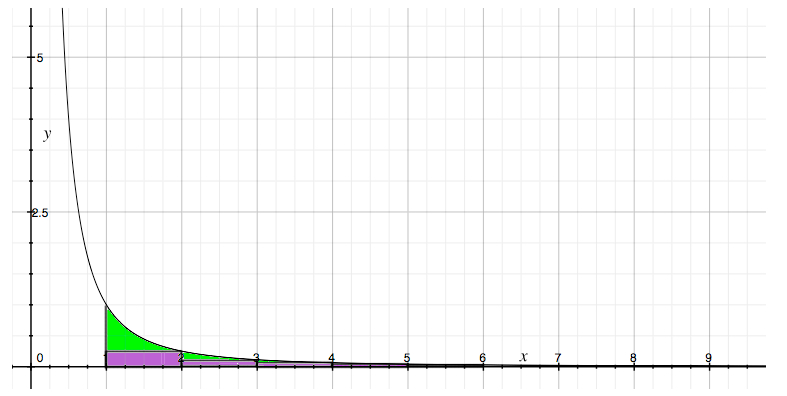
Since the area under the curve has a finite value, so does the area of all the purple bars. This means that the infinite series converges.
Area under the curve
The area under the curve on the interval [1, ∞) is evaluated using an improper integral.
Purple bars
The purple bars represent the terms of the infinite series. Note that the first term 1 is not expressed in this graph.
Example 2.3.2
Determine the convergence of the infinite series
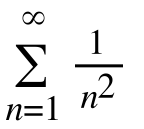
Just like in the previous example where we determined convergence by comparing area, the same method will be used in this example.
In the preceding graph, the curve is defined as the function 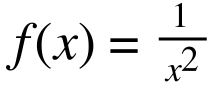
The purple bars represent the terms of the sequence, where they each have a width of 1 and a height of the function value at each consecutive x value. The area of all the purple bars is equal to

Or

The green area, representing the total area under the curve, is defined by the improper integral
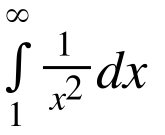
Being that the purple bars are an under-approximation of the actual area,

Since the first term (a1 = 1) of the sequence {} is not included in the graph or in the above inequality, 1 will be added across so that we can compare the infinite series with the improper integral.

Or
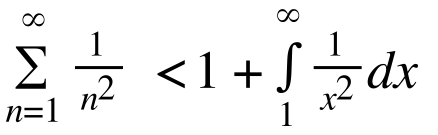
Now we have to find the value of the right side of the inequality.
= 1 + 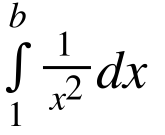
= 1 + 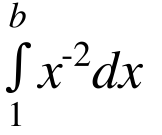
= 1 + 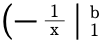
= 1 + 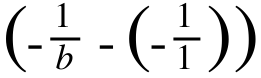
= 1 + 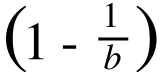
= 1 + 1
= 2
Being that
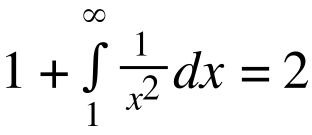
We can compare that with the infinite series to see
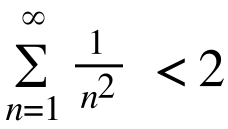
Since the terms of the sequence  are all positive, this means that the sequence of partial sums is monotonically increasing. Even though it is always increasing, the value of the infinite series is less than 2, which proves that the series converges.
Review 2.3
Question 1 of 4 · 0 correct
If  = ∞, then the infinite series...
Example 2.3.1
Determine if the infinite series
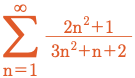
converges or diverges.
The first thing to do for any infinite series problem is to determine the limit of the sequence,
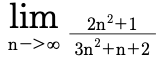
With algebraic manipulation,

and
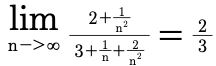
Since the sequence does not converge to 0, the infinite series diverges.
Glossary and deeper reading · 4 refreshers
These editorial refreshers supplement the reading. Definitions and examples are added guidance; original source wording and recorded answers remain in their original context.
-
Infinite series
An infinite series is the sum of the terms of an infinite sequence, defined through its partial sums. The series converges when those partial sums approach a finite value. For example, 1/2+1/4+1/8+⋯ converges to 1. Terms approaching 0 are necessary for convergence, but that condition alone is insufficient.
-
Convergence of a series
A series converges when the sequence of its partial sums approaches a finite limit. It diverges when there is no such finite limit. For example, 1/2+1/4+1/8+⋯ converges to 1, while the harmonic series diverges. Convergence of the individual terms to 0 is necessary but does not by itself establish convergence of their sum.
-
Sequence
A sequence is an ordered list of terms indexed by integers. A rule can specify each term directly or recursively from earlier terms. For example, aₙ=1/n produces 1, 1/2, 1/3, and so on. An infinite sequence converges when its terms approach a finite limit as the index grows without bound.
-
Partial sum
A partial sum adds the first finitely many terms of a series. The nth partial sum is Sₙ=a₁+a₂+⋯+aₙ when indexing begins at 1. For example, the first three terms of 1/2+1/4+1/8+⋯ give partial sum 7/8. Convergence of a series concerns the limit of these sums, not just the limit of the individual terms.