Telecoping Series
This original textbook reading covers part of the AP topic. Follow the AP course outline for complete topic instruction and practice.
Section Overview
- Telescopic Series
- Partial Fractions and Telescopic Series
Section 2
Telecoping Series
Telescoping series can be a bit strange at first. Unlike a geometric or other types of series we’re going to discuss they don’t have a certain form but instead a requirement that must be met. In particular for a series to be telescopic it’s partial sums must at some point become described by a fixed number of terms.
Let’s take a quick look at an example to see how this works.
Example 3.2.1
Determine whether the following sum forms a telescopic series.
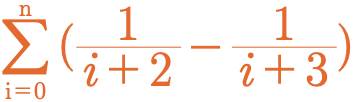
Let’s take a look at our sum
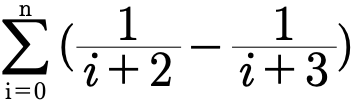
It expands out into

If you look closely you can see that quite a few of the terms end up canceling out. Regrouping everything makes this much more clear.

Supplemental Image for Example 3.2.1
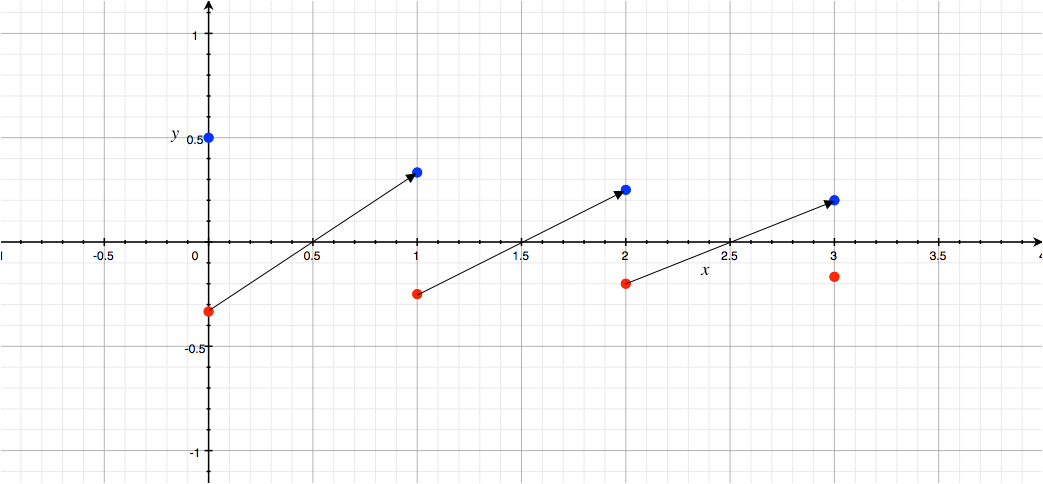
Read all original figure notes
Cancelled Terms
The arrows in this image point from negative terms to the positive terms they canceling out. For the first four terms on the series in 3.2.1 only 3 pairs exist leaving the first positive and a last negative term.
Negative Uncanceled Term
The second term in the series which is not canceled out by other terms.
Positive Uncanceled Term
One of the two terms in this series which does not cancel.
Once all the terms are cancelled out we are finally left with a much smaller expression.
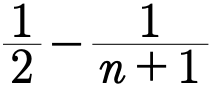
Since all the terms ended up canceling out we can say that this series is telescopic.
Unfortunately determining what is and isn’t a telescoping series isn’t as amazingly clear cut as in the example. Often the expression you’ll be given won’t have the lovely form that the sum in our example had. In order to get something that’s a bit more workable will have to use partial fractions.
Let’s do another example to see how this works.
Example 3.2.2
Determine whether the following sum forms a telescopic series.
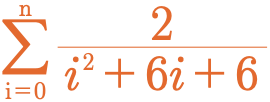
When using partial fractions to determine whether a series is telescopic the first thing you’ll want to do is take the expression inside the sum which defines the series and factor it.
In this case the expression we will want to factor and apply partial fractions to is
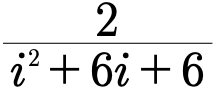
After factoring it we have
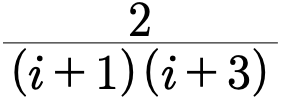
Using partial fractions we get

and finally that

We can now use this expression to make our sum a little more manageable.

From here we do the same thing as we did in the first example of this section.
First expand the sum

Then group like terms

Finally we’re left with a single expression for our sum to n terms.

Since all the terms ended up canceling out we can again concluded that our sum defines a telescopic series.
In the previous example the series reduced in an odd way. Instead of successive terms canceling out every other term did. I highly recommend sitting down with this example and seeing why the final form of the series is the way it is.
Pop Quiz 1.2.1
Question 1 of 5 · 0 correct
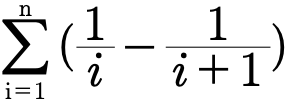
Find a formula for the following sum up to the nth term.
Glossary and deeper reading · 3 refreshers
These editorial refreshers supplement the reading. Definitions and examples are added guidance; original source wording and recorded answers remain in their original context.
-
Partial fractions
Partial fraction decomposition writes a rational expression as a sum of simpler fractions. If the numerator’s degree is at least the denominator’s, polynomial division comes first. For example, 1/[x(x+1)] equals 1/x−1/(x+1) wherever the original expression is defined. The factor types and any repeated factors determine the form of the decomposition.
-
Infinite series
An infinite series is the sum of the terms of an infinite sequence, defined through its partial sums. The series converges when those partial sums approach a finite value. For example, 1/2+1/4+1/8+⋯ converges to 1. Terms approaching 0 are necessary for convergence, but that condition alone is insufficient.
-
Partial sum
A partial sum adds the first finitely many terms of a series. The nth partial sum is Sₙ=a₁+a₂+⋯+aₙ when indexing begins at 1. For example, the first three terms of 1/2+1/4+1/8+⋯ give partial sum 7/8. Convergence of a series concerns the limit of these sums, not just the limit of the individual terms.