Improper Integrals
This original textbook reading covers part of the AP topic. Follow the AP course outline for complete topic instruction and practice.
This reading includes verified answer corrections and explicitly stated clarifications.
Section Overview
- Introduction to Improper Integrals
- Integrating with both bounds at infinities
Section 5
Improper Integrals
Improper integration is nothing too far out of this world. All it essentially boils down to is integration with the use of limits. The use of limits lets us do interesting things like take integrals with bounds at infinity.
Unfortunately not all improper integrals come out perfectly. Sometimes you can get funky answers such as infinity or worse: something which simply doesn’t exist.
That said, solving improper integrals is pretty easy so long as you know your limit and integration rules. Let’s start with a simple example.
Example 1.5.1
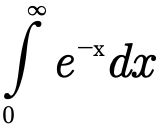
Compute the following
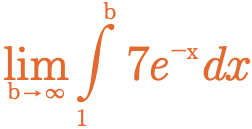
The first step of problems like these is to just ignore the limit leaving it on the outside and take the integral up until whatever point you can. In this case that should be pretty simple since we’re dealing with the well known exponential function.
Taking the integral then gives us that
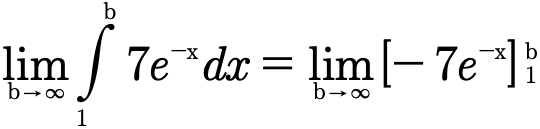
After plugging in the appropriate numbers and variables on the right side we have
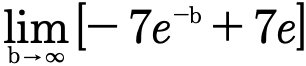
Limit rules allow us to move things around to make everything bit more clear so our previous expression becomes
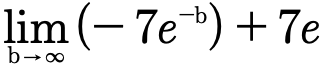
and then
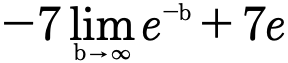
Now that’s a limit we know!
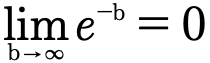
So our final answer is then
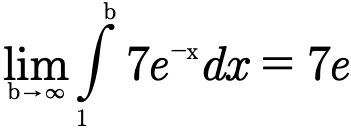
The next example will be a little more tricky. Instead of taking a single limit we will be taking two, one at  and another at
 . The process will be the same but we will have to make sure and keep track of both our limits and apply them properly.
Example 1.5.2
Do the following operation
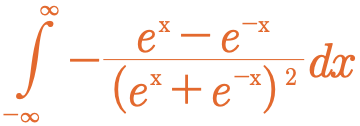
This problems notation may look a little odd but it translates directly into what occurred in first problem of this section.
The first thing that needs to be done is to take the integral of whatever is inside. In this problem you will want to use substitution.
Letting

taking the derivative and making the correct substitution.
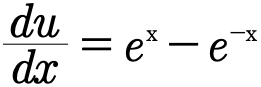
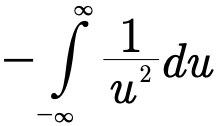
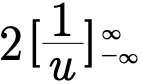
which can be easily integrated to get
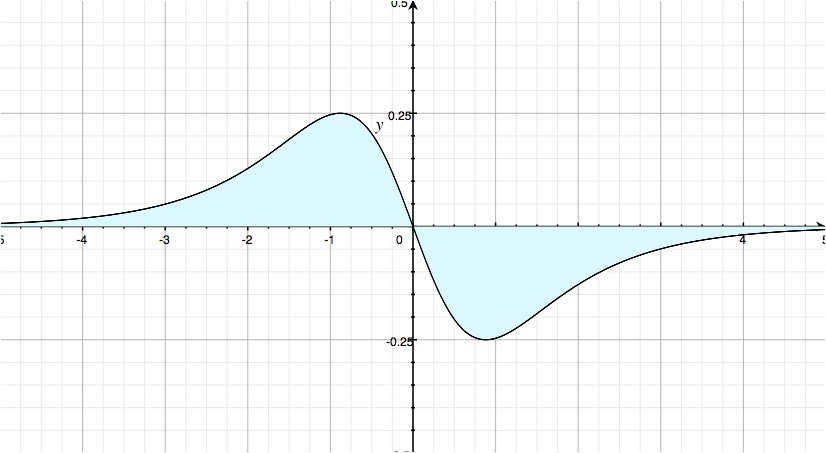
Graph of the integral in Example 1.5.2
Read all original figure notes
Positive Infinity
As x approaches positive infinity the function approaches zero
Negative Infinity
As x approaches negative infinity the function approaches zero
At this point we will need to plug in 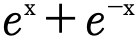 for
 in order to preserve our bounds. (If you noticed it actually doesn’t matter in this problem but in other problems it could very well make a big difference)
Plugging in gives us
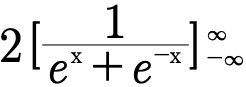
so that when we expand everything out we get

Looking at the first portion of this expression
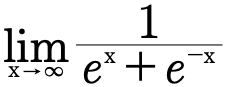
As  approaches

 approaches
 and
 approaches
 . Overall this means that the denominator is approaching infinity. Therefore
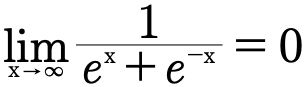
A similar argument applies to the right side of the expression so that
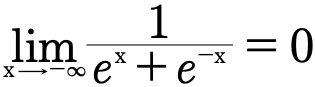
Plugging everything in finally gives us our answer

Chapter 1 Problems
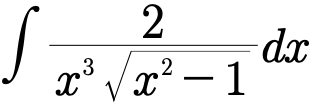
1. 
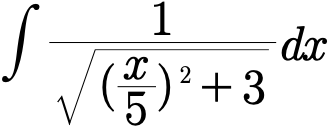
2. 
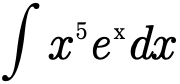
3. 
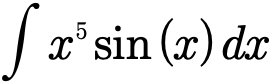
4. 
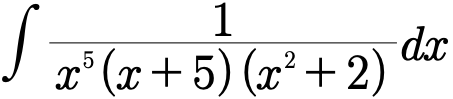
5. 
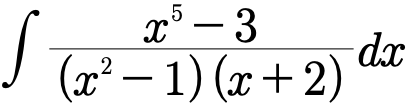
6. 
7. Find the arclength of  from
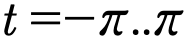 .
Clarification: the ellipse is centered at the origin and its major axis is horizontal. These conventions make the problem agree with the stated parametrization.
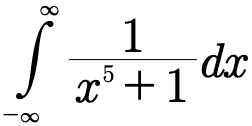
9. 
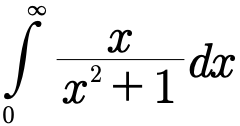
Pop Quiz 1.5.1 Improper Integrals
Question 1 of 5 · 0 correct
Solve
Glossary and deeper reading · 3 refreshers
These editorial refreshers supplement the reading. Definitions and examples are added guidance; original source wording and recorded answers remain in their original context.
-
Improper integral
An improper integral has an infinite integration interval or an integrand that becomes unbounded within the interval or at an endpoint. It is defined using limits of proper integrals rather than substituting infinity as a number. For example, the integral of 1/x² from 1 to infinity converges to 1. If an interior singularity splits an interval, the separate improper integrals must both converge.
-
Integral
Integration can mean accumulating a function over an interval or finding an antiderivative. A definite integral gives a number, while an indefinite integral represents a family of antiderivatives. For example, integrating 2x indefinitely gives x²+C, and integrating it from 0 to 2 gives 4. The Fundamental Theorem of Calculus connects these two operations under its hypotheses.
-
Limit
A limit describes the value approached by outputs as inputs approach a specified target or grow without bound. For an input approaching a finite target, its value at that exact input does not determine the limit. For example, (x²−1)/(x−1) approaches 2 as x approaches 1 even though the original expression is undefined at 1. A finite two-sided limit requires the left and right approaches to agree.