Access this content offline
Omniguides
Skip to the reading

Trigonometric Substitution

This original textbook reading covers part of the AP topic. Follow the AP course outline for complete topic instruction and practice.
Source figure
Source figure

A Special type of U-Substitution

Often times, substituting with trigonometric functions is the best type of substitution for more complicated functions. Why? Recall our trigonometric identities.

How would you solve a very complicated integral with ordinary u-substitution? Suppose we have the integral

∫00.51(1-x2)32dx

Now that we have mastered U-Substitution, we might substitute u=1-x2 into the denominator, knowing that it will be easier to split up the fraction that way in the future. Let’s go ahead and solve this problem using ordinary u-substitution, because it will be good practice to develop u-substitution skills a bit further.

u=1-x2

du=-2xdx​
​
We run into an inconvenience here. There is no 2x in the numerator. We only have a dx. Let’s play with this for a little bit. Rearranging the differential so that we have dx on one side,

-du2x=dx ​
Now we need to find x in terms of u. Let’s use the help of our original substitution to do that. We know

x2=1-u from our original substitution, so​
x=1-u Substituting this into our differential gives

-du21-u=dx

Since this is a definite integral, we should also take its range into account:

x:0→12

u:1→34​
Alright! Now let’s substitute all of these things into our integral and hope it becomes slightly simpler

∫10.751u32⋅-du21-u ​
Well, this is hopeless. This made the integral even more complicated. Let’s try this with trigonometric substitution.

Example Problem 9.2.1

Evaluate the definite integral ∫00.51(1-x2)32dx

Rather than trying to find an appropriate u this time, let’s substitute for x instead. Let’s use a function that can be written many different ways, like sinθ.

Note: We can use cosθ as well, but sinθ will make calculating the integral a little easier, as we will see.

x=sinθ

dx=cosθdθ

What’s another way we can write cosθ? Recall from our trig identities that

cosθ=1-sin2θ

Let’s also account for the intervals of integration:

As x:0→12,

sinθ:0→π6​
We are assuming that θ lies in quadrants I and IV, which is the standard domain for the function sinθ.

Hopefully you are starting to see how this will work out. If not, perhaps rewriting the integral this way will help

=∫00.51(1-x2)3dx

Now let’s begin substituting:

=∫0π6cosθ(1-sin2θ)3dθ​
​
Remember that cosθ=1-sin2θ​


=∫0π6cosθ(cosθ)32dθ

(Did you see what just happened?!?)

=∫0π6sec2θdθ

Which function has a derivative of sec2(x)? Now, before you go ahead and start deriving trigonometric derivatives using implicit differentiation, it’s tan(x).

=[tanθ]0π6

=tanπ6-tan0

=13-0=33

We’re going to encounter many integrals like these, and before we move on to finding the integrals of trigonometric functions such as tan(x) and sec(x), which will be encountered frequently in future problems, we have to first understand how they are derived.

Proof: ∫sec x  dx

This is one of the trickiest proofs we will ever come across. We have to solve it using u-substitution by substituting u=secx+tanx. Then we get:

du=secxtanx+sec2xdx

du=secx(secx+tanx)dx

Now the reason for choosing this substitution becomes more apparent, because it allows for the substitution of secxdx (highlighted in green) back into the original integral.

How do we substitute secx+tanx, though...? We do something clever.

∫secx⋅secx+tanxsecx+tanxdx

We simply multiplied the integral by a special “1,” leaving us with a denominator that is equal to u.​
Making these substitutions gives us

∫duu=∫1udu

​
=ln|secx+tanx|+C

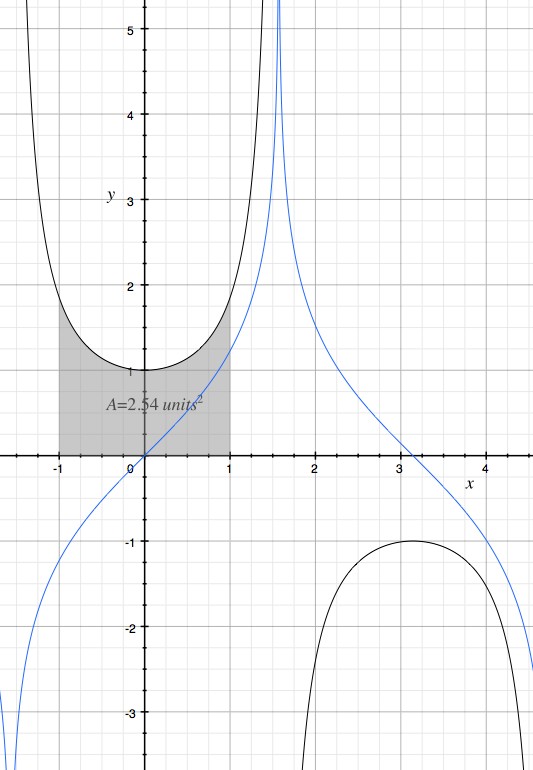
Note: Proving the integral of csc(x) uses a similar substitution method, except by usingu=cscx+cotx instead. Notice the absolute value is necessary for the integral to be defined for all intervals of x (see interactive image

Interactive 9.2.1 Trigonometric Integrals
Interactive 9.2.1 Trigonometric Integrals
Read all original figure notes

The Integral Function

Notice it equals to approximately 1.25 when x=1, and approximately -1.25 when x=-1, giving the total area under sec(x) to be equal to 2.54 units2

Why the absolute value?

The absolute value is necessary because it allows for the integral to be defined even when sec(x)+tan(x) is negative (recall that natural log is undefined when x is negative). The absolute value allows us to calculate the negative area of sec(x).

).

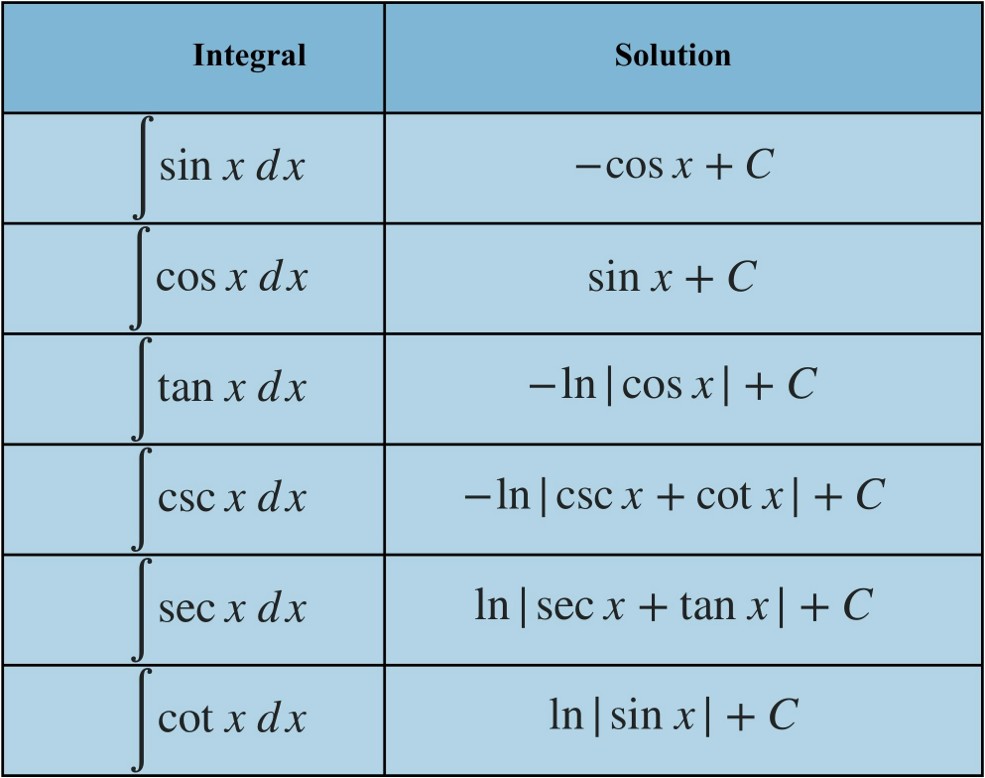
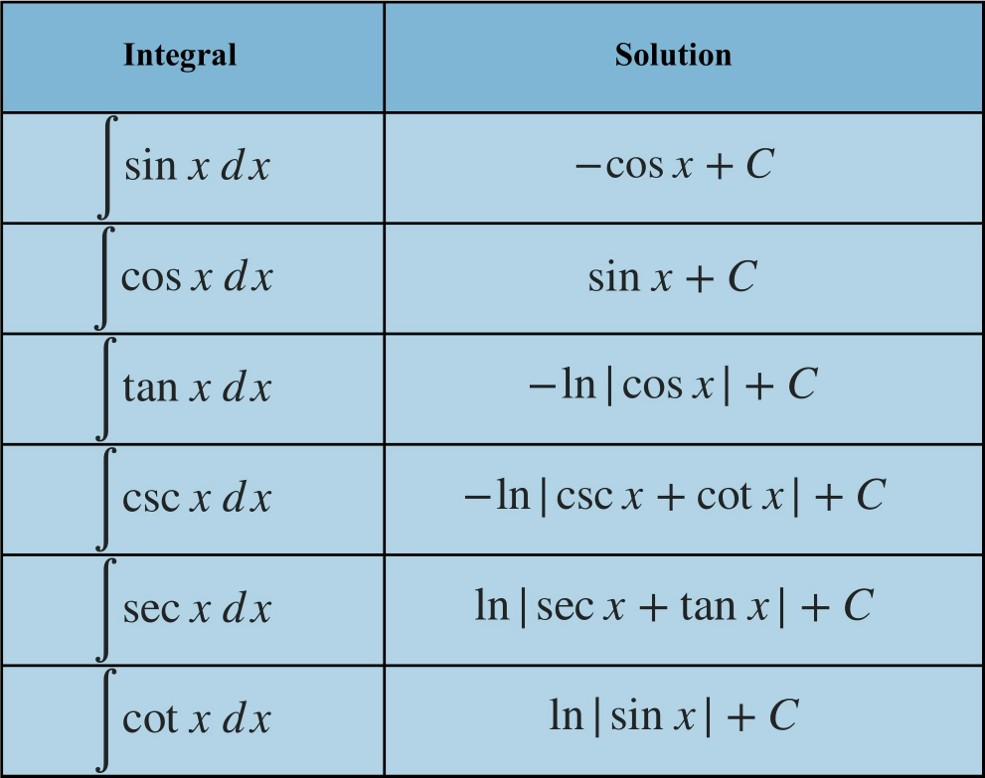
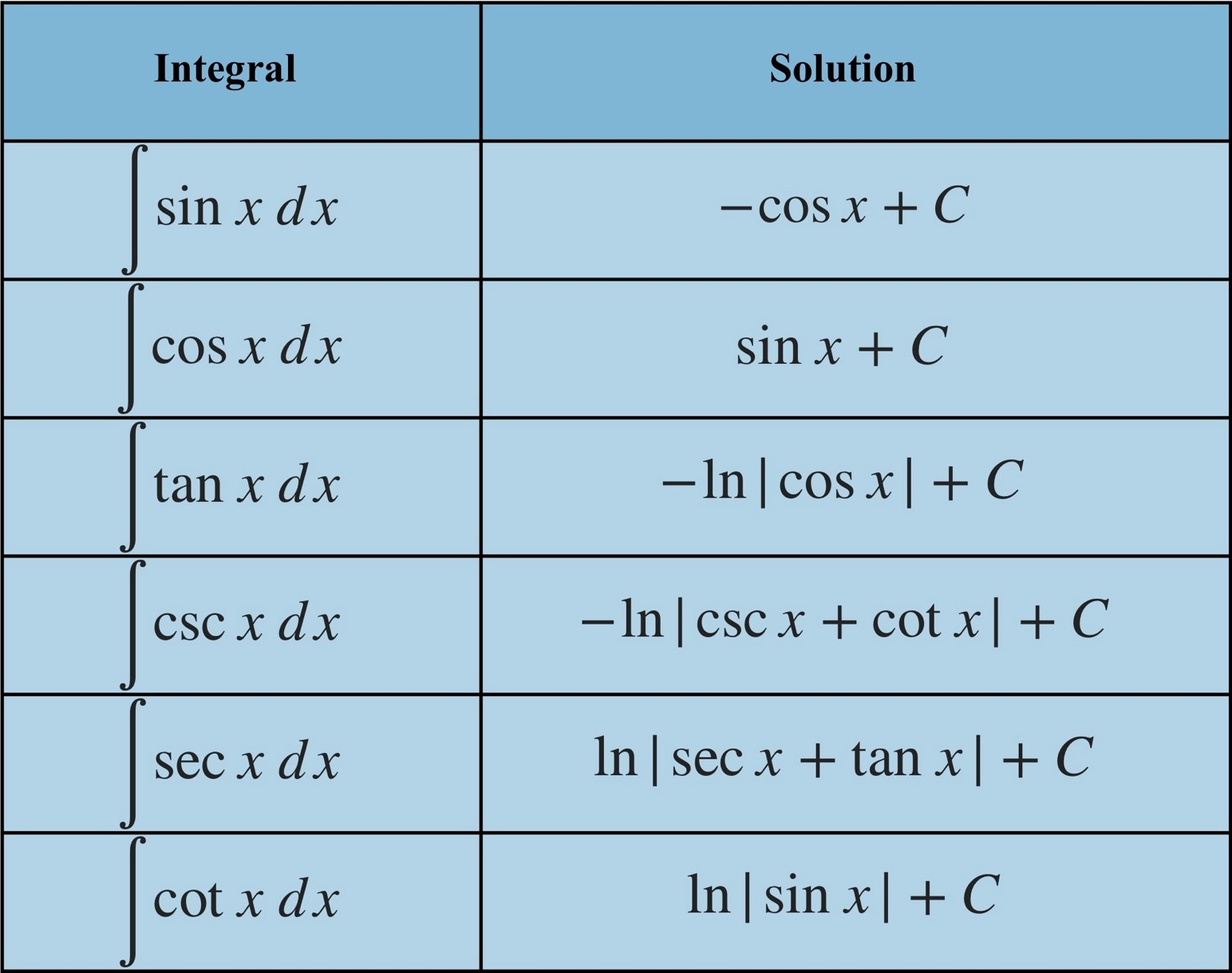
Using this information, we can formulate a table of trigonometric integrals.
Source figure

Example Problem 9.2.2

Evaluate the integral ∫-12-x2-2x+8dx

This may seem like a relatively simple integral at first, but any time we see -x2, especially inside a radical, it should alert our brains to the possibility that solving the integral will require trig substitution. Get ready for a tough problem.

In the previous problem, Example 9.2.1, we substituted x = sin(x) and converted 1-x2 into cos(x). This is a common strategy in trig substitution. Our job here is to try to change the function within the radical into the form

∫-12constant - (function)2dx

The way we do that is by completing the square.

∫-128+A-(x2+2x+A)dx​
We want to select A so that x2-2x+A will become a perfect square. Notice that the value of A does not change the function inside the radical because the A is added, then later subtracted (you can check for yourself by distributing out the negative sign).

The rules of completing the square tell us that since the coefficient of x2 is 1,

A=(22)2=1

The green 2 in the numerator is because it is the coefficient of x. We now know that A = 1, and the radical can be rewritten as

∫-129-(x+1)2dx​
The problem now is the 9. How can we change that into a 1 for easier substitution? Let’s just factor it out!

∫-129(1-(x+1)29)dx​
The rules of radicals and exponents tell us that the above expression is the same as

∫-129⋅1-(x+1)232dx​
∫-1231-(x+13)2dx

Aaaaah, now we can begin substituting. We want the integral to have 1-sin2θ in it.

sinθ=x+13

cosθdθ=13dx

3cosθdθ=dx

Plugging these substitutions into the integral, we get

=∫1231-sin2θ⋅3cosθdθ​
​
Since 1-sin2θ=cos2θ, the square root of which equals cosθ, we now have in our integrand

∫-129cos2θdθ

Before we integrate this, notice we are missing something. Can you guess what it is? The intervals of integration. They are still in the form of x ranging from -1 to 2. So we ask ourselves, when x ranges from -1 to 2, what is the range of θ? From our original substitution,

θ=sin-1(x+13)

sin-1(0)=0

sin-1(1)=π2

Plugging this into our intervals, we get

=∫0π29cos2θdθ

What to do about cos2θ, though? We want to reduce its order to 1 somehow.

Let’s seek guidance from our trigonometric identities, more specifically, the double angle formulas. Can you spot a cos2θ? It states that cos(2θ)=2cos2θ-1. Going from that, we can see that

=cos2θ=cos(2θ)+12​
​
We can substitute this into our integral to reduce the power of the integrand by 1, giving us

=∫0π292(cos(2θ)+1)dθ

We can actually go ahead and evaluate this integral because we know that the integral of cos(2θ) is equal to 0.5sin(2θ) .

=92([sin(2θ)2]0π2+[θ]0π2)​
=92[(sin(π)2-sin(0)2)+(π2-0)]​
Both sin(π) and sin(0) are 0, so the first term is 0, leaving us with the integral being equal to

=92⋅π2​

=9π4​


That was rough, but we learned quite a few tricks, and got a relatively nice area in the end. This has been a long section, but there is one more thing I want to show you before we call it quits: a shortcut to the problem we just did. After seeing this shortcut, some of you might think of me as a tyrant for not showing it to you earlier. Some of you might think of me as a mathematical dictator. However, for those of you who have a curious mind and like to be fascinated, you will think of this shortcut as ingenious. It is one that college professors often use to see if you truly understand the concept behind an integral.

Example Problem 9.2.3

An alternate way to solve ∫12-x2-2x+8dx

Recall that the purpose of an integral is to calculate the area under the curve of the integrand. So, if we know what kind of function the integrand is, then perhaps that will help us calculate its area. Let’s call the integrand y so that

​
y=-x2-2x+8

y2=-x2-2x+8​
x3+2x+y2=8​
Completing the square for the x-terms on the left side gives

x2+2x+1+y2=9

Notice that the equation still stays balanced if you subtract 1 from both sides.

(x+1)2+y2=32

This equation should look familiar. It’s the equation of a circle of radius 3, with a center at (-1, 0). However, due to the square root sign in the original function, we are only looking at the upper half of the circle (if the area in question was the lower half, there would be a negative sign in front of the square root).​


Now, what is the area of a semi-circle with radius 3 and a center at (-1, 0) from x = -1 to x = 2. It’s equal to half the area of the semi-circle!

A=14π(3)2

=9π4

Pop Quiz 9.2.1 Integrals using Trigonometric Substitution

Question 1 of 5 · 0 correct

Evaluate∫0π3tanxdx

Select one answer.
Glossary and deeper reading · 6 refreshers

These editorial refreshers supplement the reading. Definitions and examples are added guidance; original source wording and recorded answers remain in their original context.

  • Function

    A mathematical function assigns exactly one output to each input in its domain. Inputs can share an output, but one input cannot have two different outputs. For example, f(x)=x² assigns the output 9 to both 3 and −3. Function notation names the rule and its input; f(3) means the output when the input is 3.

  • Trigonometric identity

    A trigonometric identity is an equality that holds for every input where both sides are defined. Identities let you rewrite expressions without changing their values on that shared domain. For example, sin²θ+cos²θ=1 follows from the unit circle. Any division used while rewriting an identity can introduce domain restrictions.

  • Integral

    Integration can mean accumulating a function over an interval or finding an antiderivative. A definite integral gives a number, while an indefinite integral represents a family of antiderivatives. For example, integrating 2x indefinitely gives x²+C, and integrating it from 0 to 2 gives 4. The Fundamental Theorem of Calculus connects these two operations under its hypotheses.

    Read more: 6.7 · Integral →

  • Substitution for integration

    Substitution rewrites an integral using a new variable whose differential accounts for a derivative factor. It reverses the chain rule for suitable compositions. For example, with u=x²+1 and du=2x dx, the integral of 2x(x²+1)³ becomes the integral of u³. For a definite integral, transform the bounds consistently or return to the original variable before evaluating them.

    Read more: 6.9 · Substitution for integration →

  • Differential

    For a differentiable function y=f(x), the differential dy is defined as f′(x) dx. It represents the tangent-line estimate of the output change associated with an input change dx. For example, y=x² at x=3 and dx=0.01 gives dy=6·0.01=0.06. The actual change in y can differ from this linear estimate.

    Read more: 4.6 · Differential →

  • Definite integral

    A definite integral accumulates a function over a specified interval as a limit of Riemann sums when that limit exists. Its sign includes the function’s sign and the orientation of the limits. For example, the integral of the constant −2 from 0 to 3 is −6, although the geometric area is 6. In a rate model, the result has rate units multiplied by input units.

    Read more: 6.3 · Definite integral →

Search lessons, terms and problems