Trapezoidal Method
This original textbook reading covers part of the AP topic. Follow the AP course outline for complete topic instruction and practice.
This reading includes verified answer corrections and explicitly stated clarifications.
The problem of consistent accuracy
For y =x² on[0,1], midpoint accuracy improves as we use more equal subintervals. We can compare it with trapezoids by calculating both estimates and their errors. The reason I keep using this curve is that:
- It is relatively challenging to calculate.
- It illustrates general trends
- We know that its actual area is , or approximately 0.33. This allows us to compare the accuracy of each method and general trends.
For this curve, midpoint estimates with n = 1,2,3 are 1/4,5/16,35/108. Their errors decrease as n increases. Trapezoids are another useful method, but they are not automatically more accurate: with n = 3, the trapezoidal estimate is 19/54, while the midpoint estimate is 35/108. The exact value is 1/3.
A review of the mathematics of a Trapezoid
Recall that the area of a trapezoid is height multiplied by the average of its two bases. To better estimate the area under the curve of a function, we are rotating our trapezoids by 90º so our bases are on the sides, and our height is dx.
You have seen pictures of the trapezoidal method in Galleries 6.4.1 and 6.4.2, though, so I am sure you can imagine what it looks like. The best way to work out the mathematics behind it is through an example problem.
Example Problem 7.3.1
Using the trapezoidal method and n = 3, find the area under the curve from x = 0 to x = 1
Interactive 7.3.1 Example Problem 7.3.1
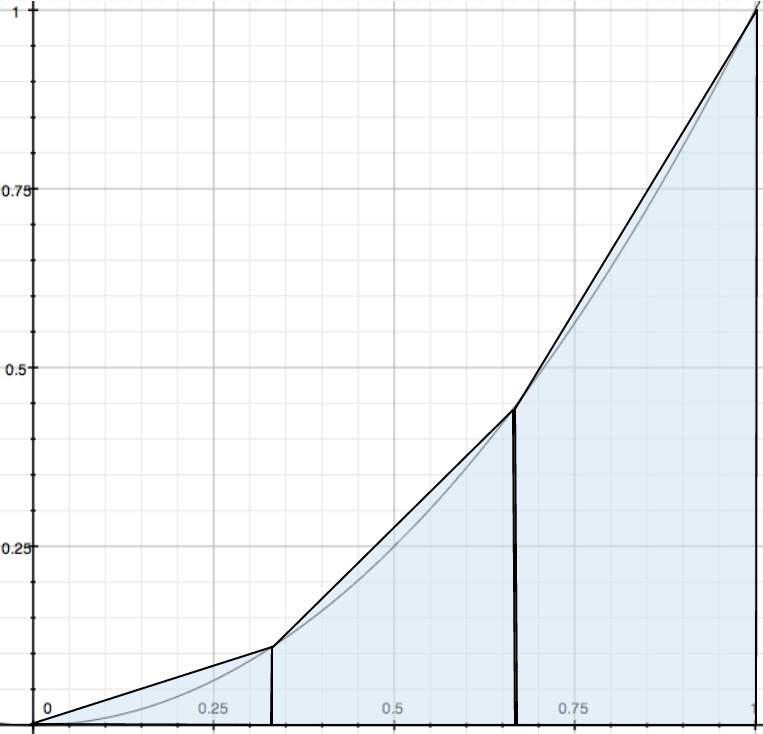
Read all original figure notes
Compare the actual errors
The height
The base
Glossary and deeper reading · 1 refreshers
These editorial refreshers supplement the reading. Definitions and examples are added guidance; original source wording and recorded answers remain in their original context.
-
Trapezoidal rule
The trapezoidal rule approximates a definite integral using a straight segment between each pair of adjacent endpoint values. Each piece contributes its width times the average of its two endpoint heights. For example, one trapezoid for x² on [0,2] has width 2 and heights 0 and 4, giving 4. For a concave-up function the trapezoidal sum overestimates the integral, while for a concave-down function it underestimates it.