Inverses Revisited
This original textbook reading covers part of the AP topic. Follow the AP course outline for complete topic instruction and practice.
Since we have already proven these derivatives, their integrals are the opposite, so here is a table we can use as a reference for upcoming problems.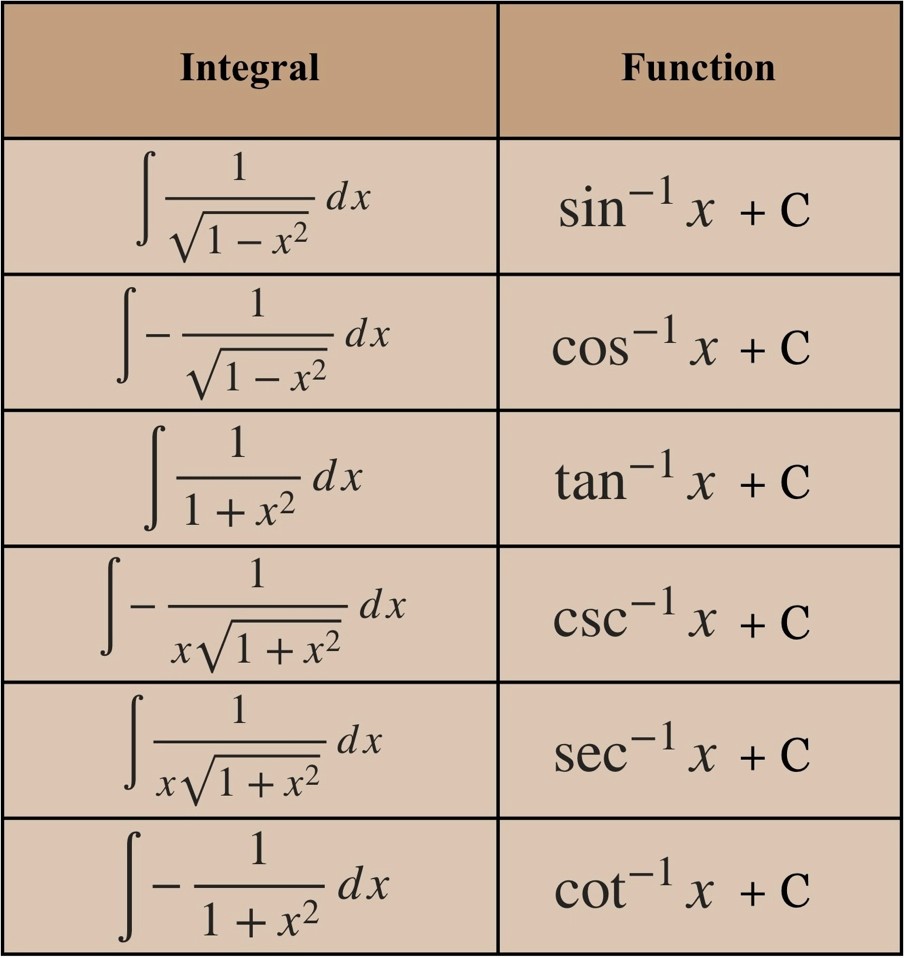
Many times, trying to calculate an integral is a learned technique that tests your mastery of derivatives and algebra, because integrals are simply calculating derivatives backwards with some skilled algebraic manipulation. To challenge ourselves, we will take a look at some integrals of inverse functions that used the chain rule in upcoming sample problems.
Something to note: Notice that all the integrals have some form of or . In future problems involving inverse trigonometric integrals, we will try to use algebraic manipulation to put our integrand (the function being integrated) into a similar form so that we can compare it with our table of known integrals on the previous page.
Taking more advanced integrals requires a delicate combination of intuition, derivative skills, and algebraic manipulation. When we learn more advanced substitution methods, all of these will come into play. Starting with inverse function gives us a nice stepping stone to steadily transition into more advanced integral calculations.
Example Problem 8.3.1
Glossary and deeper reading · 4 refreshers
These editorial refreshers supplement the reading. Definitions and examples are added guidance; original source wording and recorded answers remain in their original context.
-
Derivative
A derivative gives the instantaneous rate of change of a function with respect to its input. At a point, it is the finite limit of the difference quotient when that limit exists. For example, the derivative of x² is 2x, so the tangent slope at x=3 is 6. A derivative function collects those rates across the inputs where the function is differentiable.
-
Inverse function
An inverse function reverses another function’s input-output assignment. A function needs to be one-to-one on its chosen domain for an inverse function to exist. For example, x³ has inverse the cube-root function, while x² needs a domain restriction such as x≥0. The notation f⁻¹ denotes an inverse function rather than the reciprocal 1/f.
-
Integral
Integration can mean accumulating a function over an interval or finding an antiderivative. A definite integral gives a number, while an indefinite integral represents a family of antiderivatives. For example, integrating 2x indefinitely gives x²+C, and integrating it from 0 to 2 gives 4. The Fundamental Theorem of Calculus connects these two operations under its hypotheses.
-
Integrand
The integrand is the function or expression being integrated. The differential identifies the variable of integration. For example, in the integral of x² with respect to x, the integrand is x². Bounds belong to the integral’s interval rather than to the integrand itself.