Notation and Rules
This original textbook reading covers part of the AP topic. Follow the AP course outline for complete topic instruction and practice.
This reading includes verified answer corrections and explicitly stated clarifications.
These rules are not meant to be broken
An indefinite integral is a family of antiderivatives. A definite integral is a signed accumulation over an interval. If a function is nonnegative, that accumulation equals the area under its graph; portions below the axis count negatively. The Fundamental Theorem of Calculus is what connects these two ideas.
These are the main rules of integration. Later we will learn a couple more that will help us find exact areas, but first let’s answer some questions you might have.
What is that dx?
Remember back when we were estimating areas? We had dx as the width. In this case, the width is infinitely small, so the dx is there to remind us that we are adding up infinitesimally thin rectangles and finding the area that way.
Should I memorize these?
Knowing them definitely helps, but we will do some practice problems that will help us become familiar with them, so let’s start them now.
Example Problem 8.1.1
Solve
Interactive 8.1.1 Example Problem 8.1.1
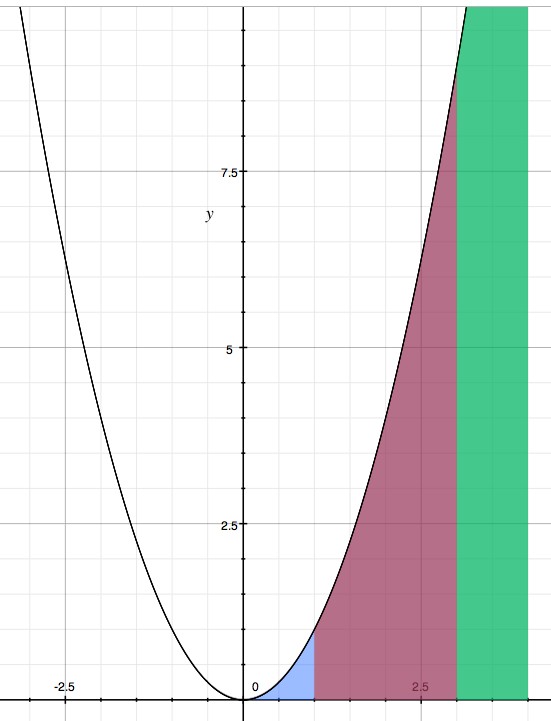
Read all original figure notes
Leftover Area
Second Term
Third term
At this point, we still have not discussed how we might go about calculating the areas, even if we know that integrals and anti-derivatives are related. This brings us to the final and most important rule of integrals.
Let F(x) be the anti-derivative to f(x). Assuming continuity over the interval, then,
You might think, really!? What happens to the constant?! The constant in F(b) cancels out with the same constant in F(a)! Then, we get a finite area! This rule is so special, that it got its own name. It is called the Second Fundamental Theorem of Calculus, or the Fundamental Theorem of Calculus part 2 (I like the first name better).
Part 1 concerns an accumulation function: if f is continuous and G(x) =∫ax f(t) dt, then G′(x) =f(x). Differentiation recovers the accumulation rate. Part 2 says an antiderivative lets us evaluate a definite integral by subtracting endpoint values.
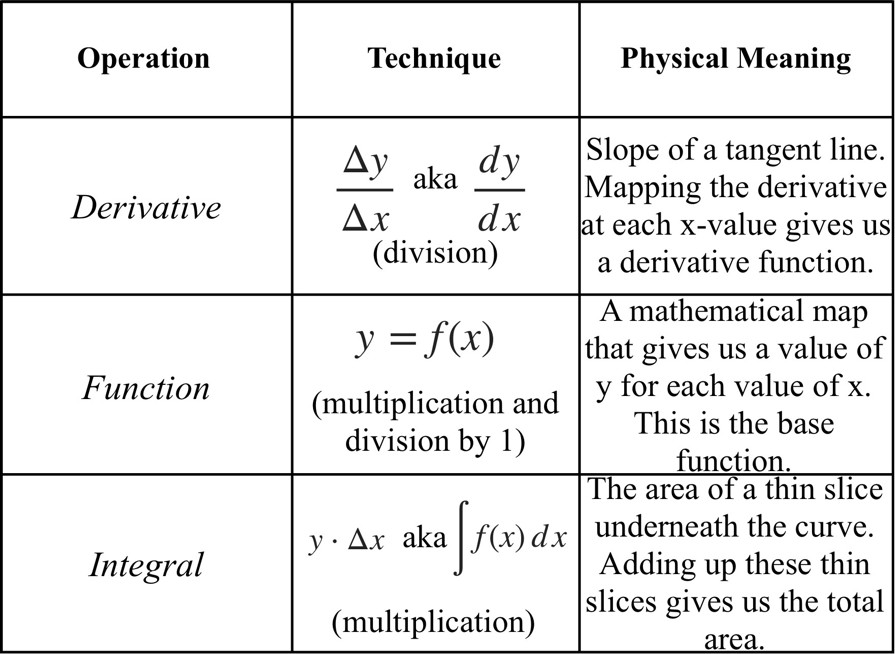 Read this retained source sketch with two qualifications. Δy/Δx is a finite secant slope; the derivative dy/dx is its limit as Δx → 0, when that finite limit exists. A single product f(xᵢ)Δx is a rectangle’s signed contribution, not an entire integral. Summing contributions and taking a partition-width limit gives the definite integral, with values below the axis counted negatively. FTC Part 1 recovers the rate from accumulation, and Part 2 evaluates the integral using an antiderivative.
We have just been doing advanced multiplication and division this whole time! That’s what all of Calculus is about!
Example Problem 8.1.2
Calculate
Before we move on to the end of the section and our quiz, let’s review a bit of what we just learned.
- An indefinite integral denotes a family of antiderivatives, F(x) +C. FTC Part 1 says that differentiating the accumulation function G(x) =∫ax f(t) dt gives f(x), when f is continuous.
- The definite integral of f over[a,b] is F(b) −F(a), where F is an antiderivative and f is continuous on the interval. It is signed area; to find total geometric area when f changes sign, integrate |f| or split at the zeros.
- Indefinite vs. definite integral: Indefinite integrals have a constant term in them, whereas definite integrals are evaluated over a specific interval, so the constant term cancels out.
It’s the difference between and . It’s subtle, but crucially important. - Calculus is all about multiplication and division
Glossary and deeper reading · 2 refreshers
These editorial refreshers supplement the reading. Definitions and examples are added guidance; original source wording and recorded answers remain in their original context.
-
Indefinite integral
An indefinite integral denotes the family of antiderivatives of its integrand on an interval. The constant of integration records the possible constant differences among those functions. For example, the indefinite integral of cos x is sin x+C. It has no pair of numerical bounds and does not by itself give a single accumulated amount.
-
Antiderivative
An antiderivative of a function is another function whose derivative equals the original function on an interval. Two antiderivatives on the same interval differ by a constant. For example, x² is an antiderivative of 2x, and x²+7 is another. An antiderivative is a function, whereas a definite integral is an accumulated value.