Access this content offline
Omniguides
Skip to the reading

To Infinity

Beyond this AP Calculus course

Optional BC enrichment on improper integrals (topic 6.13); excluded from required AB coverage. Follow the AP course outline for the complete course pathway.

This reading includes verified answer corrections and explicitly stated clarifications.

Infinitely finite areas

Sometimes a function will approach infinity, but the area under its curve will still be finite. Consider ​
∫1∞1x2dx

There are actually two ways to solve this integral. The first method is just brute force. We evaluate the integral as though ∞ was a really large number. This method is useful if we need to do an integral in our heads.

The 2nd method is more elegant and mathematically correct. It involves setting up the integral as a limit by replacing ∞ with another variable such as t and finding the integral as t→∞.

Example Problem 8.2.1

Evaluate ∫13∞1x2dx

We know this is equal to ∫13∞x-2dx

=limt→∞∫13tx-2dx​
Now we can evaluate the integral using t instead of ∞.

=limt→∞[-1x]13t

=limt→∞-(1t)-(-113)

=0-(-3)=3​


Interactive 8.2.1 Integrals at Infinity
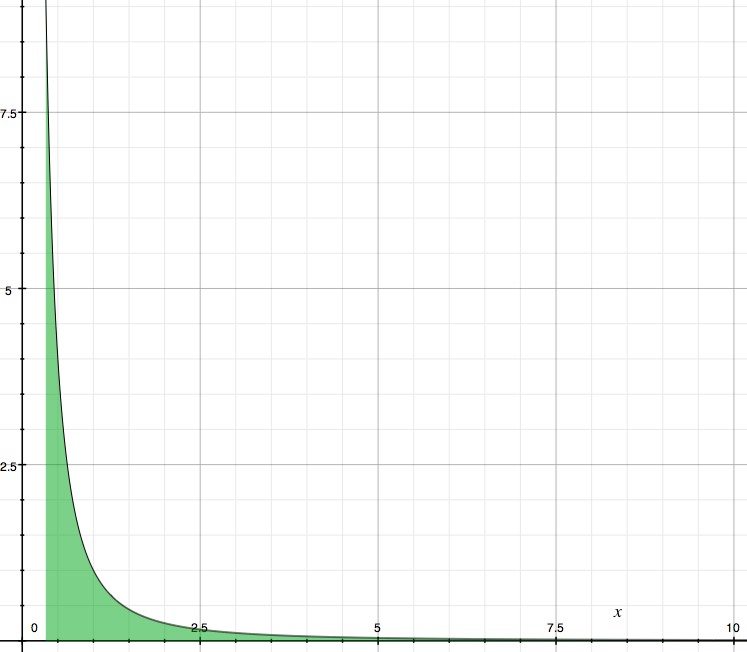
Interactive 8.2.1 Integrals at Infinity
Read all original figure notes

Bulk Area

Most of the area is already covered in this window. As the graph approaches ∞, the area under its curve approaches 0 very quickly.

Miniscule Area

We can see that by the time the graph approaches 7.5, its area is very small. In fact, after the graph passes 10, it won’t gain a single percentage point to its area.

Cool, huh? But perhaps you might have to see it to believe it! (See Interactive 8.2.1)

Example Problem 8.2.2

Evaluate ∫1∞x2+3x+6x4dx

Our best bet in this case is to split up the numerator and denominator into multiple functions added together. In order to make this question go by faster, we are going to try the brute force method rather than replacing the ∞ with another variable, t, and taking its limit at infinity.

∫1∞x2x4+3xx4+6x4dx​
Using integration rules, we can take the integral of each of these functions individually.​
∫1∞1x2dx+∫1∞3x3+∫1∞6x4dx

Now watch carefully, because we are about to take three integrals at the same time in one step! You may want to refer to the inverse power rule.

-[1x]1∞-[32x2]1∞-[63x3]1∞

=1+32+2​
=4.5​


For a >0, the improper integral ∫a∞ xq dx converges exactly when q <−1. The exponent need not be an integer: x−3/2 also has a finite integral. At q =−1, the antiderivative ln x grows without bound; at q >−1, the power antiderivative grows without bound.

Pop Quiz 8.2.1 Finite areas at infinity

Question 1 of 5 · 0 correct

Which of these areas is finite at infinity?

Select one answer.
Search lessons, terms and problems