Midpoint Method
This original textbook reading covers part of the AP topic. Follow the AP course outline for complete topic instruction and practice.
This reading includes verified answer corrections and explicitly stated clarifications.
Choosing the middle of each subinterval often improves an area estimate for a smooth curve. This is the midpoint method. It is a useful alternative to left/right sums, but no method wins for every function and every partition. Let’s try a case where midpoint rectangles work well.
As before, the base is still dx. Recall that
On an interval starting at a, the midpoint heights are f(a + Δx/2), f(a + 3Δx/2), f(a + 5Δx/2), and so on. Only when a = 0 do those simplify to f(Δx/2), f(3Δx/2), and f(5Δx/2). The heights change according to the function, not by a constant increment f(Δx).
Example Problem 7.2.1
With the midpoint method, estimate the area under the curve of from x = 0 to x = 1 using 3 rectangles.
The exact integral is 1/3, so this three-rectangle midpoint estimate is low by 1/108, about 2.78% of the exact value. Eight right-endpoint rectangles give 51/128, about 19.53% high. Midpoint works much better in this particular example. On the following page, Interactive 7.2.1 lets you compare the pictures.
Interactive 7.2.1 Example Problem 7.2.1
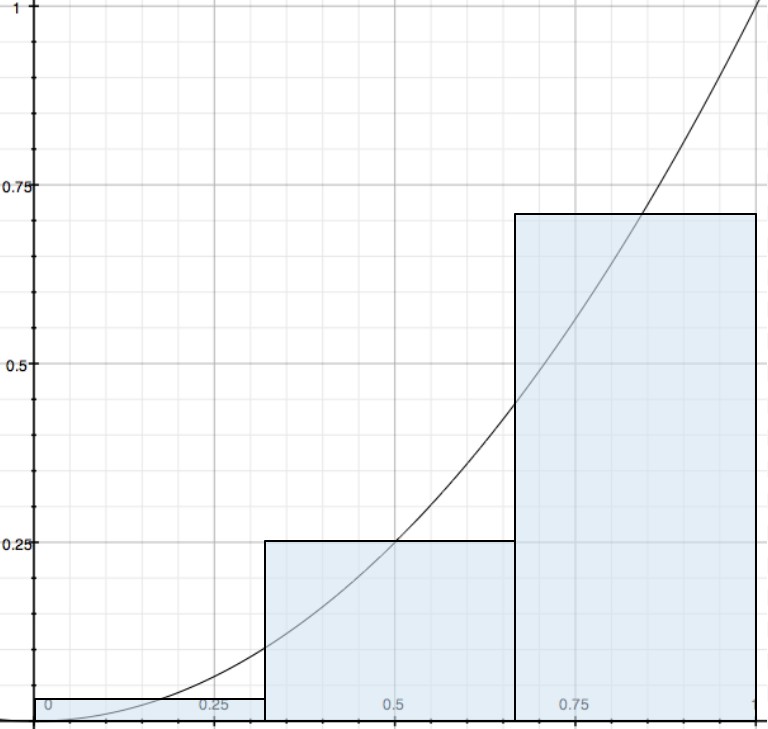
Read all original figure notes
The Midpoint
What if we just used one rectangle?
Interactive 7.2.2 Example 7.2.2
Read all original figure notes
Overestimated Area
Underestimated area
Example Problem 7.2.2
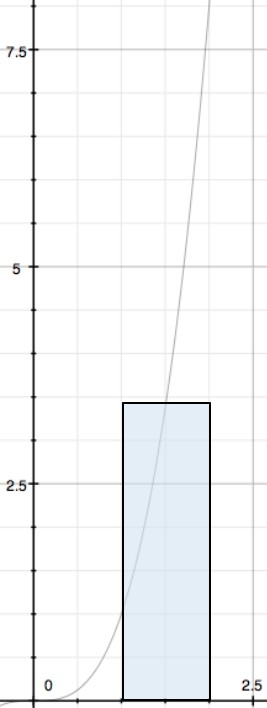
Find the area under the curve from x = 1 to x = 2 using the midpoint method and just one rectangle.
The exact integral is 3.75 and our one-rectangle midpoint estimate is 3.375. The error is 0.375, exactly 10% of the true value. That is a useful estimate with very little work, though midpoint is not guaranteed to beat every other method on every curve.
Glossary and deeper reading · 3 refreshers
These editorial refreshers supplement the reading. Definitions and examples are added guidance; original source wording and recorded answers remain in their original context.
-
Midpoint rule
The midpoint rule approximates a definite integral by sampling at the center of each subinterval. Each sampled height is multiplied by its own subinterval width. For example, one midpoint rectangle for x² on [0,2] has height 1 and width 2, giving 2. For a concave-up function the midpoint sum underestimates the integral, while for a concave-down function it overestimates it.
-
Interval
An interval is a set of real numbers containing every number between any two of its members. Parentheses exclude an endpoint, while square brackets include it. For example, (1,4] includes 4 and every number between 1 and 4, but excludes 1. An infinite endpoint always uses a parenthesis because infinity is not a real endpoint.
-
Function
A mathematical function assigns exactly one output to each input in its domain. Inputs can share an output, but one input cannot have two different outputs. For example, f(x)=x² assigns the output 9 to both 3 and −3. Function notation names the rule and its input; f(3) means the output when the input is 3.