FFR - Derivative Concepts
This original textbook reading covers part of the AP topic. Follow the AP course outline for complete topic instruction and practice.
This reading includes verified answer corrections and explicitly stated clarifications.
As you may have guessed already, so far we have only been taking first order derivatives of functions. There exists a way to take the derivative of a derivative, called a second order derivative, represented by . We can also take higher order derivatives, such as , but eventually it becomes more convenient to represent them as .
Graphical meaning of the second derivative
Just as the first derivative represents slope, the second derivative represents concavity of a graph. If the second derivative at a point is positive, the graph is Concave UP (like a CUP). If the second derivative is negative, the graph of the function at that point is concave down (like the letter n).
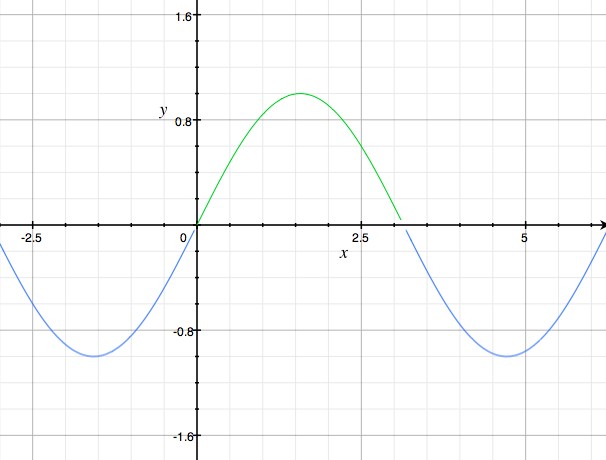
The easiest way to imagine this is with a trigonometric function like sin(x) or cos(x) because each of their second derivatives is simply the negative of the original function. Meaning, all positive values of sin(x) and cos(x) are concave down and all negative values are concave up!
If f′′(c) = 0, c is a candidate for an inflection point, not a guaranteed one. An inflection point occurs where a continuous graph changes concavity. For example, f(x) = x⁴ has f′′(0) = 0 but stays concave up on both sides of 0.
Can we differentiate complex functions?
As of now, we have no way of finding the derivatives of functions such as:
, , or . However, it is possible to differentiate all of these functions. We will learn about these advanced methods of differentiation in the next chapter. For now, however, let’s cover some important theorems that are derived from derivatives (ha!).
Rolle’s Theorem says: if a < b and f is continuous on [a, b], differentiable on (a, b), and f(a) = f(b), then f′(c) = 0 for at least one c in (a, b). Two zeros are a special case of equal endpoint values.
The Mean Value Theorem says: if a < b and f is continuous on [a, b] and differentiable on (a, b), then at some c in (a, b), f′(c) = (f(b) − f(a))/(b − a). The tangent slope there equals the secant slope between the endpoints. Check both hypotheses before using this conclusion.
Clear? Good. No, I kid... These are difficult theorems to understand. Here is a gallery demonstrating both theorems, along with the conceptualization of a second derivative.
Gallery 3.4.1 Derivative concepts
Read all original image captions
Image 1
Image 2
Image 3
Example Problem 3.4.1
Prove using the Mean Value Theorem that the derivative of ln(x) is equal to 0.582 somewhere between the points 1 and e.
Show your work for Problem 2
Drawing is temporarily unavailable. Work on paper if needed, then record your reasoning here.
Saving written working requires JavaScript. Keep your work on paper or in your own notes; the source problem above remains available.
Show your work for Problem 1
Drawing is temporarily unavailable. Work on paper if needed, then record your reasoning here.
Saving written working requires JavaScript. Keep your work on paper or in your own notes; the source problem above remains available.
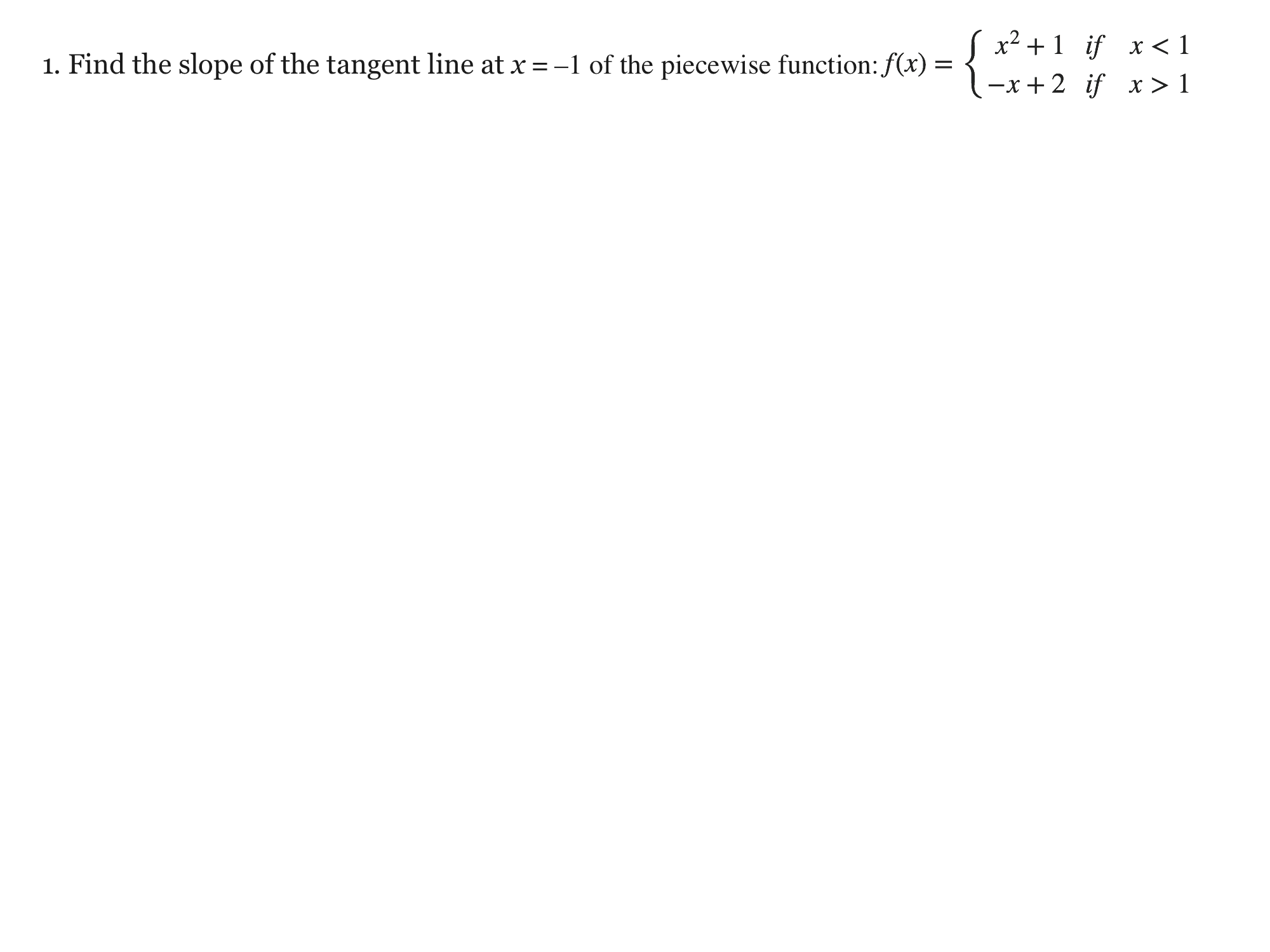
- Find the slope of the tangent line at x = –1 of the piecewise function:
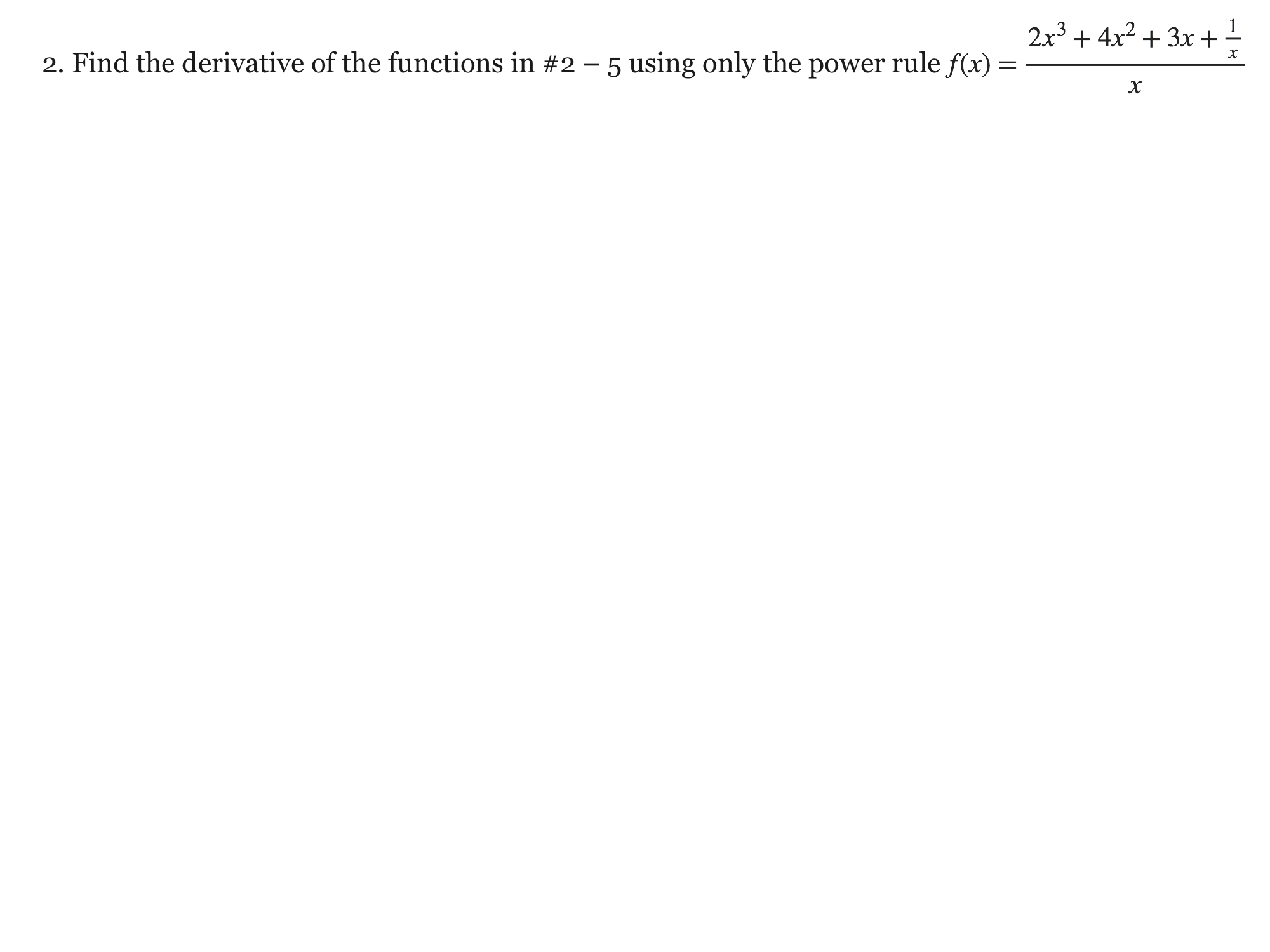
- Find the derivative of the functions in #2 – 5 using only the power rule:
Show your work for Problem 3
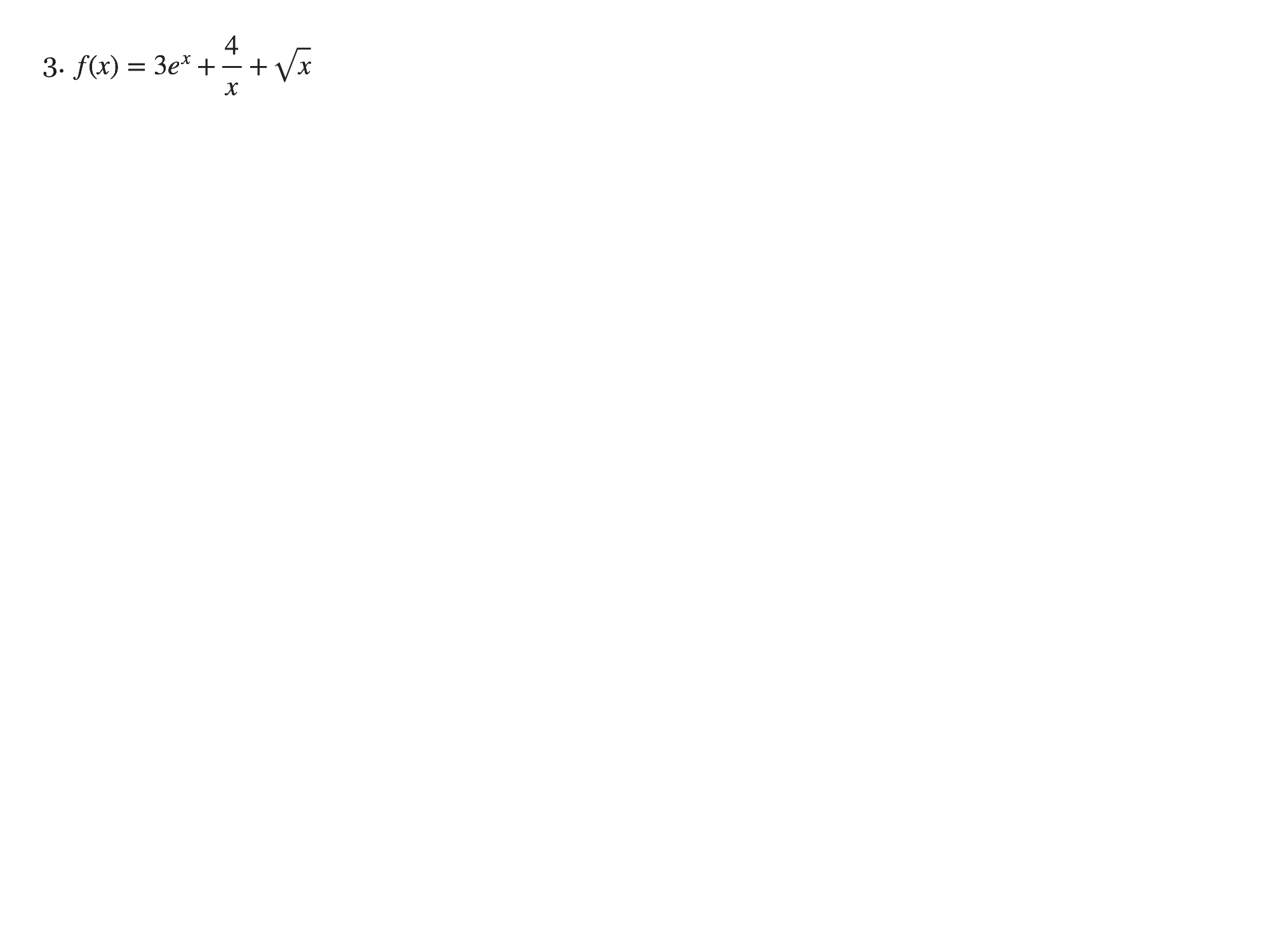
Clarification: Use the exponential derivative rule as well as the power rule.
Shared source instruction or preceding problem:
The source instruction in Problem 2 governs Problems 2–5. Each task’s own existing clarification stays attached and takes precedence where supplied.
Drawing is temporarily unavailable. Work on paper if needed, then record your reasoning here.
Saving written working requires JavaScript. Keep your work on paper or in your own notes; the source problem above remains available.
Show your work for Problem 4
Shared source instruction or preceding problem:
The source instruction in Problem 2 governs Problems 2–5. Each task’s own existing clarification stays attached and takes precedence where supplied.
Instruction clarification for Problems 4 and 5: the original shared direction says to use only the power rule. These two problems contain trigonometric functions and require trigonometric derivative rules; the power-rule-only restriction cannot be followed for them. Use the appropriate trigonometric derivative rules. The original direction, task text and corrected answers are retained.
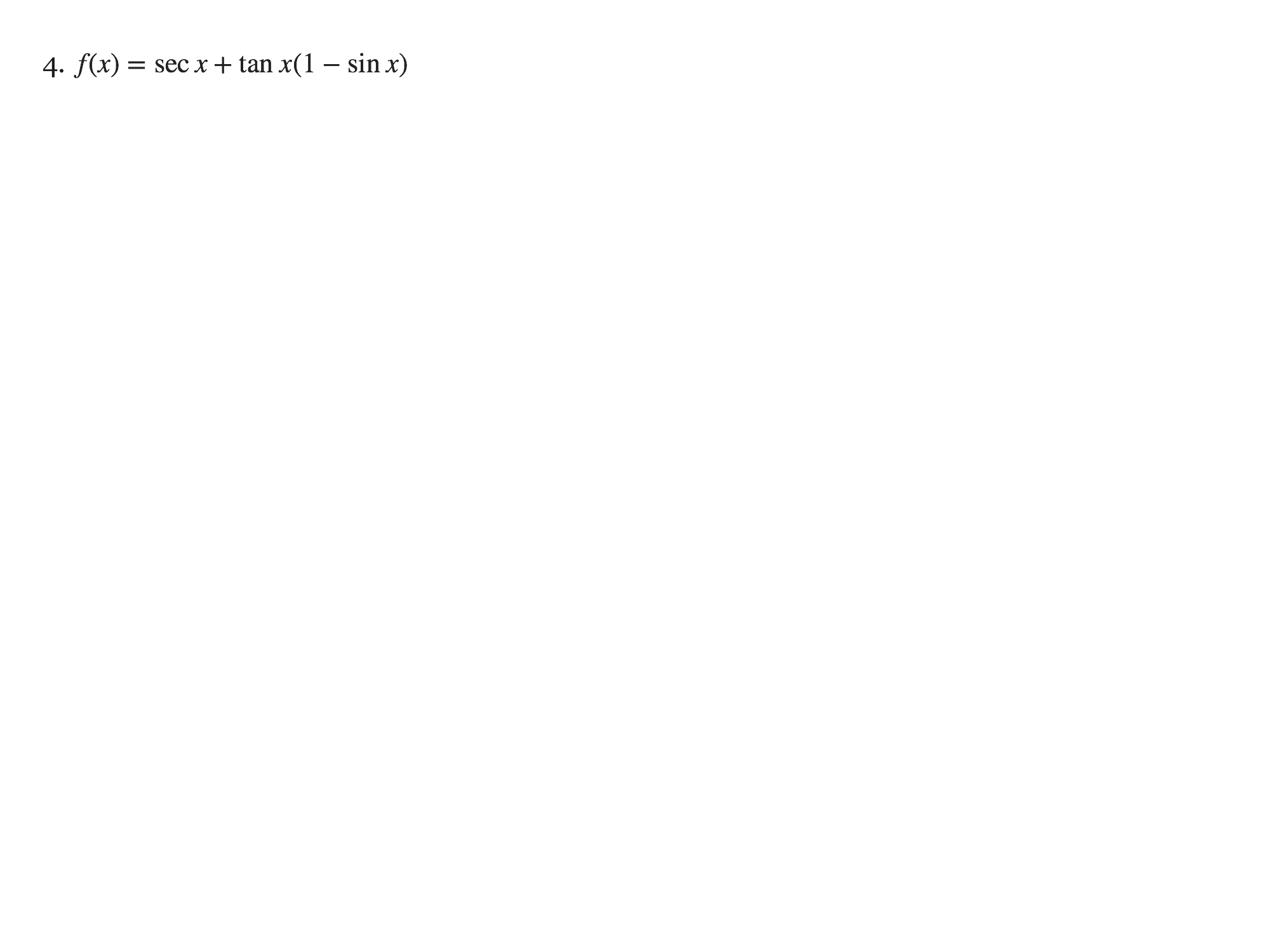
Drawing is temporarily unavailable. Work on paper if needed, then record your reasoning here.
Saving written working requires JavaScript. Keep your work on paper or in your own notes; the source problem above remains available.
Show your work for Problem 5
Shared source instruction or preceding problem:
The source instruction in Problem 2 governs Problems 2–5. Each task’s own existing clarification stays attached and takes precedence where supplied.
Instruction clarification for Problems 4 and 5: the original shared direction says to use only the power rule. These two problems contain trigonometric functions and require trigonometric derivative rules; the power-rule-only restriction cannot be followed for them. Use the appropriate trigonometric derivative rules. The original direction, task text and corrected answers are retained.
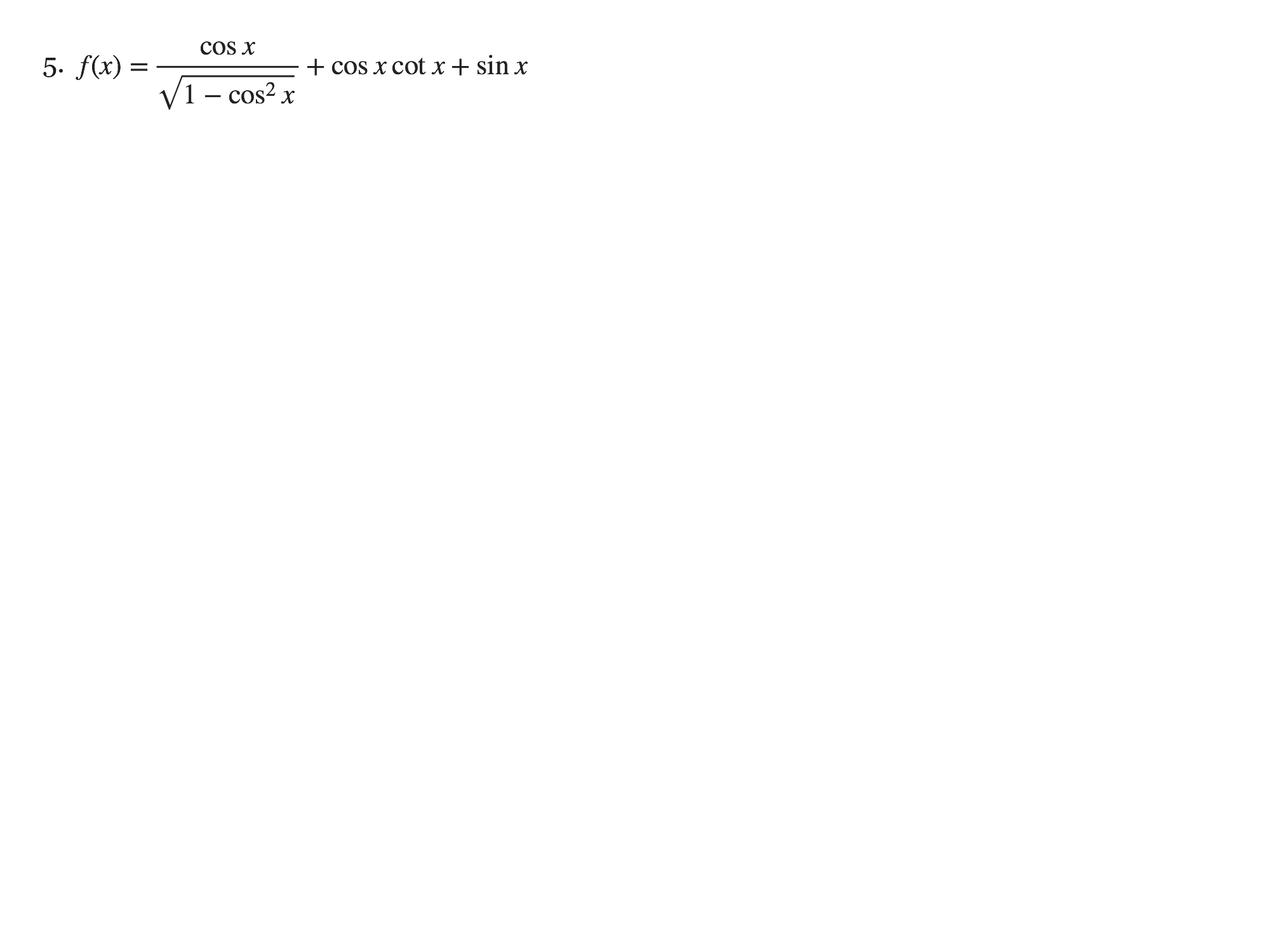
Drawing is temporarily unavailable. Work on paper if needed, then record your reasoning here.
Saving written working requires JavaScript. Keep your work on paper or in your own notes; the source problem above remains available.
Show your work for Problem 6
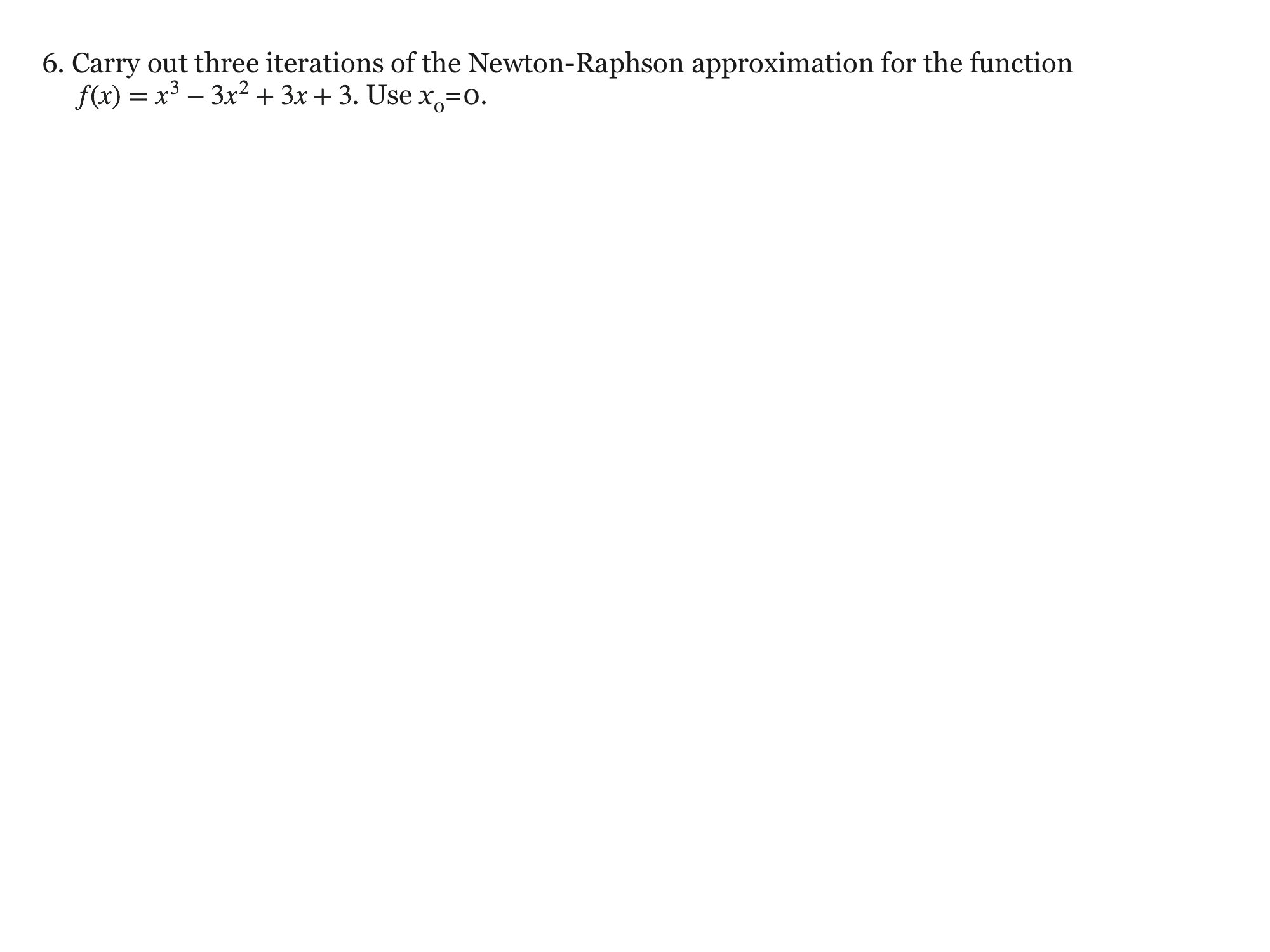
Drawing is temporarily unavailable. Work on paper if needed, then record your reasoning here.
Saving written working requires JavaScript. Keep your work on paper or in your own notes; the source problem above remains available.
- Carry out three iterations of the Newton-Raphson approximation method for the function . Use x0= 0.
Show your work for Problem 7
Source discrepancy: this image gives initial value 0, but the existing readable problem gives initial value e. Both source versions are retained. This overlay does not choose a replacement starting value or change an answer.
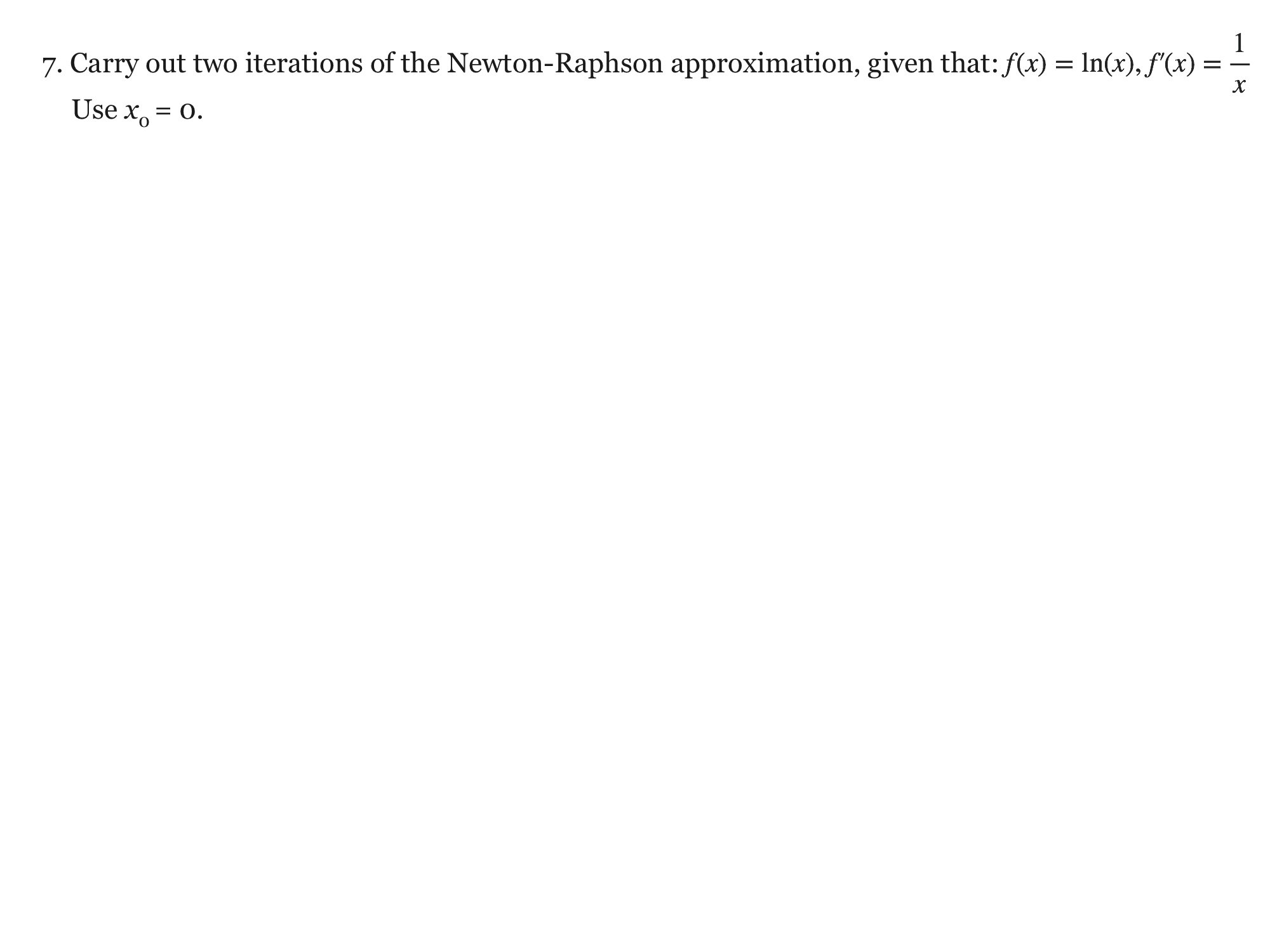
Drawing is temporarily unavailable. Work on paper if needed, then record your reasoning here.
Saving written working requires JavaScript. Keep your work on paper or in your own notes; the source problem above remains available.
Show your work for Problem 8
Drawing is temporarily unavailable. Work on paper if needed, then record your reasoning here.
Saving written working requires JavaScript. Keep your work on paper or in your own notes; the source problem above remains available.
- Carry out two iterations of Newton Raphson approximation, given that:
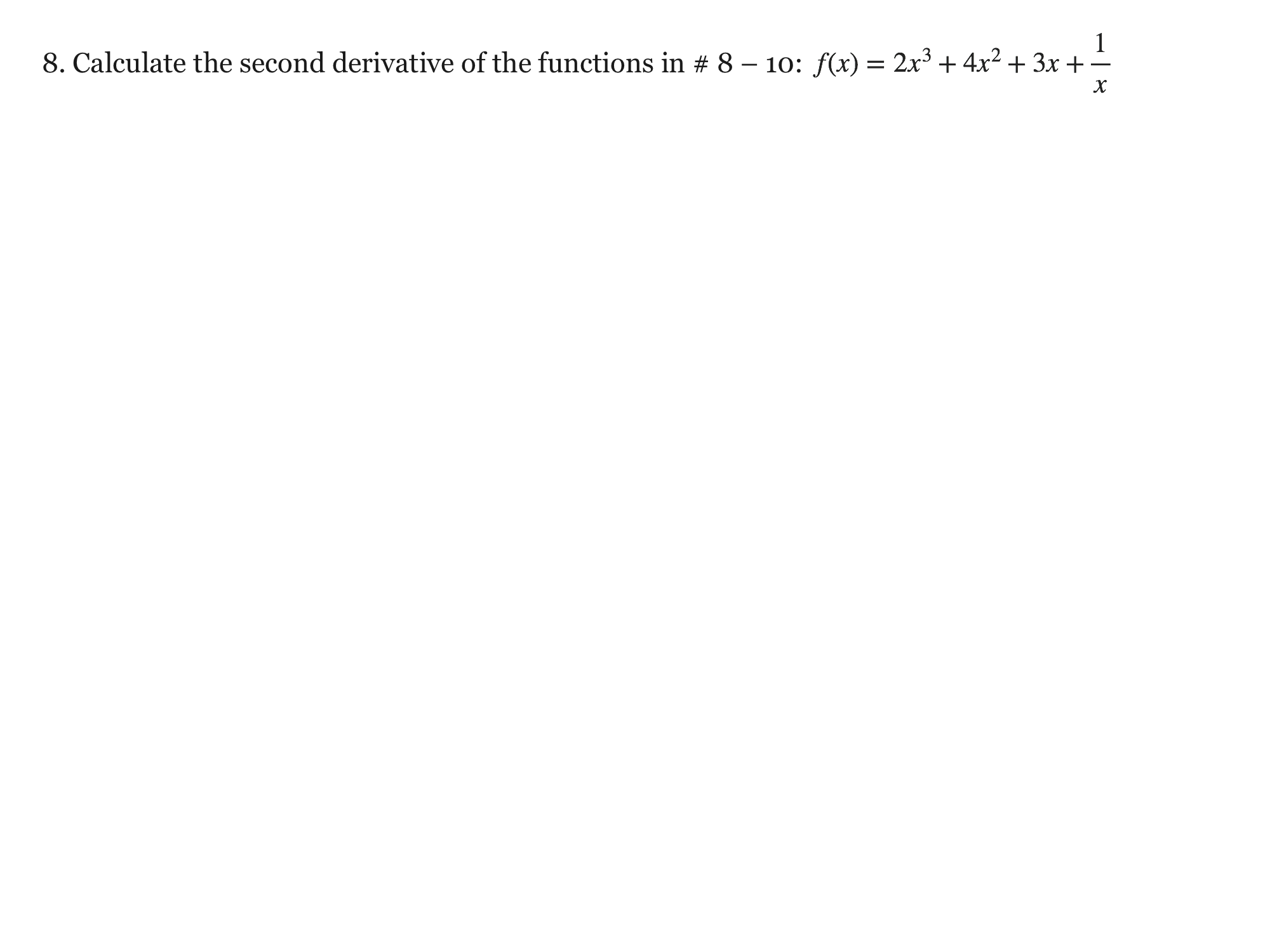
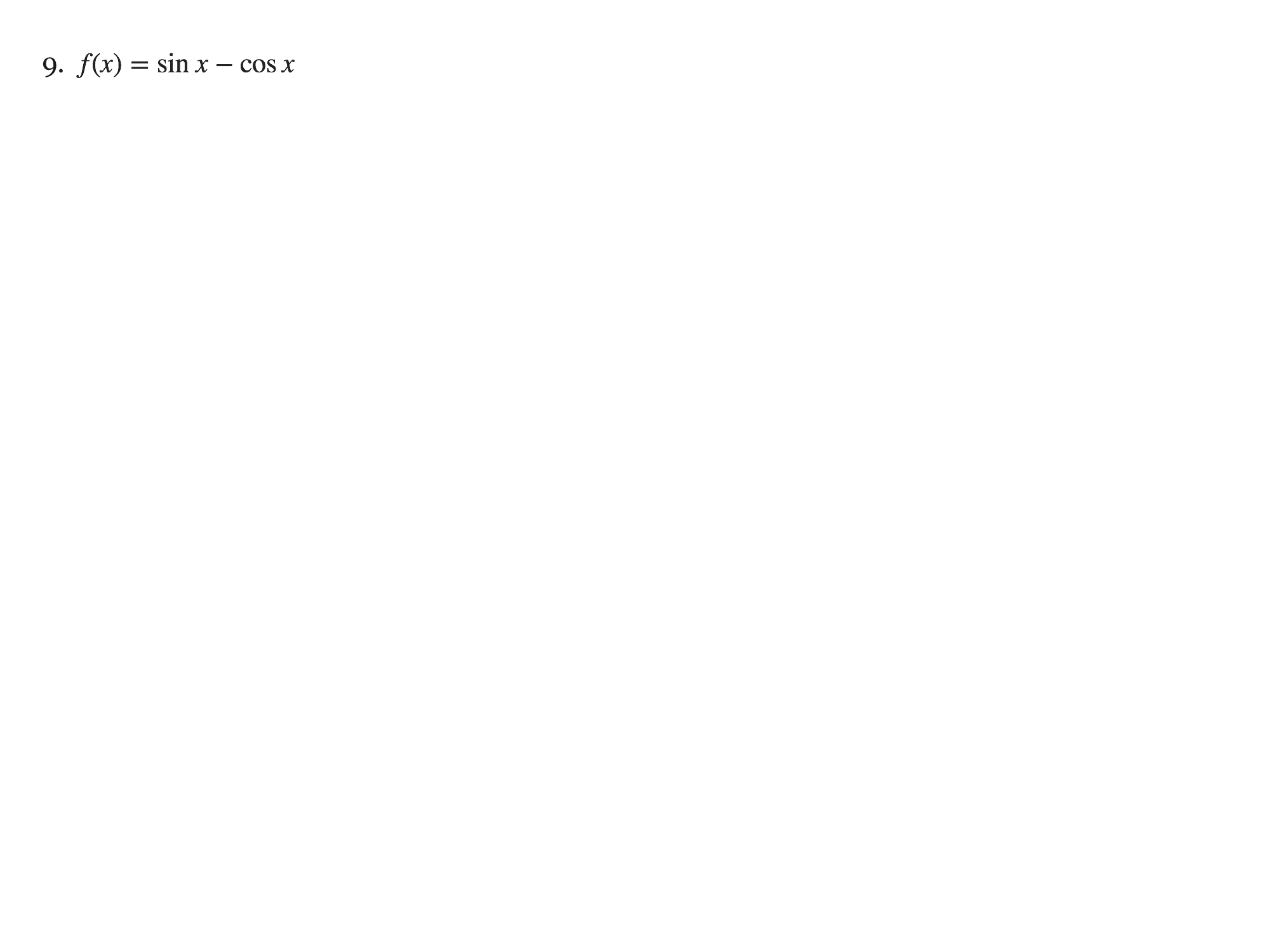
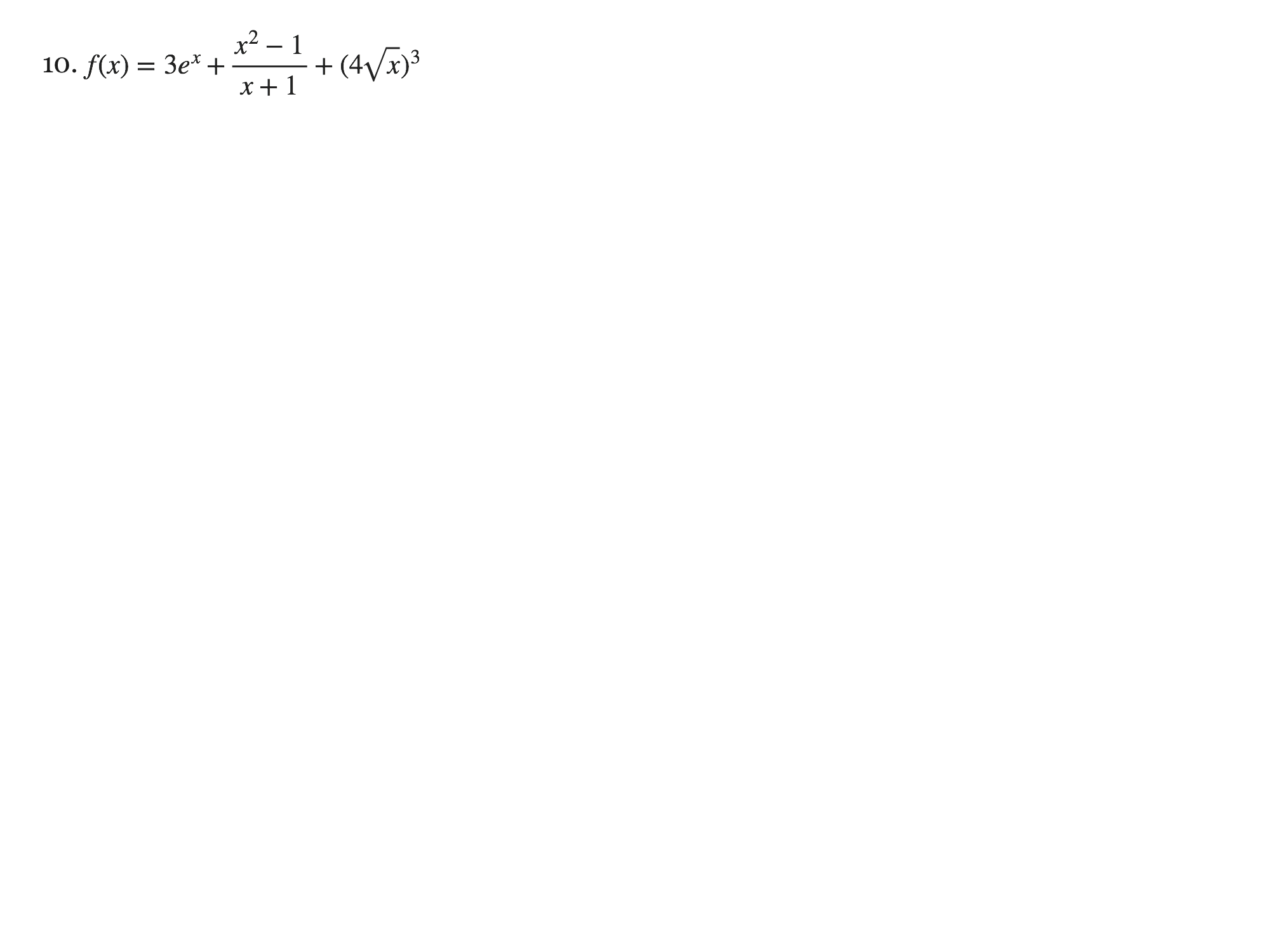
Use xo= e - Calculate the second derivative of the functions in #8 – 10:
Show your work for Problem 9
Shared source instruction or preceding problem:
The source instruction in Problem 8 governs Problems 8–10.
Drawing is temporarily unavailable. Work on paper if needed, then record your reasoning here.
Saving written working requires JavaScript. Keep your work on paper or in your own notes; the source problem above remains available.
Show your work for Problem 10
Shared source instruction or preceding problem:
The source instruction in Problem 8 governs Problems 8–10.
Drawing is temporarily unavailable. Work on paper if needed, then record your reasoning here.
Saving written working requires JavaScript. Keep your work on paper or in your own notes; the source problem above remains available.
Glossary and deeper reading · 8 refreshers
These editorial refreshers supplement the reading. Definitions and examples are added guidance; original source wording and recorded answers remain in their original context.
-
Derivative
A derivative gives the instantaneous rate of change of a function with respect to its input. At a point, it is the finite limit of the difference quotient when that limit exists. For example, the derivative of x² is 2x, so the tangent slope at x=3 is 6. A derivative function collects those rates across the inputs where the function is differentiable.
-
Second derivative
A second derivative is the derivative of the first derivative. It measures how the first rate of change changes with the input; further repeated differentiation gives higher-order derivatives. For example, f(x)=x³ has f′(x)=3x² and f″(x)=6x. For position measured against time, the second derivative is acceleration.
-
Function
A mathematical function assigns exactly one output to each input in its domain. Inputs can share an output, but one input cannot have two different outputs. For example, f(x)=x² assigns the output 9 to both 3 and −3. Function notation names the rule and its input; f(3) means the output when the input is 3.
-
Concavity
Concavity describes how a graph’s slope changes as the input increases. A graph is concave up where its derivative increases and concave down where its derivative decreases. For example, x² is concave up because its derivative 2x increases. A positive second derivative establishes concave-up behavior on an interval, while a negative one establishes concave-down behavior.
-
Inflection point
An inflection point is a point on a continuous graph where its concavity changes. A zero or undefined second derivative may identify a candidate but does not establish that change. For example, x³ changes concavity at 0, while x⁴ has second derivative zero there without changing concavity. Check the behavior on both sides of the candidate.
-
Rolle’s theorem
Rolle’s theorem is the equal-endpoint case of the Mean Value Theorem. A function continuous on [a,b], differentiable on (a,b), and satisfying f(a)=f(b) has an interior point with derivative 0. For example, x² on [−1,1] has equal endpoint values and derivative 0 at x=0. A sharp corner can break the differentiability hypothesis even when the endpoints agree.
-
Differentiability
Differentiability means that a function has a finite derivative at the point under discussion. Differentiability at a point implies continuity there, but continuity alone does not imply differentiability. For example, |x| is continuous at 0 but its left and right tangent slopes differ, so it is not differentiable there. Corners, cusps, vertical tangents, and discontinuities can prevent a finite derivative.
-
Mean Value Theorem
The Mean Value Theorem connects an average rate on a closed interval to an instantaneous rate at an interior point. It requires continuity on the closed interval and differentiability on its interior. For example, f(x)=x² on [1,3] has average slope 4 and derivative 4 at x=2. The theorem guarantees at least one such interior point but need not identify a unique one.