Access this content offline
Omniguides
Skip to the reading

Special Derivatives

This original textbook reading covers part of the AP topic. Follow the AP course outline for complete topic instruction and practice.

This reading includes verified answer corrections and explicitly stated clarifications.

Proof: Derivative of sin(x)

This is a really interesting proof, and one that we can do easily, so let’s give it a shot. Since we can’t use the power rule here, let’s go back to limits, the original definition of a derivative, and plug in our function sin(x), giving us:

ddxsin(x)=limh→0sin(x+h)−sin(x)h

Using the angle addition trigonometric formula found here, we can expand the numerator to

=limh→0sinxcosh+cosxsinh-sinxh ​
notice that the two sin(x) parts can be taken out using the distributive property, giving us

=limh→0sinx(cosh-1)+cosxsinhh

Now let’s split the numerator into two separate limits. Can you see where this is going?

=limh→0sinx(cosh-1)h+limh→0cosxsinhh​
How about now? There should be something familiar in these two limits to you. Perhaps rearranging it might help.

=sinxlimh→0cosh-1h+cosxlimh→0sinhh

I’m feeding you the answer now! These are two of the most important limits we learned earlier! You should be able to see that the first term approaches 0 and the second term approaches 1. Refer to Gallery 2.3.1 if you are unsure.

Once we evaluate the two limits, we can see that the proof simplifies to

=sinx⋅(0)+cosx⋅(1)

=cosx

Finally, we prove that ddxsinx=cosx

Additional Exercise: Prove that the derivative of cos(x) = -sin(x)

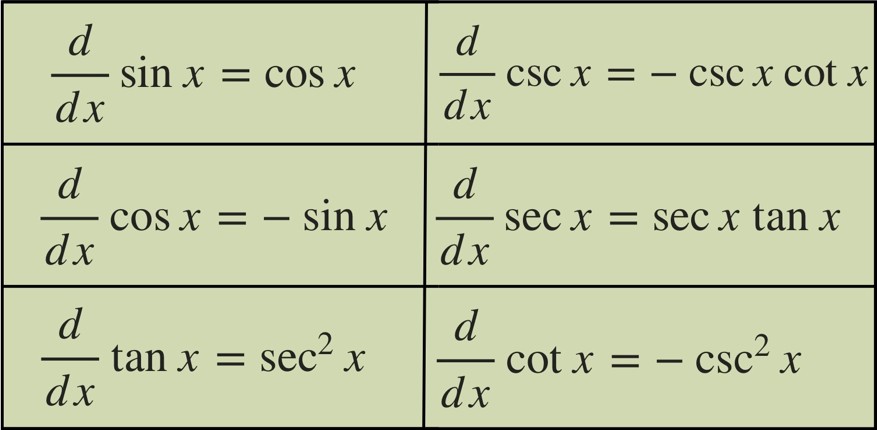
Unfortunately, cos(x) and sin(x) are the only derivatives that are actually quite easy to prove compared to the other trigonometric derivatives. For now, you will have to memorize the rest of the trigonometric derivatives until we cover the quotient rule in the next chapter. Here is a nice table to help you memorize the derivatives a bit more easily.Source figureBefore we try to prove the next derivative, ex, recall that earlier we expressed the function ex as a limit.
ek=limx→∞(1+kx)x

This is often used as the definition for the function ex. This can be altered slightly by replacing x with 1x and the limit will still keep its properties the same. Let’s test it out mathematically:

First, let j=1x. What implications does this have in our formula?

  1. j→0 as x→∞
  1. kx=j⋅k
  1. x=1j

Replacing these in our original formula gives an alternate version of the definition of ek:

ek=limj→0(1+jk)1j​
But j is just another variable, like x. Just like any variable, it can be plotted on a graph.

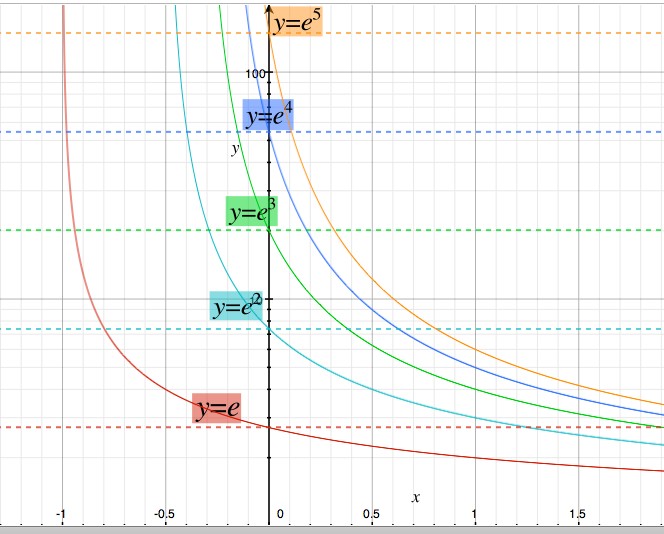
Interactive Image 3.2.1 shows how this can be plotted, rewritten as ek=limx→0(1+kx)1x . Remember this! The function approaches ek as x approaches 0, allowing us to use this as an alternate definition of e. Now, on to the proof of the derivative of ex.

Proof: The derivative of ex

ddxex=limh→0ex+h-exh​
Using exponent laws, we can rearrange part of the numerator

limh→0ex⋅eh-exh​
Writing it this way allows us to factor out the bolded ex.

=limh→0ex(eh-1)h

Interactive 3.2.1 An alternate definition of e.
Interactive 3.2.1 An alternate definition of e.
Read all original figure notes

Increasing k with each graph

This is our function y=(1+kx)1/x with multiple different values of k (represented by the different colored graphs). Notice how ek intersects the graph at 0 for multiple values of k.

Logarithmic axis

Notice that only the y-axis is logarithmic, so every big tick mark is 10 times higher than the previous big tick mark. If we were to count the small tick marks in order, they would go 1, 2, 3, 4, 5, 6, 7, 8, 9, 10, 20, 30, 40, 50, 60, 70, 80, 90, 100, 200, 300, 400, etc. This helps show the big picture on one graph.


We can take the ex out of the limit since it is independent of h, giving

After factoring out ex, the remaining limit is limh→0eh−1h. For the exponential with natural base e, this limit equals 1. We use this established exponential limit; we cannot replace e by a finite-h expression just because that expression tends to e.

ddxex=ex⋅limh→0eh−1h

The key step is a limit, not cancellation of a substituted expression: limh→0 (eh − 1)/h = 1.

Using that exponential limit, we obtain d(ex)/dx = ex · 1.

ddxex=ex

The derivative of ex is ex. Its slope and its height agree at every real x—a pretty useful property!

More generally, every function C ex, with C constant, has derivative equal to itself. This includes the zero function when C = 0.

Example Problem 3.2.1

Calculate ddxsinx+cosxsinx⋅cosx

Usually, the first step in these problems is to convert everything into functions of sine and cosine. However, since this problem is already converted, let’s proceed to splitting the numerator and taking the derivative. We can see that another way to write our function is

=ddx(sinxsinx⋅cosx+cosxsinx⋅cosx)

=ddx(secx+cscx)

=secxtanx-cscxcotx

Example Problem 3.2.2

Find ddx(cosx+sinxtanx)

Let’s simplify the terms into sin(x) and cos(x)​
=ddx(cosx+sinx⋅sinxcosx)

Now we have two separate terms that we cannot add together because they do not have a common denominator (yet). So let’s make it so that they do have a common denominator.​
=ddx(cos2xcosx+sin2xcosx)

You can probably see where this is going now. After adding the terms and simplifying using our trig identities, we get

=ddxsecx

=sec(x)⋅tan(x)

Pop Quiz 3.2.1 Special derivatives

Question 1 of 5 · 0 correct

y=cosx-cotx. What is y’?

Select one answer.
Glossary and deeper reading · 4 refreshers

These editorial refreshers supplement the reading. Definitions and examples are added guidance; original source wording and recorded answers remain in their original context.

  • Derivative

    A derivative gives the instantaneous rate of change of a function with respect to its input. At a point, it is the finite limit of the difference quotient when that limit exists. For example, the derivative of x² is 2x, so the tangent slope at x=3 is 6. A derivative function collects those rates across the inputs where the function is differentiable.

    Read more: 2.2 · Derivative →

  • Quotient rule

    The quotient rule differentiates a quotient where the denominator is nonzero and both functions are differentiable. It gives (f/g)′=(f′g−fg′)/g². For example, differentiating x/(x+1) produces 1/(x+1)² for x≠−1. The order of the subtraction and the denominator square both matter.

    Read more: 2.9 · Quotient rule →

  • Limit

    A limit describes the value approached by outputs as inputs approach a specified target or grow without bound. For an input approaching a finite target, its value at that exact input does not determine the limit. For example, (x²−1)/(x−1) approaches 2 as x approaches 1 even though the original expression is undefined at 1. A finite two-sided limit requires the left and right approaches to agree.

    Read more: 1.2 · Limit →

  • Function

    A mathematical function assigns exactly one output to each input in its domain. Inputs can share an output, but one input cannot have two different outputs. For example, f(x)=x² assigns the output 9 to both 3 and −3. Function notation names the rule and its input; f(3) means the output when the input is 3.

Search lessons, terms and problems