Rolle’s Theorem
This original textbook reading covers part of the AP topic. Follow the AP course outline for complete topic instruction and practice.
- Rolle’s Theorem
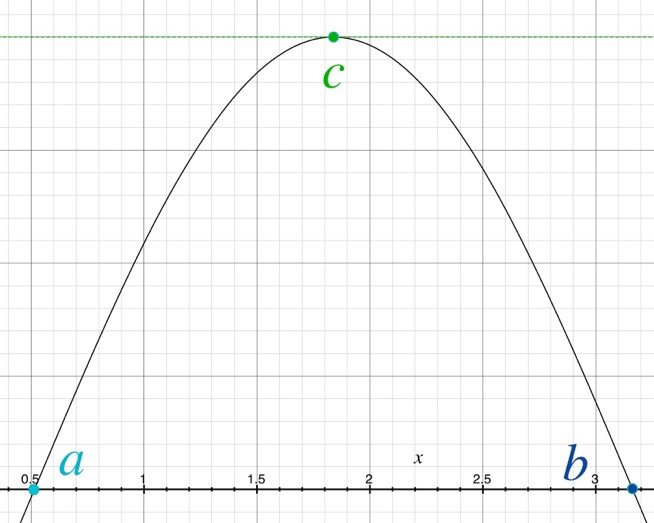
If a function has two roots, and is both continuous and differentiable between these two roots, then there exists at least one point between these two roots where the derivative equals zero.
- Related Glossary Terms
- Index
Glossary and deeper reading · 1 refreshers
These editorial refreshers supplement the reading. Definitions and examples are added guidance; original source wording and recorded answers remain in their original context.
-
Rolle’s theorem
Rolle’s theorem is the equal-endpoint case of the Mean Value Theorem. A function continuous on [a,b], differentiable on (a,b), and satisfying f(a)=f(b) has an interior point with derivative 0. For example, x² on [−1,1] has equal endpoint values and derivative 0 at x=0. A sharp corner can break the differentiability hypothesis even when the endpoints agree.