Acids and Bases
Supporting original reading. Follow the AP topic pathway for reviewed scope, worked reasoning and targeted practice.
Chemistry II · original Chapter 6 · combined Chapter 14
Section Breakdown
- Definitions of Acids and Bases
- Identifying Acids and Bases
- Conjugates
Section 2
Acids and Bases
You can now say whether a solution is acidic or basic by looking at the pH of the solution. But what makes a molecule change the pH of the solution? How can you predict if a molecule will lower or raise the pH?
This section will help you answer that question. You will be able to look at a molecule and say whether that molecule is an acid or a base.
Now, though we say it like that, it’s not actually so easy a distinction. There are actually three main ways of labeling a molecule as an acid or a base.
The original Acid-Base distinction is based on the Arrhenius definition of an acid and base. According to Arrhenius, an acid is any molecule which tends to increase the Hydronium Ion, , in solution. Conversely, a base is a molecule which will decrease the concentration of the Hydronium Ion.
This definition is useful, but it is limited, as it can only apply to compounds when they react with water. If you have an acid and a base react with one another, then neither impacts the concentration.
The next definition is quite a bit more useful. A Brønsted-Lowry Acid is a molecule which can act as a proton donor. The Brønsted-Lowry Base is a molecule which acts as a proton acceptor. This definition is quite a bit more robust, as it allows us to look at a molecule and determine if it’s an acid or base by declaring it a proton acceptor or donator.
So what makes a molecule a proton acceptor or donor?
Gallery 6.2.1 Brønsted-Lowry Acids
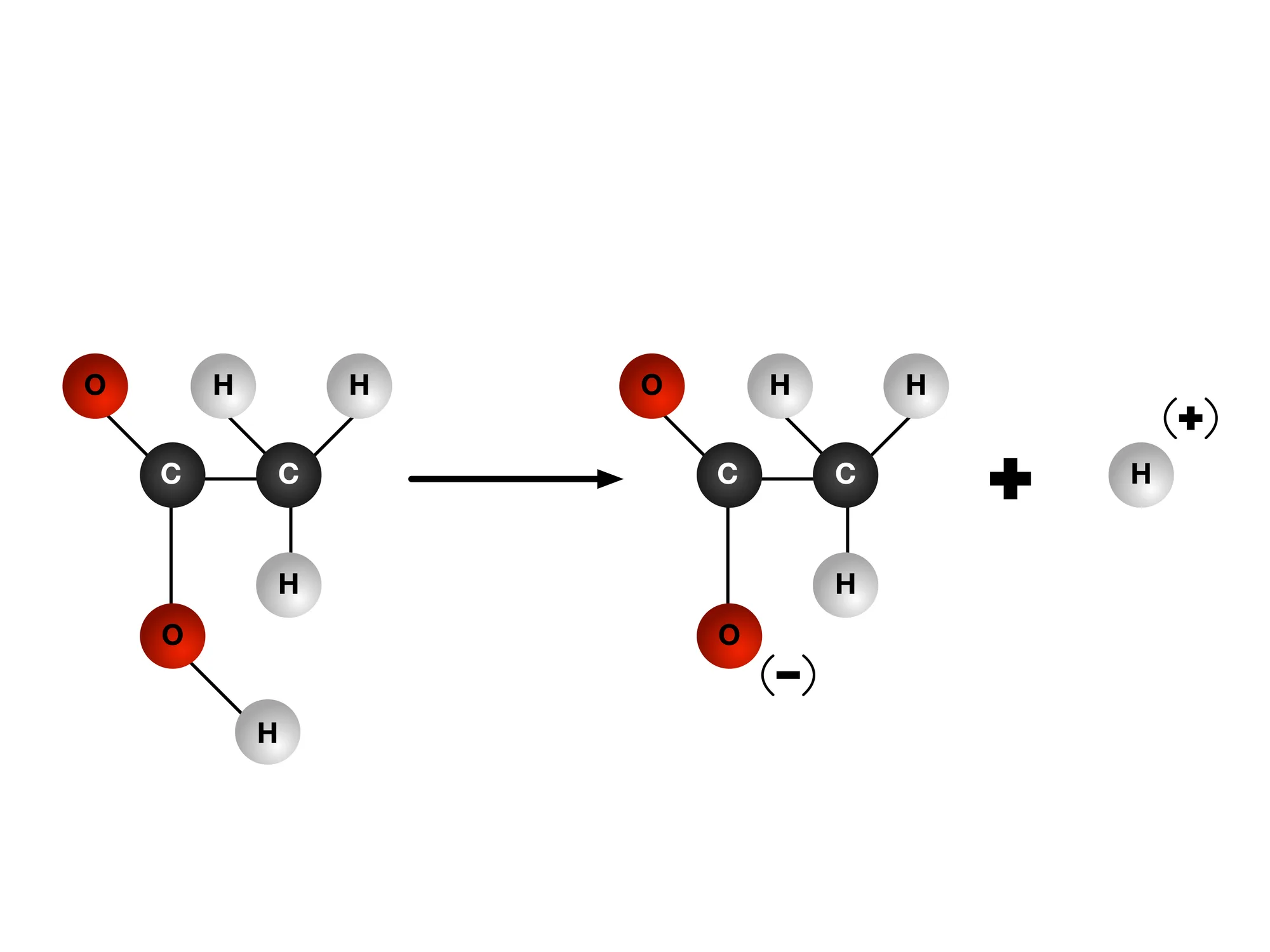
Read all original image captions
Image 1
Image 2
Image 3
HCl
HNO3
H2O
NH4+
H2CO3
Notice that all of these molecules either begin or end with a Hydrogen. Typically, a Brønsted-Lowry Acid will begin or end with a Hydrogen. Also, remember that just because a molecule is an acid or a base, it doesn’t have to act like one under normal conditions. Methane () is technically an acid, but it won’t significantly dissociate even if it is in a solution over pH 50.
| Acid | Conjugate Base |
|---|---|
| HCl | Cl- |
HNO3 | NO3- |
| HBr | Br- |
CH3COOH | CH3COO- |
H2CO3 | HCO3- |
NH4+ | NH3 |
HSO4- | SO42- |
Instead of just looking for a Hydrogen, you need to look at what the potential acid would become if it lost that hydrogen. If that compound could readily exist in solution, then the molecule could be an acid. The compound that results after the hydrogen ion is lost is the conjugate base of the acid. Here are some acid dissociation reactions:
Notice those last two reactions. The conjugate base of is . However, in the next reaction, is acting as an acid. This is because is a polyprotic acid. This means that it can donate more than one proton. Each dissociation reaction has its own equilibrium constant, and they happen separately. is a diprotic acid, as it has 2 protons to donate. is a triprotic acid, donating up to 3 protons.
Here is a table showing conjugate acid-base pairs under the Brønsted-Lowry Definition:
Brønsted-Lowry acids and bases follow a fairly strict naming convention. The acid name is dependent on the conjugate base it is associated with. If the conjugate base is a singular atom (for example, ), then the acid’s name begins with Hydro- and ends with the name of the ion, replacing the -ide with -ic. Therefore, is Hydrochloric acid, and is Hydrobromic acid.
If the conjugate base is a molecular ion (such as ), then the name is simply a modified name of the ion. If the ion ends in -ate, that gets replaced with -ic, and if the ion ends in -ite, that gets replaced with -ous. The mnemonic to recall this is typically “Ate-ic, ite-ous”.
The conjugate base of is , nitrate. Therefore, the acid name take Nitrate and replaces the -ate with -ic. is Nitric acid.
The sequential phosphate-family species are phosphoric acid H₃PO₄, dihydrogen phosphate H₂PO₄⁻, hydrogen phosphate HPO₄²⁻ and phosphate PO₄³⁻. Adjacent forms differ by one proton and are conjugate acid–base pairs.
Gallery 6.2.2 Lewis Acids
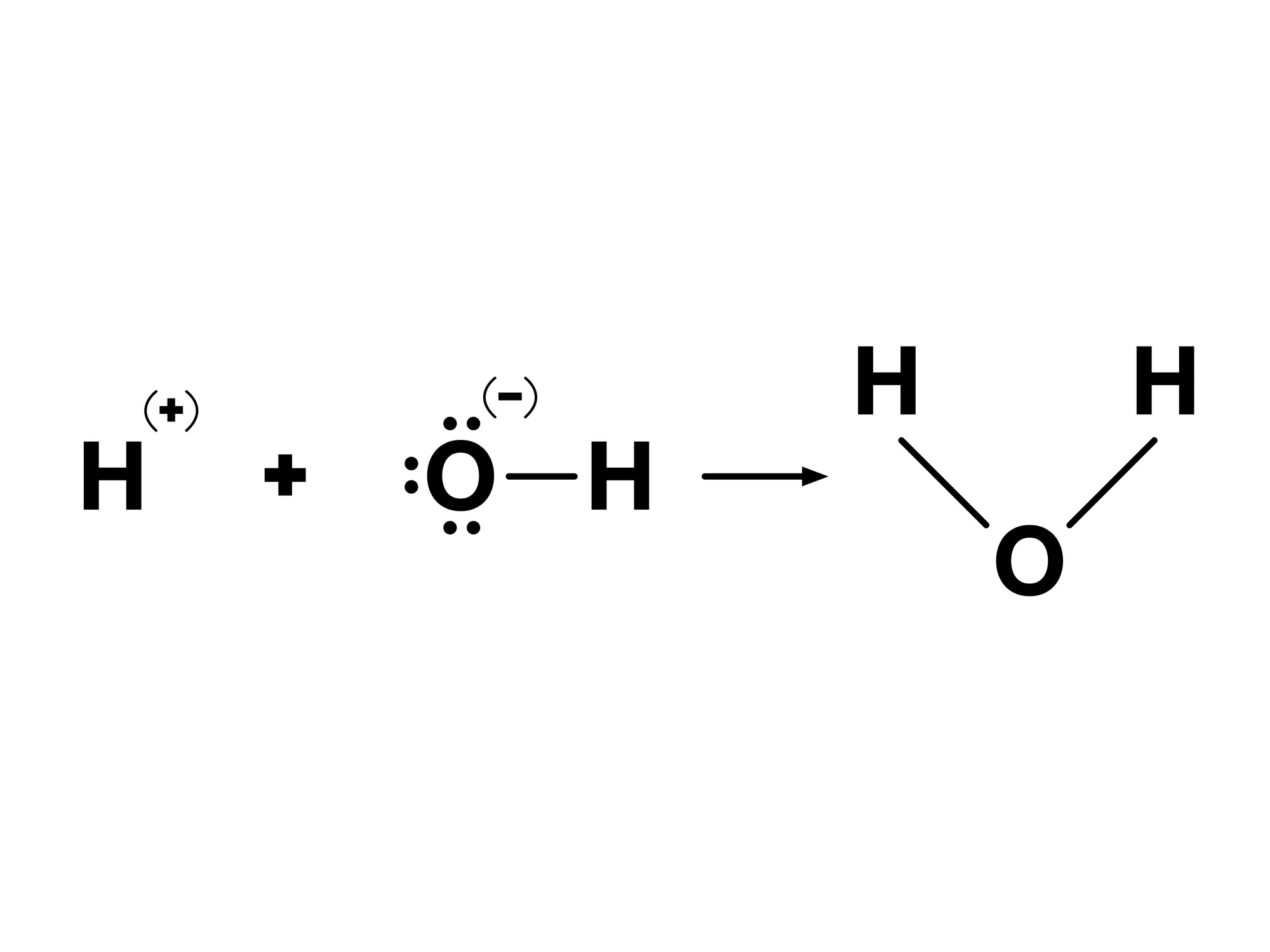
Read all original image captions
Image 1
Image 2
Image 3
The Lewis definition for acids and bases are reliant on electron pairs. According to the Lewis definition, a Lewis Acid is an electron pair acceptor, and a Lewis Base is an electron pair donor.
This definition relies on the Lewis diagrams for the molecules. An electron pair donor would be any molecule which has a lone pair of electrons available for bonding. Anions are one of the most common Lewis base, as are trigonal pyramidal
As for electron pair acceptors, those are a bit harder to identify. Typically most cations will qualify as an electron pair acceptor. This includes Ammonium, Hydronium, and metal cations. Another type of molecule that will be an electron pair acceptor is a trigonal planar molecule, as the central atom in those molecules tend to readily accept electrons.
This definition of acids and bases categorizes molecules based on their Lewis Structure. The acids do not have conjugate bases, as Brønsted-Lowry acids do. One major reason for this is that you don’t convert a Lewis acid to a Lewis base just by adding a proton. Instead, you simply have a Lewis acid or a Lewis Base. The two combine to form a Lewis Adduct.
Glossary and deeper reading · 11 refreshers
These editorial refreshers supplement the reading. Definitions and examples are added guidance; original source wording and recorded answers remain in their original context.
-
pH
pH is the negative base-ten logarithm of hydronium activity. In suitable dilute models, activity is approximated by molar concentration relative to the standard concentration. For example, lowering hydronium concentration by a factor of ten raises pH by one unit.
-
Hydronium
Hydronium is the H₃O⁺ ion used in the introductory model of proton behavior in water. Aqueous H⁺ notation is shorthand for a solvated proton rather than a bare proton moving independently in the liquid. For example, a Brønsted acid can transfer a proton to water and form hydronium.
-
Brønsted acid and base
A Brønsted acid donates a proton, and a Brønsted base accepts a proton. These roles describe a particular reaction, so some substances can act in either role. For example, water accepts a proton from hydrogen chloride but donates one to ammonia.
-
Ion
An ion is an atom or group of atoms with a net electric charge. Ordinary ion formation changes electron count without changing the element's proton count. For example, a sodium atom losing one electron becomes a sodium ion with charge +1.
-
Conjugate acid–base pair
A conjugate acid–base pair consists of species differing by one proton. Losing a proton forms an acid's conjugate base, while gaining one forms a base's conjugate acid. For example, ammonium and ammonia form a conjugate acid–base pair.
-
Polyprotic acid
A polyprotic acid can donate more than one proton per molecule in successive steps. Each step has its own equilibrium constant, so the protons need not dissociate to the same extent. For example, phosphoric acid can lose three protons through separate equilibria.
-
Equilibrium constant
An equilibrium constant is the value of the reaction quotient at equilibrium for a specified reaction and temperature. Its magnitude indicates equilibrium composition preference rather than reaction speed. For example, a large constant often indicates a product-favored equilibrium, but the starting composition still determines the immediate net direction.
-
Lewis acid and base
A Lewis acid accepts an electron pair, and a Lewis base donates an electron pair to form a bonding interaction. This definition includes some acid–base interactions without proton transfer. For example, a nitrogen lone pair can be donated when ammonia binds to an electron-pair acceptor.
-
Lewis structure
A Lewis structure represents valence electrons using bonds and lone pairs. Its construction requires an electron count, an atom arrangement, and a final check against the total available electrons and charge. For example, water's Lewis structure has two O–H bonds and two lone pairs on oxygen.
-
Lone pair
A lone pair is a pair of valence electrons assigned to one atom rather than to a bond in a Lewis model. Lone pairs influence geometry and can participate in interactions or new bonds. For example, oxygen's two lone pairs help explain water's bent molecular shape.
-
Cation
A cation is a positively charged ion. Its total positive nuclear charge exceeds its total electron charge. For example, calcium commonly forms a cation with charge +2 by losing two electrons.