Basic Procedures for Lab-work
Supporting original reading. Follow the AP topic pathway for reviewed scope, worked reasoning and targeted practice.
Chemistry II · original Chapter 4 · combined Chapter 12
Section Breakdown
- Safety
- Cleaning
- Labeling
- Consistency
Section 1
Basic Procedures for Lab-work
Interactive 4.1.1 The well-outfitted student

Read all original figure notes
This section is the boring first section which covers how not to screw up your experiments.
To begin, you should always be wearing proper lab attire when you are working in your lab. This includes long pants, close-toed shoes, goggles, and gloves and apron if needed.
No eating or drinking during lab-work.
If you decide you wish to eat a snack during your lengthy lab, you might get your delicious snack contaminated with chemicals in the lab, requiring a quick trip to the hospital. That’s not fun, so you should simply avoid eating anything in the lab. Also, the lab glassware does not function as a cup for you to drink out of. It may look clean, but there might always be residuals that can really ruin your day.
Before beginning lab work, locate the eyewash and shower and learn your school’s emergency procedure. If a chemical enters the eyes, begin continuous flushing immediately, hold the eyelids open and tell the instructor. Continue for at least 15 minutes and longer when the chemical’s safety guidance or emergency responders require it; arrange prompt medical evaluation. Do not stop after the original one-minute instruction. Corrosive exposure can require longer flushing, so follow the applicable chemical-specific and school guidance.
As for any chemicals you get on your body (arms, legs, chest) that might be cause for chemical burns, the emergency shower is there to rinse you down. This shower will get you soaked, but it will rinse all of a chemical from you so you don’t get chemical burns all over your arm or wherever you may have carelessly spilt a chemical.
Remember that it’s not only you that you need to worry about in a lab. Your lab-mates are also potential spillers, and you need to make sure they follow procedures just as well as you do if you don’t want injury to arise.
Gallery 4.1.2 Cleaning Glassware
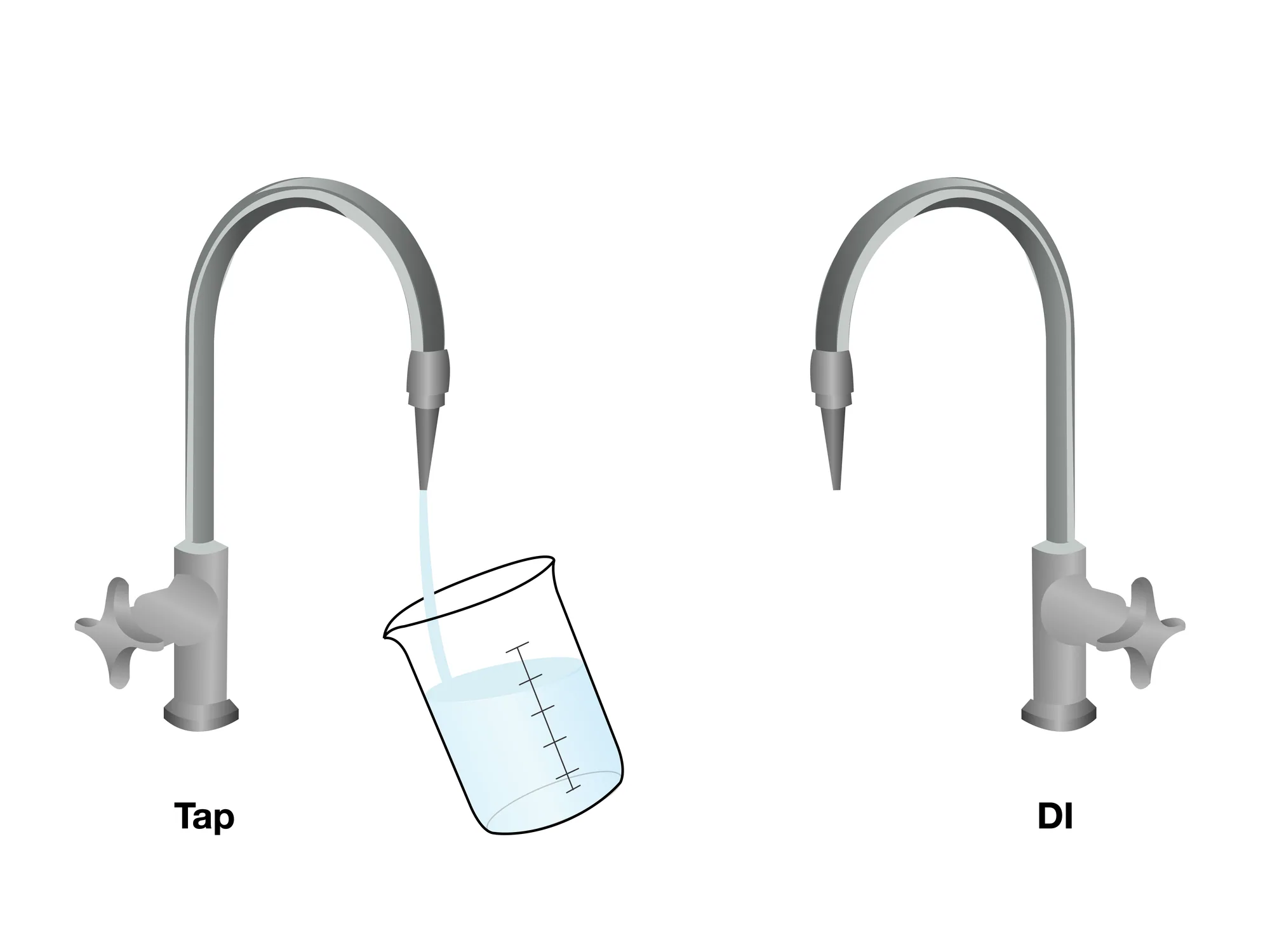
Read all original image captions
Image 1
Image 2
Image 3
Image 4
For an accurate 500 mL preparation, use appropriate clean volumetric glassware under the instructor’s procedure. Do not start by treating 500 mL of water as the final solution volume: adding dissolved solute can change volume. First dissolve the measured solute in less than the final volume, then quantitatively transfer and dilute to the calibration mark after temperature is appropriate.
Laboratory glassware looks pretty clean, but you still need to make sure you clean it yourself to ensure that it actually is clean enough to run your experiment in.
When cleaning glassware, you need to first rinse it to get any particulates off that can just be rinsed off. Then you take a wire brush and scrub the glassware clean. Once the glass is scrubbed, you need to re-rinse it. Rinse it three times with DI water to ensure that the glassware is not troubled by ions in the leftover water.
Once the glassware piece is clean, you can dry it with a paper towel or just start using it, if you don’t need a perfectly dry item.
Make sure to clean every piece of equipment that you use throughout your experiment. Otherwise you might introduce a chemical that would ruin the integrity of your experiment by causing false results.
Once you have your glassware clean, you can begin making your solution.
To make 0.100 M NH₄Cl, calculate the required moles from c=n/V, with c in mol L⁻¹ and V the final solution volume in liters. Rearranging gives n=cV. This is division in the concentration definition, not n×V. Keep the target at 0.100 M throughout; the original reference to 10 M did not match the preparation.
If we need 500mL of a 0.10M solution, we can figure out the number of moles we need by:
n=(0.100 mol L⁻¹)(0.500 L)=0.0500 mol NH₄Cl. The concentration and volume units cancel to leave moles.
Now convert 0.0500 mol NH₄Cl to a mass that the balance can measure. Molar mass relates them through n=m/M, or m=nM. The symbol M here denotes molar mass, while molarity is written c; keeping them distinct avoids a common notation mix-up.
is the number of moles of the compound
is the mass of the compound
is the molecular weight of the compound
Gallery 4.1.3 Making a Solution
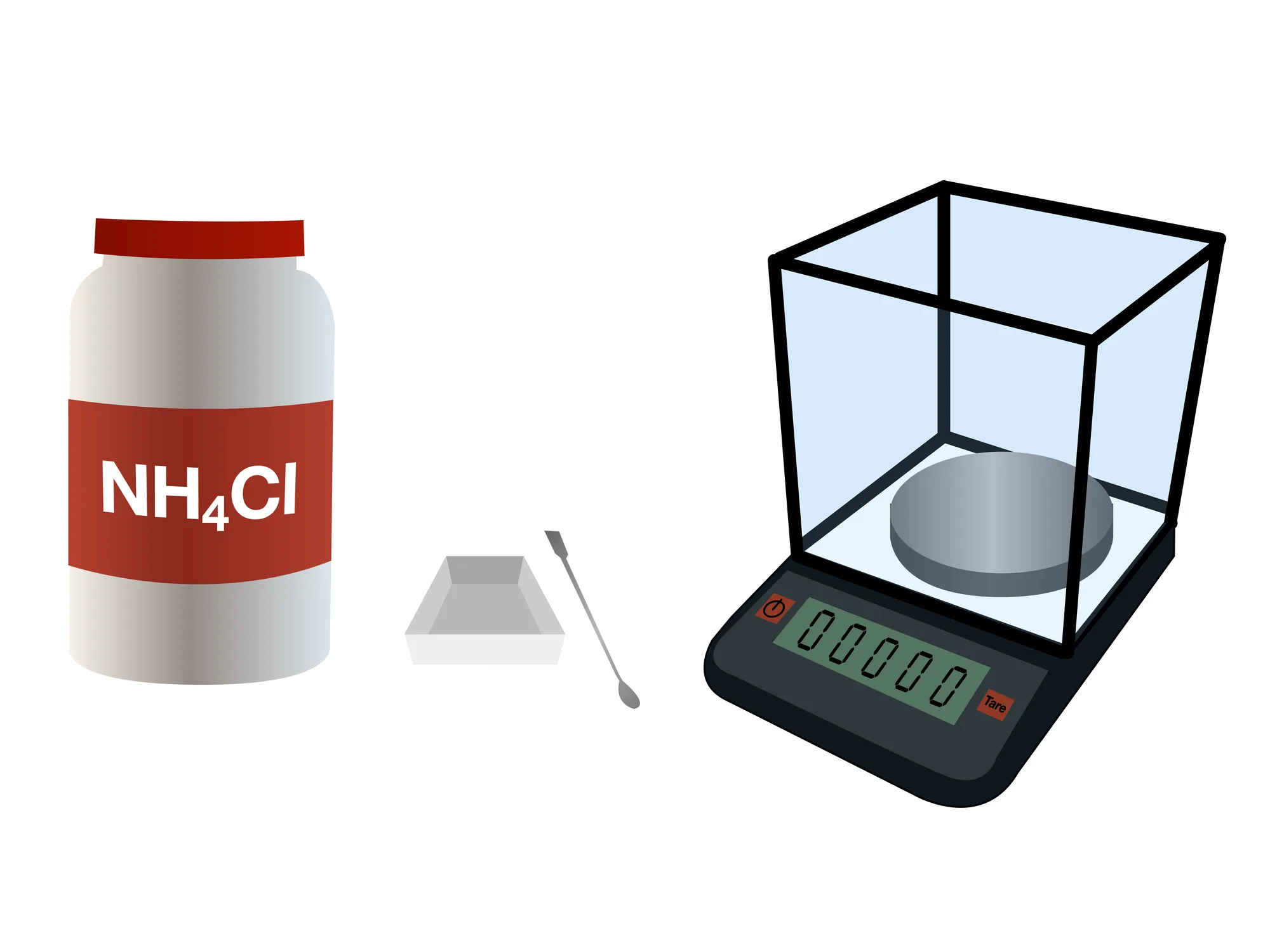
Read all original image captions
Image 1
Image 2
Image 3
Image 4
Image 5
Image 6
Image 7
Image 8
Image 9
Image 10
m=nM=(0.0500 mol)(53.49 g mol⁻¹)=2.6745 g. This keeps both the amount and molar-mass units visible.
The calculated mass is 2.6745 g, reported as about 2.67 g for the stated target precision. Record the actual mass read from the balance and use it if you later calculate the actual prepared concentration.
Therefore weigh about 2.67 g ammonium chloride for 500 mL of 0.100 M solution. It is the amount corresponding to the final 0.500 L solution, not an instruction to add 10.1 g to half a liter of water.
Use a clean weighing vessel and tare the balance before adding NH₄Cl. Add the solid gradually to obtain the calculated amount, about 2.67 g; record the displayed mass and the balance precision. Avoid implying that extra decimal places guarantee accuracy.
Use a clean scoop to add NH₄Cl until the measured mass is near 2.67 g, then record the actual value. The appropriate number of decimals depends on the balance and the required concentration precision, not simply on how many digits the earlier calculation produced.
Dissolve the weighed NH₄Cl in less than 500 mL of deionized water, transfer quantitatively into a 500 mL volumetric flask, rinse the transfer vessel into the flask, and dilute to the calibration mark at the appropriate temperature. Stopper and mix thoroughly. This gives a final solution volume of 500 mL; adding the salt to 500 mL water does not establish that volume.
You can use a spatula or other clean instrument to stir the solution to encourage homogenous mixing and complete dissolution of the salt.
Now all that’s left is to add the NaCl that the experiment called for. You can go ahead and add it the same way you measured and added the Ammonium Chloride.
Record observations carefully: bubbles, a color change, a temperature change or a solid appearing can be evidence to investigate. They do not alone prove a new chemical species formed. Bubbles may come from boiling or released dissolved gas, and temperature can change during physical dissolution. Compare observations with controls and a chemical model before claiming a reaction.
With these two chemicals, however, you probably won’t be seeing any reaction occur, as they don’t react to form anything. In the lab, you will typically encounter many reactions though, and the above list are just a few things that you might see happen.
Another basic Lab Procedure we will cover is making dilutions. Sometimes you need to get a concentrated solution and dilute it down to a lower concentration. Typically this occurs with acids and bases, and you should therefore take extreme caution working with the concentrated acid or base.
Let’s go through an example of a dilution you might prepare in lab.
Reviewed dilution exercise: you need 30.0 mL of 0.500 M HCl solution from a 5.00 M stock provided under the instructor’s approved protocol. What aliquot is needed? This replaces the unrealistic 15 M HCl stock and does not claim that ordinary dilute HCl completely dissolves a copper penny.
Use an appropriate volumetric pipette or another instructor-approved calibrated device for the required 3.00 mL aliquot of 5.00 M stock. Do not use an uncalibrated eyedropper to claim a precise volume. The stock acid is handled under the approved lab procedure.
In order to run a dilution, you need to know the volume of DI water you need to add in order to reduce the concentration to what you want. If you add water alone to adjust the volume, the moles of the solution will not change. Therefore:
The amount in a 3.00 mL aliquot of 5.00 M stock is 0.0150 mol. We want that same amount in a final volume giving c₂=0.500 M. The dilution relation c₁V₁=c₂V₂ follows from conservation of the solute amount.
Dilute the 3.00 mL stock aliquot to a final solution volume of 30.0 mL. The resulting concentration is 0.500 M in the stated preparation model. Final volume is not the same as the amount of water separately poured in.
Do not add 30.0 mL water to the aliquot and call that a 30.0 mL solution. Use calibrated final-volume preparation, and follow the instructor’s procedure for adding acid to water and allowing the solution to reach the appropriate temperature.
For the reviewed preparation, begin with some water in suitable glassware, add the measured acid aliquot to the water under the approved procedure, allow the solution to reach the calibration temperature, and dilute to a final 30.0 mL. Do not calculate an exact water-addition volume by subtracting 3.00 from 30.0; liquid mixing volumes need not be exactly additive.
Glossary and deeper reading · 8 refreshers
These editorial refreshers supplement the reading. Definitions and examples are added guidance; original source wording and recorded answers remain in their original context.
-
Solute
A solute is a component dispersed in a solvent to form a solution. It need not be a solid, and a solution need not be liquid. For example, carbon dioxide is a gaseous solute in carbonated water.
-
Dilution
Dilution lowers solute concentration by adding solvent while conserving the solute amount when no reaction or loss occurs. Concentration calculations use the final solution volume rather than simply the volume of solvent added. For example, increasing a solution's volume from 100 to 200 milliliters halves its concentration if its solute amount is unchanged.
-
Deionized water
Deionized water has had most dissolved ions removed. It is not necessarily free of every nonionic impurity or microorganism. For example, using deionized water can reduce unintended ions in a prepared analytical solution.
-
Ion
An ion is an atom or group of atoms with a net electric charge. Ordinary ion formation changes electron count without changing the element's proton count. For example, a sodium atom losing one electron becomes a sodium ion with charge +1.
-
Mole
A mole is an amount of substance containing exactly 6.02214076 × 10²³ specified entities. The entities can be atoms, molecules, ions, or formula units, so the counted entity must be named. For example, one mole of oxygen molecules contains two moles of oxygen atoms.
-
Molar mass
Molar mass is the mass of one mole of a specified substance. It is commonly expressed in grams per mole and connects a sample's mass to its amount of substance. For example, water has a molar mass of approximately 18.02 grams per mole.
-
Molarity
Molarity is the amount of a solute in moles divided by the final solution volume in liters. It describes concentration rather than the total amount of solute. For example, 0.10 mole dissolved to make 0.50 liter of solution gives a molarity of 0.20 mole per liter.
-
Aliquot
An aliquot is a measured portion taken from a sample. In analysis, a representative aliquot lets a measured result be related to the original sample's total amount. For example, a 10-milliliter portion of a uniform solution can be an aliquot of a larger prepared sample.