Predicting pH of Titrations
Supporting original reading. Follow the AP topic pathway for reviewed scope, worked reasoning and targeted practice.
Chemistry II · original Chapter 7 · combined Chapter 15
Section Breakdown
- Initial
- from start to equivalence point
- at equivalence point
- after equivalence point
Section 3
Predicting pH of Titrations
How can we predict the as we add the titrant? Well, there are two main points that will have a set , and then two ranges
The first point is the starting , before adding any titrant. Typically, this can be approximated by assuming the dissociation or association of the acid or the base is negligible. If we do so, we can find by using the or of the acid or base. Let’s make an ICE table of the situation with Ammonia:
For the equilibrium expression, we drop the , as it isn’t taking part in the reaction.
Therefore, we can approximate it as:
Where is the initial concentration of the base. This means that pH can be shown to be:
So what’s going on after that? Well, we know the neutralization reaction is occurring then.
So how can we determine the equilibrium of this reaction? First we have to look at the involved reactions, and investigate their equilibrium coefficients.
As the Hydrochloric acid is a strong acid, the equilibrium for that is assumed to be completely dissociated. Therefore we can dissociate it in the neutralization equation:
Now the Chloride ion has become a spectator, and once we eliminate that, we are left with the Ammonia protonation reaction:
Next, we take a look at the equilibrium equation for this reaction:
This looks mighty similar to the equation for Ammonium:
As the two equations are merely the inverse of one another, we can look at this part in terms of .
As we are tracking , we need to use the Henderson-Hasselbalch equation:
Now applying that to our situation, we have:
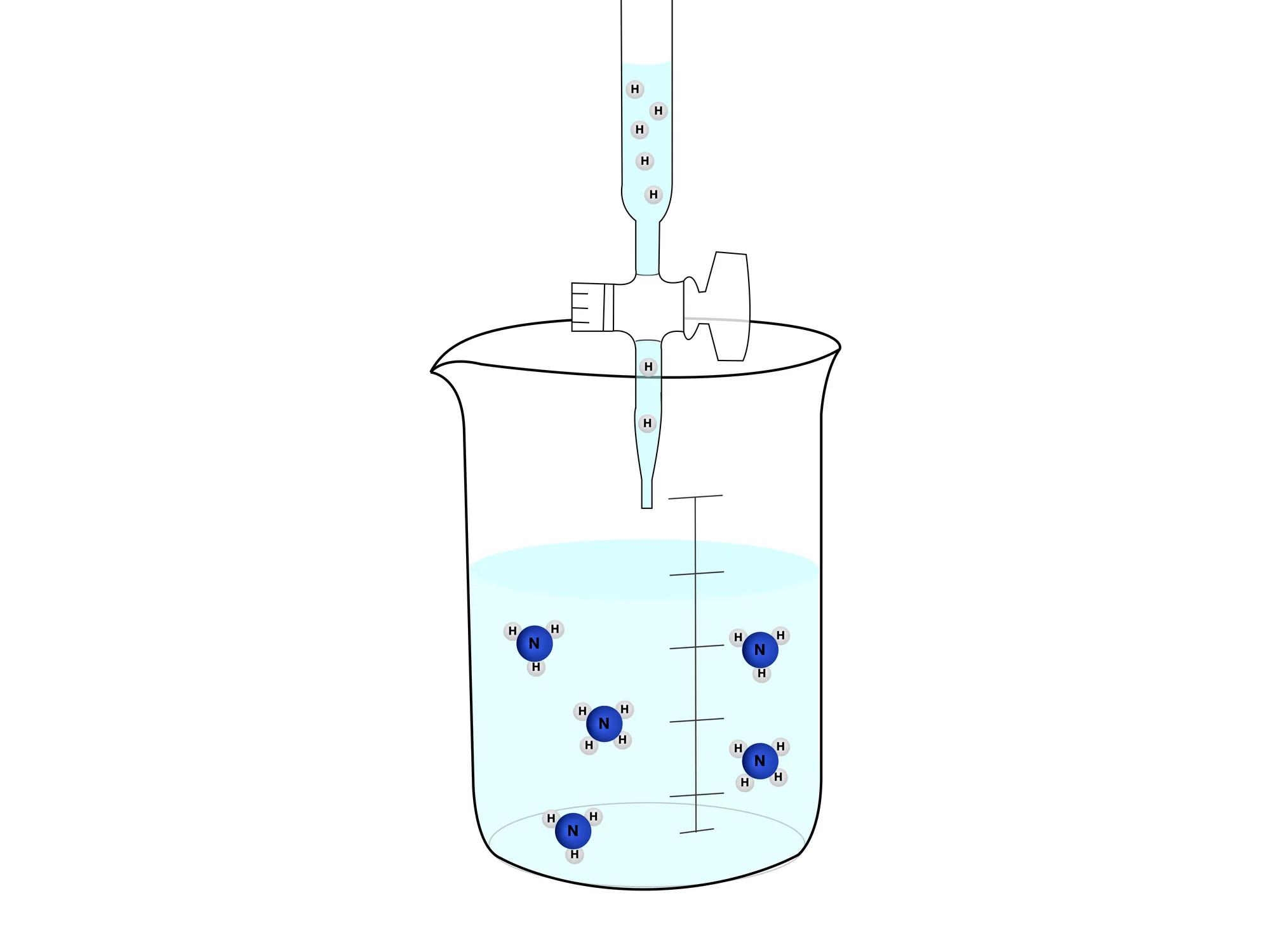
We need to figure out how to track . If we assume that there is negligible protonation of ammonia before we started adding the acid, we can safely say that the protonation of the Ammonia is solely from the addition of from the acid. Here’s the neutralization equation again:
Gallery 7.3.1 Equivalence Point
Read all original image captions
Image 1
Image 2
Image 3
Image 4
On a mole basis, the initial situation is approximately the following:
And as we add the acid, we can determine the moles acid as:
We don’t know the exact number of moles of Ammonium, as we don’t know the concentration (that’s the whole point of the titration!) We do know every other variable for these equations, as we are adding known amounts of a known concentration of to a known volume of the Ammonia solution.
We know that one mole of protonates one mole of . Therefore, we can track the moles of Ammonia in solution by subtracting the moles of we have added. Similarly, one mole of Ammonium is generated by one mole of addition, so that can be tracked the same.
Now that we have the moles, we need to re-write the Henderson-Hasselbalch equation to utilize the moles instead of the concentration.
Recall:
Throughout the titration, is going to be the sum of the initial volume and the volume of the titrant added:
The overall goal is to plot , so we need to get this equation into that form. To do so, we replace the equations for the moles of each .
Of course, we don’t know the concentration of ammonia, so we can’t just draw up the plot. We need to track as we add the .
What this shows is that the of the solution will start to drop considerably once the amount of added gets very close to the moles of , as the term will approach . Therefore, you expect to see a drop in as it reaches the equivalence point. At the equivalence point, however, the equation falls apart, as , just by the definition of the equivalence point. If we want to predict the at the equivalence point, we have to use a different approach. To find it, we need to start by making a couple assumptions.
First, being at the equivalence point, we can say that the moles of added is equivalent to the moles of initially present.
Second, we need to assume that because the neutralization reaction has completely progressed, meaning that all of the has been converted to .
This implies that the number of moles of at the equivalence point is equal to the number of moles of added.
Now let’s look at the acid equilibrium for Ammonium.
We can use this equation to solve for . The ICE table for this reaction is:
We need to come up with a value for . We know the number of moles:
We also know the volume of the solution:
Substituting these values gives us:
We can actually get rid of the volumetric variables in this equation, as the equivalence point’s is independent of the volumes, and solely reliant on the concentrations involved. To do this, we need to go back to the equivalence equation:
Now solve for
Plug this into the equation:
Now we can cancel the .
That looks bad, so let’s simplify it.
Now we can plug this into the equilibrium equation.
Use this to solve for .
That is a bit confusing, as it’s the of , the conjugate acid of the base we are titrating. Perhaps it would be easier to look at this solely in terms of and . To do this, let’s use the relationship between and .
Now we can find as:
Now we are using the of our starting base, which makes things a bit clearer.
One more part of the titration is after the equivalence point. Generally, a titration will stop once the equivalence point it reached, but sometimes you want to keep going, as you wish to examine the whole trek of the , in order to find the equivalence point as the center of the drop.
So if we want to track the as we add even more acid, we have to realize that by this point, all of the has been converted. Therefore, all the we add from this point on will have no left to protonate, so it will contribute directly to the by simply dissociating (remember it is a strong acid, so we assume complete dissociation).
For this leg of the titration, we will assume that the no longer has a significant impact on the , and the instead comes from the unreacted that is added.
To track the , we will assume complete dissociation of :
So what is the concentration of ? Well, let’s figure that out based off a molar basis. Recall that as it was first added, the was reacting with :
Therefore, the unreacted must be what is left after fully protonating the :
Now we can define in our usual terms:
Use this to determine .
We are assuming completed dissolution, so:
Now we can find :
With these equations, we can successfully predict the at any point of a titration, though it requires knowing the initial concentration of the Ammonia. We could use a program to fit these equations to a measured graph, but that is quite a bit more complicated than predicting the from these equations.
Glossary and deeper reading · 11 refreshers
These editorial refreshers supplement the reading. Definitions and examples are added guidance; original source wording and recorded answers remain in their original context.
-
Equivalence point
The equivalence point is the condition where titrant and analyte have reacted in the balanced equation's stoichiometric ratio. Its pH depends on the species remaining and is not always seven. For example, a weak-acid–strong-base titration has a basic equivalence-point solution under the usual model.
-
pH
pH is the negative base-ten logarithm of hydronium activity. In suitable dilute models, activity is approximated by molar concentration relative to the standard concentration. For example, lowering hydronium concentration by a factor of ten raises pH by one unit.
-
Titration
Titration measures an analyte by its reaction with a measured amount of another reagent. The balanced reaction and the observed endpoint must be connected to the equivalence condition. For example, an acid's amount can be inferred from a measured volume of a base with known concentration.
-
Titrant
A titrant is the reagent added in measured amounts during a titration. Its concentration and reaction stoichiometry connect the delivered volume to the analyte amount. For example, a standardized base solution can be the titrant for an unknown acid.
-
ICE table
An ICE table organizes initial concentrations, stoichiometric changes, and equilibrium concentrations. Its change entries follow the balanced equation and do not imply equal changes for every species. For example, producing two units of a product for each reactant consumed requires twice the concentration-change entry for that product.
-
Chemical equilibrium
Chemical equilibrium is a dynamic state in which forward and reverse reaction rates are equal. Macroscopic composition remains constant in a closed system under fixed conditions, but reactant and product concentrations need not be equal. For example, a reversible reaction can reach equilibrium with much more reactant than product.
-
Strong acid or base
A strong acid transfers protons essentially completely to water in the applicable aqueous-solution model. A dissolved strong hydroxide base dissociates into its constituent ions and supplies hydroxide; it does not have to react with water to generate that hydroxide. Strength is distinct from concentration and, for a solid base, from how much can dissolve. For example, dissolved sodium hydroxide supplies sodium and hydroxide ions even when the prepared solution is dilute.
-
Ion
An ion is an atom or group of atoms with a net electric charge. Ordinary ion formation changes electron count without changing the element's proton count. For example, a sodium atom losing one electron becomes a sodium ion with charge +1.
-
Henderson–Hasselbalch equation
The Henderson–Hasselbalch equation relates a buffer's pH to an acid's pKa and the ratio of conjugate-base to acid activities. Concentration ratios approximate activity ratios only when the model's conditions are appropriate. For example, equal effective amounts of an acid and its conjugate base give pH approximately equal to pKa.
-
Mole
A mole is an amount of substance containing exactly 6.02214076 × 10²³ specified entities. The entities can be atoms, molecules, ions, or formula units, so the counted entity must be named. For example, one mole of oxygen molecules contains two moles of oxygen atoms.
-
Conjugate acid–base pair
A conjugate acid–base pair consists of species differing by one proton. Losing a proton forms an acid's conjugate base, while gaining one forms a base's conjugate acid. For example, ammonium and ammonia form a conjugate acid–base pair.