FFR: Multiple Reactions
Supporting original reading. Follow the AP topic pathway for reviewed scope, worked reasoning and targeted practice.
Chemistry II · original Chapter 3 · combined Chapter 11
Earlier Kinetics questions → · Original wording and formula figures from an earlier version of this chapter.
Section Outline
- Multi-step Reactions
- Parallel Reactions
- Chapter Problems
Section 4
FFR: Multiple Reactions
In all this chapter, we have only looked at situations where we have one reaction progressing in one direction. What do we do, then, if more than one reaction is progressing in the same system?
If you recall, we actually did cover this already, though it was fairly well hidden. In our example problem last section involving Calcium Carbonate formation, there were multiple reactions occurring at the same time. Can you identify what reactions we had in that system? There were three in total.
Ca²⁺(aq)+CO₃²⁻(aq)→CaCO₃(s) describes the net precipitation. Solid CaCl₂ and Na₂CO₃ can dissolve to produce ions, but salts already supplied as aqueous solutions are already represented by dissolved ions. Neither a net dissolution nor a precipitation equation automatically describes an elementary step.
What does that mean for us? Well, let’s look at the overall reactions, starting from the salts and ending with the Calcium carbonate.
For mixed aqueous solutions, the complete ionic description has Na⁺ and Cl⁻ as spectators and the net equation Ca²⁺(aq)+CO₃²⁻(aq)→CaCO₃(s). A mechanistic rate model needs evidence and explicit conditions; do not assign exponents solely from these equations.
A sequential chemical mechanism consists of proposed elementary steps. Identify intermediates and cancel them when summing steps. The measured overall rate law tests a mechanism; a balanced overall equation alone does not specify it.
Let’s take a step back from chemistry for the time being and just look at a real world example of this situation.
Gallery 3.4.1 Plastic Bottle Production
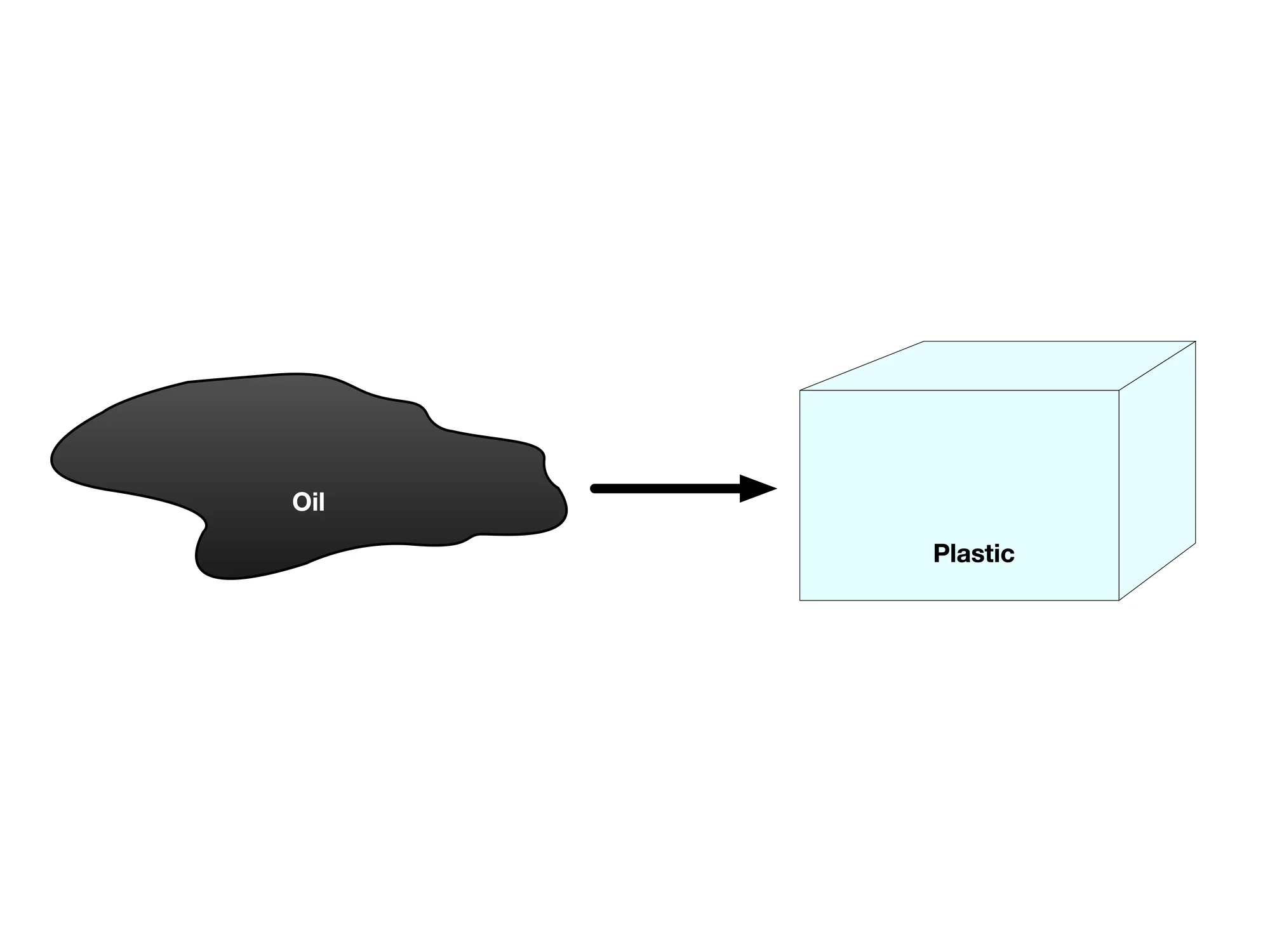
AP edition reviewed context. This is an analogy involving factory capacities, converted to the common basis bottles per day. It does not authorize comparison of different-unit chemical rate constants to find a slow step.
Read all reviewed image captions
Image 1
AP edition reviewed context. This is an analogy involving factory capacities, converted to the common basis bottles per day. It does not authorize comparison of different-unit chemical rate constants to find a slow step.
Image 2
AP edition reviewed context. This is an analogy involving factory capacities, converted to the common basis bottles per day. It does not authorize comparison of different-unit chemical rate constants to find a slow step.
Image 3
AP edition reviewed context. This is an analogy involving factory capacities, converted to the common basis bottles per day. It does not authorize comparison of different-unit chemical rate constants to find a slow step.
Let’s say that the plastic formation can create up to 100Mg of plastic per day from petroleum. The bottle factories have 1242 trucks that can move up to 2000kg of plastic per day. The bottle factories can together make up to 300,000 bottles per day, with each bottle using 1.2kg of plastic to make.
The syrup plants can produce 400L of syrup per day. Each bottle requires 1mL of syrup to reach the desired concentration. The bottling plants can fill up to 500,000 bottles per day.
We want to produce more bottled products each day, and we have only have enough money to improve one aspect of the production. Which aspect should we focus on improving?
To figure this out, we have to understand which aspect of production is slowing us down the most. In order to do so, we need to be able to compare every aspect on an single basis of comparison. Perhaps the easiest is to look at each aspect in terms of the bottles it can support per day.
The plastic formation creates 100Mg of plastic per day. We know that each bottle uses 1.2kg of plastic in its production, so that means the plastic formation can support up to 83,333 bottles per day.
The trucks can move up to 2000kg of plastic per day. With 1242 trucks, that means 2484Mg of plastic moved per day, which can make 2,070,000 bottles per day.
The bottle factories have a strict limit of 300,000 bottles per day.
If the syrup plants produce 400L, and you only need 1mL per bottle, that means 400,000 bottles per day can be supported.
The bottling plants have their limit at 500,000 bottles per day.
Now that we know what the capacities of each aspect is in bottles per day, we know what the slowest point of production is. That would be the plastic formation. Therefore, we should focus on improving our plastic formation capabilities. This is because if we were to improve some other aspect, we would not be improving the overall rate of production, as we can only produce so much plastic per day.
The factory analogy compares capacities on one basis: bottles per day. A chemical rate constant is not a capacity on that basis. Step flux depends on concentrations as well as k, and different-order constants can have different units.
A slow step can constrain a reaction under stated conditions, but selecting it needs a justified mechanism, rate law and concentration or energy-barrier information. Comparing the numerical values of unrelated k values is not enough.
Reviewed diagnostic, Example3.4.1: The source supplied four schematic steps with constants0.1353,0.00052 and0.022 L mol⁻¹ s⁻¹, and0.04 for a unimolecular BX→B+X step. If that last step is explicitly elementary first order, its k must have units s⁻¹. Explain why these constants alone cannot establish a rate-limiting step or overall empirical rate law. Species concentrations, a chemically consistent elementary mechanism and appropriate kinetic assumptions are missing.
The lowest numerical k is not enough to choose a bottleneck. Different-order constants have different units, and each step’s rate includes its reactant concentrations.
No unique rate-limiting step can be concluded from the supplied constants alone. A bimolecular step with a small k can have a larger flux than one with a larger k if its reactant concentration product is much larger.
Second-order units establish only the total power-law order under the conventional concentration-rate units. First order in each species follows from an explicitly elementary bimolecular step, or from measurements; it does not follow merely from a combination equation.
Conditionally, if B+C→D is an elementary bimolecular step, its event rate is r₂=(0.00052 L mol⁻¹ s⁻¹)[B][C]. This conditional step law is not, by itself, an established overall rate law.
For a fast pre-equilibrium followed by a slower elementary step, use the equilibrium relation to eliminate an intermediate from the slow-step law. The pre-equilibrium approximation must be justified by relative forward/reverse rates and the small disturbance made by the following step. Reversibility alone does not prove that a step stays at equilibrium.
Step2: start with the supplied slow-step rate law.
r=kₛ[A⁻][S⁺]. The first powers follow from the explicitly elementary bimolecular capture in the reviewed prompt.
Step3: eliminate the intermediate A⁻ using the maintained pre-equilibrium relation.
Being in equilibrium does not make an ion intrinsically unstable. The forward and reverse processes balance in the pre-equilibrium approximation, setting its concentration relation.
[A⁻]=Kₐ[HA]/[H⁺] in the stated concentration convention. A thermodynamic Kₐ uses dimensionless activities; this classroom substitution uses the ideal concentration relation and its consistent concentration units.
Step4: substitute into the slow-step law; do not retain an intermediate concentration in the final expressed law.
r=kₛKₐ[S⁺][HA]/[H⁺]. Numerically, kₛKₐ=0.0003465×10⁻⁴·⁷⁶=6.021479872×10⁻⁹ s⁻¹ when Kₐ is used in mol L⁻¹ in this concentration convention. This numerical coefficient times [S⁺][HA]/[H⁺] yields mol L⁻¹ s⁻¹. The statement is conditional on the declared pre-equilibrium model.
Another situation you might encounter is reactions that use the same reactant, which proceed simultaneously. That would look something like:
For two independent1:1 sinks of B, add their species disappearance contributions. If kinetic evidence or explicit elementary-step assumptions establish r₁=k₁[A][B] and r₂=k₂[C][B], then −d[B]/dt=r₁+r₂. Merely knowing each total order is two does not establish first order in each reactant.
Under those declared laws, −d[B]/dt=k₁[A][B]+k₂[C][B]. Other consumption coefficients would multiply the corresponding event rates.
Reviewed diagnostic, Example3.4.3: The source supplies [CO₃²⁻]=4.00 M, [Ca²⁺]=2.10 M and [OH⁻]=1.20 M, and proposes two sink laws r₁=0.00324[Ca²⁺][CO₃²⁻] and r₂=0.00562[Ca²⁺][OH⁻], with coefficients in L mol⁻¹ s⁻¹, plus a calcium supply0.0332[CaCl₂] M s⁻¹. Treat these as formally supplied empirical laws, not laws inferred from reaction stoichiometry. Write the conditional net disappearance expression and determine what further information a numerical answer needs. The formal molecular CaCl₂ source model is not established for an already dissolved strong electrolyte.
Net process1: Ca²⁺(aq)+CO₃²⁻(aq)→CaCO₃(s). The declared sink law is r₁=(0.00324 L mol⁻¹ s⁻¹)[Ca²⁺][CO₃²⁻]; charge on carbonate is2−.
Net process2: Ca²⁺(aq)+2 OH⁻(aq)→Ca(OH)₂(s). The declared empirical sink law is r₂=(0.00562 L mol⁻¹ s⁻¹)[Ca²⁺][OH⁻]. Its order was supplied, not inferred from the coefficients. This net ionic equation is not declared an elementary step.
A proposed supply term s=(0.0332 s⁻¹)[CaCl₂] requires a defined precursor population and its concentration. Aqueous CaCl₂ is represented as Ca²⁺ and2 Cl⁻, so a first-order reservoir of molecular dissolved CaCl₂ cannot simply be assumed. Without a justified supply model, even this term is conditional.
Use the explicitly supplied empirical sink laws, rather than deriving them from the net equations.
r₁=0.00324[Ca²⁺][CO₃²⁻]. Carbonate is CO₃²⁻, not CO₃²⁺. Its supplied contribution is0.00324×2.10×4.00=0.027216 M s⁻¹.
r₂=0.00562[Ca²⁺][OH⁻]. Its supplied contribution is0.00562×2.10×1.20=0.0141624 M s⁻¹. Total order two does not establish these individual powers; the reviewed prompt supplies them.
A calcium source subtracts from net disappearance. Conditionally s=0.0332[CaCl₂], but its concentration and molecular-reservoir model are not supplied or validated.
Add sinks and subtract sources because these terms count change of the same calcium species per time.
Conditionally, −d[Ca²⁺]/dt=0.00324[Ca²⁺][CO₃²⁻]+0.00562[Ca²⁺][OH⁻]−0.0332[CaCl₂]=0.0413784−0.0332[CaCl₂] M s⁻¹, with the concentration in M.
A numerical net rate cannot be determined without the missing precursor concentration and a justified supply model. If the source exceeds the two sinks, net disappearance is negative: calcium concentration increases.
Gallery 3.4.2 Graphs for Chapter Problem 5
.](/chemistry/ap-reviewed/c11/problem05-concentration.svg)
AP edition revised figure. Curved concentration plot. Correct vertical units are mol L⁻¹. A forced straight fit is not evidence of zero order.
Read all reviewed image captions
Image 1
AP edition revised figure. Curved concentration plot. Correct vertical units are mol L⁻¹. A forced straight fit is not evidence of zero order.
Image 2
AP edition revised figure. The log plot is straight with slope−0.0230 s⁻¹, supporting the stated first-order model. ln([A]/1 M) is dimensionless.
Image 3
AP edition revised figure. The reciprocal plot is curved. Correct vertical units are L mol⁻¹; a fitted straight line through curved data is not evidence of second order.
- A rate constant is0.0332 s⁻¹. Assuming a conventional concentration-rate power law, with rate in M s⁻¹ and concentrations in M, what is the overall order? Does this identify the reactant powers individually?
- At constant volume and temperature, a1:1 reaction A+B→P starts with [A]₀=[B]₀=10.0 M and has no other sources or sinks. The following rounded formal data are supplied. Determine the supported standard disappearance model and its first half-life.
Time(s) [A](M) 0 10 5 9.09 10 8.333 15 7.692 20 7.142 25 6.666 30 6.25 35 5.882 - Use the corrected table and maintained-equality model from Problem2. Assuming that fitted disappearance law remains valid outside the measured range, estimate when[A] reaches0.230 M.
- The source describes10 g solid NaHCO₃ added to10 mL of10 M acetic acid, gives k=0.02324 L mol⁻¹ s⁻¹ and asks for CO₂ volume after5 min at1 atm and25 °C. The balanced net stoichiometry is NaHCO₃+CH₃COOH→CH₃COONa+H₂O+CO₂. Explain why no unique time-dependent gas volume follows from these supplied data. Identify the missing kinetic information.
- Use the reviewed graphs in Gallery3.4.2. Each represents the same supplied model[A](t)=exp(2.4998−0.0230t) M, with t in seconds. Determine the supported order and rate constant, including units.
Gallery 3.4.3 Graphs for Chapter Problem 8
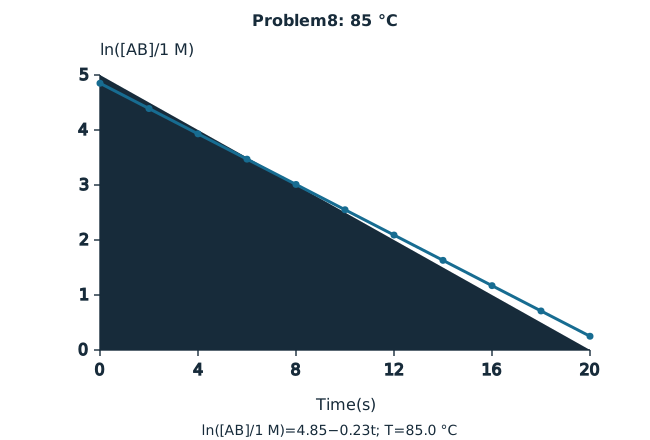
AP edition revised figure. At85.0 °C, the supplied first-order plot has slope−0.230 s⁻¹. It describes a defined remaining population.
Read all reviewed image captions
Image 1
AP edition revised figure. At85.0 °C, the supplied first-order plot has slope−0.230 s⁻¹. It describes a defined remaining population.
Image 2
AP edition revised figure. At35.0 °C, the supplied first-order plot has slope−0.0500 s⁻¹. These two model slopes support the explicitly labeled Arrhenius enrichment calculation.
- Quantitative enrichment: a hypothetical first-order disappearance model has A=4.31 s⁻¹, Eₐ=422 kJ mol⁻¹ and T=45.0 °C. Use R=8.314 J mol⁻¹ K⁻¹. Find k and its half-life;[A]₀=4.00 M. Keep the stated422 kJ mol⁻¹ value.
- Reviewed replacement with an explicit target: A hypothetical undissolved solute population obeys dnu/dt=−0.320nu s⁻¹, beginning at4.00 mol. A monitor’s threshold for this remaining population is5.00 mg NaCl-equivalent per kilogram of water; water mass=10.0 kg and equivalent molar mass=58.44 g mol⁻¹. Find the time to the threshold. This changes the source’s ambiguous target; dissolved ions would increase during dissolution, rather than disappear.
- Quantitative enrichment: two supplied first-order disappearance plots in Gallery3.4.3 have ln([AB]/1 M)=4.85−0.230t at85.0 °C and4.85−0.0500t at35.0 °C, with t in seconds. AB is the defined remaining modeled population, not a measured increase of dissolved ions. Estimate Eₐ and A using the same Arrhenius model at both temperatures and R=8.314 J mol⁻¹ K⁻¹.
- Three schematic processes have explicitly supplied event rates r₁=0.00325[AB][CD], r₂=0.221[AB] and r₃=0.322[A⁺][B⁻], each in M s⁻¹. AB is consumed once per event in processes1 and2, and produced once per event in3. The bimolecular constants have L mol⁻¹ s⁻¹ units and0.221 has s⁻¹ units. Write net AB disappearance.
- Reviewed schematic population model: X₁→X₂→X₃→X₄ consists of irreversible1:1 first-order conversions with k₁=0.411, k₂=0.121 and k₃=0.523 s⁻¹. X labels count equivalent conserved units; these are not unbalanced nitrogen chemical equations. Find the half-life of X₁. Which step has the longest isolated first-order lifetime, and why does that alone not determine every instantaneous step flux?
- Quantitative enrichment: a hypothetical fixed-volume1:1 A+B→P disappearance law is −d[A]/dt=k[A][B]. Both initial concentrations are10.0 M, with no additional sources or sinks. A=0.0324 L mol⁻¹ s⁻¹ and Eₐ=24.0 kJ mol⁻¹. Compare time to[A]=3.00 M at35.0 versus20.0 °C, using R=8.314 J mol⁻¹ K⁻¹. Treat these concentrations as formal model data.
- A supplied1:1 disappearance law is −d[A]/dt=k[A][B], with k=0.0734 L mol⁻¹ s⁻¹. A reservoir holds[B]=10.0 M constant. Find A’s half-life in this formal model.
- Two supplied irreversible first-order sinks of A have k₁=0.0003242 and k₂=0.000632 s⁻¹. The following formal concentration data include an additional unidentified sink. Show that the two known sinks are insufficient, and explain why the table alone does not uniquely establish one simple order for the extra process.
Time(s) [A](M) 0 20 30 14.6 60 10.5 90 7.35 120 4.97 150 3.14 180 1.72 210 0.596 - The source describes precipitation while a solution warms at5.00 °C min⁻¹ from35.0 °C, and asks when it boils. Explain why rate constants and ion concentrations alone do not establish the boiling temperature. As a separate stipulated temperature-threshold calculation, find time to100.0 °C if the given constant temperature-rise rate continues.
- The source calls iron oxidation pseudo-first-order but supplies k=3.2421 L mol⁻¹ yr⁻¹ and says oxygen is constant without giving its value. Explain why the time to24% conversion is underdetermined. Give the expression if the law were specifically −d[A]/dt=k[A][O₂].
- Two formal reactions consume A: A+B→AB has event rate r₁=0.23511[A]², and2A→A₂ has event rate r₂=0.331[A]. Their constants use L mol⁻¹ s⁻¹ and s⁻¹, respectively. Write A disappearance and explain why time to95% consumption and product amounts need more information.
- A source sequence supplies r₁=0.753[A][BC] and r₂=0.441 for a following step using AB. Initially[A]=[BC]=5.00 M. Explain what is missing before a crossover time can identify a kinetic bottleneck. As a conditional capacity comparison only, state the concentration at which r₁ equals0.441 M s⁻¹ when[A]=[BC].
- Reviewed replacement: A hypothetical auxiliary reactant R is consumed1:1 with A during a first stage: −d[A]/dt=−d[R]/dt=0.320 M s⁻¹ while R remains. [R]₀=3.00 M and[A]₀=5.00 M. When R reaches zero, A follows −d[A]/dt=0.02421[A] s⁻¹. Find time from the start to[A]=1.00 M. R is a consumed reactant, not a catalyst.
- Reviewed replacement: A hypothetical remaining material fraction f obeys −df/dt=k p f. k=5.00 atm⁻¹ h⁻¹, and a reservoir keeps the relevant gas partial pressure p=0.210 atm. Find the time for f to fall from1.00 to0.200. This abstract supplied model is not a wood-burning prediction or experimental procedure.
- Reviewed replacement: A hypothetical ideal-gas reservoir model has A₂+B₂→2 AB. Reservoirs keep x(A₂)=x(B₂)=0.0400 and total molar density C=P/(RT) fixed, with P=1.00 atm,T=298.15 K,R=0.082057 L atm mol⁻¹ K⁻¹. The event rate is r=0.321[A₂][B₂] M s⁻¹; AB initially has zero concentration and accumulates without removal until x(AB)=0.0100. Find the model time. This is an abstract calculation, not a room-exposure scenario.
Glossary and deeper reading · 19 refreshers
These editorial refreshers supplement the reading. Definitions and examples are added guidance; original source wording and recorded answers remain in their original context.
-
Precipitate
A precipitate is a solid phase that forms from species in a solution. Whether it forms depends on the ion concentrations and the relevant equilibrium conditions. For example, silver ions and chloride ions can produce a silver chloride precipitate.
-
Ion
An ion is an atom or group of atoms with a net electric charge. Ordinary ion formation changes electron count without changing the element's proton count. For example, a sodium atom losing one electron becomes a sodium ion with charge +1.
-
Aqueous solution
An aqueous solution is a solution in which water is the solvent. The dissolved substance may originate as a solid, liquid, or gas, so aqueous does not mean that a solid has melted. For example, sodium chloride dissolved in water is aqueous even though the pure salt is solid.
-
Elementary reaction
An elementary reaction is one step in a proposed mechanism rather than the sum of multiple steps. For a specified elementary step, the rate-law concentration factors follow its reacting-particle event. For example, a bimolecular elementary collision can have a rate proportional to the concentrations of its two reactants.
-
Reaction intermediate
A reaction intermediate is produced in one mechanism step and consumed in another. It cancels from the overall equation and differs from a catalyst, which is present before it is consumed and then regenerated. For example, a short-lived species formed in step one and used in step two can be an intermediate.
-
Rate constant
A rate constant is the proportionality factor in a specified rate law. Its value depends on conditions such as temperature, and its units depend on the law's overall order. For example, a first-order rate constant has units of inverse time when concentration is measured per unit volume.
-
Rate law
A rate law relates a reaction rate to reactant concentrations and a rate constant under stated conditions. For an overall reaction, its concentration exponents are established from evidence rather than copied from the balanced equation. For example, doubling one reactant concentration doubles the rate when the reaction is first order in that reactant and other conditions are fixed.
-
Reaction order
Reaction order describes the concentration dependence in a rate law. An order in one reactant is its exponent, and overall order is the sum of the concentration exponents. For example, a second-order dependence on one reactant makes quadrupling the rate follow from doubling that reactant's concentration under fixed conditions.
-
Pre-equilibrium approximation
The pre-equilibrium approximation treats a fast reversible mechanism step as close to equilibrium before a slower step proceeds. Its equilibrium relation can replace an intermediate concentration in the proposed rate law. For example, a fast association can express an intermediate's concentration in terms of the reactants that form it.
-
Chemical equilibrium
Chemical equilibrium is a dynamic state in which forward and reverse reaction rates are equal. Macroscopic composition remains constant in a closed system under fixed conditions, but reactant and product concentrations need not be equal. For example, a reversible reaction can reach equilibrium with much more reactant than product.
-
Stoichiometry
Stoichiometry uses a balanced chemical equation to relate amounts of reactants and products. Equation coefficients provide mole ratios rather than direct mass ratios. For example, forming water from hydrogen and oxygen consumes two moles of hydrogen molecules per mole of oxygen molecules.
-
Electrolyte
An electrolyte forms mobile ions when dissolved and can allow a solution to conduct electric current. Strong and weak electrolytes differ in the extent to which dissolved species form ions under the stated conditions. For example, dissolved sodium chloride supplies sodium and chloride ions to water.
-
Net ionic equation
A net ionic equation shows the species that undergo the chemical change. It removes spectator ions while preserving atom and charge balance. For example, precipitation of silver chloride can be written using aqueous silver and chloride ions forming solid silver chloride.
-
Reaction half-life
A reaction half-life is the time needed for a reactant's concentration to fall to half its starting value under the specified model. A first-order reaction has a half-life independent of its starting concentration, while other orders generally do not. For example, consecutive equal time intervals halve a first-order reactant's concentration repeatedly.
-
Solute
A solute is a component dispersed in a solvent to form a solution. It need not be a solid, and a solution need not be liquid. For example, carbon dioxide is a gaseous solute in carbonated water.
-
Molar mass
Molar mass is the mass of one mole of a specified substance. It is commonly expressed in grams per mole and connects a sample's mass to its amount of substance. For example, water has a molar mass of approximately 18.02 grams per mole.
-
Arrhenius equation
The Arrhenius equation models how a rate constant depends on absolute temperature and an activation-energy parameter. Within the applicable model, increasing temperature raises the rate constant for a positive activation energy. For example, a larger activation-energy parameter can make a reaction's rate constant more sensitive to a temperature change.
-
Catalyst
A catalyst participates in a reaction pathway and is regenerated overall. It can increase the reaction rate by providing a different pathway without changing the reaction's equilibrium constant at fixed temperature. For example, a catalyst can help a mixture reach equilibrium sooner without changing the final equilibrium composition.
-
Partial pressure
A gas's partial pressure is the pressure it would exert alone in the mixture's volume at the same temperature. In an ideal mixture, the component partial pressures add to the total pressure. For example, a component with mole fraction 0.20 contributes 0.20 of the total ideal pressure.