Buffers
Supporting original reading. Follow the AP topic pathway for reviewed scope, worked reasoning and targeted practice.
Chemistry II · original Chapter 7 · combined Chapter 15
Section Breakdown
- Equilibrium Review
- Le Chatelier's Principle with Acids
- Buffers
Section 1
Buffers
A useful buffer contains appreciable amounts of a weak acid and its conjugate base, or a weak base and its conjugate acid. A weak-acid solution alone usually has much less conjugate base than acid and does not provide the same capacity to resist added strong acid.
Let’s also say you then add another acid into the solution. Due to the nature of the acid, it will generate increased levels of the Hydrogen ion.
When strong acid is added, the buffer’s conjugate base consumes H⁺ to form the weak acid. When strong base is added, the weak acid consumes OH⁻ to form its conjugate base and water. The amounts matter: the buffer stops working effectively when one component is nearly consumed.
A buffer doesn’t only protect against decreases in pH. It also protects against increases in pH. When is decreased by the addition of a base, the buffer acid will shift to the right, resulting in a replenishment of the missing .
Because a buffer relies on the presence of both the acid and its conjugate base, a buffer protects best around the of the acid. If you want to keep a solution at a certain pH, you’re best off picking a buffer agent with a near the pH at which you want to keep your solution.
Gallery 7.1.1 — Conserved HA/A− buffer response
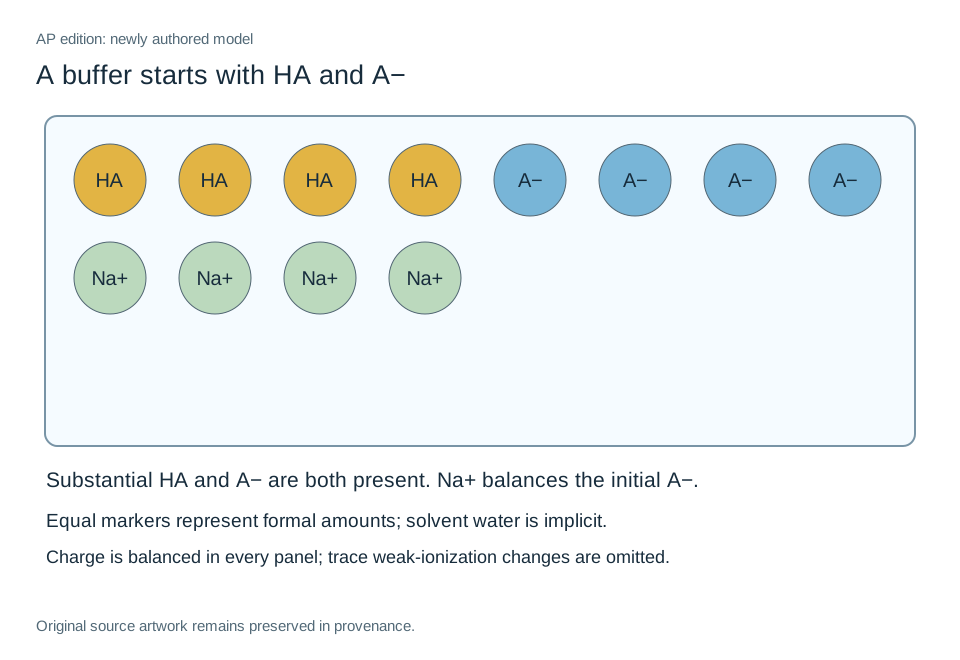
AP edition authored model. Substantial HA and A− are both present. Na+ balances the initial A−. The replacement uses a stated HA/A− buffer with balanced spectator charges. It is a new formal-amount model, not a relabeling of the source HF images; solvent water and trace weak-ionization species are implicit.
Read all reviewed image captions
Image 1
AP edition authored model. Substantial HA and A− are both present. Na+ balances the initial A−. The replacement uses a stated HA/A− buffer with balanced spectator charges. It is a new formal-amount model, not a relabeling of the source HF images; solvent water and trace weak-ionization species are implicit.
Image 2
AP edition authored model. Before the rapid reaction: add one H3O+ and one Cl− amount. The replacement uses a stated HA/A− buffer with balanced spectator charges. It is a new formal-amount model, not a relabeling of the source HF images; solvent water and trace weak-ionization species are implicit.
Image 3
AP edition authored model. A− + H3O+ → HA + H2O. HA rises by one; A− falls by one. The replacement uses a stated HA/A− buffer with balanced spectator charges. It is a new formal-amount model, not a relabeling of the source HF images; solvent water and trace weak-ionization species are implicit.
Image 4
AP edition authored model. Before the rapid reaction: add one Na+ and one OH− amount. The replacement uses a stated HA/A− buffer with balanced spectator charges. It is a new formal-amount model, not a relabeling of the source HF images; solvent water and trace weak-ionization species are implicit.
Image 5
AP edition authored model. HA + OH− → A− + H2O. HA falls by one; A− rises by one. The replacement uses a stated HA/A− buffer with balanced spectator charges. It is a new formal-amount model, not a relabeling of the source HF images; solvent water and trace weak-ionization species are implicit.
Image 6
AP edition authored model. Equal acid and base additions restored the initial HA/A− amounts; spectator ions remain. The replacement uses a stated HA/A− buffer with balanced spectator charges. It is a new formal-amount model, not a relabeling of the source HF images; solvent water and trace weak-ionization species are implicit.
Reviewed hypothetical model: use ideal concentrations, fixed final volume, total acetic-acid-family concentration C=10.0 M, pKₐ=4.76 and target [H⁺]=0.100 M at 25 °C. This concentrated solution is not a realistic ideal buffer; the exercise diagnoses the original charge-balance error.
Mass balance gives [HA]+[A⁻]=10.0 M. Kₐ=[H⁺][A⁻]/[HA], so [A⁻]=CKₐ/([H⁺]+Kₐ).
Kₐ=10⁻⁴·⁷⁶=1.73780×10⁻⁵. Thus [A⁻]=10.0Kₐ/(0.100+Kₐ)=0.001737499 M and [HA]=9.998262501 M.
For the hypothetical final solution, charge balance is [H⁺]=[A⁻]+[Cl⁻]+[OH⁻]. With Kw=10⁻¹⁴, [OH⁻]=10⁻¹³ M.
[Cl⁻]=0.100−0.001737499−10⁻¹³=0.098262501 M. With complete HCl dissociation, this is the analytical HCl concentration in the final fixed-volume model.
The original 0.1114 M result lost the initial acid contribution and does not satisfy charge balance. The ideal-model requirement is approximately 0.0983 M HCl, compared with 0.100 M for otherwise pure water at this target pH.
For otherwise pure water, [Cl⁻]=[H⁺]−[OH⁻]=0.100−10⁻¹³≈0.100 M. Weak acid alone is not a buffer containing appreciable acid and conjugate base.
Glossary and deeper reading · 10 refreshers
These editorial refreshers supplement the reading. Definitions and examples are added guidance; original source wording and recorded answers remain in their original context.
-
Le Châtelier’s principle
Le Châtelier’s principle predicts the qualitative response when a system initially at equilibrium is disturbed. A justified explanation distinguishes the immediate disturbance from the subsequent reaction toward a new equilibrium. For example, adding a reactant can favor its net consumption, while temperature changes can also alter the equilibrium constant.
-
Buffer
A buffer contains appreciable amounts of a weak acid and its conjugate base, or the corresponding weak-base pair. Those partners consume small added amounts of strong base or acid, limiting the pH change within the buffer's capacity. For example, an acetic acid–acetate mixture can resist modest additions of acid or base.
-
Weak acid or base
A weak acid or base reacts only partially with water and establishes an equilibrium. Its equilibrium constant describes strength, while analytical concentration describes how much was prepared per volume. For example, acetic acid leaves both acid molecules and its conjugate base in water.
-
Conjugate acid–base pair
A conjugate acid–base pair consists of species differing by one proton. Losing a proton forms an acid's conjugate base, while gaining one forms a base's conjugate acid. For example, ammonium and ammonia form a conjugate acid–base pair.
-
Ion
An ion is an atom or group of atoms with a net electric charge. Ordinary ion formation changes electron count without changing the element's proton count. For example, a sodium atom losing one electron becomes a sodium ion with charge +1.
-
Strong acid or base
A strong acid transfers protons essentially completely to water in the applicable aqueous-solution model. A dissolved strong hydroxide base dissociates into its constituent ions and supplies hydroxide; it does not have to react with water to generate that hydroxide. Strength is distinct from concentration and, for a solid base, from how much can dissolve. For example, dissolved sodium hydroxide supplies sodium and hydroxide ions even when the prepared solution is dilute.
-
pH
pH is the negative base-ten logarithm of hydronium activity. In suitable dilute models, activity is approximated by molar concentration relative to the standard concentration. For example, lowering hydronium concentration by a factor of ten raises pH by one unit.
-
Mixture
A mixture contains two or more substances whose proportions can vary. Its components retain their chemical identities until a chemical reaction changes them. For example, water and ethanol can form mixtures with many different compositions.
-
Polyprotic acid
A polyprotic acid can donate more than one proton per molecule in successive steps. Each step has its own equilibrium constant, so the protons need not dissociate to the same extent. For example, phosphoric acid can lose three protons through separate equilibria.
-
pKa
pKa is the negative base-ten logarithm of an acid's dissociation constant. A smaller pKa means a stronger acid under comparable conditions. For example, when an acid and its conjugate base have equal activities, their buffer's pH equals that acid's pKa.