FFR: Le Chatelier’s Principle
Supporting original reading. Follow the AP topic pathway for reviewed scope, worked reasoning and targeted practice.
Chemistry II · original Chapter 5 · combined Chapter 13
Section Breakdown
- Le Chatelier's Principle
- Adjusting concentrations.
- Adjusting Pressures
- Adjusting Temperatures
- Chapter Problems
Section 3
FFR: Le Chatelier’s Principle
The previous sections helped you to determine a lot about how a reaction will proceed as it currently exists. What would happen, then, if you were to change something? Say a reaction was at equilibrium, and then you added some reactant. Would would occur?
To answer that, we turn to Le Chatelier’s Principle. The principle states that: If a system currently at equilibrium undergoes a change in either Concentration, Temperature, Pressure, or Volume, then the system will undergo chemical reactions to counteract this change until equilibrium is re-established.
Basically, when something changes, the equilibrium will no longer be held true, and therefore the chemicals must react to fix this.
Let’s start by looking at concentration. If you have a solution with NaCl and AgNO3, and they are in equilibrium, reacting by the following reaction:
So as to not get too confusing, let’s remove the spectator ions:
Now say you add some more Chlorine into the solution. That pushes the equilibrium out of whack, as you now have too many reactants. Therefore, more AgCl must form in order to reach equilibrium once more. Once that happens, the reactants are lowered, resulting in equilibrium being reached once more.
Now for the more complicated changes that would result in re-establishment of equilibrium. Let’s start off with temperature.
Temperature having an effect on equilibrium is a bit confusing as we have yet to see the impact of temperature. In fact, the Equilibrium Constant of a reaction relies on temperature, and different temperatures result in different Equilibrium Constants.
In order to predict what happens when temperature changes, we need to look at a new aspect of the reaction, it’s enthalpy change ( ). You may recall from Chemistry I that enthalpy is a measurement of heat, and the enthalpy change of a reaction is the heat taken up or released by the reaction. If you have a , then your reaction is endothermic, and energy has to be added for the reaction to progress. Conversely, a reaction with a is exothermic, meaning it releases energy upon progressing.
Therefore, if you know whether a reaction is endothermic or exothermic, you can add an energy term to the equation. For example, a solid melting is an endothermic reaction. Therefore, it can be written like this:
Now it is easy to tell that if this reaction is initially at equilibrium, and you add energy, then more of A will have to melt for equilibrium to be re-established.
Interactive 5.3.2 Enthalpy of a Reaction

Read all original figure notes
Instead, let’s look at a different reaction. A + B > C + D has a . This means that it is exothermic, so it releases energy. This means energy is a product. Therefore, it we were to increase the energy by raising the temperature, then equilibrium will shift to the left, creating more of A and B.
That covers Temperature, so let’s move on to Volume. Volume typically only modifies gaseous systems, so let’s look at those.
Say we have a system at a certain volume containing Nitrogen Monoxide and Oxygen gas, which react to produce Nitrogen Dioxide. The reaction is written as:
The ideal gas law tells us that is we change volume then we have to also change pressure. Therefore the partial pressures of each component will change, so we can determine which way the reaction moves. So which way would this reaction move if we decrease the volume?
Well let’s look at the expression for this reaction’s Equilibrium Constant.
Now let’s figure out what will happen if we decrease the volume to 80% of its original size. Let’s start by figuring out the change in pressure:
With this relationship, let’s determine the Quotient Constant for the new state with the reduced volume.
This means that the Quotient Constant is less than the Equilibrium constant, causing the reaction to proceed towards the right.
Okay, well that was straightforward, but it wasn’t really that quick or easy. How can you tell what will happen without going through that whole shebang?
Well the answer lies in the molar ratio of the reactants and products. Let’s look at our equation again.
Notice that we have three moles of gaseous reactants for every two moles of products. This means we have a molar ratio of 3:2. Now let’s look at the Quotient Constant we determined previously.
Let’s pull out that coefficient.
Notice that the exponents are in the same ratio as the moles. That will always be true, and it means that the side with the higher number of moles will be the predominating side of the equation for determining the impact of a volumetric change.
The other link to make is that an increase in volume will result in a shift towards the dominant side. In other words, the increased volume makes the reaction proceed to generate pressure in the system, by proceeding in such a way as to generate the most gas. In the example case, the reactants had the most moles of gas, meaning that the reaction used products to make reactants.
So what happens when you have a reaction that is equimolar on each side? A reaction like the formation of HCl gas:
Well, in this case, a change in volume would actually result in equilibrium being maintained, as both pressures change correspondingly, resulting in the Quotient Constant after a volume change (in either direction) equaling the Equilibrium Constant.
Chapter Problems
- Carbon Dioxide can react with Hydrogen to form Methane. The reaction is as follows. Name three ways of pushing the equilibrium to the right.
- Reviewed replacement: in a 1.00 L closed ideal-gas vessel at a fixed stated temperature, A(g)⇌B(g), Kc=12.4. Initially [A]=0.100 M and [B]=0. Calculate equilibrium [B].
Review the authored solution
Let [B]=x and [A]=0.100−x. 12.4=x/(0.100−x), so x=0.0925373 M. All concentrations are nonnegative and their total remains 0.100 M. The original copper/HCl hydrogen-generation premise is superseded.
- Reviewed replacement: in a constant-volume irreversible model, the methane partial-pressure disappearance law is −dp/dt=kp², with k=0.0422 (atm·s)⁻¹. How long does p fall from 0.400 atm to 0.200 atm?
Review the authored solution
t=(1/0.200−1/0.400)/0.0422=59.2417 s. This is a concentration/pressure threshold in a specified kinetic model, rather than time to equilibrium.
- Ammonia is fixed from atmospheric nitrogen by reacting it with hydrogen. Given that the equilibrium constant is 2.7, if a greenhouse starts out at 1atm, with 70% Nitrogen and 0.5% Hydrogen, what will the partial pressure of ammonia be at equilibrium?
- Ammonia gas reacts with oxygen according to the following unbalanced equation. A reactor held at 10L and 25ºC contains 4mol of Ammonia and 5mol of Oxygen gas. What is the total pressure of the container at equilibrium?
- Reviewed replacement: an irreversible first-order disappearance model for a gas has k=32.0 min⁻¹. How long does its partial pressure fall from 0.100 atm to 0.0100 atm at fixed volume and temperature?
Review the authored solution
t=ln(0.100/0.0100)/32.0=0.0719558 min=4.31735 s. No equilibrium-time or tanker-purity prediction is inferred.
- Hydrogen Cyanide gas can be produced by reacting Methane and Ammonia. The reaction has a .
The system is currently at equilibrium. Declare what happens under the following conditions:
a) System volume increases
b) Temperature increases
c) Pressure of Ammonia increases - Reviewed replacement: A(aq)⇌B(aq) has Kc=7.231. An ideal 0.800 L solution initially has [A]=0.600 M and [B]=0. Calculate the moles of B at equilibrium.
Review the authored solution
x/(0.600−x)=7.231 gives x=0.527105 M. n(B)=0.800x=0.421684 mol. This complete aqueous model avoids the original missing gas-space volume and mixed-phase convention.
- Elemental sulfur can be obtained by treating Hydrogen Sulfide gas with Sulfur Dioxide. If a 100L reactor chamber at 20ºC reacts with 10atm Hydrogen Sulfide and 7atm Sulfur Dioxide, how much Sulfur is created at equilibrium?
- In 1890, a way to purify Nickel was discovered. It involved passing heated Carbon Monoxide over Nickel. The two reacted to form Nickel Tetracarbonyl () gas. at 50ºC, the equilibrium constant is 12.3. A container is initially at 100kPa CO and contains 10g of Nickel. The container is heated to 50ºC, and its volume is 5L. What is the equilibrium mass of Nickel in the container?
- Carbon Monoxide and Water vapor can react to form Carbon Dioxide and Hydrogen. The reaction has a , and an equilibrium constant . A 1L canister at 5atm and 25ºC contains equal amounts by volume of Carbon Monoxide and Water. What is the equilibrium mass of Hydrogen gas in the canister?
- Reviewed replacement: in an irreversible first-order disappearance model, [NO₂⁻] starts at 4.00 M and k=42.1 day⁻¹. Find its half-life. This formal model does not claim to describe the original reversible gas-producing reaction.
Review the authored solution
t½=ln 2/42.1=0.0164643 days=23.7086 min. Equilibrium composition and approach time require separate thermodynamic and reversible kinetic data.
- Reviewed replacement: A(g)+B(g)⇌2 C(g) in an ideal 5.00 L vessel at 273.15 K has Kc=13.21. Initially there is 1.00 mol each A and B and no C. Calculate equilibrium moles and total pressure, using R=0.082057 L atm mol⁻¹ K⁻¹.
Review the authored solution
Let the forward extent be ξ mol. √13.21=2ξ/(1−ξ), so ξ=0.645047 mol. Thus n(A)=n(B)=1.00−ξ=0.354953 mol≈0.355 mol each, and n(C)=2ξ=1.290094 mol≈1.29 mol. The total gas amount remains 2.00 mol because Δn=0. P=nRT/V=8.96555 atm≈8.97 atm (three significant figures). This is a complete hypothetical gas-equilibrium task rather than assumed sulfuric-acid vapor chemistry.
- Reviewed replacement: a specified reaction has ΔH=−481.1 kJ per mole of reaction as written. Independent equilibrium analysis establishes that its forward extent is 0.250 mol. What is the system’s enthalpy change?
Review the authored solution
ΔHsystem=(0.250)(−481.1)=−120.275 kJ≈−120 kJ at three significant figures. It releases about 120 kJ under constant-pressure conditions with only pressure–volume work. The reaction extent is supplied rather than inferred from the original unbalanced equation.
- Reviewed replacement: a formal irreversible disappearance law −d[A]/dt=k[A]² has k=4.20 L mol⁻¹ h⁻¹ and [A]₀=0.100 M. How long until [A]=0.0500 M?
Review the authored solution
t=(1/0.0500−1/0.100)/4.20=2.38095 h. The balanced chemical reaction and reverse kinetics of the original lead-oxide task are not inferred.
- Reviewed replacement: 0.0100 mol Zn reacts with excess dilute nonoxidizing acid by Zn(s)+2 H⁺(aq)→Zn²⁺(aq)+H₂(g). Assuming quantitative reaction, how many moles of hydrogen form?
Review the authored solution
One mole of Zn forms one mole H₂, so 0.0100 mol H₂ forms. This explicit reviewed metal/nonoxidizing-acid model replaces the original nitric-acid hydrogen premise.
Interactive 5.3.1 Problem 20
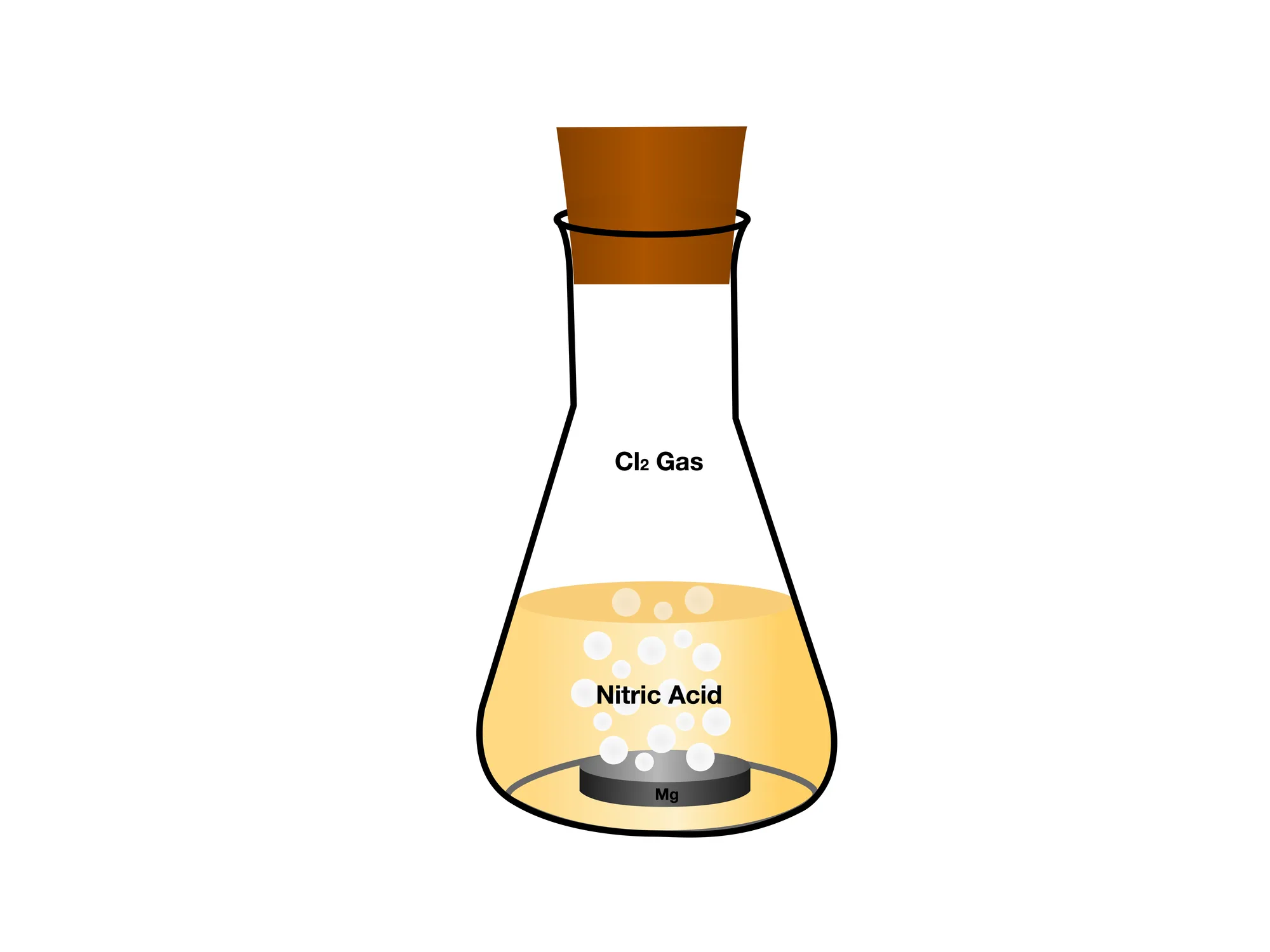
Read all original figure notes
- Reviewed replacement: an abstract reactant A undergoes irreversible first-order disappearance with k=0.004333 min⁻¹ and [A]₀=0.150 M. Calculate [A] after 10.0 min and 120 min.
Review the authored solution
[A]=[A]₀e⁻ᵏᵗ gives 0.143639 M at 10.0 min and 0.0891816 M at 120 min. Heating NaCl solution does not establish the source’s proposed chlorate/hydrogen reaction; this is a stated kinetic model.
- Reviewed replacement: for a stipulated hot-alkali stoichiometric model, 3 Cl₂+6 OH⁻→ClO₃⁻+5 Cl⁻+3 H₂O. How many moles of Cl₂ react when 99.0% of an initial 0.500 mol OH⁻ is consumed? This is a paper stoichiometry exercise.
Review the authored solution
Consumed OH⁻=0.495 mol. The ratio is 3 mol Cl₂ per 6 mol OH⁻, giving 0.2475 mol Cl₂≈0.248 mol. The original unspecified equilibrium and gas-volume conditions are superseded.
- Reviewed replacement: in an irreversible first-order disappearance model with k=0.3211 day⁻¹, find the time to consume 90.0% of a reactant.
Review the authored solution
[A]/[A]₀=0.100, so t=ln(10)/0.3211=7.17093 days. This operational threshold differs from exact equilibrium time.
- Reviewed replacement: a closed ideal gas system contains H₂(g)+Cl₂(g)⇌2 HCl(g), with Kp=4.19 at the specified temperature. Initial partial pressures are p(H₂)=p(Cl₂)=1.00 atm and p(HCl)=0. Find equilibrium partial pressures in the same convention.
Review the authored solution
Let x be the pressure extent. √4.19=2x/(1−x), giving x=0.505801 atm. Thus p(H₂)=p(Cl₂)=0.494199 atm and p(HCl)=1.011601 atm. No nitric-acid hydrogen generation or mixed aqueous/gas calculation is assumed.
Glossary and deeper reading · 14 refreshers
These editorial refreshers supplement the reading. Definitions and examples are added guidance; original source wording and recorded answers remain in their original context.
-
Le Châtelier’s principle
Le Châtelier’s principle predicts the qualitative response when a system initially at equilibrium is disturbed. A justified explanation distinguishes the immediate disturbance from the subsequent reaction toward a new equilibrium. For example, adding a reactant can favor its net consumption, while temperature changes can also alter the equilibrium constant.
-
Chemical equilibrium
Chemical equilibrium is a dynamic state in which forward and reverse reaction rates are equal. Macroscopic composition remains constant in a closed system under fixed conditions, but reactant and product concentrations need not be equal. For example, a reversible reaction can reach equilibrium with much more reactant than product.
-
Spectator ion
A spectator ion appears unchanged on both sides of the complete ionic equation. It is omitted from the net ionic equation because it does not undergo the represented reaction. For example, sodium ions can be spectators when two other dissolved ions form a precipitate.
-
Partial pressure
A gas's partial pressure is the pressure it would exert alone in the mixture's volume at the same temperature. In an ideal mixture, the component partial pressures add to the total pressure. For example, a component with mole fraction 0.20 contributes 0.20 of the total ideal pressure.
-
Equilibrium constant
An equilibrium constant is the value of the reaction quotient at equilibrium for a specified reaction and temperature. Its magnitude indicates equilibrium composition preference rather than reaction speed. For example, a large constant often indicates a product-favored equilibrium, but the starting composition still determines the immediate net direction.
-
Enthalpy
Enthalpy is a state function defined from internal energy, pressure, and volume. At constant pressure with only pressure–volume work, an enthalpy change equals the heat transferred to the system. For example, a negative reaction enthalpy indicates heat release for the written reaction under those conditions.
-
Endothermic process
An endothermic process absorbs heat into the chosen system. Under constant-pressure conditions with only pressure–volume work, its enthalpy change is positive. For example, melting ice absorbs heat while the phase change occurs.
-
Exothermic process
An exothermic process transfers heat from the chosen system to its surroundings. Under constant-pressure conditions with only pressure–volume work, its enthalpy change is negative. For example, freezing water releases heat to the surroundings.
-
Ideal gas law
The ideal gas law relates pressure, volume, amount, and absolute temperature in an idealized gas model. It treats particles as having negligible volume and no intermolecular attractions. For example, at fixed amount and temperature, doubling the container volume halves the ideal gas pressure.
-
Mole
A mole is an amount of substance containing exactly 6.02214076 × 10²³ specified entities. The entities can be atoms, molecules, ions, or formula units, so the counted entity must be named. For example, one mole of oxygen molecules contains two moles of oxygen atoms.
-
Reaction order
Reaction order describes the concentration dependence in a rate law. An order in one reactant is its exponent, and overall order is the sum of the concentration exponents. For example, a second-order dependence on one reactant makes quadrupling the rate follow from doubling that reactant's concentration under fixed conditions.
-
Reaction half-life
A reaction half-life is the time needed for a reactant's concentration to fall to half its starting value under the specified model. A first-order reaction has a half-life independent of its starting concentration, while other orders generally do not. For example, consecutive equal time intervals halve a first-order reactant's concentration repeatedly.
-
Dilution
Dilution lowers solute concentration by adding solvent while conserving the solute amount when no reaction or loss occurs. Concentration calculations use the final solution volume rather than simply the volume of solvent added. For example, increasing a solution's volume from 100 to 200 milliliters halves its concentration if its solute amount is unchanged.
-
Stoichiometry
Stoichiometry uses a balanced chemical equation to relate amounts of reactants and products. Equation coefficients provide mole ratios rather than direct mass ratios. For example, forming water from hydrogen and oxygen consumes two moles of hydrogen molecules per mole of oxygen molecules.