Types of Chemical Bonds
Supporting original reading. Follow the AP topic pathway for reviewed scope, worked reasoning and targeted practice.
Chemistry I · original Chapter 4 · combined Chapter 4
Section Breakdown
Section 1
Types of Chemical Bonds
The Two Major Types of Bonds
Covalent Bond: This type of bond typically occurs between two non-metals, and it is the result of electron sharing.
Ionic Bond: This type of bond typically occurs between a metal and a non-metal, and it is the result of electron transfer.
We will first look at covalent bonds. The covalent bond results from two atoms each providing one electron to form a bond.
This means that each atom effectively has one extra electron. This may be a bit confusing, as you might not understand how an atom can share an electron to another atom without losing it. The following gallery shows just what is happening between the two atoms. It is important to note that each covalent bond involves two electrons: one from each atom. This means that if you have two pairs of electrons involved, we would be looking at a double bond.
Another important aspect of atomic bonds is the degree to which an atom attract electrons: electronegativity. This determines how strongly an atom holds onto an electron in a bond. In the first example in the gallery, the H2 bond, the two Hydrogen atoms have the same electronegativities. This means that they both hold onto the electrons equally. Typically, the non-metals don’t have extremely different negativities, but you will sometimes see a fair difference. The second example, water (H2O) shows this.
Gallery 4.1.1 Covalent Bonds
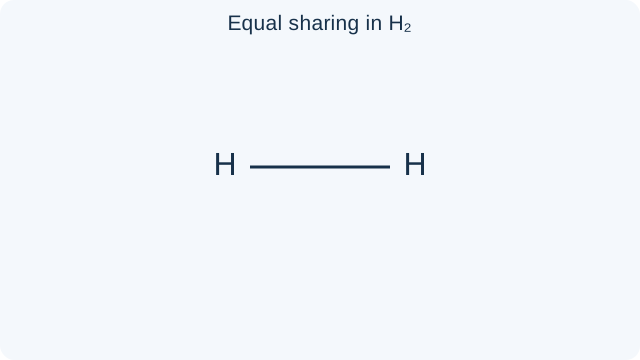
New reviewed diagram replaces the source numeral placeholder.
H₂ has two equivalent nuclei and symmetric bonding electron density. A Lewis line represents a shared pair; it is not an electron trajectory.
Read all reviewed image captions
Image 1
New reviewed diagram replaces the source numeral placeholder.
H₂ has two equivalent nuclei and symmetric bonding electron density. A Lewis line represents a shared pair; it is not an electron trajectory.
Image 2
New reviewed diagram replaces the source numeral placeholder.
Water has two O–H bonds and two oxygen lone pairs. Oxygen attracts bonding electron density more strongly than hydrogen. The bent shape makes the bond dipoles add to a net molecular dipole. Partial charges are not full ionic charges.
When Oxygen forms a covalent bond with hydrogen, it forms what is known as a polar covalent bond. This means that the electrons are not evenly shared between the two atoms. Instead, the electrons tend to gather more commonly around the more electronegative atom, in this case oxygen. Due to the uneven distribution of electrons, we see the formation of a dipole. This means that the molecule formed will have a partial charge on either side. The gallery illustrates this, giving color to the charge, red for negative and blue for positive. You can think of a dipole as a magnet, which has two sides to it. The more electronegative side will tend to have more electrons, making it have a partially negative charge. As the molecule as a whole is uncharged, this means that a partially positive charge results on the other side of the molecule.
Gallery 4.1.2 Dipoles
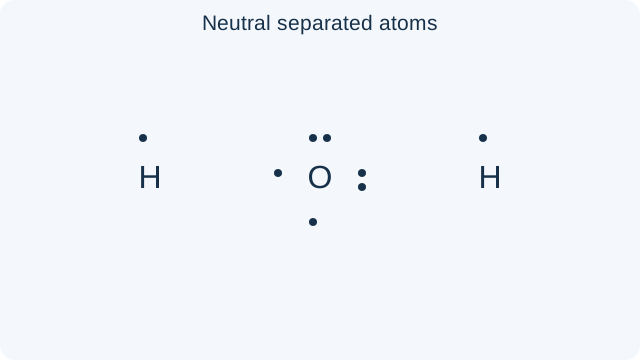
New reviewed diagram replaces the source numeral placeholder.
Separated neutral H and O atoms are shown as Lewis valence symbols. These are electron-counting symbols, not measured cloud boundaries.
Read all reviewed image captions
Image 1
New reviewed diagram replaces the source numeral placeholder.
Separated neutral H and O atoms are shown as Lewis valence symbols. These are electron-counting symbols, not measured cloud boundaries.
Image 2
New reviewed diagram replaces the source numeral placeholder.
Water has two O–H bonds and two oxygen lone pairs. Oxygen attracts bonding electron density more strongly than hydrogen. The bent shape makes the bond dipoles add to a net molecular dipole. Partial charges are not full ionic charges.
Therefore, ionic bonds typically occurs between metals and non-metals because metals tend to have much lower electronegativities than nonmetals.
Metallic Bonds:
We have covered bonds between two nonmetals, a metal and a nonmetal, but what about two metals? You may think that two metals would have a covalent bond form, as they would have low differences in electronegativities. This isn’t quite true, however, as the electronegativities of each atom is low. This means that while the atoms are sharing their electrons, they don’t necessarily congregate between the two atoms, like a typical covalent bond.
A metal is an extended structure. Its valence electrons are delocalized across many metal centers, while the positive ion cores form the lattice. This model helps explain why metals conduct electricity and can be reshaped without simply breaking into isolated molecules. It differs from a covalent molecule and from an ionic lattice of positive and negative ions.
Let’s move onto a quick review of characterizing atomic bonds. In the following review widget you will be tested on your understanding of the different bonds.
Valence Electrons:
Electron-density drawings show where electrons are likely to be found in a bonding model. They do not show tiny electrons following circular paths. When a bond forms, attraction involving the nuclei and electron density competes with nucleus–nucleus and electron–electron repulsion. A useful diagram makes the shared or delocalized density visible without turning it into a planetary orbit.
When an atomic bond forms, it involves only these valence electrons, meaning that the number of bonds an atom can make is determined by the number of valence electrons an atom has. This is why hydrogen can only form one bond, but oxygen can bond with two atoms. More on that in the following section.
Glossary and deeper reading · 10 refreshers
These editorial refreshers supplement the reading. Definitions and examples are added guidance; original source wording and recorded answers remain in their original context.
-
Covalent bond
A covalent bond involves shared electron density between atoms. The sharing can be approximately equal or unequal depending on the atoms and their environment. For example, the bond in a hydrogen molecule shares electrons between two identical atoms.
-
Ionic bonding
Ionic bonding is electrostatic attraction among oppositely charged ions. An ionic solid normally forms an extended lattice rather than separate ion-pair molecules. For example, sodium chloride consists of a repeating array of sodium and chloride ions.
-
Metallic bonding
Metallic bonding involves metal centers held together by electrons delocalized through the solid. The mobile electronic charge helps explain electrical conductivity and the ability of many metals to deform. For example, copper remains bonded as its atoms shift when a wire is bent.
-
Valence electron
Valence electrons are the electrons most directly involved in an atom's bonding and chemical behavior. For main-group atoms, they occupy the highest occupied principal shell. For example, neutral chlorine has seven valence electrons, helping explain its tendency to form a chloride ion.
-
Electronegativity
Electronegativity describes an atom's tendency to attract shared electron density in a bond. It helps predict bond polarity but is not the same as ionization energy or electron affinity. For example, oxygen attracts shared electrons more strongly than hydrogen in an O–H bond.
-
Partial charge
A partial charge describes an uneven distribution of electron density within a bond or molecule. It is marked by a delta symbol and does not necessarily represent a full ionic charge. For example, oxygen carries a partial negative charge in water while its hydrogens carry partial positive charges.
-
Ion
An ion is an atom or group of atoms with a net electric charge. Ordinary ion formation changes electron count without changing the element's proton count. For example, a sodium atom losing one electron becomes a sodium ion with charge +1.
-
Cation
A cation is a positively charged ion. Its total positive nuclear charge exceeds its total electron charge. For example, calcium commonly forms a cation with charge +2 by losing two electrons.
-
Electron delocalization
Electron delocalization means that an electronic description extends across multiple atoms rather than being confined to one localized bond or atom. It can affect bond equivalence and charge distribution. For example, nitrate's bonding electrons are described across several nitrogen–oxygen positions.
-
Crystal lattice
A crystal lattice describes the repeating arrangement of structural sites in a crystalline solid. The occupants can be ions, atoms, or molecules depending on the material. For example, an ionic lattice places opposite charges near one another throughout a sodium chloride crystal.