Changing Phases
Supporting original reading. Follow the AP topic pathway for reviewed scope, worked reasoning and targeted practice.
Chemistry II · original Chapter 1 · combined Chapter 9
Table of Contents
- Phase changes
- Intermolecular Forces
- Effects of Pressure
- Phase Diagrams
- Triple Point
Section 3
Changing Phases
When a solid body gets warm enough, it melts. If you heat it up further, it evaporates. Have you ever thought about why that happens? Well this section will help to explain that for you.
Let us start with a solid object. As with most subjects, water seems to be one of our best examples. Therefore we can start with ice.
Ice, as we explained before, is a collection of water molecules all held together by van der Waals forces, in this case H-Bonds. When water exists as ice, that means that its internal energy is too low for the molecules to move enough to break the intermolecular forces binding them together.
Once you start adding energy to the ice, i.e. heating it up, you see that it begins to melt. What that entails is that the molecules are now moving so fast they can break free of the intermolecular forces that were previously holding them in place. Now free to move, they exist as liquid water.
You may recall from previous experience with chemistry that there is such a thing called Heat of Fusion, which is the energy required to melt a solid, or the energy released by freezing a solid. The reason this property exists is that once matter reaches its melting point, it begins to melt. The temperature doesn’t increase until the entire mass has melted. This means that if you add a constant amount of energy over time to a bit of ice, its temperature will increase up until it starts to melt. There, it will remain constant until all of the ice has melted. Only then will it again begin to rise in temperature.
This results in a situation that can be shown in the following graph:
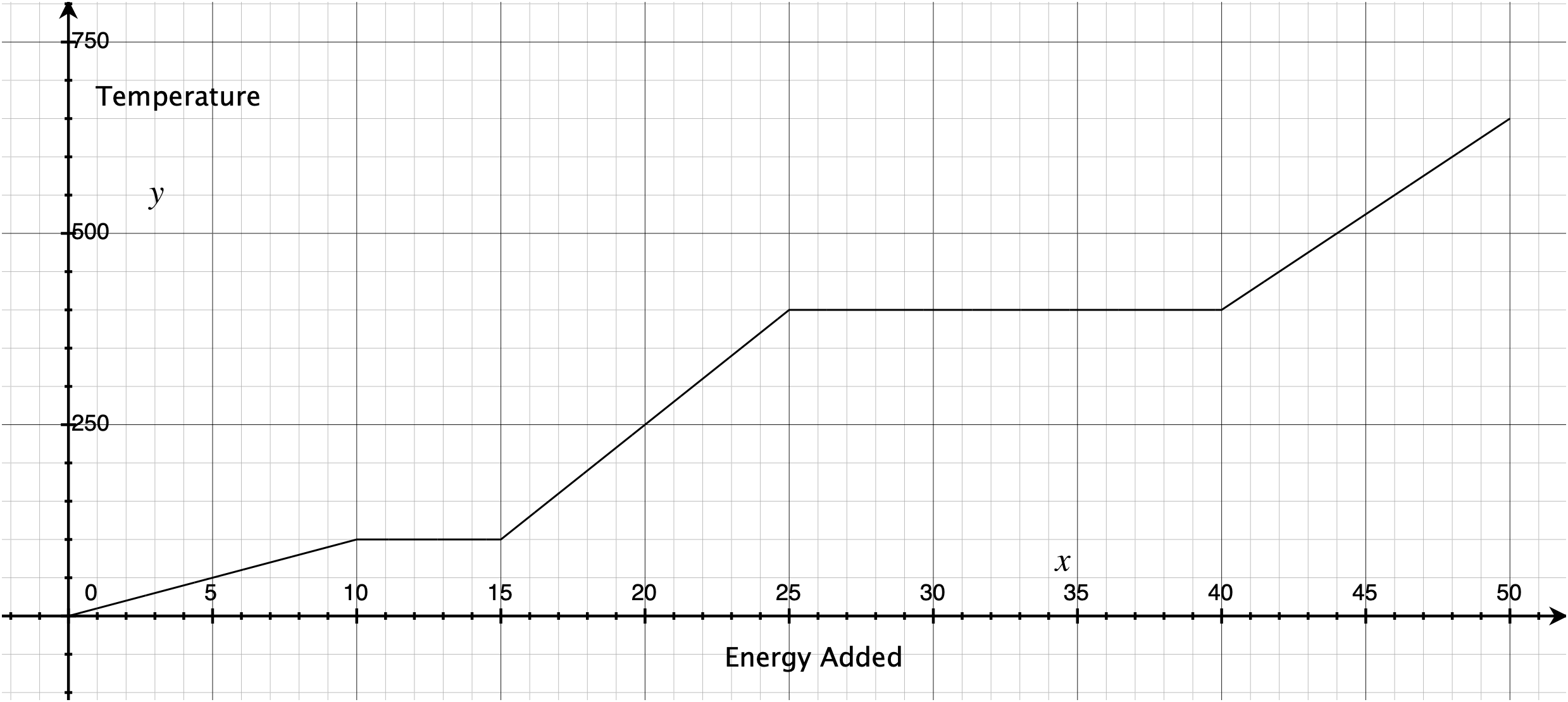
What you see here is the temperature remains constant while energy is being added because the Heat of Fusion must be met. The length of this stop is determined by the Heat of Fusion, and therefore different compounds have different graphs based on more than just their melting and boiling points.
I may still be covering topics you have already known, but here we will introduce the intermolecular force aspect of phase changes. I briefly mentioned that the intermolecular forces were involved in melting as they had to be overcome to allow the solid to become liquid. The intermolecular forces really don’t provide as much effect on the melting point as the boiling point (especially when the solid is held together by Covalent or Ionic Bonds). Once the liquid begins to boil, there van der Waals forces really start to have an effect.
In a liquid, as the molecules are free to move around, they can still form van der Waals bonds, and often do so. In fact, many times the van der Waals are better in liquids than solids, as there is more ability for dipoles to align themselves.
In order for a solid to melt, the van der Waals forces don’t need to be completely overcome, as they still play a vital role in liquid molecular interaction. However, once a molecule begins to evaporate, the gas molecules are so spread out that they are no longer significantly affected by van der Waals forces. This means that you truly need to break free of the van der Waals forces if you wish to become a gas. This is why you see Heat of Vaporization as being much greater than Heat of Fusion.
The intermolecular forces also ensure that higher temperatures must be reached for matter to evaporate. This means that you can safely assume that if the intermolecular forces of one compound are stronger than the intermolecular forces of another, then that first compound will have a higher boiling point.
Gallery 1.3.1 Vapor Pressure vs. Atmospheric Pressure
Read all original image captions
Image 1
Image 2
Image 3
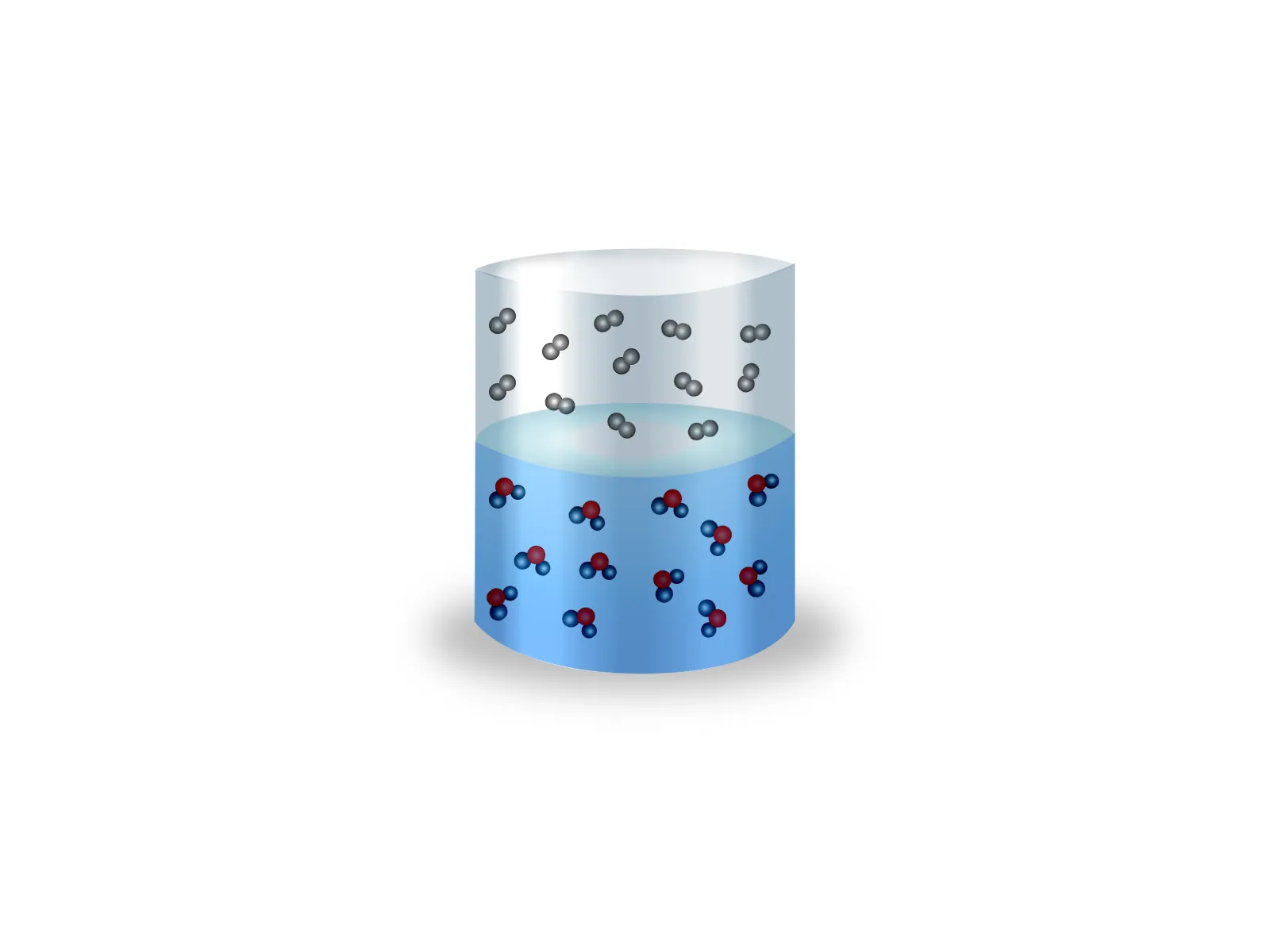
Equilibrium vapor pressure is the pressure of vapor in equilibrium with its liquid at a specified temperature. In a closed container, molecules continue to evaporate and condense; the rates become equal while the measured vapor pressure stays constant. Stronger attractions often lower vapor pressure at the same temperature for suitably comparable liquids, but use actual species and data rather than a universal category rule.
Knowing the what vapor pressure is allows us to properly define the boiling point of a liquid. The boiling point of a liquid is the temperature at which the vapor pressure of the liquid equals the atmospheric pressure at the surface of the liquid.
This means that not only does the boiling point vary with the strength of the intermolecular forces, it also varies with the air pressure, a value completely unrelated to the liquid itself! You may have already seen this in action without realizing it.
Many recipes that involve boiling water to cook food have a second version to be used by people in higher altitudes. This is because at higher altitudes, the pressure is lower. When the pressure is lower, the vapor pressure doesn’t need to be as high for the liquid (water) to boil. This means that water actually boils at a lower temperature than it would at sea level.
If we return to our liquid being a group of people holding hands, then we could represent the impact of the atmospheric pressure as another group of people who instead of holding on to people, push them back towards the crowd as they try to leave. A higher atmospheric pressure (say, at sea level) would have more strength to keep the people in the crowd, while lower pressures (on top of a mountain) they aren’t strong enough to keep the crowd contained.
We know that water boils at 100ºC, so this means that at 100ºC, the vapor pressure of water is equal to the atmospheric pressure. In fact, the vapor pressure of water at 100ºC is 1atm, which is the air pressure at sea level. In case you haven’t seen that unit before, atm = atmosphere. There are a few other ways of writing pressure:
1atm = 760mmHg = 101.3kPa = 14.7psi
The other units there include mmHg: millimeters Mercury, kPa: kiloPascal, and psi: pounds per square inch.
You don’t need to dwell on the units too much at this point. Instead, just remember that a liquid’s vapor pressure has to equal the outside pressure in order for it to boil, and also that vapor pressures increase with temperature.
Temp (ºC) | P vap (atm) | Temp (ºC) | P vap (atm) |
|---|---|---|---|
| 5 | 0.00855 | 50 | 0.121 |
| 10 | 0.0121 | 60 | 0.196 |
| 15 | 0.0168 | 70 | 0.307 |
| 20 | 0.0230 | 80 | 0.466 |
| 25 | 0.0312 | 90 | 0.691 |
| 30 | 0.0418 | 100 | 1.00 |
| 35 | 0.0554 | 125 | 2.28 |
| 40 | 0.0726 | 150 | 4.66 |
Interactive 1.3.1 Phase Diagram
Read all original figure notes
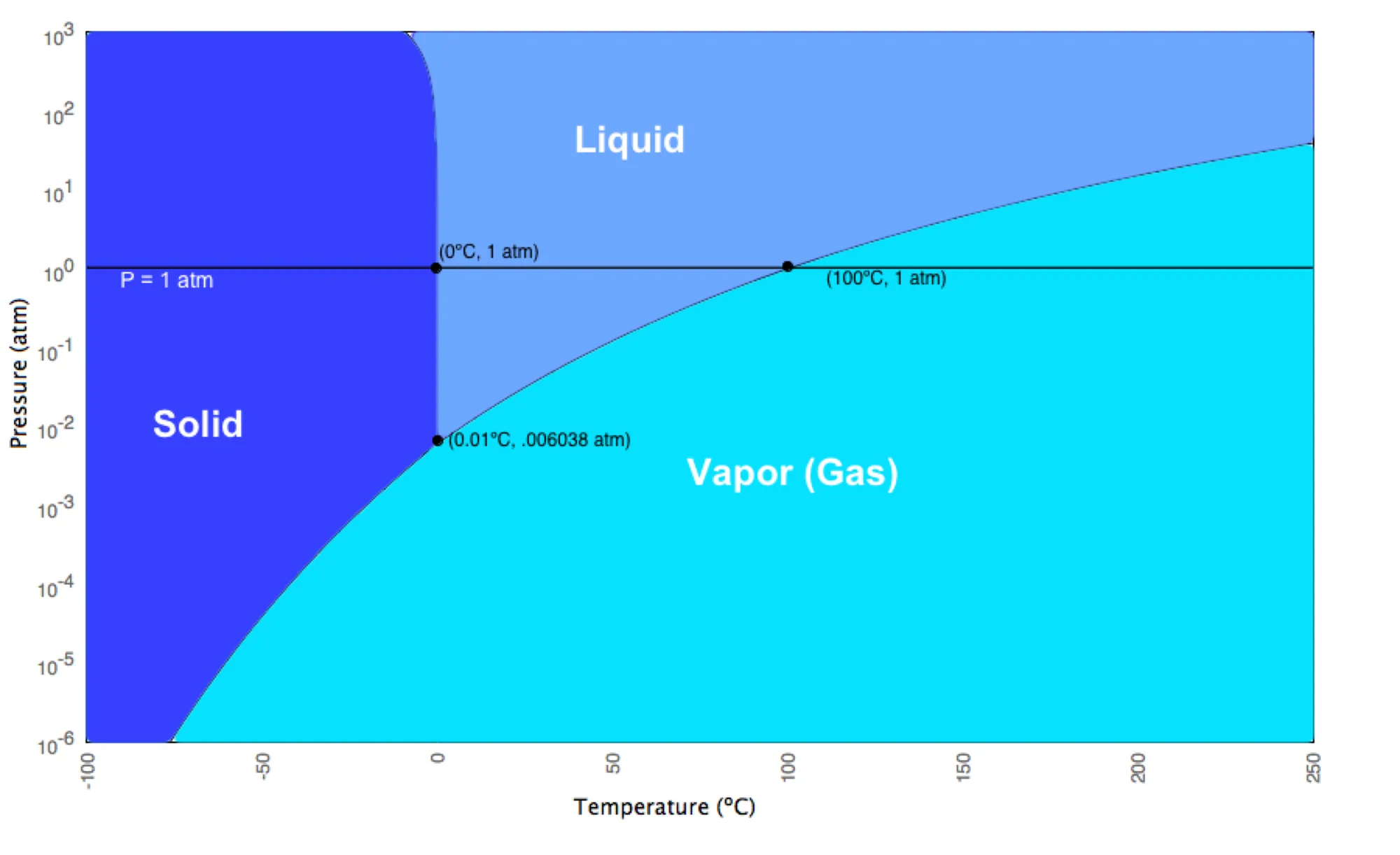
Liquid-Gas Border
Water transitions between liquid and gaseous states by crossing this line. The gas form of water is more commonly known as ‘vapor’
Gas-Liquid Border
This line represents the point at which water transitions between solid and liquid.
This table uses the Antoine Equation to calculate the vapor pressure at each temperature. This equation relates Pressure and Temperature:
In this equation, P is pressure, T is temperature, and A, B, and C are constants that you need to look up in a table. Typically one set of values only works for a certain temperature range.
If we were to have units of P in atm, T in ºC, then the following values hold true.
Sublimation is direct conversion from solid to gas without passing through a liquid phase. Its reverse is deposition. It is not simultaneous melting and boiling. Whether a substance follows that route depends on its temperature and pressure conditions.
You should now be able to see that the state matter is in is not just dependent on temperature, it is also dependent on pressure. If you want to show this relationship more explicitly, you would use a phase diagram. Interactive 1.2 shows the phase diagram for water.
Dry ice changes directly from solid CO₂ to gas under ordinary atmospheric pressure. The cold gas cools moist air and can produce a visible cloud of tiny condensed water droplets. CO₂ gas itself is colorless; the white fog is not evidence that gaseous carbon dioxide is visibly white.
A phase diagram predicts what phase matter will be in when it is at a certain temperature or pressure. The intersection of all three phase change lines is called the triple point.
Interactive 1.3.2 Expanded Phase Diagram of Water
Read all reviewed figure notes
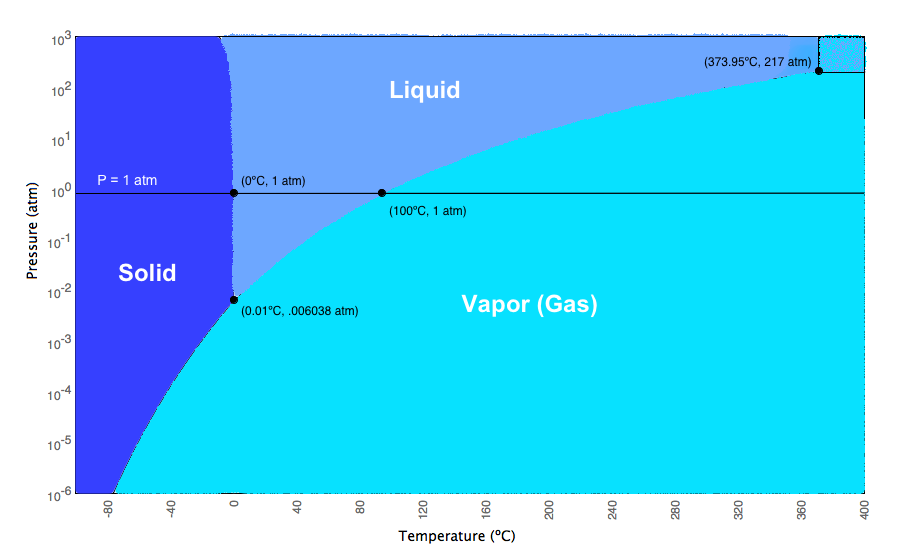
Supercritical Fluid
Phase-diagram enrichment: above a substance’s critical temperature and critical pressure, there is no liquid–gas phase boundary. A supercritical fluid has continuously variable fluid properties. This is a liquid/gas distinction, not an assertion that solid and liquid become identical. Detailed phase diagrams are beyond this AP edition’s required topic coverage.
Example Problem 1.3.1
What pressure does water need to be at to boil at 35ºC?
The key to understanding this problem is to recall that when matter boils, its vapor pressure equals the pressure surrounding it. This means that we need to find the vapor pressure of water at 35ºC.
Let’s use the Antoine Equation.
Step 1: Plug in the Antoine coefficients
Use NIST’s water fit valid304–333K:A5.20389,B1733.926,C−39.485; P is inbar andT inK.
log₁₀(P/bar)=5.20389−1733.926/(T/K−39.485).
Step 2: Plug in T and solve
Now that we have the coefficients, we just need to pop in T.
AtT308.15K, P=0.056238bar, or0.05550atm.
Step 3: Solve for P
Reviewed vapor-pressure enrichment: NIST’s water Antoine fit valid from 304 to 333 K uses log₁₀(P/bar)=5.20389−1733.926/(T/K−39.485). At 35.00 °C, T=308.15 K, so P=0.056238 bar=0.05550 atm. The original coefficients and 0.0603 atm result are superseded. Use a fit only within its stated temperature range and carry its pressure units explicitly.
Before we leave phase diagram completely, it’s to to look at the area beyond the water/gas divider. That’s right, that line ends. At a point called the critical point, matter becomes indistinguishable between gas or liquid. This state is called a supercritical fluid. When matter goes beyond the critical point, that means it is both beyond the critical pressure and temperature. Therefore the liquid can only be a supercritical fluid above the critical temperature and above the critical pressure. Here’s a phase diagram that goes beyond the previous and shows the supercritical portion of water:
Finally, beyond intermolecular forces, you can further predict the boiling point amongst some organic molecules by looking at the number of carbon atoms in the molecule. Generally, the higher the number of Carbon atoms, the higher the boiling point. For example, Propene (C3H6) has a boiling point of 236K, while 1-Butene (C4H8) has a boiling point of 267K, a bit higher
Glossary and deeper reading · 9 refreshers
These editorial refreshers supplement the reading. Definitions and examples are added guidance; original source wording and recorded answers remain in their original context.
-
Phase change
A phase change alters a substance's physical state without changing its chemical identity. It involves a change in particle arrangement and interactions and can transfer energy without raising temperature during a pure-substance transition at fixed pressure. For example, vaporizing liquid water separates water molecules into a gas.
-
Intermolecular force
Intermolecular forces are interactions between molecules. They affect properties such as boiling point and solubility and are distinct from the bonds within each molecule. For example, vaporizing water separates molecules while largely preserving their O–H bonds.
-
Hydrogen bond
Hydrogen bonding is a directional interaction involving hydrogen bonded to a sufficiently electronegative atom and an appropriate electron-rich acceptor. In the introductory model, N, O, and F commonly provide the relevant partners. For example, water molecules hydrogen bond when one molecule's O–H group interacts with another molecule's oxygen lone pair.
-
Ionic bonding
Ionic bonding is electrostatic attraction among oppositely charged ions. An ionic solid normally forms an extended lattice rather than separate ion-pair molecules. For example, sodium chloride consists of a repeating array of sodium and chloride ions.
-
Evaporation
Evaporation is vaporization occurring at a liquid's surface. It can occur below the boiling point as some particles escape into the gas phase. For example, liquid water can evaporate at room temperature and leave less liquid behind.
-
Vaporization
Vaporization is a phase change from liquid to gas. It requires energy to separate particles against their attractive interactions without ordinarily breaking the molecules' internal bonds. For example, boiling liquid water produces water vapor while preserving the water molecules.
-
Chemical equilibrium
Chemical equilibrium is a dynamic state in which forward and reverse reaction rates are equal. Macroscopic composition remains constant in a closed system under fixed conditions, but reactant and product concentrations need not be equal. For example, a reversible reaction can reach equilibrium with much more reactant than product.
-
Condensation
Condensation is a phase change from gas to liquid. It releases energy to the surroundings as particles form more closely associated liquid arrangements. For example, water vapor condensing on a cooler surface forms liquid droplets.
-
Sublimation
Sublimation is a phase change directly from solid to gas without an intervening liquid phase. Whether it occurs depends on the substance and pressure–temperature conditions. For example, solid carbon dioxide sublimes at ordinary atmospheric pressure.