The Hydrogen Ion
Supporting original reading. Follow the AP topic pathway for reviewed scope, worked reasoning and targeted practice.
Chemistry II · original Chapter 6 · combined Chapter 14
Interactive 6.1.1 The Hydrogen Atom
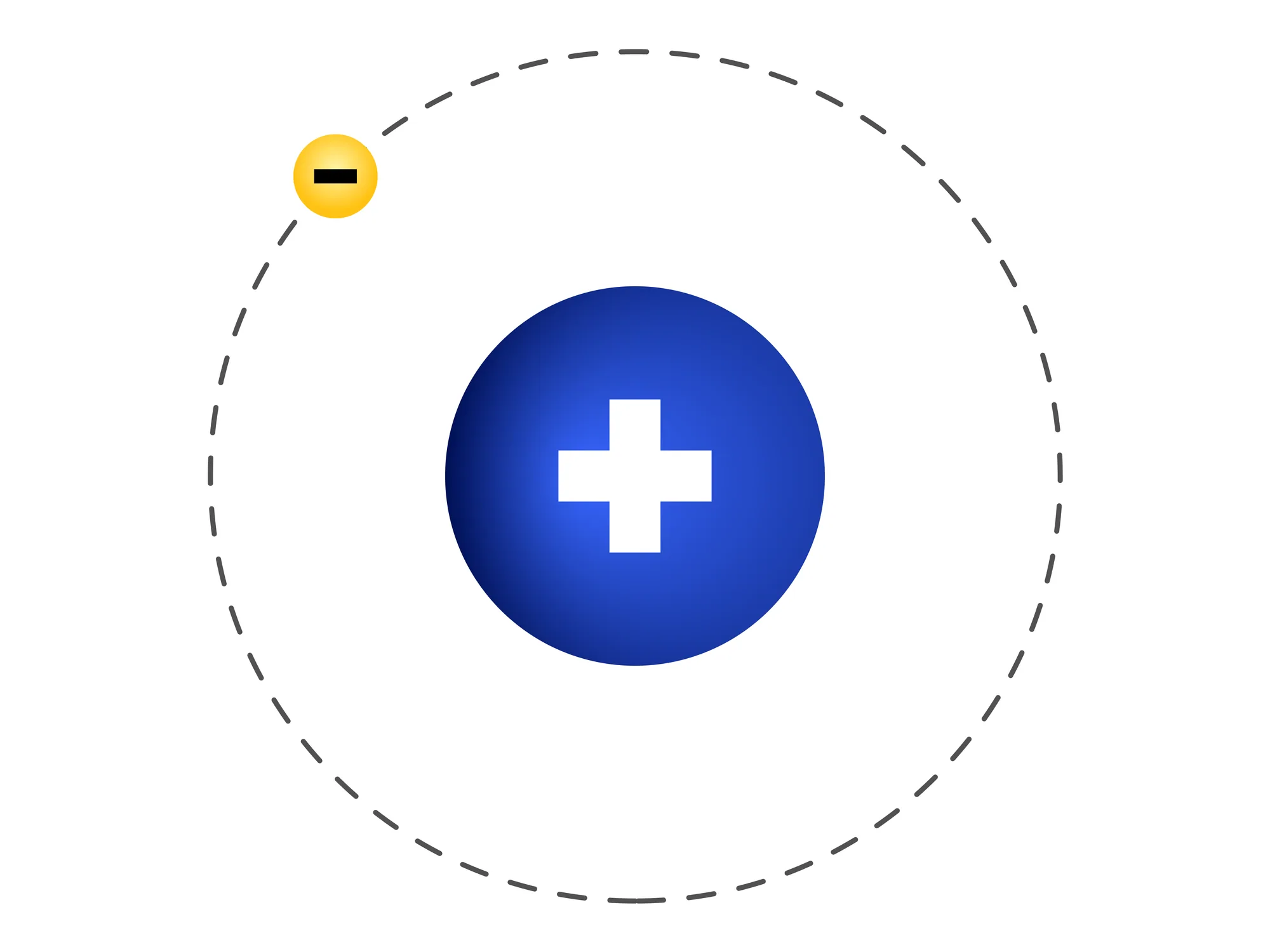
Read all original figure notes
In order to answer that question, we have to look at the defining feature of an acid. The Hydrogen Ion (H+) is the primary feature of an acid, and the relationship between the Hydrogen ion and acid (or base) molecules is the big concept to understand when it comes to acids.
So why Hydrogen? What makes the Hydrogen Ion so important when it comes to acids and bases? Well, let’s think about what makes up a Hydrogen Ion.
Hydrogen is element 1 on the periodic table. This means that a hydrogen atom contains one proton and one electron. Now, the other major component of atoms is the neutron. Hopefully you know that an element can have a varied number of neutrons, though it might not be stable with the wrong number. These atoms with varying numbers of neutrons are called isotopes.
Hydrogen has three main isotopes, , , and , each containing 0, 1, and 2 neutrons, respectively. Perhaps surprisingly, the most common isotope for Hydrogen is the isotope, which does not contain any neutrons at all. This isotope actually comprises over 99% of all Hydrogen!
An ordinary hydrogen-1 atom has one proton and one electron, with no neutron. Hydrogen-2 and hydrogen-3 isotopes have one and two neutrons respectively. Losing the electron leaves the hydrogen-1 nucleus, a proton; in water it is hydrated rather than an isolated bare proton.
In water, H⁺(aq) denotes the hydrated proton, commonly represented as H₃O⁺. It is not a bare solitary proton freely approaching atomic nuclei. Hydration structures and proton transfer involve the surrounding water molecules.
A Brønsted–Lowry acid donates a proton to a base. For example, HCl+H₂O→H₃O⁺+Cl⁻. Water acts as the proton acceptor in that reaction; atoms and total charge are conserved.
Removing a proton from an acid leaves its conjugate base. The ability of a species to donate or accept a proton depends on its bonding, charge, electronic structure and solvent environment, rather than a neutron count rule.
Use molecular structures and a balanced proton-transfer reaction to identify acid–base partners. Compare acid strengths by the specified equilibrium constants and solvent conditions; nuclear size is not an AP acid-strength model.
Proton transfer can occur among water molecules and other bases in solution. The source bare-sphere drawing is superseded by a molecular hydrated-proton/proton-transfer representation.
Keep nuclear composition and acid–base behavior as distinct models. Hydrogen isotope differences can affect physical chemistry, but “absent neutrons allow acidity” does not explain ordinary aqueous proton transfer.
At some point, you have probably encountered the term pH. You may even know it has something to do with acids. What is pH, though, really?
Due to the great importance of the Hydrogen Ion we just reviewed, chemists like to look at the concentration of Hydrogen in solution quite often. So often, in fact, that they created the term pH to describe just that.
In formal terms, pH is calculated via the following equation:
The concentrations that the Hydrogen typically exists at in solution are much lower than what you are used to. Normally the lowest concentrations you have been interested in are probably down to 0.001M. If you had an concentration of 0.001M, it would actually be really high!
Typically, the pH scale is given as 0-14. This is the typical range you will be dealing with when learning about acids and bases. Let’s convert that scale to actual concentrations.
Gallery 6.1.1 — Hydrated protons and proton transfer
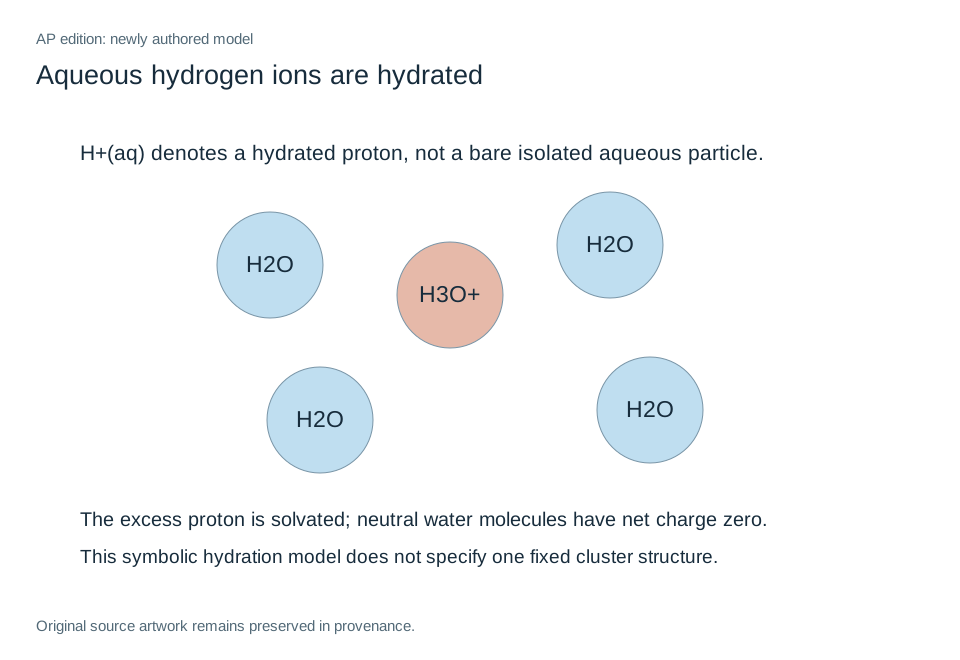
AP edition authored model. Hydronium surrounded by neutral water. H+(aq) is shorthand for the hydrated proton. These molecular models replace the source neutron/nuclear-size account of acidity. They do not claim a single fixed proton-hydration cluster.
Read all reviewed image captions
Image 1
AP edition authored model. Hydronium surrounded by neutral water. H+(aq) is shorthand for the hydrated proton. These molecular models replace the source neutron/nuclear-size account of acidity. They do not claim a single fixed proton-hydration cluster.
Image 2
AP edition authored model. HCl transfers a proton to water, giving hydrated hydronium and chloride. These molecular models replace the source neutron/nuclear-size account of acidity. They do not claim a single fixed proton-hydration cluster.
As you can see, the Hydrogen Ion concentration can reach extremely low values and still be relevant.
As we said before, when the Hydrogen Ion is around any other molecule or atom, it is unavoidably attracted to it. Therefore, the lone proton does not exist in solution. In water, the Hydrogen Ion bonds itself to water molecules, forming what is known as the Hydronium Ion, .
Normally, this is assumed, and we still look at pH as being the concentration of in the water, even though it actually is .
It is important to note here that the water molecule is accepting a Hydrogen Ion when it forms the Hydronium Ion. As you will find out later, this is one property of a base. Water is a special substance, as it can also release a Hydrogen Ion in the right environment, forming Hydroxide.
Water autoionization has Kw=[H₃O⁺][OH⁻] in the ideal concentration convention. Kw depends on temperature. At 25 °C it is approximately 1.0×10⁻¹⁴, which lets us determine the neutral pH at that temperature.
Example Problem 6.1.1
The Equilibrium constant for the deprotonation of water is . Use this information to determine the pH of pure water. The equation for the deprotonation of water is:
Step 1: Write the Equilibrium Equation.
Step 2: Set up the ICE table.
We are going to start with pure water, without any in it.
Step 3: Plug in the values to the Equilibrium Equation.
Step 4: Determine x, and the final concentration.
Step 5: Calculate pH.
Interactive 6.1.2 pH Chart

Read all original figure notes
We tend to say that a solution with a pH below 7 is acidic, and a solution with a pH above 7 is basic. Most natural systems are within one or two pH units of neutral, but some surprisingly strong acids or bases can be found in nature. One in particular resides in your body! Stomach acid has a pH near 1. This makes it very acidic, and that acidic property is used to digest your food.
On the next column, you can see a cool chart outlining the pH of various common solutions and chemicals.
Sometimes you will see something known as the pOH. This is very similar to pH, as its formula is nearly the same, but with the Hydroxide Ion instead of the Hydrogen Ion.
Thanks to the dissociation reaction of water, we can give a nice relationship between pH and pOH:
pH+pOH=pKw(T). At 25 °C this becomes approximately pH+pOH=14.
The reason for this relationship relies on the Equilibrium Equation for the water dissociation. Recall that for water, . Let’s use that to prove the relationship between pH and pOH.
The relationship follows from water autoionization. Use pKw at the stated temperature; the value 14 is the approximate 25 °C value. Other solvents have their own acid–base and autoionization conventions.
Glossary and deeper reading · 9 refreshers
These editorial refreshers supplement the reading. Definitions and examples are added guidance; original source wording and recorded answers remain in their original context.
-
Ion
An ion is an atom or group of atoms with a net electric charge. Ordinary ion formation changes electron count without changing the element's proton count. For example, a sodium atom losing one electron becomes a sodium ion with charge +1.
-
pH
pH is the negative base-ten logarithm of hydronium activity. In suitable dilute models, activity is approximated by molar concentration relative to the standard concentration. For example, lowering hydronium concentration by a factor of ten raises pH by one unit.
-
Hydronium
Hydronium is the H₃O⁺ ion used in the introductory model of proton behavior in water. Aqueous H⁺ notation is shorthand for a solvated proton rather than a bare proton moving independently in the liquid. For example, a Brønsted acid can transfer a proton to water and form hydronium.
-
Isotope
Isotopes are atoms of the same element with different numbers of neutrons. They have the same proton number but different masses. For example, carbon-12 and carbon-13 each have six protons but have six and seven neutrons, respectively.
-
Brønsted acid and base
A Brønsted acid donates a proton, and a Brønsted base accepts a proton. These roles describe a particular reaction, so some substances can act in either role. For example, water accepts a proton from hydrogen chloride but donates one to ammonia.
-
Conjugate acid–base pair
A conjugate acid–base pair consists of species differing by one proton. Losing a proton forms an acid's conjugate base, while gaining one forms a base's conjugate acid. For example, ammonium and ammonia form a conjugate acid–base pair.
-
Solvent
A solvent is the component used as the dissolving medium in a solution. It is often present in the greater amount, though the designation also depends on the mixture's context. For example, water is the solvent in a dilute aqueous sugar solution.
-
Equilibrium constant
An equilibrium constant is the value of the reaction quotient at equilibrium for a specified reaction and temperature. Its magnitude indicates equilibrium composition preference rather than reaction speed. For example, a large constant often indicates a product-favored equilibrium, but the starting composition still determines the immediate net direction.
-
Aqueous solution
An aqueous solution is a solution in which water is the solvent. The dissolved substance may originate as a solid, liquid, or gas, so aqueous does not mean that a solid has melted. For example, sodium chloride dissolved in water is aqueous even though the pure salt is solid.