Reaching Equilibrium
Supporting original reading. Follow the AP topic pathway for reviewed scope, worked reasoning and targeted practice.
Chemistry II · original Chapter 5 · combined Chapter 13
Section Breakdown
- Equilibrium Review
- Quotient Constant
- Reaction Direction
Section 1
Reaching Equilibrium
A reversible reaction in a closed system can reach dynamic equilibrium. The forward and reverse reactions continue at equal rates, so macroscopic concentrations stay constant. Equilibrium means no net change in composition; it does not mean molecular reactions stop.
When a reaction is given, in order to determine the equilibrium expression, you have to look at the reactants and coefficients. For a reaction of the form
A concentration expression Kc can include dissolved species and gases represented by their equilibrium concentrations. A pressure expression Kp uses gas partial pressures. The thermodynamic equilibrium constant is defined with dimensionless activities; the familiar concentration and pressure forms are useful ideal approximations.
In these equations, K is the equilibrium constant based off of either concentration () or partial pressures (). represents the concentration of A at equilibrium, and represents the partial pressure of A at equilibrium.
Include gaseous and dissolved species in the appropriate equilibrium expression, each raised to its stoichiometric coefficient. Omit pure solids and pure liquids because their activities are taken as one. A gas is not omitted merely because it is not aqueous.
The net equation conserves atoms and charge. If calcium chloride supplies Ca²⁺, its formula is CaCl₂. Na⁺ and Cl⁻ spectators cancel; do not introduce CaCl₃.
K=a(CO₂)/[a(Ca²⁺)a(CO₃²⁻)a(H⁺)²a(SO₄²⁻)]. Each activity is referred to its standard state; the gas activity can be represented as p(CO₂)/p°.
Pure CaSO₄(s) and pure liquid water have unit activity in this model. CO₂ remains in the numerator, and the coefficient 2 on H⁺ gives exponent 2.
The reaction quotient Q describes a current composition and changes as a reaction proceeds. The equilibrium constant K is the value Q has at equilibrium at the specified temperature. Use the same balanced equation and expression when comparing them.
If you know the value of the reaction’s Equilibrium Constant, then by calculating the value of the Quotient Constant for the reaction at its current state, you can tell which direction the reaction will proceed to. The relationships are:
the reaction will proceed to the left.
the reaction will proceed to the right.
If Q=K at the stated temperature, the system is at equilibrium: forward and reverse rates are equal and there is no net reaction.
If you don’t want to just trust me on those relationships, let’s look at the equation for Q or K for our basic reaction:
We can just label the numerator products and the denominator reactants:
Gallery 5.1.1 Determining Direction of Reactions
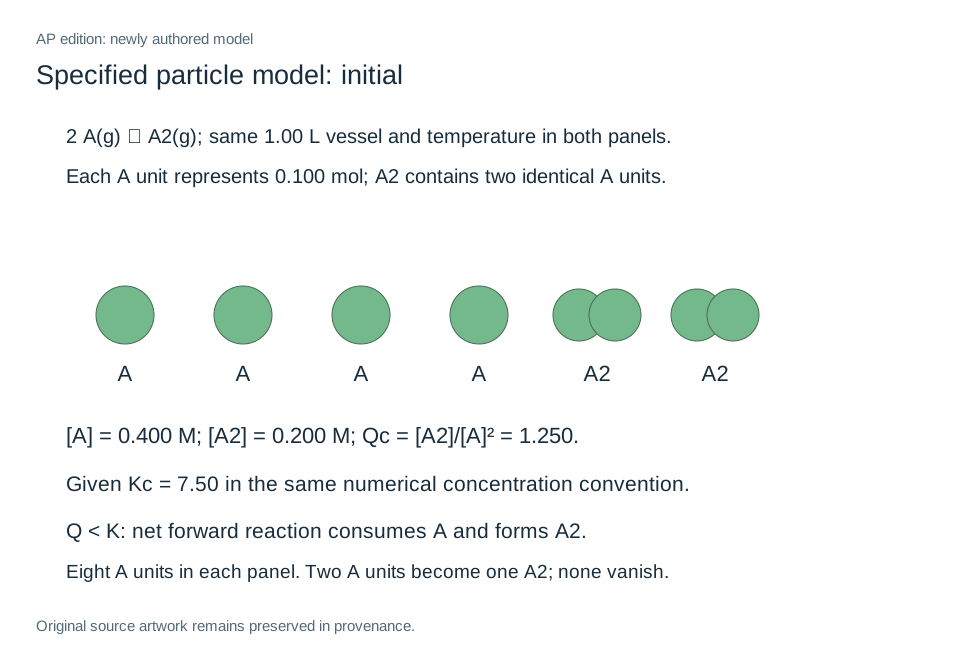
AP edition authored model. A count-conserving 2A to A2 equilibrium model with specified volume and Kc. The original unlabeled artwork does not establish a balanced reaction or Q/K. These hypothetical A/A2 panels state the model and conserve eight A units.
Read all reviewed image captions
Image 1
AP edition authored model. A count-conserving 2A to A2 equilibrium model with specified volume and Kc. The original unlabeled artwork does not establish a balanced reaction or Q/K. These hypothetical A/A2 panels state the model and conserve eight A units.
Image 2
AP edition authored model. A count-conserving 2A to A2 equilibrium model with specified volume and Kc. The original unlabeled artwork does not establish a balanced reaction or Q/K. These hypothetical A/A2 panels state the model and conserve eight A units.
If your Quotient Constant is equal, then you must be at equilibrium, due to the definition of the Equilibrium Constant.
Glossary and deeper reading · 8 refreshers
These editorial refreshers supplement the reading. Definitions and examples are added guidance; original source wording and recorded answers remain in their original context.
-
Reversible reaction
A reversible reaction can proceed in both forward and reverse directions under the modeled conditions. Its net direction depends on the current composition and temperature. For example, a product-rich starting mixture can react backward toward equilibrium.
-
Chemical equilibrium
Chemical equilibrium is a dynamic state in which forward and reverse reaction rates are equal. Macroscopic composition remains constant in a closed system under fixed conditions, but reactant and product concentrations need not be equal. For example, a reversible reaction can reach equilibrium with much more reactant than product.
-
Partial pressure
A gas's partial pressure is the pressure it would exert alone in the mixture's volume at the same temperature. In an ideal mixture, the component partial pressures add to the total pressure. For example, a component with mole fraction 0.20 contributes 0.20 of the total ideal pressure.
-
Equilibrium constant
An equilibrium constant is the value of the reaction quotient at equilibrium for a specified reaction and temperature. Its magnitude indicates equilibrium composition preference rather than reaction speed. For example, a large constant often indicates a product-favored equilibrium, but the starting composition still determines the immediate net direction.
-
Stoichiometry
Stoichiometry uses a balanced chemical equation to relate amounts of reactants and products. Equation coefficients provide mole ratios rather than direct mass ratios. For example, forming water from hydrogen and oxygen consumes two moles of hydrogen molecules per mole of oxygen molecules.
-
Aqueous solution
An aqueous solution is a solution in which water is the solvent. The dissolved substance may originate as a solid, liquid, or gas, so aqueous does not mean that a solid has melted. For example, sodium chloride dissolved in water is aqueous even though the pure salt is solid.
-
Standard state
A standard state is a defined reference for a substance's thermodynamic properties. It specifies activities or reference forms and does not by itself fix the temperature at 25 °C. For example, gases commonly use a one-bar reference pressure while the table states temperature separately.
Read more: Gibbs Free Energy and Thermodynamic Favorability →
-
Reaction quotient
The reaction quotient describes a mixture's current composition using the equilibrium-expression form. It uses species activities, approximated by concentrations or partial pressures in suitable models, with powers from balanced coefficients. For example, a quotient below the equilibrium constant favors net forward reaction toward equilibrium.