FFR: Faraday’s Laws
Supporting original reading. Follow the AP topic pathway for reviewed scope, worked reasoning and targeted practice.
Chemistry II · original Chapter 8 · combined Chapter 16
Section Breakdown
- Electrochemical Corrosion
- Faraday’s First Law
- Faraday’s Second Law
- Chapter Problems
Section 4
FFR: Faraday’s Laws
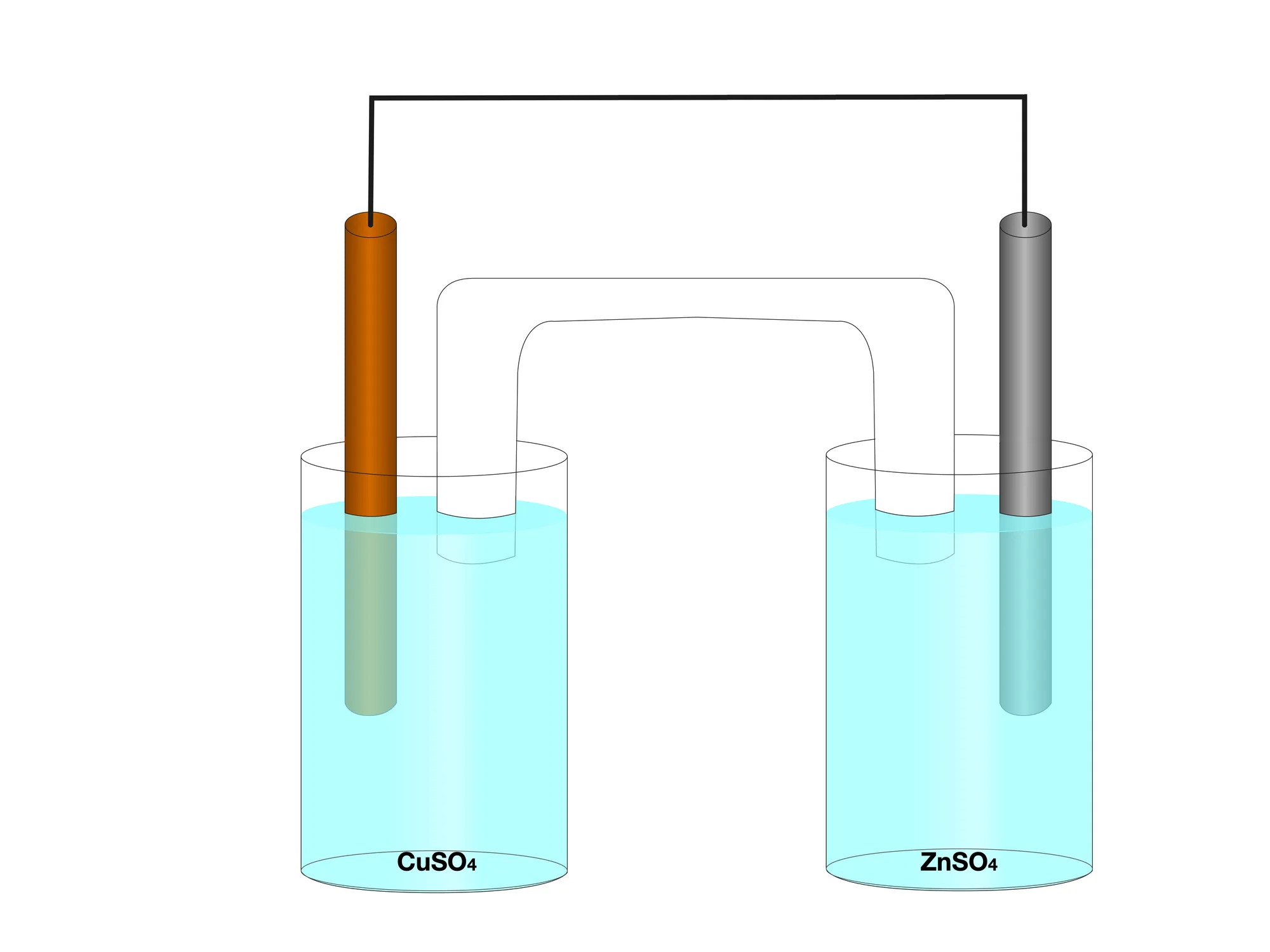
During an electrochemical reaction, one electrode undergoes electrochemical corrosion. That means that the electrode is losing mass as it reacts. Typically, in a metal-metal cell, the anode degrades as it gets oxidized. Let’s take a look at our favorite galvanic cell, the Zinc-Copper cell.
Zinc has a Standard Electrode Potential of -0.7618V. Copper’s is 0.34V. Therefore, copper gets reduced and zinc gets oxidized. The reaction is:
As you can see, the copper ions initially in solution become solid copper once getting reduced. Zinc, however, starts out as a solid electrode, and then gets oxidized into zinc ions in solution. Through this process, the zinc electrode loses mass as it gets oxidized, causing a decrease in the mass of the electrode.
Gallery 8.4.1 Galvanic Corrosion
Read all original image captions
Image 1
Image 2
Image 3
So how can we determine how long it takes for the anode to fully degrade? Or perhaps how big a sacrificial anode is needed for cathodic protection.
For this, we turn to the two laws developed by Michael Faraday. The two laws are very similar, with slight differences.
As he originally put it, Faraday’s first law reads: “...that when subjected to the influence of the electric current, a quantity of [water] is decomposed exactly proportionate to the quantity of electricity which has passed”.
In other words, the mass of an electrode affected is directly proportional to the amount of electricity that passes through it. Put simply, the amount of material affected by electrolysis is dependent on how much electricity is used. If we want to apply this to solve problems, we have to use it to formulate an equation.
The law states that mass of the water is exactly proportional to the amount of electricity passed through.
Therefore, we can start with:
We know that this is exactly proportional, so we just need to work with units to develop our equation. Let’s start with electricity. When Faraday states “quantity of electricity” he refers to the amount of charge that passes through. That is typically represented by and given in coulombs.
Okay, so now we need to get from coulombs to units of mass. Let’s say we are working with a half-cell whose equation is:
Now we can say that we are trying to determine the relationship between the mass of electrode affected and the charge passed through the electrode.
Charge in electrochemistry is carried by the electrons moving from one electrode to the other. This means we can change into the number of electrons. The relationship between that is:
Where is the number of electrons in moles. Now we need to relate the moles of electrons to the mass of electrode. We turn to the reaction for this.
As you can see, in this particular half-cell, we have a 1:1 molar ratio of electrons:electrode. Keeping with our general terms, we will call the number of electrons .
We can use this relationship to reach mole of electrode affected.
So now we are at:
We are nearly there. We are at the moles of electrode. If we want to convert moles to mass, we just need to use the molar mass of the electrode.
This puts us at:
As the law states exactly proportional, we can now make this an equality:
This equation relates the mass of the electrode degraded or deposited to the the amount of electricity that is passed through the electrode.
Faraday’s first law asserts that a given compound will be predictably affected by electricity depending on the amount of electricity used. His second law generalizes that even further, stating that the same amount of electricity will act upon the same equivalent mass of different compounds.
The big difference between this law and the first law is that the amount of electricity is constant, but the amount of electrode affected is not. The equivalent mass for a compound is the ratio of molar mass to moles of electrons. This is because the same amount of electricity (the same number of electrons) can only react with half the oxygen as it can silver. This is due to their half-reactions:
As you can see, silver only needs one electron, but there are two electrons required per oxygen atom, and 4 per oxygen molecule. This means that the same amount of electricity that would degrade one mole of silver would only react with one fourth mole of oxygen.
This law uses the same mathematical formula as the first law, but we are holding different values constant. With the first law, we were varying the charge to solve for the mass. With the second law, we keep charge constant and change the equivalent mass to solve for the mass affected.
Example Problem 8.4.1
Reviewed Zn/Cu galvanic model: initial usable zinc mass is stipulated as 20.00 g. The cell transfers 3.00×10³ C, entirely through Zn→Zn²⁺+2 e⁻ with 100% useful-current efficiency. Use F=96485 C mol⁻¹ and M(Zn)=65.38 g mol⁻¹. Find remaining zinc mass.
Q/F=3000/96485 mol electrons; divide by two to find the moles of Zn oxidized.
m(consumed)=(3000/96485)(65.38/2)=1.016427 g.
m(remaining)=20.00−1.016427=18.983573 g≈18.98 g. The original 17.98 g is a subtraction error; oxidation consumes zinc rather than depositing it.
Q/F=3000/96485 mol electrons; divide by two to find the moles of Zn oxidized.
m(consumed)=(3000/96485)(65.38/2)=1.016427 g.
m(remaining)=20.00−1.016427=18.983573 g≈18.98 g. The original 17.98 g is a subtraction error; oxidation consumes zinc rather than depositing it.
One common situation involved in problems regarding Faraday’s laws is the constant-current situation.
Current, represented as , is a measure of the flow of electricity. It’s base unit is the Ampere, , which is the equivalent of . That means that in a cell which outputs of current, there will be of charge put off over . Generally, we can use this equation to relate current to charge:
This equation only holds true for constant-current situations, but under those situations, the equation for Faraday’s laws can be modified to:
This allows us to predict the lifetime of a cell that undergoes a constant current by determining when the electrodes will be used up. This assumption of a constant current is fairly invalid, but we can think of it as an average current throughout the lifetime of the cell.
Example Problem 8.4.2
Reviewed ideal lead–acid discharge model: 10.0 kg usable Pb and 10.0 kg usable PbO₂ are available with excess acid. Each half-reaction transfers two electrons; current is constant at 5.00×10² A. Assume 100% utilization and Faradaic efficiency, M(Pb)=207.2 and M(PbO₂)=239.2 g mol⁻¹, F=96485 C mol⁻¹. Find active-material-limited lifetime.
Pb is oxidized at the anode and PbO₂ reduced at the cathode during discharge. Net reaction: Pb+PbO₂+2 H₂SO₄→2 PbSO₄+2 H₂O.
The two electrodes supply the same total circuit charge. Capacity(Pb)=2F×10000/207.2; capacity(PbO₂)=2F×10000/239.2. The larger molar mass means the equal-mass PbO₂ electrode has fewer moles and is limiting.
Qlimited=2×96485×10000/239.2≈8.06731×10⁶ C. t=Q/I≈16134.6 s≈4.48184 h≈4.48 h.
This ideal active-material model does not predict a practical car-battery lifetime; actual usable mass, acid quantity, discharge rate and efficiency matter. Charging reverses the reaction and roles.
Batteries are sometimes rated in terms of the charge they can provide. It is a way of determining the life-time of the battery without requiring a constant current assumption. Battery ratings are typically given in . Since we typically deal with charge in coulombs, let’s convert that.
Using the definition of Amps we discussed earlier:
There’s our conversion factor. This lets us convert between and .
Example Problem 8.4.3
What is the rating (in ) of a zinc-copper battery that starts fresh with 4g of zinc and 6g of copper in its ionic form?
Step 1: Determine Cell set-up.
This battery is our familiar zinc-copper cell, with the anode zinc and cathode copper:
This reaction shows that we have a 2 electron reaction between copper and zinc.
Step 2: Determine limiting electrode.
To figure out our limiting electrode, we need to know the electrode with the highest equivalent weight.
Copper:
Zinc:
Just the equivalent mass isn’t enough, though, as we have unequal starting values for the electrode mass.
In order to determine which electrode is limiting, we need the one with the shortest lifetime on a charge-basis. Equivalent mass gives us the value of . We need to use the initial mass of each electrode to figure out which one will pass the fewest electrons.
So for copper:
and zinc:
This means that the Zinc electrode can pass the fewest electrons, causing it to be the limiting electrode.
Step 3: Determine the rating of the battery
We have determined that the zinc electrode will only provide . We can convert that to coulombs with Faraday’s constant:
Finally, we need to convert the rating into the appropriate units.
Our battery has a rating of .
Chapter Problems
- Reviewed replacement: at 298.15 K, a hypothetical M²⁺/M reduction half-cell is measured at E=−3.220 V relative to a same-temperature SHE, with a(M²⁺)=2.00 and pure M activity 1. Find E°, using E=E°−RT ln Q/(nF), R=8.31446 and F=96485.3 in SI units.
Review the authored solution
For M²⁺+2 e⁻→M, n=2 and Q=1/2. E=E°+(RT/2F)ln2. Thus E°=−3.220−0.008904=−3.228904 V≈−3.229 V. The explicit sign, reference, temperature and formal species model supersede the incomplete gallium record.
Glossary and deeper reading · 10 refreshers
These editorial refreshers supplement the reading. Definitions and examples are added guidance; original source wording and recorded answers remain in their original context.
-
Corrosion
Corrosion is deterioration of a material through chemical or electrochemical reactions with its environment. Metal corrosion commonly involves oxidation coupled to a reduction process. For example, rust formation involves iron oxidation together with reactions involving oxygen and water.
-
Faraday’s constant
Faraday’s constant is the magnitude of electric charge carried by one mole of electrons. It is approximately 96485 coulombs per mole and connects measured charge to the amount of electrons transferred. For example, depositing one mole of a metal from ions with charge +2 requires two moles of electrons in the ideal model.
-
Anode
The anode is the electrode where oxidation occurs. This definition applies to both galvanic and electrolytic cells. For example, a zinc electrode releasing zinc ions and electrons is an anode in the zinc–copper galvanic model.
-
Oxidation
Oxidation is electron loss, represented by an increase in oxidation number. It occurs together with reduction so that electrons are conserved in the overall reaction. For example, a zinc atom becoming a zinc ion with charge +2 undergoes oxidation.
-
Ion
An ion is an atom or group of atoms with a net electric charge. Ordinary ion formation changes electron count without changing the element's proton count. For example, a sodium atom losing one electron becomes a sodium ion with charge +1.
-
Electrolyte
An electrolyte forms mobile ions when dissolved and can allow a solution to conduct electric current. Strong and weak electrolytes differ in the extent to which dissolved species form ions under the stated conditions. For example, dissolved sodium chloride supplies sodium and chloride ions to water.
-
Electrolysis
Electrolysis uses an external electrical source to drive an electrode reaction in an otherwise unfavorable direction. The products depend on the specified half-reactions and medium, including possible competition from water. For example, reduction of metal ions at a cathode can produce an electroplated metal layer.
-
Mole
A mole is an amount of substance containing exactly 6.02214076 × 10²³ specified entities. The entities can be atoms, molecules, ions, or formula units, so the counted entity must be named. For example, one mole of oxygen molecules contains two moles of oxygen atoms.
-
Molar mass
Molar mass is the mass of one mole of a specified substance. It is commonly expressed in grams per mole and connects a sample's mass to its amount of substance. For example, water has a molar mass of approximately 18.02 grams per mole.
-
Half-reaction
A half-reaction describes either the oxidation or reduction part of a redox process. It includes electrons explicitly so that charge and electron transfer can be balanced. For example, zinc forming a zinc ion and two electrons is an oxidation half-reaction.