Periodic Trends
Supporting original reading. Follow the AP topic pathway for reviewed scope, worked reasoning and targeted practice.
Chemistry I · original Chapter 6 · combined Chapter 6
Section breakdown
- Atomic Radius
- Electronegativity
- Properties of Periodic Table
Section 1
Periodic Trends
In this section, it is important to realize that the periodic table has a lot of trends associated with it and from the table, we can extract a lot of useful information. The table reveals to us a lot of properties that each atom has and the reason why they can make certain bonds and have such a high energy associated with them. We’ll look at a couple of trends that are very important in chemistry such as the atomic radius and electronegativity as well as other properties.
Atomic Radius
As we saw in Chapter 5, just as the size of an orbital cannot be specified neither can the size of an atom, let alone its radius. It is therefore required that assumptions and estimations be made concerning the atomic radii of each atom. It is estimated that an average atomic radius can be deduced from measuring the distance between two atoms in a chemical compound. For example, lets take the chemical compound of Chlorine. It is known that the distance between the nucleus of two chlorine atoms is 198 pico meters (pm). Therefore, the atomic radius is estimated to be half that distance, or 99 pm.
A better view to understand this can be seen on the next page with the two chlorine atoms side to side in Figure 6.1.1.
Interactive 1.1 Determination of Chlorine atomic radius

Read all original figure notes
Merging
Slight merging of electrons causes averaged values to be estimated.
Distance
Distance between two nuclei (2r)
You may be asking, now wait a minute, is this assuming though that both atoms are perfect in shape and identical? Well, the answer is, YES. This is science, and science isn’t perfect, but it gives us a good estimate into the actual size of an atom. Something important to note here is that these sizes are somewhat skewed from the actual size because when atoms attach to form molecules, remember that their electron clouds and orbitals are shared so there is some deformation in the shape and some interpenetration between each atom so the radius values aren’t exact but again, they are good estimates for all purposes.
These estimates have been done for all elements and the results are displayed on Gallery 6.1.1, which clearly shows the trend of atomic radii as you go across and down the periodic table.
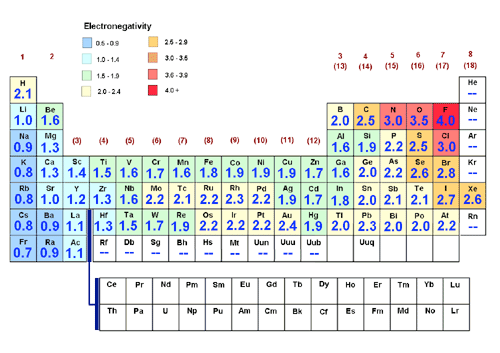
Interactive 1.2 Electronegativity on the Periodic Table
Read all original figure notes
Decreasing
Lower values indicate lower affinity for electrons
Increasing
Values increase as you go across table which can be attributed to smaller radii pulling electrons in closer.

Read note
This concept is very important as it helps connect the ideas behind covalent and ionic bonding and as to why atoms can have certain affinities for each other that can cause bonding. Electronegativity is essentially an atom’s affinity in a molecule to shared electrons, but in general, it is an atoms affinity for electrons.
The image above shows us the electronegativity values that each element has on the periodic table which were all discovered and formulated by Linus Pauling. As said earlier, these electronegativity values explain why some bonds are stronger with each other and others are not.
As you can tell from the table, the values in electronegativity tend to decrease as you go down the periodic table and increase as you go across the table. Thus, the higher the electronegativity value, the more affinity that atom has for electrons, and consequently, the lower the value the less affinity an atom has for electrons, which is why in a typical bond between two atoms you will most likely see one bonded between two atoms that have very different values in electronegativity. The relationship between bond type and electronegativity differences are shown on the next page.
Gallery 1.2 Atomic Radius vs. Electronegativity

Look at this sulfur atom. It has a high electronegativity value of 2.5. And thus the nucleus has a higher affinity for the electrons and wants to keep it close resulting in a smaller radius.
Read all original image captions
Image 1
Look at this sulfur atom. It has a high electronegativity value of 2.5. And thus the nucleus has a higher affinity for the electrons and wants to keep it close resulting in a smaller radius.
Image 2
In comparison, look at potassium (K) which is a period down with an electronegativity value of 0.8. Smaller E value results in the nucleus having less affinity for the electrons and thus having a larger radius
Across a period, increased nuclear charge with broadly comparable core shielding often strengthens attraction to valence electrons and reduces atomic radius. Down a group, additional occupied shells place valence electrons farther away and increase shielding. Electronegativity follows related causes; it is not an independent force that makes the radius smaller.
Use charge, shielding and distance together. A smaller atom with strong effective nuclear attraction often attracts a shared electron pair more strongly, but exceptions need the actual configuration and chemical setting. Saying “more electronegative” names the trend; explaining the attraction tells us why the trend occurs.
Let’s take a look at an example that you may typically see on the next page.
Example 6.1.1: Electronegativity
Using the supplied electronegativities H2.1,O3.5,Na0.9,Cl3.0andF4.0, compare the absolute differences forH–H,O–H,Na–ClandF–H. Explain bond polarity and distinguish molecularHF from solidNaCl. Do not use this comparison to infer bond energies or relative chemical stability.
i.) H-H
ii.) O-H
iii.) Na-Cl
iv.) F-H
Step 1- Look up the electronegativity values
Looking at this problem, it is actually not that hard. The key here is just remembering where to find the elements on the periodic table and write them down. The values are as follows for H, O, Na, Cl, and F: 2.1, 3.5, 0.9, 3.0, and 4.0, respectively.
Step 2- Calculate the Differences
Electronegativity difference helps compare bond polarity between specified atom pairs. A larger difference often means a more unequal electron distribution, not universally a stronger bond. Bond strength also depends on bond order, distance and electronic structure. For a whole molecule, combine bond dipoles with geometry to determine whether they cancel. The comparisons below should therefore be read as bond-polarity comparisons.
i.) H-H -> |(2.1-2.1)| = 0
ii.) O-H -> |(3.5-2.1)| = 1.4
iii.) Na-Cl -> (0.9-3.0)| = 2.1
iv.) F-H -> |(4.0-2.1)| = 1.9
Step3: compare electronegativity differences, not bond strengths.
As you can see, we will rank the values obtained from lowest to highest:
H-H -> O-H -> F-H -> Na-Cl
0 1.4 1.9 2.1
Step 4- Determine the types of Bonds
H-H: since it has a difference of zero, we can say that the bonds are covalent as the sharing of electrons isn’t being pulled towards one side or the other
O-H: The difference is high but not too high so it is still covalent in nature but having some polarity to it, so we call this polar covalent
H–F is strongly polar covalent in a molecular species. A large electronegativity difference alone does not makeHF an ionic lattice, nor does a nonmetal/nonmetal label make its bond less stable. Bond energy requires separate evidence.
Ordinary solidNaCl is an extended ionic lattice ofNa⁺andCl⁻. Its structure distinguishes it from molecularHF. Electronegativity difference is a useful qualitative indicator, not a universal discrete ionic/covalent cutoff.
Glossary and deeper reading · 6 refreshers
These editorial refreshers supplement the reading. Definitions and examples are added guidance; original source wording and recorded answers remain in their original context.
-
Electronegativity
Electronegativity describes an atom's tendency to attract shared electron density in a bond. It helps predict bond polarity but is not the same as ionization energy or electron affinity. For example, oxygen attracts shared electrons more strongly than hydrogen in an O–H bond.
-
Atomic orbital
An atomic orbital is a quantum state used to describe an electron in an atom. Its spatial description gives a probability distribution rather than a definite path around the nucleus. For example, an s orbital has a spherical spatial probability distribution, and one orbital can accommodate at most two electrons with opposite spins.
-
Covalent bond
A covalent bond involves shared electron density between atoms. The sharing can be approximately equal or unequal depending on the atoms and their environment. For example, the bond in a hydrogen molecule shares electrons between two identical atoms.
-
Ionic bonding
Ionic bonding is electrostatic attraction among oppositely charged ions. An ionic solid normally forms an extended lattice rather than separate ion-pair molecules. For example, sodium chloride consists of a repeating array of sodium and chloride ions.
-
Electron shielding
Electron shielding is the reduction in nuclear attraction experienced by an electron because other electrons also repel it. Inner electrons generally shield an outer electron more effectively than electrons in the same shell. For example, adding an occupied inner shell helps explain why atomic size usually increases down a periodic-table group.
-
Valence electron
Valence electrons are the electrons most directly involved in an atom's bonding and chemical behavior. For main-group atoms, they occupy the highest occupied principal shell. For example, neutral chlorine has seven valence electrons, helping explain its tendency to form a chloride ion.