FFR: Chirality
Beyond AP Physics 1
Original enrichment beyond the AP requirements; relevant foundational ideas are linked separately.
Chemistry II · original Chapter 1 · combined Chapter 9
Table of Contents
- Chirality
- Naming Conventions
- Thalidomide
- Chapter Problems
Section 4
FFR: Chirality
If you are not familiar with our books, these FFR sections are ‘For Future Reference’, typically covering a little bit beyond the scope of the chapter. In this case, we will be covering the topic of chirality.
Chirality occurs when an object is unable to be superimposed on its mirror image. The most common example of chirality lies in your hands. No, not this iPad, but instead your hands themselves. Look at your your hands with the palms facing you. You can easily see that they are mirror images of one another. However, you cannot superimpose them on one another. Sure, you can put your hands palm-to-palm and have them together, but to truly superimpose them, you would need to be able to have them overlapping but overall showing the same object.
In other words, you would need to have one hand on top of the other, both palms the same way, and have all the features overlapping. Obviously, that pesky thumb throws this off. The thumb gives your hands chirality.
If you’re still not sure what I mean by chirality, let’s look at an object without chirality, that is, one that is achiral. An easy example would be a chair.
When you take a chair and mirror it, the mirrored image takes up exactly the same orientation as the original. This leads to the chair not having chirality. The ability for the chair to look exactly the same when it is mirrored is the factor which makes it achiral.
Gallery 1.4.2 Chirality in Molecules
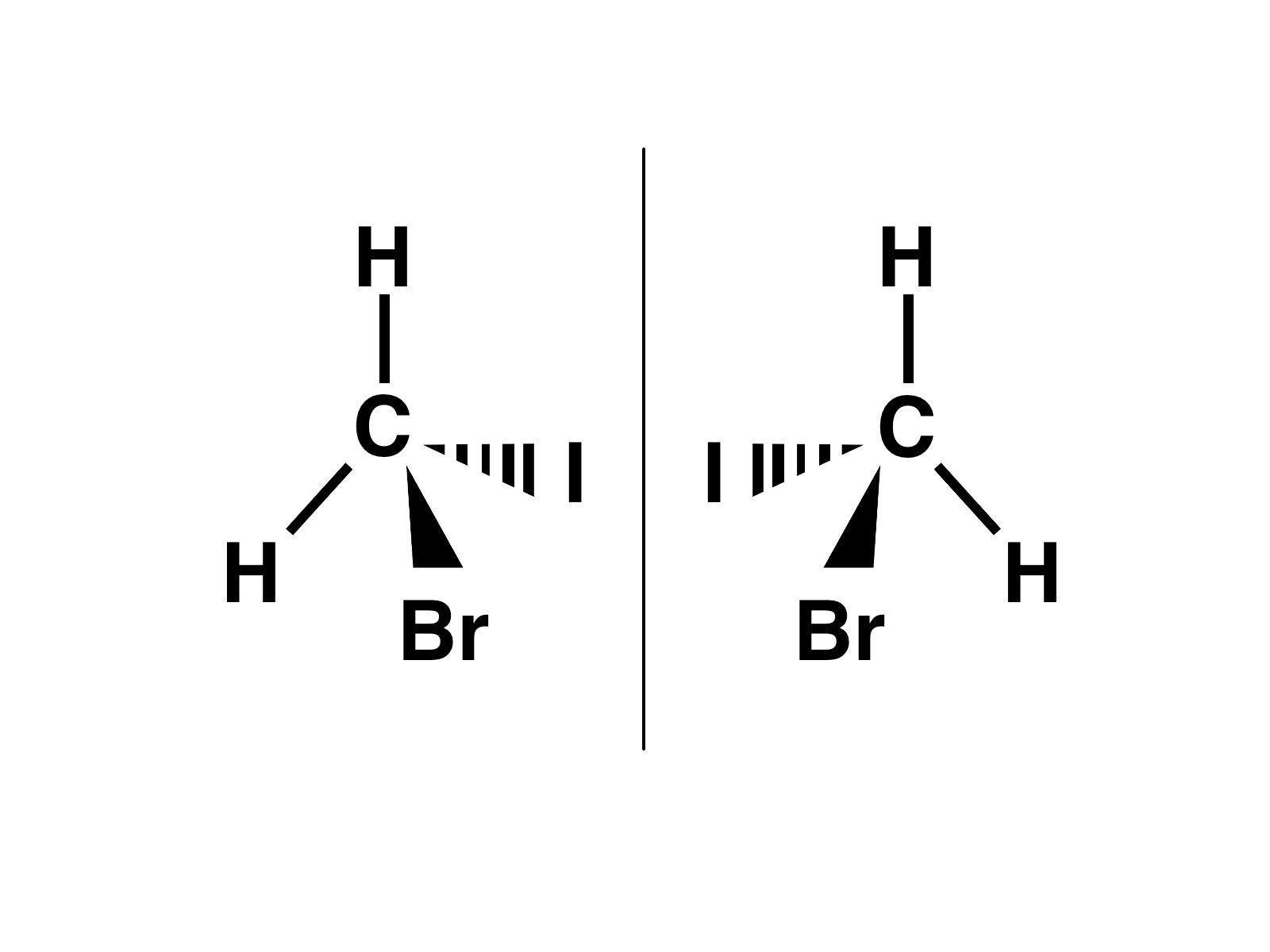
Read all original image captions
Image 1
Image 2
Image 3
Image 4
Gallery 1.4.1 Chirality in Objects
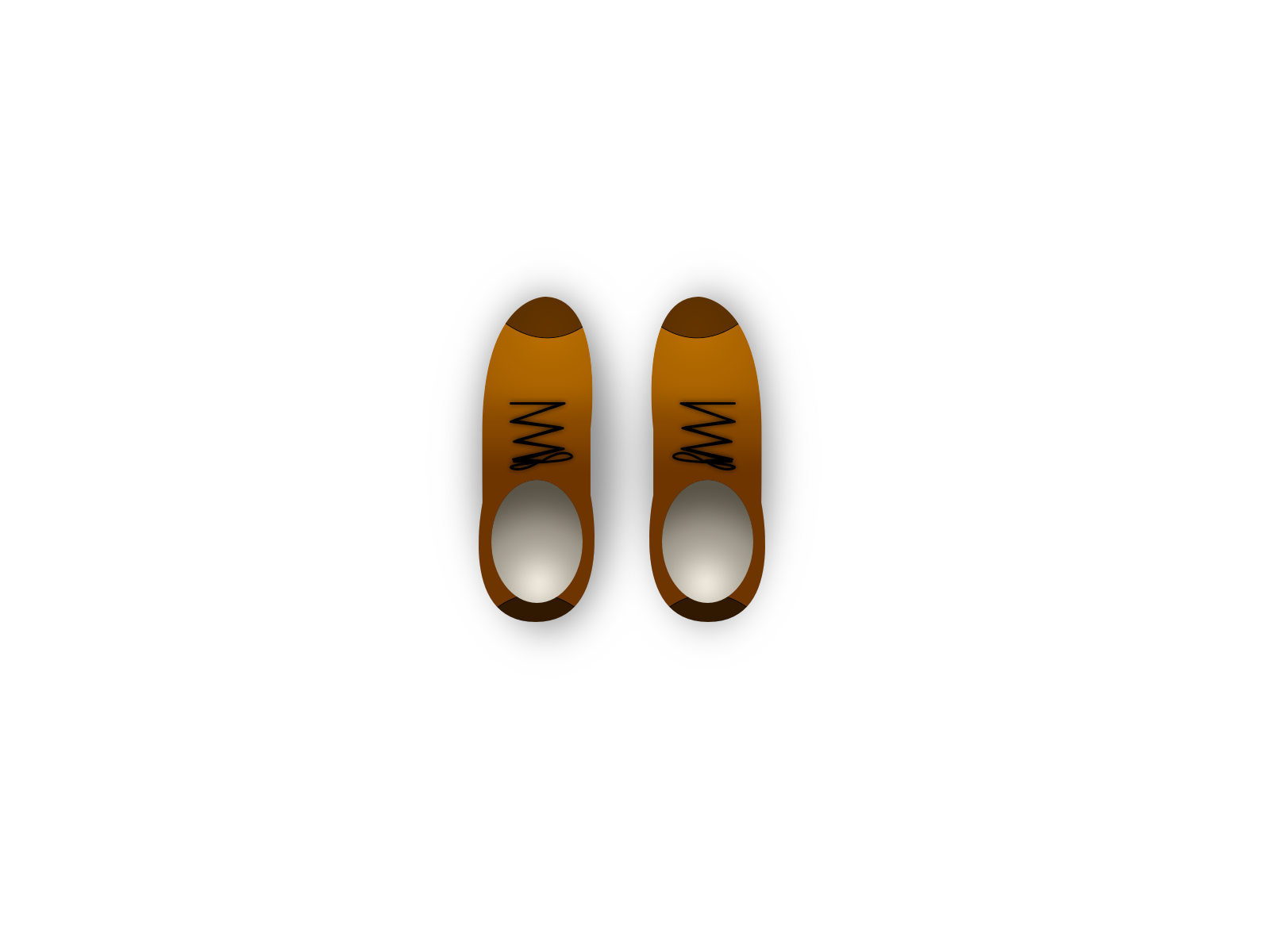
Read all original image captions
Image 1
Image 2
Image 3
While that’s all fine and dandy, how does that relate to chemistry? Well, not only can objects be chiral, but molecules can be as well. Past that, even though our hands function in (mostly) the same way, sometimes molecules function drastically different when compared to their mirror image.
To start with, let’s examine a few molecules that exhibit chirality, and learn how to name them.
Each pair of molecules, the original and the mirror image, are known as Optical Isomers. The isomer refers to the difference in structure, and optical limits that to the chirality exhibited by the molecules. To differentiate between each optical isomer, you have a few options. One special aspect of optical isomers is that when light shines from behind them, they interact with the light in opposite ways. This leads to a naming system based on which direction they impact the light. If the light is thrown clockwise, it is the (+) isomer. Fittingly, if it is rotated anti-clockwise, it is known as the (-). The impact the molecule has on light is very complicated, so we will stick to a different naming convention. We will be using the R/S naming convention. The R and S refer to Rectus and Sinister, the latin names for right and left, respectively. To determine the R or S name, you must first find the point of chirality, i.e. the stereocenter, which is the center of the rotation of the molecule. Then you number the attached atoms in order of decreasing atomic number. Now put the highest number behind the stereocenter and identify whether the numbers increase clockwise or anti-clockwise. If it increases clockwise, then it is the R stereoisomer. Otherwise, it is the S.
While all these molecules look very similar, they don’t always behave the same way.
As a case study, let us examine the properties of thalidomide. The structures are shown in the previous gallery. In the 1950s, it was found that R-Thalidomide was a great sedative drug, and many women found it effective against morning sickness. What they didn’t know was that the S-Thalidomide (aptly the Sinister-Thalidomide) caused major birth defects when taken by pregnant women. This led to a massive recall in 1962, after which the drug was classified as Pregnancy Risk: X, meaning do not ever take when pregnant.
Gallery 1.4.3 Naming Optical Stereoisomers
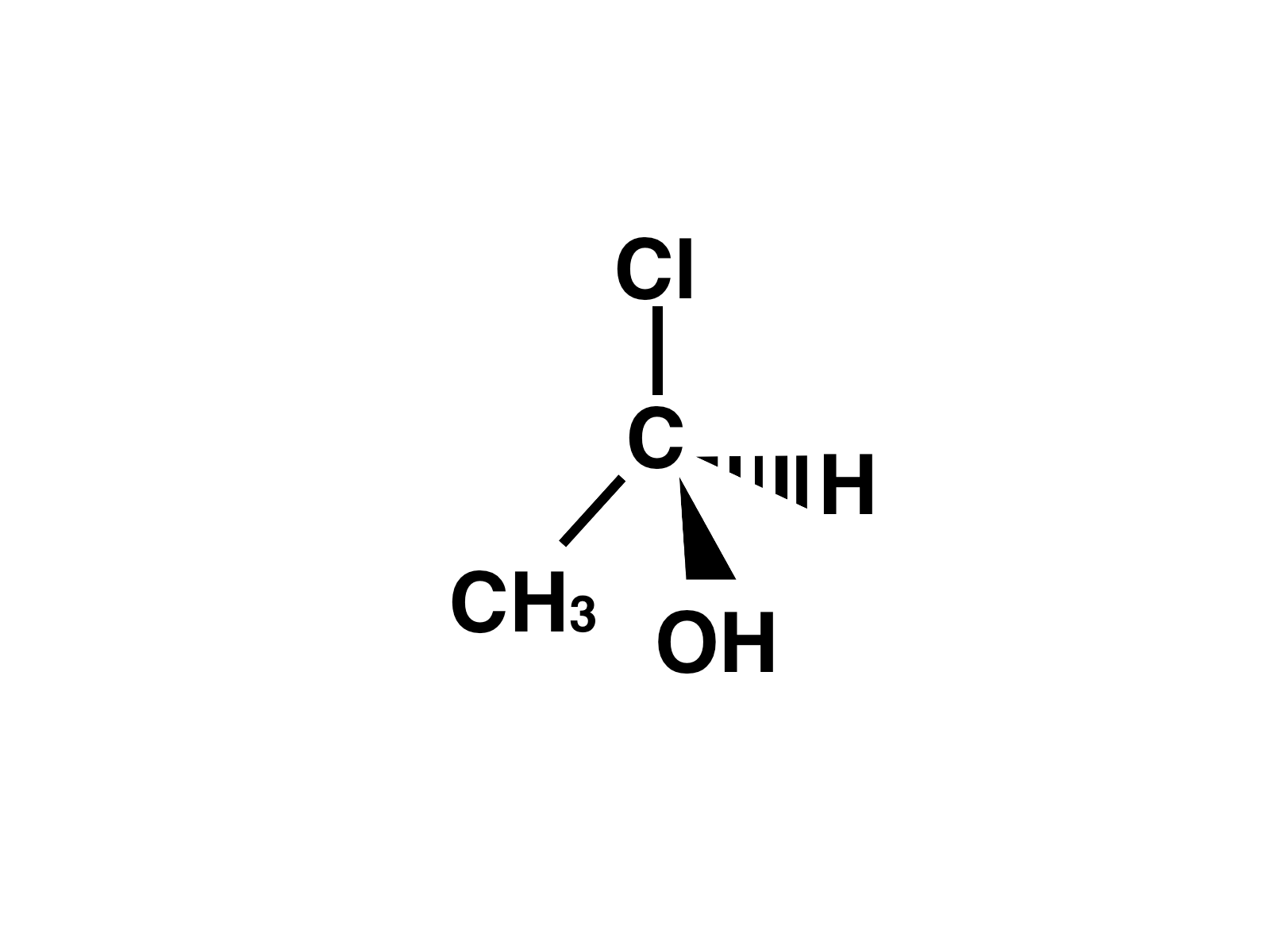
Read all original image captions
Image 1
Image 2
Image 3
As that case shows, even though two optical isomers look very similar, they can lead to majorly different effects. This is a great example of the fact that chemical properties are as much determined by chemical make-up as they are chemical structure.
Interactive 1.4.2 Phase Diagram of Water
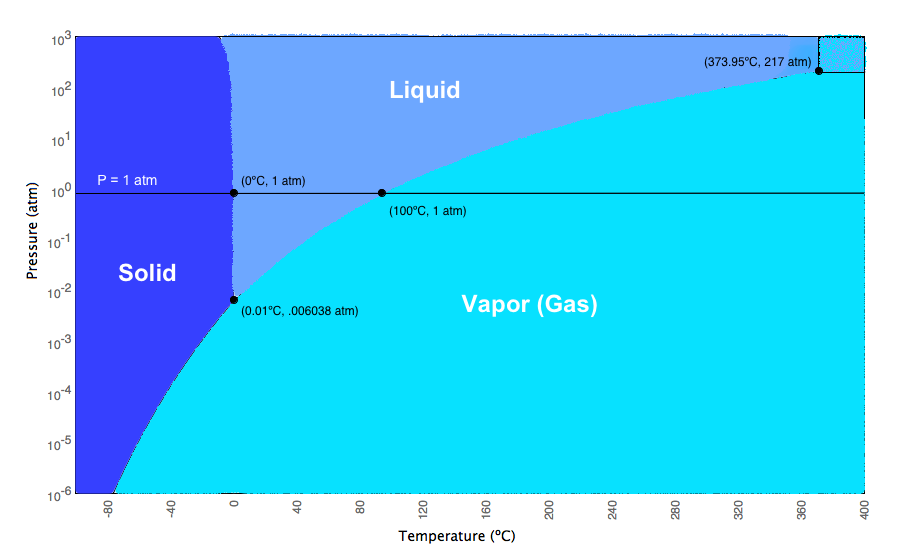
Read all original figure notes
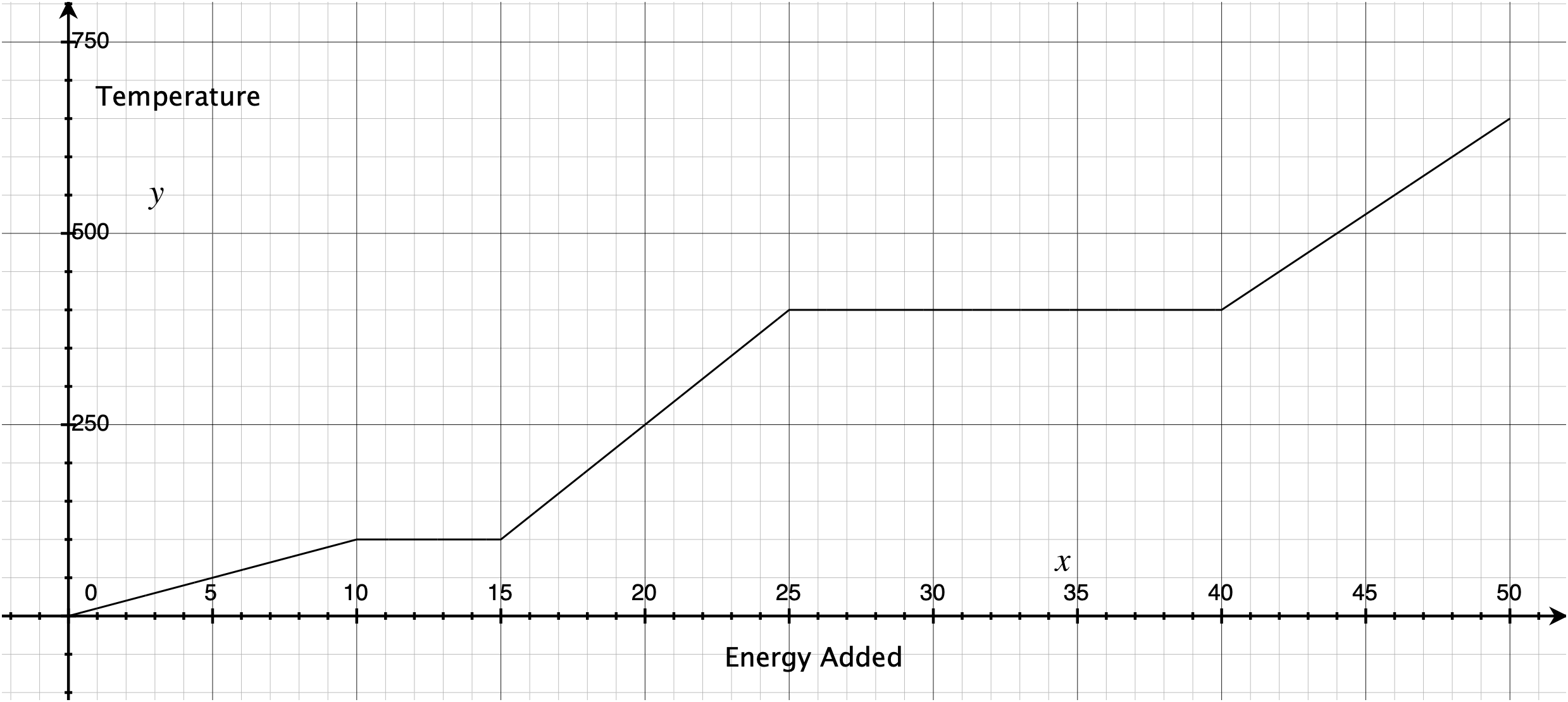
Interactive 1.4.1 Temperature vs. Energy
Read all original figure notes
- Which of the following molecules are polar? Rank the molecules in order of increasing boiling point.
CH3OH, CH4, C2H6, H2O - Given the following temperature vs energy graph, predict what changes you would see if pressure were to increase from 1 atm to 5 atm.
- Ammonia is heated at a factory during the production of a new dye. In order to keep the ammonia from evaporating, the plant operators keep the ammonia under pressure. If the ammonia reaches a temperature of 80ºC, at what pressure does it need to be kept?
- Refer to the given phase diagram of water. If you start with ice at -50ºC and 0.5 atm, then you heat it to 200ºC, then increase the pressure to 100 atm, then finally cool it down to -10ºC, what phase changes will the water undergo? Include when they occur during the T or P change.
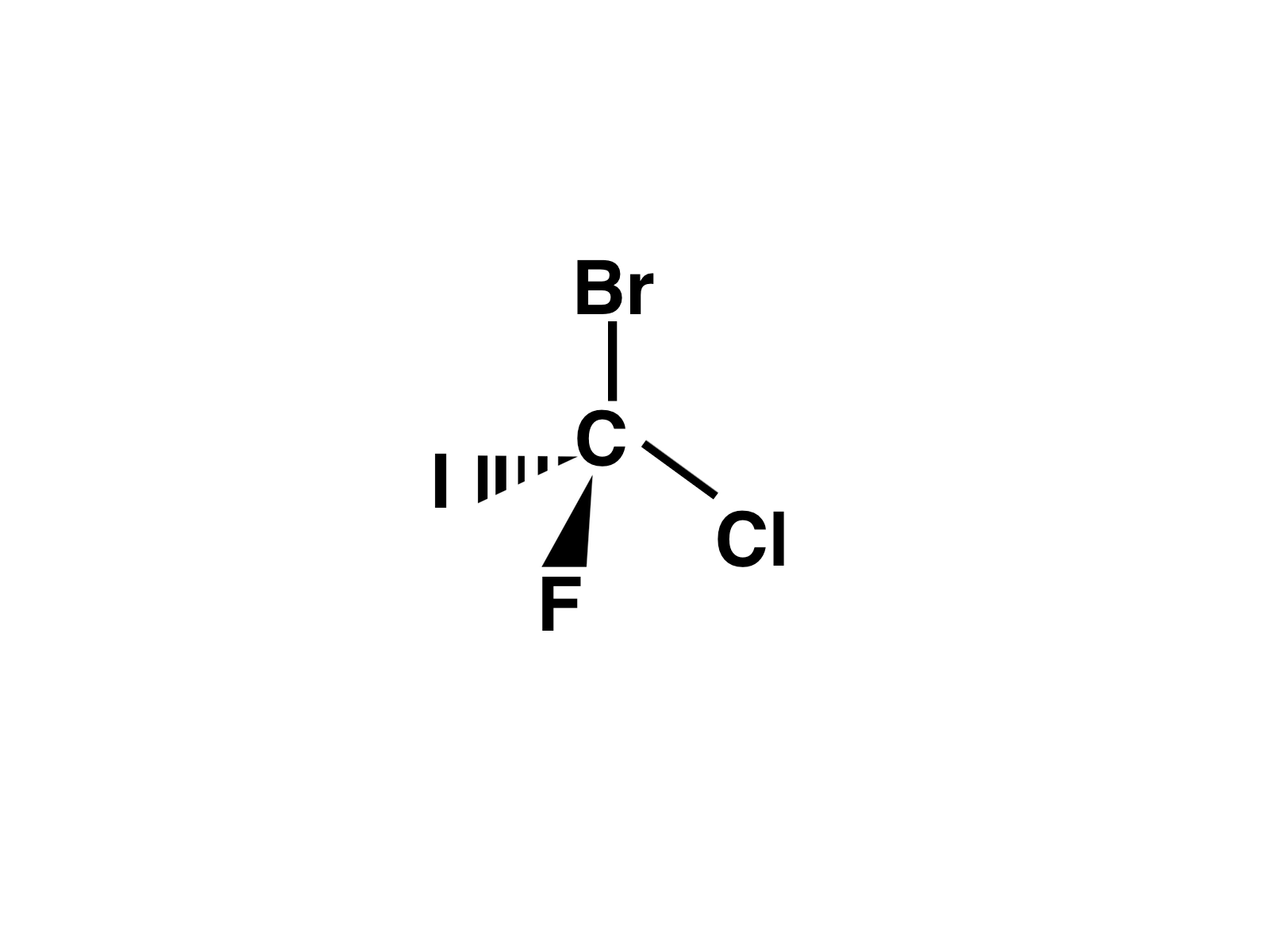
Interactive 1.4.3 Chirality, Problem 6
Read all original figure notes
- Reviewed solubility explanation: compare CH₄, C₄H₉OH and C₈H₁₈ qualitatively in water, and explain why a simple polarity ranking does not establish the solubility of SO₂. Butanol’s OH group can interact with water, while its carbon chain also affects dissolution. Methane and octane are nonpolar, but molecular size and thermodynamics still matter. SO₂ also participates in aqueous reactions, so a numerical ranking needs measured data and specified conditions.
- Draw and name the optical isomers of Bromochlorofluoroiodomethane (CBrClFI) One is shown in the below image.
- Temperature varies with elevation according to the following equation:
If a hospital keeps their interior at 1 atm, but they are at an elevation of 2321m, at which temperature would the pain killer Pain-B-Gone evaporate when brought outside? Assume Pain-B-Gone has Antoine coefficients of
A = 3.553, B = 1222.4, C = 311.2. - Reviewed ideal-gas enrichment: a 1.00 L sealed vessel at a stated temperature contains benzene vapor and an inert gas. The benzene saturation vapor pressure at that temperature is supplied as 0.100 atm. If the benzene partial pressure initially is 0.150 atm, how much benzene must condense to reach saturation? Assume fixed temperature and gas volume and negligible liquid volume. Δn=(0.150−0.100)(1.00)/(0.082057T) mol. Use benzene partial pressure, not the vessel’s total air pressure.
- Give the combination of molecules from amongst the following that would result in the strongest intermolecular forces:
CH4, CHCl3, SO2, C3H8, H2 - You are given a faulty table for the Antoine constants of an unknown chemical. All you know is that C is 178, but the values given for A and B are both ‘Err’. As you don’t think that’s correct, you conduct an experiment to figure out the true value of A and B.
You find that the chemical boils at 500ºC at 1 atm, and then it boils at 820ºC at 4 atm. What is the correct A value?
Gallery 1.4.4 C4H10
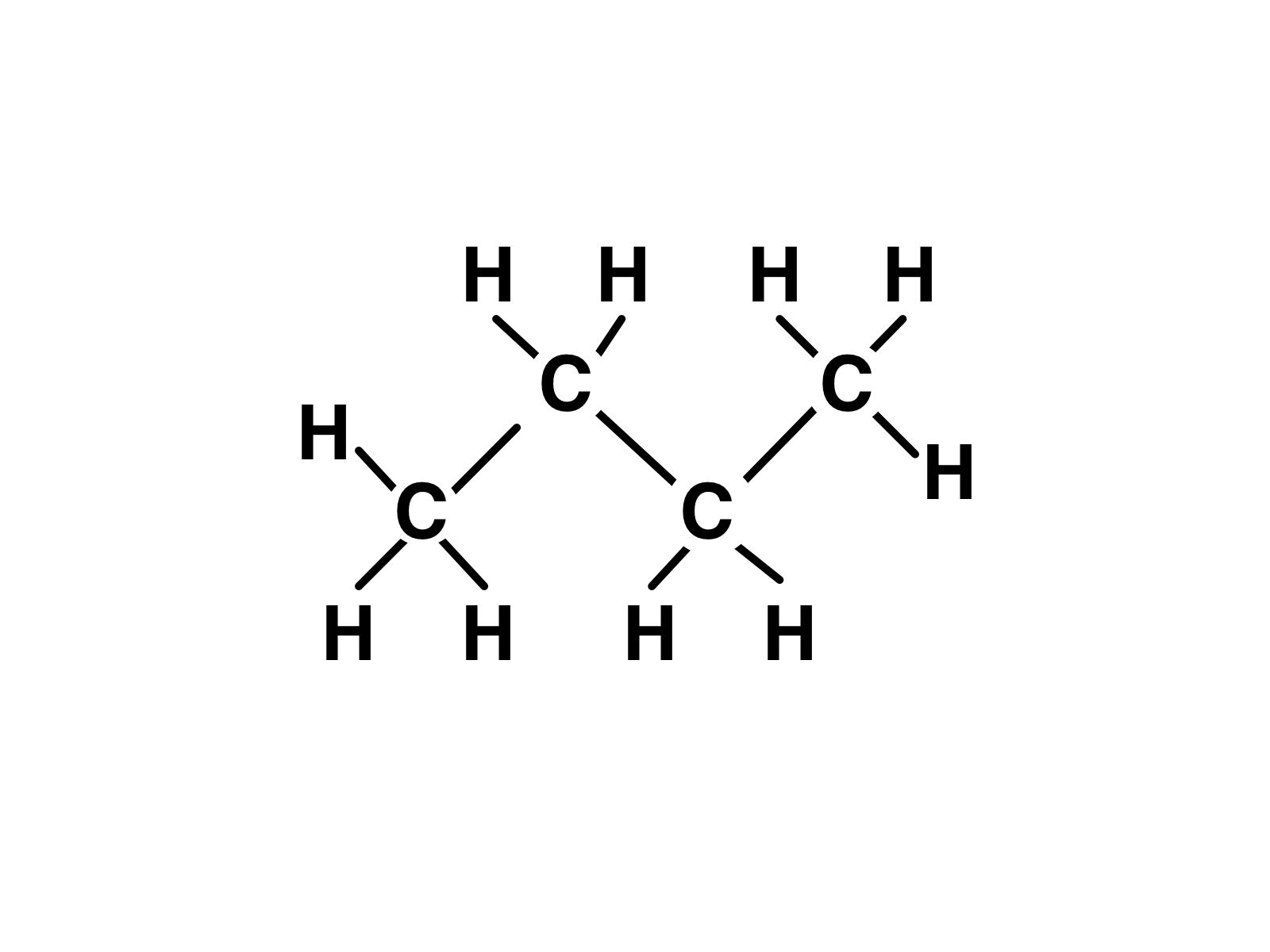
n-Butane
Read all original image captions
Image 1
n-Butane
Image 2
iso-Butane
- A jar of liquid is suspended is sitting in a pressure chamber sitting at 80ºC and 10 atm. The temperature is held constant and the pressure is decreased. At 0.50 atm, the liquid begins to boil. If you know the liquid is either Benzene, Ethene, or Propanol, based on the information given, what chemical is the liquid?
- Which structure of C4H10 would have the strongest intermolecular forces, n-Butane or isobutane?
- Reviewed hypothetical mixtures at the same300K:A hasPtotal1.00atm andx(O₂)0.210/x(N₂)0.790;B hasPtotal0.750atm andx(O₂)0.400/x(N₂)0.600. Find each partial pressure. UsePi=xiPtotal:A gives0.210and0.790atm;B gives0.300and0.450atm. These are supplied calculation conditions, not a universal airline-cabin pressure or composition.
- What temperature does Mercury boil at on the surface of Venus (90atm).
- Distillation enrichment: benzene and water form largely separate liquid layers under the simplified immiscible-liquid model. While both pure liquid phases remain, their equilibrium vapor pressures add: boiling occurs when P°benzene(T)+P°water(T)=Pexternal. Both species then appear in the vapor, so do not predict two independent boiling stages using their separate normal boiling points. A numerical boiling temperature needs valid vapor-pressure data for both components.
- There is a point in Earth’s atmosphere where the air pressure is so low that water boils at normal body temperature (37ºC). Using the pressure vs. height equation, approximate the height of this point.
- Phase-model enrichment: methane’s critical temperature is about 190.6 K, far below 5 °C (278.15 K). At 5 °C, compression alone cannot produce a distinct liquid methane phase. The original Antoine condensation calculation at that temperature is superseded; extrapolating a liquid–vapor correlation past its applicable range cannot create a valid saturation pressure.
- You are part of a research team developing a new food additive to promote iron uptake. After a month of research, your team finds out that the S isomer of a chemical increases iron uptake by 21%. Your project head, Henry, wants to go ahead and begin producing rice infused with your additive to begin distribution. Do you agree with his decision? Explain.
- You place 4 cups of the following fluids into a vacuum chamber and then reduce the pressure until all the cups are empty (all the liquid boils away). What order would the cups boil in? They contain: H2O, CH3OH, C3H7OH, and C2H6.
- A truck carrying a chemical X is traveling up a steep mountain road. The road has a slope of 10%, meaning for every 10m you drive you go up one meter in elevation. The truck is driving at 20m/s, and it springs a leak at 10m above sea level. The summit is 15km away (1500m up). The Antoine coefficients for Chemical X are A = 7.662, B = 1621, C = 195, and it is 15ºC.
If Chemical X leaks at 4g/s when it is liquid and 1 g/s when it is gaseous, how much Chemical X leaks by the time the truck reaches the summit?
Glossary and deeper reading · 12 refreshers
These editorial refreshers supplement the reading. Definitions and examples are added guidance; original source wording and recorded answers remain in their original context.
-
Chirality
Chirality is the property of an object that cannot be superimposed on its mirror image. Molecules related as nonsuperimposable mirror images are enantiomers and can interact differently with other chiral species. For example, a tetrahedral carbon bonded to four different groups can produce a pair of enantiomers.
-
Evaporation
Evaporation is vaporization occurring at a liquid's surface. It can occur below the boiling point as some particles escape into the gas phase. For example, liquid water can evaporate at room temperature and leave less liquid behind.
-
Phase change
A phase change alters a substance's physical state without changing its chemical identity. It involves a change in particle arrangement and interactions and can transfer energy without raising temperature during a pure-substance transition at fixed pressure. For example, vaporizing liquid water separates water molecules into a gas.
-
Solubility
Solubility describes how much of a substance can dissolve in a specified solvent under stated conditions. It depends on the solute, solvent, temperature, and other relevant conditions and is distinct from how fast dissolution occurs. For example, two salts can have different equilibrium solubilities in water at the same temperature.
-
Aqueous solution
An aqueous solution is a solution in which water is the solvent. The dissolved substance may originate as a solid, liquid, or gas, so aqueous does not mean that a solid has melted. For example, sodium chloride dissolved in water is aqueous even though the pure salt is solid.
-
Saturated solution
A saturated solution has the dissolved concentration corresponding to equilibrium with the undissolved phase under the stated conditions. Microscopic dissolution and precipitation can continue at equal rates when the solid is present. For example, additional solid may remain undissolved after a saturated salt solution is reached at fixed temperature.
-
Partial pressure
A gas's partial pressure is the pressure it would exert alone in the mixture's volume at the same temperature. In an ideal mixture, the component partial pressures add to the total pressure. For example, a component with mole fraction 0.20 contributes 0.20 of the total ideal pressure.
-
Intermolecular force
Intermolecular forces are interactions between molecules. They affect properties such as boiling point and solubility and are distinct from the bonds within each molecule. For example, vaporizing water separates molecules while largely preserving their O–H bonds.
-
Mixture
A mixture contains two or more substances whose proportions can vary. Its components retain their chemical identities until a chemical reaction changes them. For example, water and ethanol can form mixtures with many different compositions.
-
Distillation
Distillation separates mixture components using differences in their vaporization behavior. Vapor is collected and condensed, with composition depending on the mixture and conditions. For example, a vapor can be enriched in the more volatile component of a liquid mixture.
-
Chemical equilibrium
Chemical equilibrium is a dynamic state in which forward and reverse reaction rates are equal. Macroscopic composition remains constant in a closed system under fixed conditions, but reactant and product concentrations need not be equal. For example, a reversible reaction can reach equilibrium with much more reactant than product.
-
Condensation
Condensation is a phase change from gas to liquid. It releases energy to the surroundings as particles form more closely associated liquid arrangements. For example, water vapor condensing on a cooler surface forms liquid droplets.