Laws of Thermodynamics
Supporting original reading. Follow the AP topic pathway for reviewed scope, worked reasoning and targeted practice.
Chemistry I · original Chapter 8 · combined Chapter 8
Section 1
Laws of Thermodynamics
The Four Laws
The Zero Law: Chemists originally came up with three laws, and then realized they forgot the most important one, so they called it the Zeroth Law of Thermodynamics, which states that Temperature is a transitive property. Recall from Pre-Algebra (I know, it’s been a while) that the transitive property is: if A = C and B = C, then A = B. Replace the equal sign with “is at thermal equilibrium with” and we get the Zeroth law – if a system can be brought into thermal equilibrium with two other, separate systems, then the two other systems can also be brought into thermal equilibrium with each other. This concept allows us to prove that there is some criteria for thermal equilibrium, paving the way for us to be able to measure temperature. In essence, that is what this law says: that temperature exists and can be measured. Here is a more difficult question though: What is temperature, quantitatively?
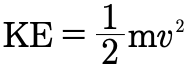
For an ideal gas, absolute temperature is proportional to average translational kinetic energy per particle: ⟨KE⟩=3kBT/2. Kinetic energy depends on speed squared. This ideal-gas relation is not a complete description of the internal energy of every substance in every state.
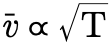
For a gas of the same composition, both the mean speed and root-mean-square speed vary as √T, with T in kelvin. Speed is a magnitude. The vector average velocity of a gas at rest is zero because particle motions point in different directions.
 from the Kinetic Energy equation. Since proportions are interchangeable,
Example Problem 8.1.1
Convert temperatures to kelvin: 268.15 K and 298.15 K. At fixed gas composition, mean speed is proportional to √T.
v̄(warm)/v̄(cold)=√(298.15/268.15)=1.054456. Percent increase=(1.054456−1)×100%=5.45%.
The molar mass cancels in this ratio. Individual speeds or a mean vector velocity are not required.
The First Law: This is probably the most famous law in thermodynamics. It is also called The Law of Conservation of Energy, because it states that energy can neither be created nor destroyed. It simply changes form. In order to fully understand this law, it is important to realize that there are many types of energy. These are covered more in depth in Physics.
Kinetic Energy is the energy of an object due to its movement.
Potential Energy is the energy of an object that can be converted into a different form of energy (sub-types include gravitational potential energy, electrical potential energy).
Chemical Energy is the energy released due to chemical reactions, such as our body using up nutrients.
Electrical Energy is energy due to the movement of electrons.
Heat is energy transferred between a system and its surroundings because their temperatures differ. Thermal energy describes microscopic energy associated with particle motion and interactions; heat is a transfer, rather than energy stored in an object. Thermal energy can participate in work-producing processes subject to thermodynamic limits.
The Second Law: Although the first law is the most well-known, the second law is the most important law to understand. The second law of thermodynamics is not only the most important law in Thermodynamics or Chemistry, many people would argue that it is the most important law in all of the sciences because of its applications and implications.
Entropy is a state function associated with the distribution of energy among accessible microscopic arrangements. More accessible arrangements generally correspond to greater entropy. “Disorder” can be a useful informal image, but visual messiness alone is not a quantitative rule for predicting ΔS.
The second law concerns the total entropy change of a system plus its surroundings. For an isolated total system, ΔSuniverse is positive in an irreversible spontaneous change and zero in an ideal reversible change. The system’s own entropy can decrease if its surroundings gain enough entropy.
Gibbs free energy combines enthalpy and entropy: G=H−TS. At constant temperature and pressure, with only pressure–volume work, a spontaneous change decreases the system’s G. For a reaction, ΔG<0 favors the forward direction, ΔG>0 favors the reverse direction, and ΔG=0 at equilibrium.

Interactive 1.1 The Law of Conservation of Energy

Read all original figure notes
Chemical Energy
When we eat fruit or other foods, the energy inside of their molecules is broken down and used by our muscles to do work. Some of this work is converted to kinetic energy. The rest is dissipated as heat, which is why we sweat to cool ourselves down. In almost all thermodynamic processes, heat is almost always the primary form of wasted energy, whether it is because of friction, combustion, or electrical resistance.
Sunlight
Sunlight is the source of all energy on the earth. Because plants can use the energy in sunlight through photosynthesis and store it as potential chemical energy inside of the bonds of biological molecules, life can sustain itself on Earth.
In ΔG=ΔH−TΔS, use temperature in kelvin and consistent energy units. ΔH and ΔS can each be positive or negative. ΔG applies to the current composition; ΔG° applies to the defined standard states. Thermodynamic favorability does not tell you how fast a reaction occurs.
Enthalpy is the state function H=U+PV. Its change describes the difference between specified initial and final states. At constant pressure, when pressure–volume work is the only work, ΔH equals qp, the heat transferred into the system. A negative ΔH means the system releases heat to its surroundings.
Example Problem 8.1.2
Reviewed conceptual task: why is a comparison of “enthalpy per mole of gasoline” and carbon dioxide incomplete without a named fuel composition, specified physical states and thermochemical reference?
Over the next few sections, we will strengthen our applications of these concepts in chemical reactions and become comfortable using the various new equations introduced in thermodynamics.
Most of the rest of the chapter focuses on the first and second laws, as these have the greatest quantitative applications, especially in chemistry. Until then, let’s discuss the final law.
Absolute-zero and low-temperature research use careful definitions of temperature and entropy. For AP Chemistry, use the perfect-crystal third-law limit to understand the reference for absolute molar entropies. The third law does not remove the conditions or limits in the second law.
The retained gasoline comparison is underspecified. For a defined fuel, combustion is exothermic when product-bond formation releases more energy than breaking the fuel and oxygen bonds requires. Breaking hydrocarbon bonds itself takes energy. Use a named fuel, balanced equation, physical states and thermochemical data to calculate heat release.
Glossary and deeper reading · 2 refreshers
These editorial refreshers supplement the reading. Definitions and examples are added guidance; original source wording and recorded answers remain in their original context.
-
Thermal equilibrium
Thermal equilibrium means that bodies in thermal contact have the same temperature and no net heat transfer between them. It does not mean that they contain equal amounts of energy or have the same mass. For example, a small metal sample and a large water bath can reach the same temperature.
-
Vector
A vector is a quantity with a magnitude and a direction, represented by an arrow or by components along chosen axes. Vectors add by adding corresponding components rather than simply adding their magnitudes. For example, an eastward displacement followed by a northward displacement produces a resultant pointing northeast. The zero vector has zero magnitude and no unique direction.