First-Order Reactions
Supporting original reading. Follow the AP topic pathway for reviewed scope, worked reasoning and targeted practice.
Chemistry II · original Chapter 3 · combined Chapter 11
Section Outline
- First-Order Rate Equation
- Integrated First-Order Rate Equation
- Practice with First-Order equations
- Half-Life of First-Order reactions
Section 2
First-Order Reactions
A zero-order law means rate is insensitive to the specified concentration over a particular range at fixed conditions. It need not remain zero order when reactants become scarce or a surface is no longer saturated.
First order means the exponents in the empirical power-law rate law sum to one. A common single-reactant disappearance law is −d[A]/dt=k[A]. It does not mean that the balanced equation contains only one reactant; overall order is established from kinetic evidence.
In a First-Order reaction, the units of k will be , or . If you are ever given a , then you would be able to tell the overall reaction order based on the units has. This doesn’t always mean you have enough information to use the rate equation, as you still need to know which reactant the reaction rate relies upon.
This means that as the concentration of the reactant decreases, it will progress more slowly. Many first-order reactions are decomposition reactions, where one compound decomposes into daughter compounds:
A first-order disappearance model does not require products to escape. If the reverse reaction becomes important, use a reversible model rather than this simple irreversible law. For hydrogen peroxide, the observed law depends on catalyst, temperature and other conditions; the balanced decomposition equation alone cannot establish first order.
Interactive 3.2.1 First-Order Reactions
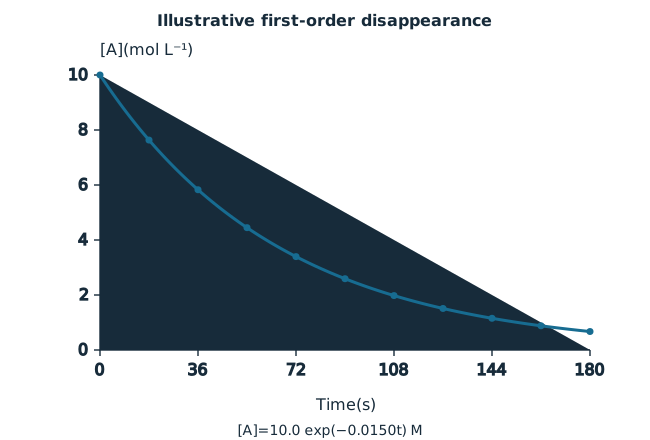
Read all reviewed figure notes
Non-Linear
This specified first-order model has an exponential concentration curve. Curvature alone does not distinguish it from every other model; check the linearized plots and data.
Now when you are working with a reaction that is in first-order, you should expect to see a relationship between concentration and time that is non-linear. Instead, you will have a reaction that is initially very quick, however as the concentration drops off, the reaction slows, meaning that the concentration will take longer to drop.
For the specified law −d[A]/dt=k[A], a plot of ln([A]/1 M) versus time is linear. The logarithm uses a dimensionless ratio. The slope is −k, and k has inverse-time units.
To figure out why this graph is linear, we will have to derive the Integrated First-Order Rate Equation. Once again, this involves calculus to perform, but it should solve our question of why we need to use the vs graph to find a linear relationship.
Gallery 3.2.1 Concentration-Based Reactions
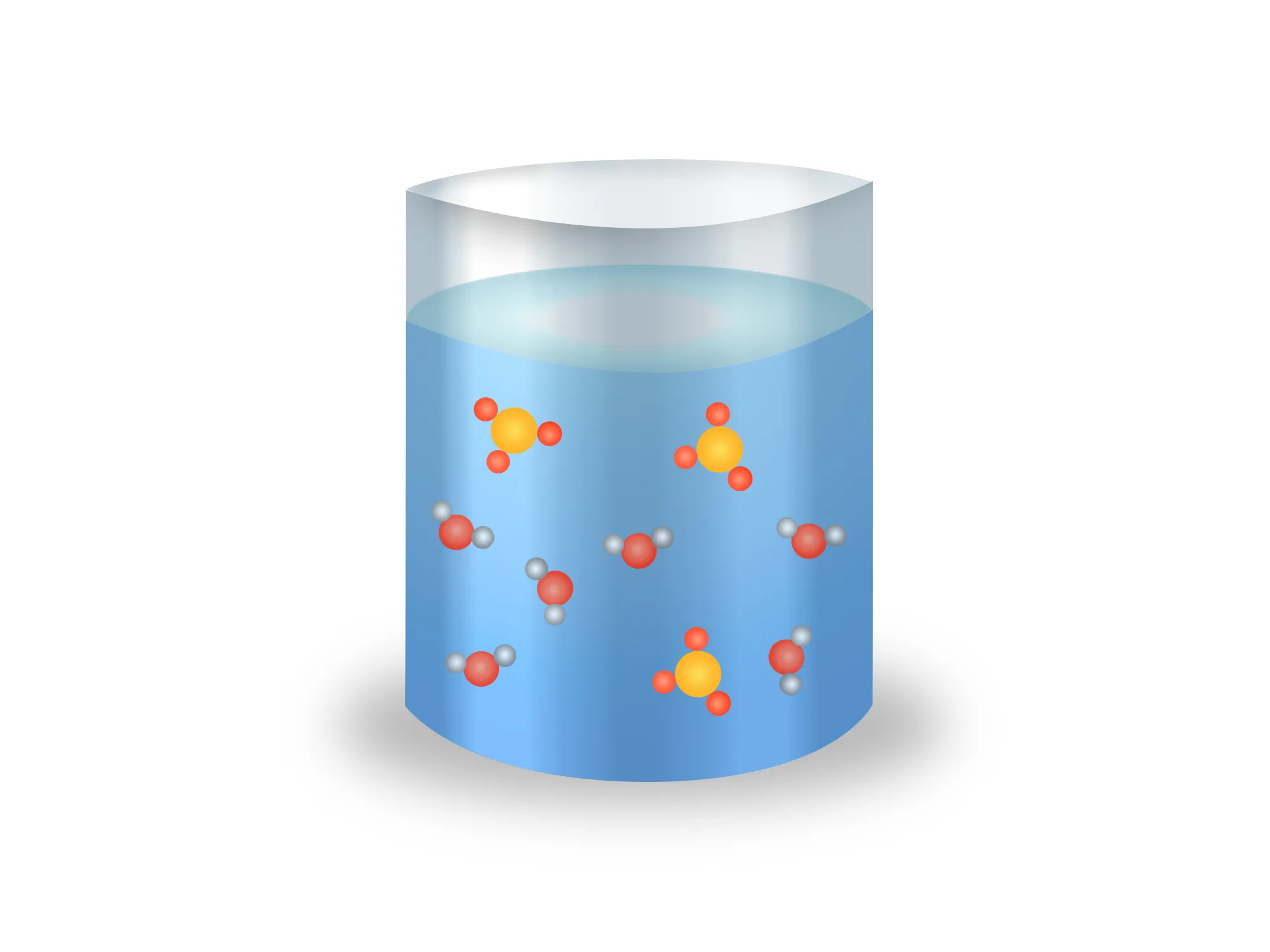
AP edition reviewed context. These retained source snapshots are unbalanced illustrations with unspecified species identities and sources or sinks: the yellow clusters appear to increase from3 to5 while6 other clusters remain unchanged. They do not depict an established closed-system reaction or demonstrate conservation of atoms. Do not infer a reaction time course or first-order law from them; kinetic order requires controlled rate/concentration data.
Read all reviewed image captions
Image 1
AP edition reviewed context. These retained source snapshots are unbalanced illustrations with unspecified species identities and sources or sinks: the yellow clusters appear to increase from3 to5 while6 other clusters remain unchanged. They do not depict an established closed-system reaction or demonstrate conservation of atoms. Do not infer a reaction time course or first-order law from them; kinetic order requires controlled rate/concentration data.
Image 2
AP edition reviewed context. These retained source snapshots are unbalanced illustrations with unspecified species identities and sources or sinks: the yellow clusters appear to increase from3 to5 while6 other clusters remain unchanged. They do not depict an established closed-system reaction or demonstrate conservation of atoms. Do not infer a reaction time course or first-order law from them; kinetic order requires controlled rate/concentration data.
Interactive 3.2.2
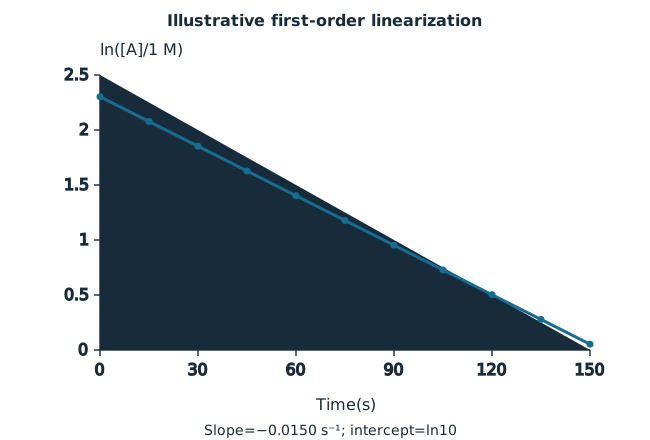
Read all reviewed figure notes
Linear
The log plot is straight for −d[A]/dt=k[A]; slope is−k in s⁻¹. ln([A]/1 M) is dimensionless.
ln[A]0
At t=0 the intercept is ln([A]₀/1 M), not[A]₀. This reviewed plot uses the same10M initial concentration as the preceding concentration plot.
If we want to define C, we have to eliminate one of the variables. Let’s do this by setting t = 0, which also makes .
Now we can plug this into our equation, which provides:
This is the integrated first-order disappearance law: ln([A]/[A]₀)=−kt, or [A]=[A]₀e⁻ᵏᵗ. It is not the zero-order law.
Sometimes, as we might prefer a equation for directly, we can solve for that by the following:
Now we have two forms for our Integrated First-Order Rate Equation. The first form explains why we see a linear relationship develop when we graph vs. .
For y=ln([A]/1 M), the integrated line is y=ln([A]₀/1 M)−kt. Its slope is −k and its intercept is ln([A]₀/1 M), not the initial concentration itself.
Convert1 min to60 s. Apply[A]=[A]₀e⁻ᵏᵗ: [SO₂Cl₂]=(4.0 M)exp[−(4.2×10⁻⁴ s⁻¹)(60 s)]=3.900459 M≈3.9 M.
One last thing before we move on is the Half-Life of a First-Order reaction.
Let’s derive the half-life equation, starting with the form of the First-Order rate equation:
Perhaps surprisingly, this half-life equation is independent of the initial concentration, unlike the Zeroth-Order reaction’s half-life. This means that you can determine the half-life of a first order reaction by only knowing the of the reaction.
One great application is that a first order reaction has a constant half-life, meaning you can find the ‘quarter-life’ by merely doubling the half-life of the reaction. This is because you would start with a concentration of , and after one half-life passes, you are down to . Should you allow another half-life to pass, you’ll be at , or .
Interactive 3.2.3 Half-lives
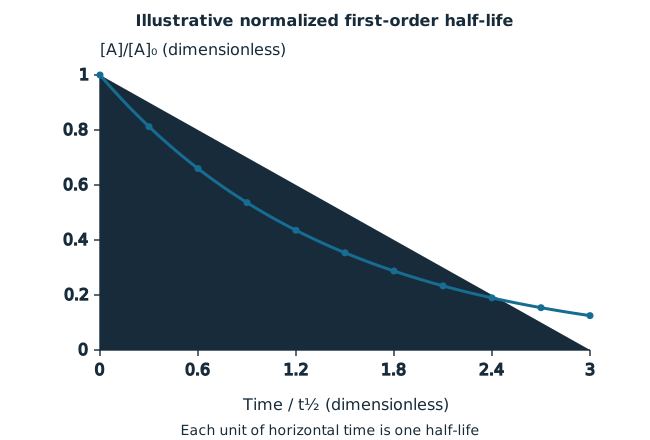
Read all reviewed figure notes
First Half-Life
After one first-order half-life, [A]/[A]₀=1/2.
Second Half-Life
After a second equal half-life interval, [A]/[A]₀=1/4. This constant interval is specific to the declared first-order model.
Looking at a normalized graph, you can see this relationship in action. If you’re unfamiliar with normalization, that merely means that instead of looking at , we are looking at , meaning that if the y-axis was 1, then .
Glossary and deeper reading · 5 refreshers
These editorial refreshers supplement the reading. Definitions and examples are added guidance; original source wording and recorded answers remain in their original context.
-
Reaction order
Reaction order describes the concentration dependence in a rate law. An order in one reactant is its exponent, and overall order is the sum of the concentration exponents. For example, a second-order dependence on one reactant makes quadrupling the rate follow from doubling that reactant's concentration under fixed conditions.
-
Reaction half-life
A reaction half-life is the time needed for a reactant's concentration to fall to half its starting value under the specified model. A first-order reaction has a half-life independent of its starting concentration, while other orders generally do not. For example, consecutive equal time intervals halve a first-order reactant's concentration repeatedly.
-
Rate law
A rate law relates a reaction rate to reactant concentrations and a rate constant under stated conditions. For an overall reaction, its concentration exponents are established from evidence rather than copied from the balanced equation. For example, doubling one reactant concentration doubles the rate when the reaction is first order in that reactant and other conditions are fixed.
-
Reaction rate
Reaction rate describes how quickly a reactant or product quantity changes with time. Rates expressed using different species must account for their stoichiometric coefficients. For example, a product's concentration–time slope can be used to determine its rate of formation.
-
Catalyst
A catalyst participates in a reaction pathway and is regenerated overall. It can increase the reaction rate by providing a different pathway without changing the reaction's equilibrium constant at fixed temperature. For example, a catalyst can help a mixture reach equilibrium sooner without changing the final equilibrium composition.