Intro to Orbitals
Supporting original reading. Follow the AP topic pathway for reviewed scope, worked reasoning and targeted practice.
Chemistry I · original Chapter 5 · combined Chapter 5
Section Breakdown
- Introduction into s, p, d, and f orbitals
- Basic Orbital Notation
- Example 5.1.1
Section 1
Intro to Orbitals
Interactive 5.1.1 What an orbital typically looks like

Read all original figure notes
Nucleus
This conglomeration of neutrons and protons represents the nucleus of the atom.
Electron ‘Cloud’
This cloudy area shows where the electrons are going to be in orbit around the nucleus. This is an example of an orbital (in this case an s-orbital).
An orbital describes an allowed electron state and its probability distribution. It is not a path an electron follows around the nucleus. You can picture a region that contains a chosen proportion of possible measurement locations, while remembering that the electron is described by a quantum state. Ground-state hydrogen occupies a 1s state; changes between allowed states absorb or emit particular photon energies.
Gallery 5.1.1 Hydrogen Orbitals and Energy Levels
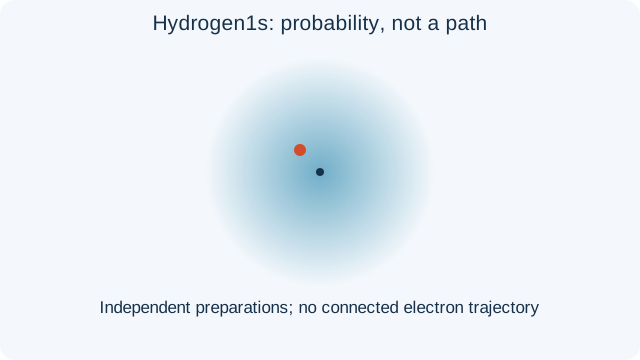
New reviewed diagram replaces the source numeral placeholder.
One illustrative position measurement in a repeatedly prepared hydrogen1s state. The cloud schematically represents probability density, not a material shell.
Read all reviewed image captions
Image 1
New reviewed diagram replaces the source numeral placeholder.
One illustrative position measurement in a repeatedly prepared hydrogen1s state. The cloud schematically represents probability density, not a material shell.
Image 2
New reviewed diagram replaces the source numeral placeholder.
A second independently prepared atom can give a different position result. These dots are not time-ordered positions of one orbiting electron.
Image 3
New reviewed diagram replaces the source numeral placeholder.
A third independent result adds to the sample. Connecting these points would invent a classical trajectory that the orbital does not provide.
Image 4
New reviewed diagram replaces the source numeral placeholder.
Repeated identically prepared measurements sample the position probability distribution. The schematic1s density is spherically symmetric; an orbital is a quantum state, not a sharply bounded region containing a track.
The supplied COLLADA file is byte-identical across 13 source placements with different titles. This viewer shows that original geometry.
3-D 5.1.1 Rendering of a hydrogen orbital
Loading the original 3D model…
Original preview and model
This viewer rotates the original source mesh. Lighting and controls are a web adaptation.
Download original COLLADA modelWell then how do we characterize the location of an electron? It is different for each element but lets use hydrogen as our case example:
As seen in the gallery 5.1.1, hydrogen only has one valence electron to move within the given orbital and notice how the shape of the orbital is spherical in nature. (See 3D picture 5.1.1) This is just a characteristic associated with electrons that are located in this orbital. As we will come to learn, there are multiple orbitals in which the electron can reside, each with a different shape and energy associated with them.
S-Orbitals
Interactive 5.1.2: 2s orbital of Li
Read all original figure notes
2S Orbital
This orbital is larger and further from the nucleus compared to the 1S orbital.
The 1S orbital
Smaller than the 2S orbital, and closer to the nucleus.
Interactive 5.1.3 P-orbitals
Read all original figure notes
x, y, z axes
These axes represent the relative location of each orbital around the nucleus, which resides at the origin of the coordinate system.
3 pairs
Each pair that resides on the same axis (x,y,z) is one orbital. There are a total of 3 orbitals in the p-block.
The interactive image shows how Lithium has a second s orbital. This 2s orbital is where the area in which finding the electron is much higher. The same idea applies for a 3s and 4s orbital.
P-Orbitals
The supplied COLLADA file is byte-identical across 13 source placements with different titles. This viewer shows that original geometry.
3-D 5.1.2 D orbital
This is just one of the 5 d-orbitals.

The source placement has no attached COLLADA geometry.
d and f orbitals
It is also important to note that there are orbitals available at higher energy levels such as the d orbital, which has a total of five orbitals that electrons can inhabit. The same methods from p and s orbitals are applied for d orbitals in terms of energy levels. An interactive image below displays what a d-orbital can look like.
At even higher energy states, f-orbitals exist, where there are a total of 7 orbitals, but these will be less encountered.
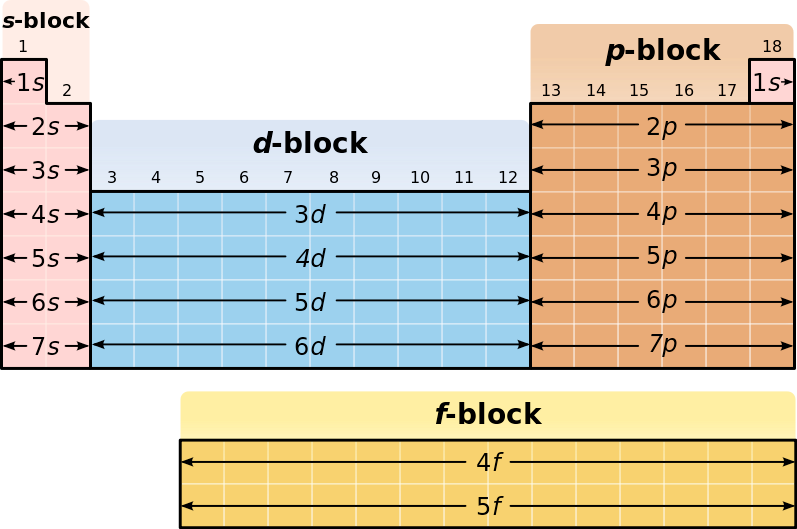
Interactive 5.1.4 Periodic Table with orbitals sections
Read all original figure notes
Now, how do we characterize these orbitals and put it in a notation that’s easy to read. Well a very easy system has been implemented and it goes great in conjunction with the Aufbau Principle in which electrons will fill orbitals with lower energy (closer to the nucleus) before high ones first. But before getting too in depth with that, we first must characterize which elements on the periodic table have s, p,d and sometimes f orbitals.
As shown in the previous image, each element on the periodic table can fall in different orbital ranges, but in terms of reading it and interpreting it, that is up to us to help you understand.
Each spatial orbital can hold at most two electrons, with opposite spins. The dorm-room analogy can help you remember the capacity, provided you do not treat an orbital as a literal room or an electron path. Ground-state helium has two electrons in 1s, written 1s². Helium can occupy other allowed states when excited; its ground-state occupancy does not mean only s orbitals can exist for the atom.
Neutral oxygen has eight electrons in total and six valence electrons. Its ground-state configuration is 1s² 2s² 2p⁴. The 2p subshell has three orbitals, each capable of holding two electrons. First put one electron in each equal-energy p orbital with parallel spins, then pair the fourth with an opposite spin. The configuration notation states subshell occupancy; it does not say there are only one or two p orbitals.
Example Problem 5.1.1
What are the electron configurations for the following:
- Be. This reviewed exercise uses beryllium, matching the worked response below; the original prompt accidentally named Ba.
- Na
- Al
- Sc
Step 1: Locating the Orbitals Associated with the Element
Use a periodic table to identify ground-state occupancies. Be is 1s² 2s²; Na is [Ne]3s¹; Al is [Ne]3s²3p¹; and Sc is [Ar]4s²3d¹. These examples involve different occupied subshells, not electrons traveling along tracks. The reviewed first item is Be rather than the original mismatched Ba.
Step 2: Getting number of electrons in each orbital
It is important to remember that there are only two electrons that can be housed in each orbital and it is also equally important to remember that s orbitals only have one orbital, p orbitals have three, and d orbitals have five (f we don’t run into that much and neither will you, so don’t worry).
Counting the total number electrons (or just look at the periodic table) and you will see that the list of elements have the following number of electrons: 4, 11, 13, and 21, respectively.
Step 3: Bookkeeping and Writing the Notation
Things to keep in mind here are the varying energy levels since each element will be on different energy levels and making sure your electrons all add up to the same value. So looking at the periodic table and paying attention to where the elements are on the table, we get the following solutions:
i. Be: 1s² 2s². Beryllium has four electrons in its neutral ground state. If the intended element were Ba instead, the answer would be [Xe]6s²; that is a different atom and is not the reviewed prompt here.
ii.) Na- 1s22s22p63s1
iii.) Al- 1s22s22p63s23p1
iv.) Sc- 1s22s22p63s23p64s23d1
Remember to check the electrons and that they add up to the total amount found in step 2. The key is realizing that there are only two electrons per orbital and there are different number of orbitals each type can hold. (s holds one orbital, p holds three, d holds five, and f holds 7).
Glossary and deeper reading · 6 refreshers
These editorial refreshers supplement the reading. Definitions and examples are added guidance; original source wording and recorded answers remain in their original context.
-
Atomic orbital
An atomic orbital is a quantum state used to describe an electron in an atom. Its spatial description gives a probability distribution rather than a definite path around the nucleus. For example, an s orbital has a spherical spatial probability distribution, and one orbital can accommodate at most two electrons with opposite spins.
-
Photon
A photon is a quantum of electromagnetic radiation. Its energy increases with frequency and decreases as wavelength increases. For example, a blue-light photon carries more energy than a red-light photon.
-
Heisenberg uncertainty principle
The Heisenberg uncertainty principle places an intrinsic limit on simultaneously specifying a particle's position and momentum. It is a property of quantum states rather than merely a problem caused by poor measuring instruments. For example, atomic electrons are described with probability distributions instead of exact classical trajectories around a nucleus.
-
Valence electron
Valence electrons are the electrons most directly involved in an atom's bonding and chemical behavior. For main-group atoms, they occupy the highest occupied principal shell. For example, neutral chlorine has seven valence electrons, helping explain its tendency to form a chloride ion.
-
Aufbau principle
The Aufbau principle describes constructing a ground-state electron configuration by occupying lower-energy orbitals before higher-energy ones. Orbital energies and some observed configurations require more care than a simple fixed filling diagram suggests. For example, helium fills its 1s orbital before lithium begins occupying 2s.
-
Electron subshell
A subshell is a set of atomic orbitals with the same principal and angular-momentum quantum numbers. The s, p, d, and f subshells contain one, three, five, and seven orbitals, respectively. For example, a p subshell can accommodate six electrons because each of its three orbitals can hold two.