Rate of Reaction
Supporting original reading. Follow the AP topic pathway for reviewed scope, worked reasoning and targeted practice.
Chemistry II · original Chapter 3 · combined Chapter 11
Section Outline
- Reaction Rate
- Zero-Order Reactions
- Integrated Rate Equation
- Half-life
Section 1
Rate of Reaction
Thermodynamics predicts the favored direction at specified temperature, pressure and composition. Kinetics asks how quickly that change happens. A favorable reaction can still proceed slowly because of its activation barrier.
Reaction rate measures concentration or amount changing per time. The rate constant k is a factor in a rate law; it is not itself the reaction rate. Holding temperature and the reaction conditions fixed keeps k fixed in the model, while changing concentrations can change the rate.
For an empirical power-law rate law r=k[A]x[B]y, x and y are experimentally determined orders. k depends on temperature and the reaction conditions. Declare whether r means a particular species disappearance rate or the stoichiometrically normalized reaction rate before calculating.
There, is the reaction rate, is the rate constant for the reaction, and are the concentrations of the reactants, while the powers they are raised to, and represent their relative impact on the reaction rate. This impact is known as order. If the equation looked like this:
We would say that the reaction is 2nd order in A and 1st order in B, for an overall order of 3.
It is important to note that these orders are not the same as the stoichiometric coefficients for each reactant. Sometimes they coincide, but do not assume they will always be equal. Many times you will have a reaction rate that is 2nd order in a component whose stoichiometric coefficient is 1, or perhaps you will have a reaction that is not even dependent on one of the components (0th order).
For the single-reactant model in this section, zero order in A means its disappearance rate is independent of[A] over the stated range at fixed conditions: −d[A]/dt=k. This is a declared regime, not a guarantee that the rate remains constant through every possible concentration or surface condition.
The units of both r and k in this equation are . The units of r are always going to be the same, but k will change depending on the order of the reaction. For example, a first-order reaction will always have k in units of .
So okay, we have this simple rate equation. What can we do with it? To find out what this lets us do, let’s look at the units for r.
Do you see anything that looks familiar?
Perhaps the , which is the units of Molarity, a measure of concentration. Okay. Let’s replace that with M, for Molarity units. This gives us:
The disappearance rate of a reactant A is −Δ[A]/Δt, so it is positive when [A] falls. For aA+bB→cC, the normalized reaction rate is r=−(1/a)Δ[A]/Δt=−(1/b)Δ[B]/Δt=(1/c)Δ[C]/Δt at constant volume. The coefficients connect species rates; they do not generally supply empirical rate-law exponents.
Species disappearance: −d[A]/dt. Normalized reaction rate for aA: r=−(1/a)d[A]/dt. In the following integrated-law examples, k is explicitly the constant in the stated A-disappearance law.
This lets us know how we can use the reaction rate to find out the concentration of our reaction components as a function of time. Perhaps a quick example problem could help with this point.
Gallery3.1.1 Reviewed hypothetical population model
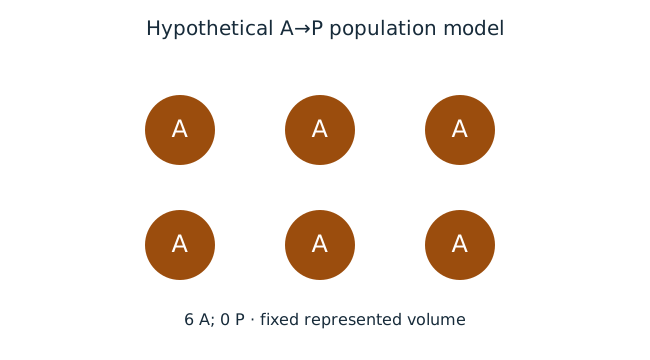
AP edition revised figure. Abstract initial state:6 A and0 P. This is an authored A→P state model, not the source titanium catalytic-converter claim.
Read all reviewed image captions
Image 1
AP edition revised figure. Abstract initial state:6 A and0 P. This is an authored A→P state model, not the source titanium catalytic-converter claim.
Image 2
AP edition revised figure. Intermediate abstract state:3 A and3 P in the same represented volume. State counts alone do not establish a rate law without time/model information.
Image 3
AP edition revised figure. Final abstract state:0 A and6 P. Modeled units are conserved; this figure does not identify a real automotive catalyst or nitrogen reaction.
Reviewed replacement, Example3.1.1: In a hypothetical fixed-volume model, −d[A]/dt=k=212 mol L⁻¹ s⁻¹ over the stated range. [A]₀=30.0 M. Find the mathematical exhaustion time. These formal concentration data illustrate zero-order integration; they are not a measured automobile catalytic-converter model.
The prompt specifies the disappearance law −d[A]/dt=k=212 M s⁻¹, so no extra stoichiometric factor is needed.
At constant k, [A](t)=[A]₀−kt. This line is applicable only while A is available and the specified regime holds.
For the exhaustion threshold, [A](t)=0 and [A]₀=30.0 M.
0=30.0−212t, with concentration in M and t in s.
The change is −30.0 M. Its disappearance magnitude is +30.0 M.
t=30.0/212=0.141509 s. Do not extrapolate the linear model to negative concentration.
The formal exhaustion time is 0.142 s. This is a consequence of the supplied hypothetical law and numbers.
A real catalytic converter involves a mechanism, surface conditions and other reactants. The preceding formal zero-order calculation does not establish its reaction products, catalyst material or operating rate.
Integrate the explicitly specified disappearance law −d[A]/dt=k at fixed conditions.
Separate variables: d[A]=−k dt. Integrating gives [A]=−kt+C.
Use the initial condition t=0 and [A]=[A]₀ to find the integration constant.
[A]₀=C in the form [A]=−kt+C. If instead one writes [A]+C′=−kt, then C′=−[A]₀; do not mix these two conventions.
The integration constant in [A]=−kt+C is the initial concentration [A]₀.
C=[A]₀. The alternate left-hand-side constant would have the opposite sign.
Substitute C=[A]₀ into the integrated law.
[A](t)=[A]₀−kt. Equivalently, [A]−[A]₀=−kt.
This is the zero-order integrated disappearance law. A plot of [A] in M against time in s has slope −k in M s⁻¹; it is valid within the zero-order regime, before mathematical exhaustion.
Now we have two equations that both give a bit of information about a Zeroth-Order reaction, but there’s one more major equation that you should know.
This other equation is the half-life of reaction. Half-life is defined as the time it takes for one half of a species to be either used up, or decompose, or in any way get depleted. Perhaps you have heard of half-life in reference to radioactive elements, particularly Uranium.
Radioactive decay commonly follows first-order kinetics, with a concentration-independent half-life. Chemical zero-order disappearance has t½=[A]₀/(2k), so successive halving intervals become shorter. The word half-life alone does not identify an order.
Mathematically, half-life is the time at which . Using this equation, let’s determine the half-life equation for a Zeroth-Order reaction.
We start with the integrated Zeroth-Order rate equation:
Now set :
Finally, solve for .
Interactive 3.1.2 Zeroth-Order reaction
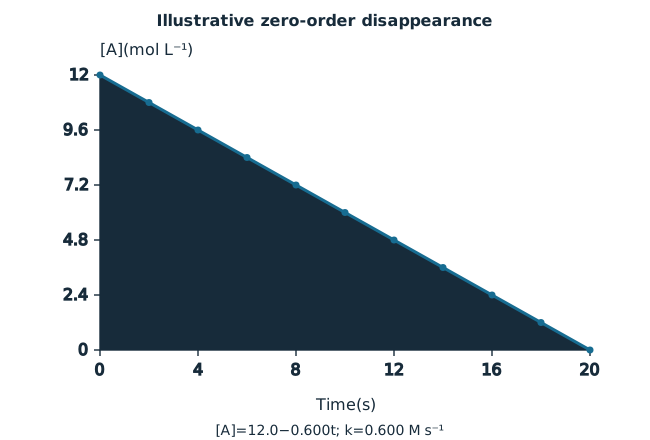
Read all reviewed figure notes
Linear
A straight decreasing concentration-versus-time line supports the specified zero-order range. The slope is−k with concentration/time units.
Initial Concentration
At t=0, the vertical intercept is[A]₀. A zero-order line must stop at exhaustion or when its regime ends.
In summation, we now have 3 useful equations for a Zeroth-Order reaction:
The rate equation:
The integrated rate equation:
The half-life equation:
It is important to remember that these are only applicable to zero-order reactions.
If you wish to determine the reaction rate constant for a reaction that you believe is Zeroth-Order, you would need to track the concentration of a reactant over time. If you graph the reaction, you should expect it to look like a straight line.
Once you have the data points, you would need to determine a “best-fit” line. This type of line is the straight line which is as close to the data points as possible. There are many ways to determine this, but if you try to do it by hand, it is quite difficult. Instead, we’ll be giving you the best fit lines when you need them.
If you graph [A] vs. t, and it doesn’t come out like a straight line, it might not be a Zeroth-Order reaction. We will cover how to figure our higher order reactions in the upcoming sections. For now, let’s give you a bit more practice working with Zeroth-Order reactions.
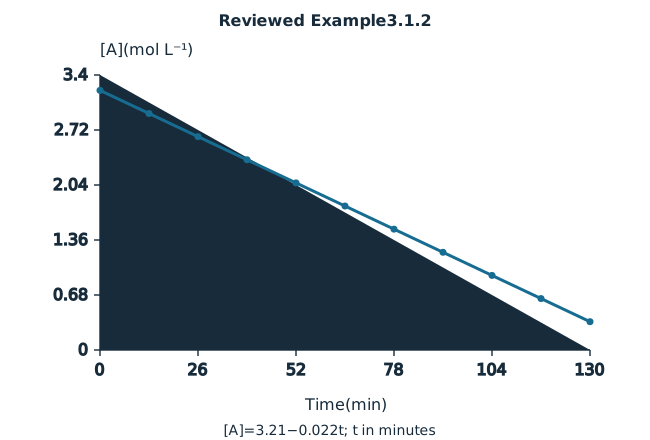
Interactive 3.1.1 Example Problem 3.1.2
Read all reviewed figure notes
Luckily, this graph is actually all we need to determine the half-life of this reaction. We can use the best-fit line to give us the reaction rate. Our best-fit line is given by:
One important thing to note is that the time axis is given in minutes, so in this case, we will be working in minutes instead of seconds.
The best-fit line actually is simply our integrated rate equation. The generic form of that is:
By comparing these two equations, we find that:
Now that we know these two numbers, we can solve for :
Finally we have our answer: 73 minutes.
Temperature often increases a reaction rate at fixed concentrations, but dissolution speed and equilibrium solubility are different quantities. Solubility can increase or decrease with temperature depending on the dissolution enthalpy. Do not infer the amount that can dissolve merely from how fast it dissolves.
Quantitative enrichment: Arrhenius relates the rate constant, not the rate alone, to temperature: k=A exp(−Eₐ/RT). AP instruction uses activation-energy and collision reasoning qualitatively; this chapter’s numerical Arrhenius calculations are additional practice.
This equation introduces a few new variables that you’ve yet to see. Let’s start with the familiar: is the gas constant, the one you will typically be using is . You also have , the rate constant, and , the temperature (in K).
A is the pre-exponential factor and has the same units as k. Eₐ is molar activation energy. With R=8.314 J mol⁻¹ K⁻¹, convert Eₐ to J mol⁻¹ and T to kelvin. Treat A and Eₐ as constant only over the specified model range; real mechanisms can change with conditions.
Glossary and deeper reading · 11 refreshers
These editorial refreshers supplement the reading. Definitions and examples are added guidance; original source wording and recorded answers remain in their original context.
-
Reaction rate
Reaction rate describes how quickly a reactant or product quantity changes with time. Rates expressed using different species must account for their stoichiometric coefficients. For example, a product's concentration–time slope can be used to determine its rate of formation.
-
Reaction order
Reaction order describes the concentration dependence in a rate law. An order in one reactant is its exponent, and overall order is the sum of the concentration exponents. For example, a second-order dependence on one reactant makes quadrupling the rate follow from doubling that reactant's concentration under fixed conditions.
-
Rate constant
A rate constant is the proportionality factor in a specified rate law. Its value depends on conditions such as temperature, and its units depend on the law's overall order. For example, a first-order rate constant has units of inverse time when concentration is measured per unit volume.
-
Rate law
A rate law relates a reaction rate to reactant concentrations and a rate constant under stated conditions. For an overall reaction, its concentration exponents are established from evidence rather than copied from the balanced equation. For example, doubling one reactant concentration doubles the rate when the reaction is first order in that reactant and other conditions are fixed.
-
Stoichiometry
Stoichiometry uses a balanced chemical equation to relate amounts of reactants and products. Equation coefficients provide mole ratios rather than direct mass ratios. For example, forming water from hydrogen and oxygen consumes two moles of hydrogen molecules per mole of oxygen molecules.
-
Molarity
Molarity is the amount of a solute in moles divided by the final solution volume in liters. It describes concentration rather than the total amount of solute. For example, 0.10 mole dissolved to make 0.50 liter of solution gives a molarity of 0.20 mole per liter.
-
Catalyst
A catalyst participates in a reaction pathway and is regenerated overall. It can increase the reaction rate by providing a different pathway without changing the reaction's equilibrium constant at fixed temperature. For example, a catalyst can help a mixture reach equilibrium sooner without changing the final equilibrium composition.
-
Reaction half-life
A reaction half-life is the time needed for a reactant's concentration to fall to half its starting value under the specified model. A first-order reaction has a half-life independent of its starting concentration, while other orders generally do not. For example, consecutive equal time intervals halve a first-order reactant's concentration repeatedly.
-
Chemical equilibrium
Chemical equilibrium is a dynamic state in which forward and reverse reaction rates are equal. Macroscopic composition remains constant in a closed system under fixed conditions, but reactant and product concentrations need not be equal. For example, a reversible reaction can reach equilibrium with much more reactant than product.
-
Solubility
Solubility describes how much of a substance can dissolve in a specified solvent under stated conditions. It depends on the solute, solvent, temperature, and other relevant conditions and is distinct from how fast dissolution occurs. For example, two salts can have different equilibrium solubilities in water at the same temperature.
-
Activation energy
Activation energy is the energy barrier associated with a reaction pathway in an introductory energy-profile model. It concerns the pathway and is distinct from the reactant-to-product energy change. For example, a thermodynamically favored reaction can remain slow when its activation barrier is large.