Ionization Energies & Electron Affinities
Supporting original reading. Follow the AP topic pathway for reviewed scope, worked reasoning and targeted practice.
Chemistry I · original Chapter 6 · combined Chapter 6
section breakdown
Section 2
Ionization Energies &
Electron Affinities
Ionization Energy
Ionization energy describes the energy required to remove an electron from a gaseous species. Forming an ionic compound can be modeled through electron-transfer bookkeeping followed by attraction between oppositely charged ions. That differs from the shared electron pairs of a covalent bond. Keep the individual steps and their energy changes separate when building the ionic model.

Notice how these atoms have charges on them. This is because they are both in their ionic states. Now how exactly did those charges occur? Well that’s exactly the phenomenon behind atomic interactions that we are going to explore.
When an atom or even an ion is transferring electrons, essentially removing it, it gains a more positive charge. But of course not everything in life is free as this process has an energy requirement associated with it. It takes energy to remove the electrons from an atom to make it an ion; and this energy is the ionization energy. This is assuming though that the atom begins in its ground state (no charge) before losing an electron,

Gallery 1.3: Ionization

Here you can see the atom in it’s ground state with a set number of electrons orbiting around in the electron shells
Read all original image captions
Image 1
Here you can see the atom in it’s ground state with a set number of electrons orbiting around in the electron shells
Image 2
And here is the electron being removed from the shell and being transferred elsewhere. Again, there is energy that is required to do this!
To introduce this concept a little further, lets take a look at an example of where electrons are removed consecutively.
Let’s consider an aluminum ion in its gaseous state, and we will consider the energies required to remove electrons consecutively. The ionization energies are as follows:




These results explain a lot of things about this whole process. Notice as more electrons are removed from the aluminum atom, the higher the ionization energies are, meaning that it requires more energy to remove those consecutive electrons. Notice that removing the first electron requires less energy than removing the second. This is due to shielding effects that the occur from the core electrons in aluminum and also the fact that these valence electrons are farther away from the nucleus (therefore less pull).
But, also notice the spike in energy going from  to
 , its a pretty big change. Why is this? Again its the fact that when aluminum is at its 3+ charge, it has a stable set of core electrons in its 2p orbitals which are not affected as much from shielding effects (the nucleus will want to hold onto those electrons). Let’s take a look at an example.
Consider atoms with the following electron configurations:
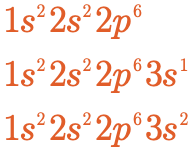
Which atom has the largest second ionization energy? Explain
The answer lies in the electron configurations. Removing two electrons from magnesium is not as hard since its two valence electrons are shielded from the core electrons and are far away from the nucleus. Neon’s first IE will be very high due to ineffective shielding in the 2p orbitals, but the second one will be a little higher.
Sodium’s first IE is low for the same reasons as magnesium, but its second IE must be high due to highly inefficient shielding in the 2p orbitals plus the electrons are much closer to the nucleus.
At this point then its between Neon and sodium. It’s a little tricky here just because you really have to know your your periodic trends, specifically atomic radii. At this point, since sodium has a larger nucleus with more protons than electrons, there will be more pull for those electrons to prevent them from leaving. Neon has a smaller nucleus so the pull for the electrons will not be as great.
Therefore, sodium is our answer!!
Just as electrons can leave an atom to ionize it, atoms also can accept electrons. Some atoms have higher affinities for electrons than others and just like before there is an energy change associated with this process. This is known as an atom’s electron affinity. A better way to look at it is:

Interactive 1.3 Trend of Electron Affinity on the Periodic Table

Read all original figure notes
Decreasing Radii
Smaller nuclei as you go across period therefore there are more charges so there is a greater pull for electrons
For electron addition written X(g)+e⁻→X⁻(g), a negative enthalpy change means energy is released. Some tables instead quote the positive magnitude of energy released as the electron affinity, so always state the sign convention. Neither convention says that a negative electron-addition enthalpy means no energy release.
Now there is a trend that occurs as you go across a period on the table; that the electron affinity values become more negative (releasing more energy), which makes sense seeing that there are more charges in the nucleus and the atomic radii are getting smaller. The charges are going to want to pull the electrons in closer while also having a greater affinity for more electrons.
Electron-affinity exceptions show why configuration matters. Adding an electron to nitrogen’s 2p³ arrangement requires pairing in one p orbital; that creates additional same-orbital repulsion. Adding one to carbon’s 2p² arrangement can occupy the third p orbital before pairing. Repulsion still exists among all electrons in both species, and the resulting gas-phase affinity does not by itself establish a common stable aqueous C⁻ or N⁻ ion. Use energy data and state the species being compared.
Gallery 6.1.2: Electron Transference for Nitrogen and Carbon
Notice the simple orbital diagrams for both carbon and nitrogen.
Read all original image captions
Image 1
Notice the simple orbital diagrams for both carbon and nitrogen.
Image 2
Adding another electron to achieve ion stability is not possible with N because of electron repulsion in the first p orbital. However, with C it is possible because there is no repulsion.
Glossary and deeper reading · 13 refreshers
These editorial refreshers supplement the reading. Definitions and examples are added guidance; original source wording and recorded answers remain in their original context.
-
Ionization energy
Ionization energy is the energy required to remove an electron from a gaseous atom or ion. Removing an electron requires energy, and successive removals can reveal a transition from valence to core electrons. For example, sodium's second ionization requires much more energy than its first because it removes a core electron.
-
Electron affinity
Electron affinity describes the energy change associated with adding an electron to a gaseous atom. Tables may use different sign conventions, so the stated definition and sign must be checked. For example, adding an electron to a chlorine atom releases energy under the usual energy-change convention.
-
Ion
An ion is an atom or group of atoms with a net electric charge. Ordinary ion formation changes electron count without changing the element's proton count. For example, a sodium atom losing one electron becomes a sodium ion with charge +1.
-
Covalent bond
A covalent bond involves shared electron density between atoms. The sharing can be approximately equal or unequal depending on the atoms and their environment. For example, the bond in a hydrogen molecule shares electrons between two identical atoms.
-
Mole
A mole is an amount of substance containing exactly 6.02214076 × 10²³ specified entities. The entities can be atoms, molecules, ions, or formula units, so the counted entity must be named. For example, one mole of oxygen molecules contains two moles of oxygen atoms.
-
Electron shielding
Electron shielding is the reduction in nuclear attraction experienced by an electron because other electrons also repel it. Inner electrons generally shield an outer electron more effectively than electrons in the same shell. For example, adding an occupied inner shell helps explain why atomic size usually increases down a periodic-table group.
-
Core electron
Core electrons occupy inner shells and are usually less directly involved in bonding than valence electrons. They help shield outer electrons from the nucleus's full positive charge. For example, sodium's ten inner electrons form its neon-like core beneath its outer electron.
-
Atomic orbital
An atomic orbital is a quantum state used to describe an electron in an atom. Its spatial description gives a probability distribution rather than a definite path around the nucleus. For example, an s orbital has a spherical spatial probability distribution, and one orbital can accommodate at most two electrons with opposite spins.
-
Electron configuration
An electron configuration describes how an atom's or ion's electrons occupy shells and subshells. A ground-state configuration places electrons in the lowest-energy arrangement consistent with the electron-filling rules. For example, neutral helium has two electrons in its 1s subshell.
-
Valence electron
Valence electrons are the electrons most directly involved in an atom's bonding and chemical behavior. For main-group atoms, they occupy the highest occupied principal shell. For example, neutral chlorine has seven valence electrons, helping explain its tendency to form a chloride ion.
-
Exothermic process
An exothermic process transfers heat from the chosen system to its surroundings. Under constant-pressure conditions with only pressure–volume work, its enthalpy change is negative. For example, freezing water releases heat to the surroundings.
-
Enthalpy
Enthalpy is a state function defined from internal energy, pressure, and volume. At constant pressure with only pressure–volume work, an enthalpy change equals the heat transferred to the system. For example, a negative reaction enthalpy indicates heat release for the written reaction under those conditions.
-
Aqueous solution
An aqueous solution is a solution in which water is the solvent. The dissolved substance may originate as a solid, liquid, or gas, so aqueous does not mean that a solid has melted. For example, sodium chloride dissolved in water is aqueous even though the pure salt is solid.