FFR: Polyprotic Titrations
Supporting original reading. Follow the AP topic pathway for reviewed scope, worked reasoning and targeted practice.
Chemistry II · original Chapter 7 · combined Chapter 15
Section Breakdown
- Diprotic Titration
- Polyprotic Equivalence Points
- Polyprotic Titration Curves
- Chapter Problems
Section 4
FFR: Polyprotic Titrations
Interactive 7.4.1 Diprotic Titration
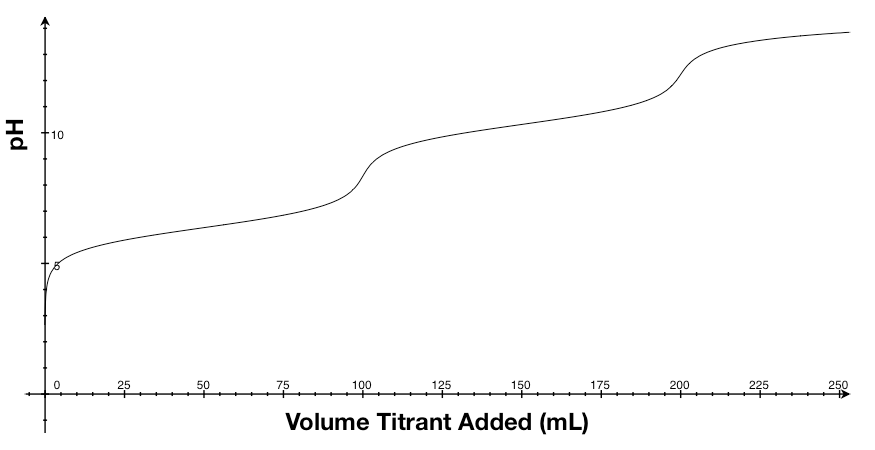
Read all original figure notes
Equivalence Point 1
Here is the equivalence point for the first neutralization reaction.
Equivalence Point 2
This is the equivalence point for the second neutralization reaction.
Overall stoichiometric neutralization: H₂CO₃+2 OH⁻→CO₃²⁻+2 H₂O. Sodium ions are spectators if NaOH supplies the base.
The titration shown here, of , has two equivalence points, as there are two neutralization reactions. The overall neutralization reaction is:
First step: H₂CO₃+OH⁻→HCO₃⁻+H₂O. One mole of hydroxide per mole of carbonic acid reaches the first stoichiometric equivalence point.
However, this reaction occurs in two steps:
The titration equation we are used to has to be modified slightly to account for the double-deprotonation going on here.
In the first reaction, we can see that the normal situation is occurring. All the we have added has reacted completely with the , turning it completely into . Therefore, for that point, we have only removed one proton:
At each equivalence point the added titrant has consumed a specified number of acid equivalents. Whether separate pH-curve jumps are resolved depends on the separated acid strengths, concentrations and measurement conditions. Counting protons alone does not guarantee visible jumps.
Second step: HCO₃⁻+OH⁻→CO₃²⁻+H₂O. The complete ionic form would place any Na⁺ spectator on both sides.
Combining the two steps gives H₂CO₃+2 OH⁻→CO₃²⁻+2 H₂O. Both atom totals and charge are conserved. The corresponding formal dominant acid-family form changes as base equivalents are added.
This reaction is not a ratio for the acid and base, therefore the equivalence formula is a bit different:
At the second equivalence point the formal product is carbonate. Subsequent equilibrium with water still produces some bicarbonate and hydroxide; “complete stoichiometric neutralization” does not mean every other acid-family form is literally absent.
Some examples of equivalence formulas for titrations:
Titration of with :
Equivalence Point 1:
Equivalence Point 2:
Equivalence Point 3:
Titration of with :
Equivalence Point 1:
Equivalence Point 2:
Chapter Problems
- Problem 1
Glossary and deeper reading · 9 refreshers
These editorial refreshers supplement the reading. Definitions and examples are added guidance; original source wording and recorded answers remain in their original context.
-
Polyprotic acid
A polyprotic acid can donate more than one proton per molecule in successive steps. Each step has its own equilibrium constant, so the protons need not dissociate to the same extent. For example, phosphoric acid can lose three protons through separate equilibria.
-
Titration
Titration measures an analyte by its reaction with a measured amount of another reagent. The balanced reaction and the observed endpoint must be connected to the equivalence condition. For example, an acid's amount can be inferred from a measured volume of a base with known concentration.
-
Equivalence point
The equivalence point is the condition where titrant and analyte have reacted in the balanced equation's stoichiometric ratio. Its pH depends on the species remaining and is not always seven. For example, a weak-acid–strong-base titration has a basic equivalence-point solution under the usual model.
-
Titrant
A titrant is the reagent added in measured amounts during a titration. Its concentration and reaction stoichiometry connect the delivered volume to the analyte amount. For example, a standardized base solution can be the titrant for an unknown acid.
-
Stoichiometry
Stoichiometry uses a balanced chemical equation to relate amounts of reactants and products. Equation coefficients provide mole ratios rather than direct mass ratios. For example, forming water from hydrogen and oxygen consumes two moles of hydrogen molecules per mole of oxygen molecules.
-
Ion
An ion is an atom or group of atoms with a net electric charge. Ordinary ion formation changes electron count without changing the element's proton count. For example, a sodium atom losing one electron becomes a sodium ion with charge +1.
-
Mole
A mole is an amount of substance containing exactly 6.02214076 × 10²³ specified entities. The entities can be atoms, molecules, ions, or formula units, so the counted entity must be named. For example, one mole of oxygen molecules contains two moles of oxygen atoms.
-
pH
pH is the negative base-ten logarithm of hydronium activity. In suitable dilute models, activity is approximated by molar concentration relative to the standard concentration. For example, lowering hydronium concentration by a factor of ten raises pH by one unit.
-
Chemical equilibrium
Chemical equilibrium is a dynamic state in which forward and reverse reaction rates are equal. Macroscopic composition remains constant in a closed system under fixed conditions, but reactant and product concentrations need not be equal. For example, a reversible reaction can reach equilibrium with much more reactant than product.